Sep 11, 2026
New Mexico Hummingbird Season: A Month-by-Month Calendar
New Mexico doesn't have one hummingbird story — it has at least three, running at once. Black-chinned Hummingbird and Broad-tailed Hummingbird are both real, statewide breeders — not one dominant species with a token second, but two genuinely comparable birds, arriving within days of each other in April and both still common into October. Layered on top of that, Rufous and Calliope pass through in real numbers from late June into fall — not breeding here, but moving through in a volume most states never see from either species. And then the state's far southwest corner runs an almost entirely different calendar: Hidalgo County (the Bootheel), Grant County, and Catron County hold genuine breeding Lucifer, Broad-billed, Rivoli's, and Violet-crowned Hummingbirds, plus a real, regular Anna's presence — five more species that barely register anywhere else in the state. Seventeen species have accepted New Mexico records in all, one of the longest lists of any state we've covered. One thing that might surprise you: Ruby-throated Hummingbird, the default bird almost everywhere else in this series, is a genuine rarity here. Here's how it unfolds, month by month.
The short answer: statewide arrivals begin in early April, with Black-chinned and Broad-tailed both reliably common by early May; July into August is the real peak, when Black-chinned, Broad-tailed, and Rufous are all near their own highs at once; most of the state is quiet again by late October. The Bootheel and the southwest corner run a longer, richer season on top of that, with real breeding activity from species found nowhere else in New Mexico and a genuine winter Anna's presence.
| Question | Answer |
|---|---|
| When do they arrive? | Early April statewide for both Black-chinned and Broad-tailed — Eddy County runs about a week ahead, in late March |
| When should feeders go up? | Last week of March statewide; mid-March in Eddy County |
| When do they nest? | May through August — New Mexico has six breeding species, one of the most in this series |
| Busiest month? | Late July into August — Black-chinned peaks near 40% of checklists in the third week of July, Broad-tailed and Rufous both peak within a few weeks after, in August |
| When do they leave? | Most of the state is quiet by mid-to-late October; the southwest corner runs later |
| Any in winter? | Yes, but it's regional — Anna's Hummingbird is real and recurring specifically in Grant and Hidalgo counties, in the far southwest. Statewide, winter is genuinely quiet |
Free download
The whole year on one page
Arrival and departure region by region, when to hang feeders in your part of the state, and when to watch for the southwest corner's specialties — sized 8.5" x 11" for easy reference and printing.
Download the printable calendarOne page · PDF · free to print and share
New Mexico's Hummingbird Season at a Glance
Before the month-by-month detail, here's the whole season in one picture. Most states in this series need two or three charts — one dominant species that flattens everything else on a shared scale, then a second chart to rescue the smaller ones. New Mexico's real species count makes that approach unworkable: with 17 accepted species and a gap between the biggest peak and the smallest that runs into the thousands, no shared scale survives. Instead, all 11 chartable species are ranked top to bottom by how common they genuinely are, but each one is scaled to its own peak — so a species that barely clears half a percent statewide still shows its real, distinct season, right alongside Black-chinned's much bigger one.

How often each species turns up on eBird checklists, week by week — statewide, 2016-2025, each species scaled to its own peak. Source: eBird bar chart data (Cornell Lab of Ornithology), 2016-2025 (pulled Sep 2026). Six more New Mexico hummingbirds — Allen's, Blue-throated Mountain-gem, White-eared, Berylline, Cinnamon, and Mexican Violetear — are all real, committee-accepted birds with far too few records for a reliable weekly pattern, and can't be charted.
Regions used below
We track five counties chosen to span New Mexico's real geography: Bernalillo County (Albuquerque), the state's population center; Grant County (Silver City), in the southwest highlands; Catron County, the state's largest and most remote, in the western mountains; Hidalgo County, the Bootheel, New Mexico's true southwest corner on the Arizona and Mexico borders; and Eddy County (Carlsbad), in the southeast. Statewide figures cover the whole state, including Santa Fe, Doña Ana, and the counties we don't break out separately.
Regional Arrival and Departure Snapshot
Here's the same timing on the map. Black-chinned's own arrival and departure run close together across all five counties — the real regional differences in this state show up in which other species are present, not in when the main breeders show up.

One thing to know before you start
Most of this calendar describes New Mexico as a whole, and for Black-chinned and Broad-tailed that's a fair description — both are real breeders nearly everywhere we track. But the far southwest corner, Hidalgo County especially, isn't really covered by a statewide average at all. It holds four more real breeding species — Lucifer, Broad-billed, Rivoli's, and Violet-crowned — plus a genuine winter Anna's presence, none of which show up in meaningful numbers anywhere else in the state. If you garden in the Bootheel or around Silver City, treat the statewide sections as a floor, not the whole picture, and pay close attention to the southwest-specific notes in each month below.
January: Grant County's Real Winter Holdouts
Statewide, every main breeder is silent — Black-chinned, Broad-tailed, Rufous, and Calliope are all at or near zero. Grant County tells a different story. Anna's Hummingbird is still genuinely present here, carrying over from a real fall build rather than freshly arriving: one or two of every hundred Silver City-area checklists in the first week of January, climbing to about one in thirty in the second — the highest Anna's reporting rate we see anywhere in the state this month. Rivoli's Hummingbird holds on too, at one or two checklists in a hundred through the first three weeks, a genuine near-year-round presence in Grant County rather than a true winter arrival. If you're in Silver City or the Bootheel and see a hummingbird this month, it's worth a second look and a photo — New Mexico has real winter activity here that most of the state simply doesn't.
February: The Quiet Month, Statewide and in Grant County Both
February is genuinely quiet everywhere, including Grant County. Anna's fades from January's high to only about three checklists in a thousand, and Rivoli's thins out to one in a hundred at most. Statewide, Black-chinned and Broad-tailed are both still effectively at zero, with real arrivals still a month or more out. This is the window to get a feeder cleaned and ready before the season actually needs it — by the time the first scouts show up in Eddy County in late March, there won't be time to catch up.
March: Eddy County First, Then a Statewide Pause
Eddy County is the first to stir, crossing our arrival threshold in the last week of March — fewer than one in fifty Carlsbad-area checklists, then about one in thirteen in the first week of April. Everywhere else is still genuinely quiet: statewide, Black-chinned is essentially absent through the first three weeks of the month and reaches only about one checklist in a hundred by the fourth; Broad-tailed is a little further along, at about one in seventy by month's end. Grant County's winter Anna's and Rivoli's have both faded to a thin trickle by now, and the Bootheel's specialty species — Lucifer, Broad-billed — haven't shown up yet at all. March is transition, not arrival, for all but the southeast corner of the state.
April: The Whole State Wakes Up, the Bootheel Included
April is when New Mexico's real season begins almost everywhere at once. Bernalillo and Grant counties both cross our arrival threshold in the first week — Bernalillo climbing fast, from about one Albuquerque-area checklist in a hundred to about half of them by the fourth week; Grant close behind, from about one in twelve to more than one in three. Catron and Hidalgo, both slower to start, cross the threshold a week later and build more gradually, to between one in twelve and one in eight checklists by month's end. This is also when Hidalgo County's real specialty species wake up: Lucifer Hummingbird arrives and peaks within the month, on about one checklist in thirty in the third week; Broad-billed builds steadily, reaching about the same level that week on its way to a much bigger July peak.
| Region | Black-chinned Arrives | Black-chinned Leaves |
|---|---|---|
| Eddy County (Carlsbad) | Last week of March | First week of October |
| Bernalillo County (Albuquerque) | First week of April | Mid-October |
| Grant County (Silver City) | First week of April | Last week of October |
| Catron County | Second week of April | Last week of September |
| Hidalgo County (the Bootheel) | Second week of April | Mid-October |
"Arrives" and "leaves" are the first and last of two consecutive weeks where at least 1% of a region's checklists report the species, backed by at least five real checklists behind the percentage. We checked the checklist count behind every one of these, not just the rate: Catron's second-week-of-April arrival rests on 9 effective checklists, thinner than the others but still real signal, not a fluke on a single busy day.

Get a feeder up before the first bird arrives, not after.
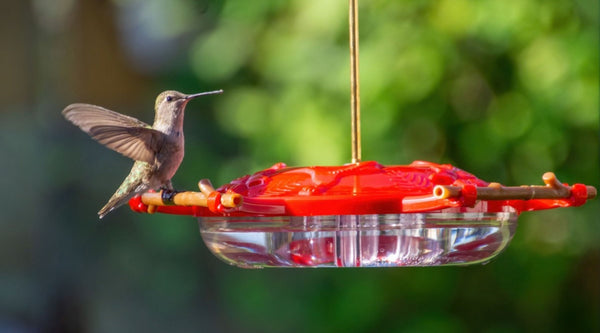
Eddy County sees real activity by the last week of March; the rest of the state follows within two weeks. A feeder out by mid-March costs you nothing, while one still packed away when the first scout turns up costs you the sighting. This is also the month to check last year's feeder for cracked seals and worn ports. AspenPerch® has a built-in ant moat and a Polyperch® comfort perch, so birds rest between sips instead of hovering through the whole meal.
Shop AspenPerch® →May: Black-chinned Plateaus Near Its Peak
May is when Black-chinned effectively arrives at full strength statewide — close to two in five checklists across the month, barely below where it'll sit at its official July peak. Broad-tailed keeps climbing but isn't there yet, at about one in five. Every county we track is reliably common by now. In Hidalgo County, Broad-billed Hummingbird has its own early-season high point this month, about one checklist in twenty-five in the third week, before a bigger push in July. Rufous and Calliope are both still completely absent statewide — their season is still six or more weeks out.
June: Nesting Settles In, Then the Passage Begins Late
Black-chinned and Broad-tailed both hold steady through most of June as birds settle into nesting — females become secretive around the nest, which can make feeder activity look quieter even though the birds haven't gone anywhere. Statewide, Rufous and Calliope are still at zero through the first three weeks. Then, right at the very end of the month, Rufous makes its first real move — about one checklist in a hundred in the last week of June, the opening signal of a passage that will dominate July and August. Catron County sees it earliest and strongest: about one in seventeen by the last week of June, well ahead of the statewide number.
Why nesting season is the demanding one
There's a wrinkle specific to hummingbirds. Most female birds build up a temporary calcium store in their bones, called medullary bone, and draw on it to make eggshell. Hummingbirds have very little of it, so a laying female has less in reserve. Researchers have seen nesting females eating wood ash and other mineral-rich materials, which they think helps replace the calcium that goes into eggs. In one 1994 study, every bird seen eating ash was a female tending a nest.

It's part of why Pop's Nectar includes calcium and electrolytes rather than sugar alone. Nesting females need extra calcium during egg-laying, and plain sugar water has essentially none. Read more on the research behind it.
Shop Nectarlyte® 8 oz →July: Black-chinned's Statewide Peak, and the Real Passage Begins
July holds Black-chinned's statewide high point — two in five checklists in the third week — but it's also when the state's whole character changes. Rufous climbs from about one in seventeen checklists to more than one in four across the month, and Calliope from under one in a hundred to about one in fourteen, both moving through in numbers most states never see from either species. Catron County runs hottest of all for Rufous, already on about three in ten checklists by the fourth week. In the Bootheel, Broad-billed hits its real peak this month too — nearly one in ten Hidalgo checklists in the second week, its highest point anywhere in the state. July is genuinely the month every one of New Mexico's main species is doing something at once.

Keep pests off without pesticides — hummingbirds rely on small insects for protein, so spraying near a feeder can cost them a food source, not just protect one.
With this many species converging on feeders at once, competition for a clean, pest-free station matters more in New Mexico in July than almost anywhere else in this series. AspenPerch®'s built-in ant moat blocks ants with a water barrier, and HummGuard® Nectar Tips keep bees and wasps out without changing anything for the birds.
Shop HummGuard® →August: Broad-tailed and Rufous Both Peak
August is the second half of New Mexico's double peak. Broad-tailed reaches its own statewide high here, about three in ten checklists in the third week, and Rufous peaks even earlier in the month, at about three in ten in the first week — genuinely comparable numbers, in the same month, from two different species. Black-chinned is easing back from its July high but still strong, close to two in five — though Bernalillo County's own number is far higher, more than three in five Albuquerque-area checklists in the first week of August, the single highest reading anywhere in this dataset. Grant County's Rufous is the strongest Rufous signal anywhere we track in the state: more than two in five Silver City-area checklists in the first week of August. Calliope holds near its own peak too, about one in fifteen. Every main species is present and countable at once this month — if you only watch feeders one week a year, this is it.
This is the month to be generous, not economical.
With four species fueling for migration or finishing up nesting at the same time, a feeder that runs dry mid-surge is a missed meal at the worst possible moment. The large 2lb Nectarlyte® powder or the Nectarade® liquid concentrate keeps you from running out.


September: A Statewide Decline, and a Later Peak in the Bootheel
Statewide, every main species is easing off from its summer high — Black-chinned from more than one in three checklists to under one in five, Broad-tailed from more than one in four to about one in nine, Rufous from about one in five to about one in twelve, and Calliope from about one in sixteen to about one in eighty across the month. But Hidalgo County runs on its own calendar here. Rufous doesn't peak statewide until August, but in the Bootheel it keeps climbing into September, reaching its own high point, about one in five checklists, in the third week — a full month after the state as a whole. Calliope does the same thing, and goes further: more than one in nine Hidalgo checklists in the first week of September, actually higher than Calliope's own statewide peak in July. Whatever's driving that lag, the Bootheel isn't just a smaller version of the statewide pattern — it's genuinely running later and, for Calliope, bigger.

Seeing one bird chase everyone else off a feeder?
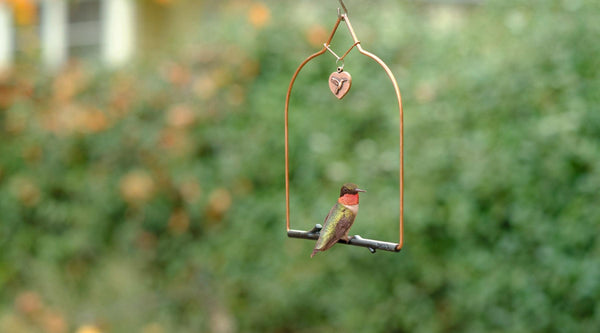
With this many species moving through at once, a resident claiming a feeder and a nearby swing as guarded territory is common this time of year. A second feeder and a second swing, spaced out of sight of each other, gives another bird — the incoming migrant or a displaced resident — its own station to guard instead of fighting over one.
Shop a second swing →October: The Fast Exit
October is when most of New Mexico's hummingbirds leave, and it happens quickly. Statewide, Black-chinned falls from about one in nine checklists in the first week to about one in a hundred by the third, and fewer still by the fourth; Broad-tailed and Rufous both follow the same steep drop. Eddy County empties earliest — under one checklist in a hundred by the second week — while Grant and Hidalgo, in the southwest, hold on longest: Grant is still on about one in seven checklists in the first week, and both counties stay ahead of the statewide pace through the middle of the month. By the last week of the month, the main breeding season is over almost everywhere in the state.

October is the planting month, not the tidying-up month.
Sow native wildflower seed now and it gets the cold, moist stretch most varieties need before they'll bloom reliably next spring — the same spring your hummingbirds come back to.
Shop the Perfect Little Sanctuary® blend →November: Statewide Quiet, Grant County's Anna's Holds On
Statewide, hummingbirds are essentially gone in November. Grant County is the exception, and it's in the strongest stretch of its Anna's year: after an October high, Anna's Hummingbird is still on about one in twenty-five Silver City-area checklists in the first week and roughly one in forty through the rest of the month. Rivoli's Hummingbird holds on at a thinner but genuine level alongside it, one checklist in seventy at most. Nowhere else in the state shows anything comparable this month.
December: The Deep Quiet, Except in Grant County
December is New Mexico's quietest month almost everywhere — Black-chinned, Broad-tailed, Rufous, and Calliope are all effectively at zero statewide. Grant County's Anna's Hummingbird is still present, on one or two Silver City-area checklists in a hundred through most of the month, tapering from its fall high but genuinely there — not a fresh arrival, but the tail end of a season that actually started back in September. If you're in Grant County or the Bootheel and keep a feeder up through winter, December is exactly when it can pay off. Our winter hummingbird feeder care guide covers heated feeders and the two-feeder swap.
The Year at a Glance
| Months | Statewide Activity |
|---|---|
| January | Silent statewide; Grant County's Anna's and Rivoli's hold real winter numbers |
| February | The quiet month everywhere, including Grant County; feeder-check window |
| March | Eddy County arrives last week; everywhere else still quiet |
| April | The real statewide arrival; Hidalgo's Lucifer and Broad-billed wake up too |
| May | Black-chinned plateaus near its peak; every county reliably common |
| June | Nesting settles in; Rufous and Calliope's passage begins in the final week |
| July | Black-chinned's statewide peak (40%); Rufous and Calliope climbing fast |
| August | Broad-tailed and Rufous both peak; every main species active at once |
| September | Statewide decline; the Bootheel peaks later and, for Calliope, higher |
| October | The fast exit — most of the state quiet by month's end |
| November | Statewide quiet; Grant County's Anna's holds near its fall high |
| December | Deep quiet everywhere except Grant County, where Anna's lingers on |
Frequently Asked Questions
When do hummingbirds come back to New Mexico?
Eddy County (Carlsbad) sees the first real arrivals in the last week of March. Bernalillo (Albuquerque) and Grant (Silver City) follow in the first week of April, and Catron and Hidalgo counties a week or so behind that. Statewide, reliably common arrivals settle in through April and into early May, and feeders should be up by mid-March in Eddy County and by the last week of March everywhere else.
When do hummingbirds leave New Mexico?
Most of the state by mid-to-late October, but not all of it at once. Eddy County empties earliest, down to under one checklist in a hundred by the second week of October. Grant and Hidalgo counties, in the southwest, hold on longest — Grant is still on about one in seven checklists in the first week of October, and both stay ahead of the statewide pace through mid-month. Statewide, the season is effectively over by early November, except for Grant County's real winter Anna's presence.
When do hummingbirds leave the Bootheel?
Later than the rest of the state, and the departure isn't as clean. Hidalgo County's Rufous doesn't even peak until mid-September — a full month after the statewide high point — and Black-chinned there is still on about one in ten checklists in the first week of October, when Eddy and Catron counties have already dropped well below that. The Bootheel runs on a genuinely later calendar than the state as a whole.
Are there hummingbirds in New Mexico in winter?
Statewide, no — by December, Black-chinned, Broad-tailed, Rufous, and Calliope are all essentially absent. Grant County is the real exception: Anna's Hummingbird is present in genuine, recurring numbers from around September through January, peaking in October and November, and Rivoli's Hummingbird holds on at a thinner but real level too. If you're not in the far southwest of the state, winter hummingbird activity is a long shot; if you are, it's a real possibility worth a feeder left up.
What types of hummingbirds are in New Mexico?
Seventeen species have accepted New Mexico records, one of the longest lists of any state we've covered. Black-chinned and Broad-tailed are both real, statewide breeders. Rufous and Calliope pass through in real numbers each summer without breeding here. Lucifer, Broad-billed, Rivoli's, and Violet-crowned are genuine breeders too, but only in the far southwest corner. Anna's is a real, recurring visitor. Costa's turns up often enough to chart but is still on the New Mexico Bird Records Committee's review list, so every sighting needs documentation. Ruby-throated — the default species almost everywhere else in this series — is a genuine New Mexico rarity. The remaining six — Allen's, Blue-throated Mountain-gem, White-eared, Berylline, Cinnamon, and Mexican Violetear — each have only a handful of accepted records.
Should I keep a feeder up through a New Mexico winter?
It depends where you are. Statewide, winter hummingbird activity is genuinely rare, and a feeder left up most places won't see much traffic. In Grant County and the broader southwest corner, it's a different story — Anna's Hummingbird is real and recurring there from fall into January, and a feeder left up gives it somewhere to be. Whatever you see at a winter feeder in the southwest is worth a photograph.
Why We Built This Calendar
Pop's Birding has been helping hummingbird lovers for three generations, and one of the questions our customers ask most is "When do hummingbirds arrive and leave my state?" That question is harder to answer honestly for New Mexico than for almost any other state: two statewide breeders run side by side, a major migrant passage sits on top, and the southwest corner keeps a separate calendar most of the state never sees. A single date, or a single species, would leave out most of what's happening here. We wanted a calendar that tells the truth about all of it.
How We Built This Calendar
We pulled eBird bar chart data (Cornell Lab of Ornithology) for New Mexico statewide and five counties spanning its geography — Bernalillo, Grant, Catron, Hidalgo, and Eddy — for 2016–2025. A county's arrival or departure counts only when at least 1% of its checklists report the species for two weeks running, backed by at least five checklists. Grant County's Rufous and Anna's seasons wrap past the new year, so we read them week by week. Species status follows the New Mexico Bird Records Committee. The regional comparison is our own, not a rewrite of eBird's bar charts.
Sources
- eBird bar chart data, Cornell Lab of Ornithology — New Mexico statewide and county-level (Bernalillo, Grant, Catron, Hidalgo, Eddy), 2016-2025. Source for all month-by-month seasonal figures and the regional arrival/departure pattern.
- Checklist of New Mexico Bird Species and the New Mexico Bird Records Committee (NMBRC), New Mexico Ornithological Society. Source for each species' accepted status and review-list designation.
- des Lauriers, J. R. (1994). Hummingbirds eating ashes. The Auk, 111(3), 755–756. Documents five nesting female hummingbirds eating wood ash; no males were seen doing so in that study.
- Adam, M. D., & des Lauriers, J. R. (1998). Observations of hummingbirds ingesting mineral-rich compounds. Journal of Field Ornithology, 69, 257–261. Source for hummingbirds' greatly reduced medullary bone and for the mineral-rich materials they eat.
- Werning, S. (2018). Medullary bone is phylogenetically widespread and its skeletal distribution varies by taxon. Journal of Ornithology, 159, 527–543. Source for medullary bone being confirmed in hummingbirds.
- Estades, C. F., Vukasovic, M. A., & Tomasevic, J. A. (2008). Giant Hummingbirds (Patagona gigas) ingest calcium-rich minerals. The Wilson Journal of Ornithology, 120(3), 651–653.
Know before they arrive
You don't have to keep this calendar taped to the fridge. Insider Birding Access members get seasonal notes timed to your region — when to have feeders out, what the birds are doing right now, and what's worth doing in your yard this season. We take the guesswork out of the calendar. Joining takes about thirty seconds, and there's 10% off your first order in it.
Join Insider Birding Access →Free to join. 10% off your first order.
Shop New Mexico's Hummingbird Favorites


Bethany Sloan has served as General Manager of Pop's Birding since 2010, continuing the legacy of her grandfather, William "Pops" Sloan, inventor of the Original Hummingbird Swing. A lifelong hummingbird enthusiast, educator, and independent researcher, she leads the company's educational content, including its 50-State Hummingbird Guide series, Regional Guide, Species Guide and Hummingbird Learning Center. Bethany combines scientific research, regional migration data, and more than 16 years of hands-on experience to create trusted educational resources for bird enthusiasts across North America.