Jul 25, 2026
Texas Hummingbird Season: A Month-by-Month Calendar
Texas is big enough that a single date is never the right answer. The first hummingbirds reach Big Bend nearly a month before they arrive in Dallas, and South Texas never really has an off-season at all.
The short answer: feeders up mid-February in West Texas, late February in Central, mid-March in the north. Nearly the whole state peaks in September, not spring — and in the Rio Grande Valley there is no off-season to plan around.
| Question | Answer |
|---|---|
| When do they arrive? | Early March in West Texas; late March in the north. Year-round in the Valley. |
| When should feeders go up? | Mid-February West, late February Central, mid-March North |
| When do they nest? | Late March through early September |
| Busiest month? | September, nearly everywhere — not spring |
| When do they leave? | Usually late October or November — Leave your feeder out two weeks after your last sighting |
| Any in winter? | Yes. Buff-bellied and Black-chinned in the Valley every week of the year |
Free download
The whole year on one page
Every month broken down by season — arrival windows, the September peak, what to do for feeders and nectar each season, real local festivals, and where in the state to never take your feeder down at all.
Download the printable calendarOne page · PDF · free to print and share
Texas's Hummingbird Season at a Glance
Before the month-by-month detail below, here's the whole season in one picture — five species, five very different curves, shaped as much by where in Texas you are as by the calendar.

How often each species turns up on eBird checklists, week by week — statewide, 2016–2025. The month-by-month and region-by-region breakdown below shows how these same curves shift earlier, later, or vanish almost entirely depending on where in Texas you are.
That chart tells you who's biggest, but it can hide who's smallest — Ruby-throated's huge peak visually flattens rarer species like Broad-tailed or Lucifer into what looks like a flat line next to it, even though each has a real season of its own. Here's the same nine species again, but each one scaled to its own peak instead of a shared one, so a species you'd never spot on the chart above still shows its actual shape below.

Bar height shows each week's frequency relative to that species' own peak — statewide, 2016–2025, eBird checklist data (Cornell Lab of Ornithology). Also documented but too rare to chart reliably: Allen's, Amethyst-throated Mountain-gem, Berylline, Blue-throated Mountain-gem, Broad-billed, Costa's, Mexican Violetear, Violet-crowned, and White-eared Hummingbird.
That statewide curve is really five very different calendars averaged together — where you land inside it depends entirely on where in Texas you are. Here's the region-by-region detail, month by month, so you can see exactly where you fall.
Regions used below
Valley (Hidalgo) — Rio Grande Valley: McAllen, Brownsville
Coast (Nueces) — Corpus Christi to Houston and East Texas
Central (Travis) — Austin, San Antonio, the Hill Country
North (Dallas) — Dallas, Fort Worth, the Panhandle
West (Brewster) — Alpine, Marathon, Big Bend, the Davis Mountains
One thing to know before you start
Most of this calendar describes birds arriving and leaving. The Rio Grande Valley is the exception — Buff-bellied and Black-chinned Hummingbirds are reported there every week of the year, and Ruby-throated are present ten months out of twelve. If you live south of Kingsville, the useful question isn't when hummingbirds arrive. It's which ones are around this month.
January
Winter residents only, and only in the south.
| Valley | Three species, all month. Buff-bellied, Black-chinned and Ruby-throated are all present through the depths of winter. |
| Coast | Ruby-throated and Buff-bellied in smaller numbers — plus wintering Rufous, which peak here in the first week of January. |
| Central & West | Wintering Rufous and a smaller, steady trickle of wintering Broad-tailed, both in small but reliable numbers. |
| North | Essentially none. |
What to do: South of San Antonio, keep the feeder up and clean. Nectar spoils slowly in winter, but a neglected feeder is worse than no feeder. Everywhere else, a winter feeder is a lottery ticket — the prize is a western vagrant.
February
The month feeders go up in half the state.
| Week 1–2 | Feeders up in West Texas. Hummingbirds arrive here earlier than almost anywhere in the state. |
| Week 3–4 | Feeders up in Central Texas. |
| Valley & Coast | Ruby-throated numbers already climbing. |
Pop's tip: Put the feeder out before you expect birds, not after. Hummingbirds have exceptional spatial memory and return to reliable food sources year after year. Being first in the neighborhood pays dividends for seasons.
March
Arrival month, and the start of nesting.
| Week 1–2 | First Broad-tailed Hummingbirds reach West Texas, with numbers climbing clearly by mid-month. Black-chinned follow close behind. |
| Week 2 | Black-chinned arrive in Central Texas and along the Coast. |
| Week 3 | Black-chinned numbers crest in the Valley — their highest of the year there. |
| Week 4 | Ruby-throated arrive in Central and North Texas. Feeders up in North Texas. |
| Late March | Nesting season opens statewide. |
What to do: Feeders up everywhere by month's end. Watch for males chasing each other — territorial behavior is the first real sign the season has started.
April
Peak spring migration, and the demanding part of the year for females.
| Valley & Coast | Ruby-throated pouring north. Peak spring numbers. |
| Central & West | Black-chinned settling onto breeding territory. Nesting underway. |
| North | Ruby-throated and Black-chinned both establishing. |
Why nesting season is the demanding one
A nesting female lays two eggs, incubates for 12 to 14 days, feeds young in the nest for around 21 days, then keeps feeding them for at least a week after they fledge. That's roughly seven weeks of sustained effort per brood — and many raise two in a season.
There's a wrinkle specific to hummingbirds. Most female birds build up a temporary calcium store in their bones, called medullary bone, and draw on it to make eggshell. Hummingbirds have very little of it, so a laying female has less in reserve. Researchers have seen nesting females eating wood ash and other mineral-rich materials, which they think helps replace the calcium that goes into eggs. In one 1994 study, every bird seen eating ash was a female tending a nest.

It's part of why Pop's Nectar includes calcium and electrolytes rather than sugar alone. Nesting females need extra calcium during egg-laying, and plain sugar water has essentially none. Read more on the research behind it.
Shop Nectarlyte® 8 oz →What to do: Keep feeders full and clean, and skip the insecticide entirely. Nesting females need small insects and spiders for protein, and spider silk is what holds a hummingbird nest together.
May
The spring wave finishes; the south empties out.
| Valley & Coast | Ruby-throated clear out almost entirely by month's end. They were passing through, not staying. |
| North | Black-chinned peak for the year in early May — most are passing through rather than staying to nest. |
| Central & West | Breeding in full swing. |
What to do: Heat changes everything. Above 90°F, change nectar every one to two days. Fill the feeder only as full as your birds will drink in a couple of days — a half-full clean feeder beats a full sour one.
Keep pests off without pesticides — hummingbirds rely on small insects for protein, so spraying near a feeder can cost them a food source, not just protect one.
AspenPerch®'s built-in ant moat blocks ants with a water barrier, and HummGuard® Nectar Tips keep bees and wasps out without changing anything for the birds.


June
The lull — and it's regional.
| Valley & Coast | Ruby-throated essentially absent in June and most of July. The quietest stretch of the year. |
| Central & West | Black-chinned on territory and nesting. Busy. |
What to do: Don't read a quiet feeder as the end of the season. In South Texas, June is the pause before the biggest month of the year.
July
Black-chinned peak inland; the first Rufous appear west.
| Central | Black-chinned at their peak in Austin and across Central Texas. Second broods underway. |
| West | First adult male Rufous arrive — they head south remarkably early, well ahead of females and young. Black-chinned are climbing toward their own late-summer peak. |
| Valley | Still mostly empty of Ruby-throated, with the first trace signal of returning birds right at month's end. Buff-bellied hold steady. |

Seeing one bird chase everyone else off?
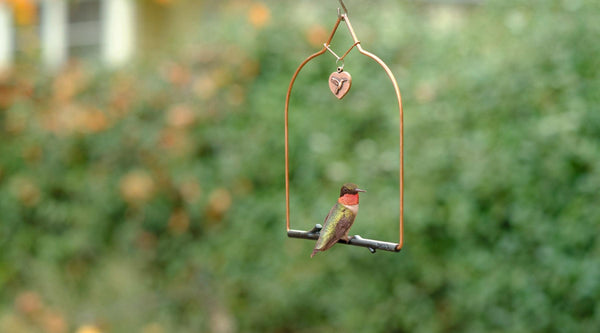
That's usually a resident claiming both the feeder and a nearby swing as its own guarded territory — Rufous is especially known for this. A second feeder and a second swing, spaced out of sight of each other, gives another bird — the incoming migrant or a displaced resident — its own station to guard instead of fighting over one.
Shop a second swing →August
The fall build begins.
| West | The busiest month in Big Bend. Rufous surge through — from none in June to nearly one in five checklists, one of the commonest birds at a feeder, by mid-August — and Black-chinned hit their own peak in the last week of the month. Two abundant species at once. |
| Statewide | Ruby-throated numbers climbing everywhere. |
| Valley & Coast | Ruby-throated return, and fast. |
Events: The Davis Mountains Hummingbird Celebration in Fort Davis runs in late August every other year — field trips, seminars, and a banquet. Registration is usually required in advance.
What to do: Keep everything full. Birds are fuelling for a Gulf crossing or a long overland flight, and a reliable feeder in August matters more than one in April.
This is the month to be generous, not economical.
Birds fueling for a long flight need feeders topped up more often — the large 2lb Nectarlyte® powder or the Nectarade® liquid concentrate keeps you from running out mid-surge.


September
The biggest month of the year, nearly everywhere in Texas.
| Valley | Peak. Ruby-throated go from absent in July to a bird at nearly every feeder by mid-September. |
| Coast | Peak in Houston and along the Coast. The great staging grounds before the Gulf crossing. Rufous pass through in their own smaller wave in the first week. |
| Central & North | Peak, then a fast decline through the month. |
| West | Peak diversity. Rufous, Black-chinned, Broad-tailed, Calliope and more, all at once. |
Events — three festivals, all in September:
- Rockport-Fulton HummerBird Celebration (Rockport and Fulton) — one of the most established hummingbird festivals in the country, built around the fall Ruby-throated migration along the Gulf Coast. Speaker programs, guided birding trips, hummingbird home tours, and public banding demonstrations. Annual.
- Xtreme Hummingbird Xtravaganza at the Gulf Coast Bird Observatory (Lake Jackson) — a public banding celebration during peak migration, with symbolic hummingbird adoptions and live banding demonstrations. Annual.
- Hummingbird Festival at Kleb Woods Nature Center (Tomball) — a free, long-running community event with live banding, guided nature walks, and a historic homestead tour. Annual.
What to do: More feeders, filled more often. This is the month to be generous.
October
Inland empties; the south stays busy; the planting month.
| Central & North | This is when most of Central and North Texas — and East Texas along with them — sees hummingbirds leave, though gradually rather than all at once: Ruby-throated numbers stayed close to their September peak through that month's third week, then decline steadily through October, down to roughly one checklist in twenty by month's end, with real stragglers reported into November. Last birds are usually that summer's young. |
| Valley & Coast | Still busy. No real drop-off. |
| West | Rufous thinning out; a few settle in for winter. |

This is the planting month.
Sow now and native wildflowers get the cold, moist period most varieties need to bloom reliably next spring, from late September into early November.
Shop the Perfect Little Sanctuary® blend →Leave your feeder up. It's a myth that doing so delays migration — hummingbirds move on day length and instinct, not food supply.
November
Winter settles in.
| Central, North & West | By now hummingbirds have left most of Central, North, and East Texas for the year. Quiet — though wintering Rufous, and a smaller number of Broad-tailed, begin settling in across the centre of the state. |
| Valley & Coast | Buff-bellied and Ruby-throated both present. No off-season here. |
What to do: Take feeders down about two weeks after your last sighting — a better guide than any date, because it accounts for your own yard and this year's weather. South of San Antonio, don't take them down at all.
December
Winter residents only.
| Valley | Buff-bellied, Black-chinned and Ruby-throated all present. The Valley genuinely has no off-season. |
| Coast | Ruby-throated in modest numbers. |
| Central & West | Wintering Rufous, plus a small, steady presence of wintering Broad-tailed centered on Central Texas. Occasionally something rarer. |
What to do: If you're keeping a winter feeder, report what turns up. Winter hummingbirds in Texas are of real interest to researchers, and many are only identified once a licensed bander gets a look in the hand. Our winter hummingbird feeder care guide covers heated feeders and the two-feeder swap.
The Year at a Glance
| When | What |
|---|---|
| Mid-February | Feeders up in West Texas |
| Late February | Feeders up in Central Texas |
| Mid-March | Feeders up in North Texas |
| Late March – early September | Nesting season |
| June – July | The lull in South Texas; peak breeding inland |
| September | Peak month statewide, and festival season |
| October | Sow wildflower seed |
| Two weeks after your last sighting | Feeders down — except south of San Antonio, where they stay up year-round |
Frequently Asked Questions
When do hummingbirds come back to Texas?
Broad-tailed reach West Texas in the first week of March, with Black-chinned following mid-month. Central Texas and the Coast get Black-chinned in the second week of March, and Ruby-throated reach Central and North Texas in the last week. Elevation and latitude both matter, but so does the route — western species arrive from the southwest, not from the Gulf, which is why Big Bend beats Dallas by nearly a month despite sitting farther from the coast. The Rio Grande Valley never empties, so nothing "returns" there.
When do hummingbirds leave Texas?
Central and North Texas empty out through October, with the last stragglers usually that summer's young. Take feeders down about two weeks after your last sighting — a better guide than any date. South of San Antonio, don't take them down at all.
What month has the most hummingbirds in Texas?
September, nearly everywhere in the state. Texas's own breeding birds are joined by everything moving down from the north and west at once. Big Bend is the exception — its busiest month is August, when Rufous surge through and Black-chinned peak together.
Are there hummingbirds in Texas in winter?
Yes, in the south. Buff-bellied and Black-chinned are reported in the Rio Grande Valley every week of the year, and Ruby-throated ten months out of twelve. Wintering Rufous settle across Central and West Texas in small but reliable numbers, and a smaller number of Broad-tailed winter in Central Texas as well.
Why is my Rio Grande Valley feeder empty in June?
Because Ruby-throated are almost entirely absent from the Valley and Coast in June and most of July — the quietest stretch of the year there. It's the pause before September, which is the busiest month. Buff-bellied hold steady throughout.
When do hummingbirds leave Houston?
Houston falls in the Coast region on this calendar, which stays busy through October with no sharp drop-off — later than Central or North Texas. Take your feeder down about two weeks after your last sighting, typically sometime in late October or November.
Are there hummingbirds in Austin year-round?
Not quite, but close. Austin (Central Texas) sees Black-chinned nesting from March through September, and Ruby-throated pass through in spring and fall. There's a real quiet stretch in June and early July, but nothing like the total absence you'd see in North Texas — and wintering Rufous, along with a smaller number of Broad-tailed, occasionally turn up even in the coldest months.
Why We Built This Calendar
Pop's Birding has been helping hummingbird lovers for three generations. One of the questions our customers ask most often is "When do hummingbirds arrive and leave my state?" — we built this calendar to give a direct, sourced answer, not a generic one. Most timing advice online gives a single date for an entire state, which is exactly wrong for a place the size of Texas: Big Bend gets its first arrivals nearly a month before Dallas does, and the Rio Grande Valley never has an off-season at all. A single "put your feeders out in March" answer would be genuinely misleading for a third of the state. We wanted a calendar that tells you the truth for where you actually live, not an average that's wrong everywhere.
How We Built This Calendar
Every arrival, departure, and peak date on this page comes from eBird checklist data (Cornell Lab of Ornithology), 2016–2025, for Texas statewide and five counties chosen to represent its regions: Hidalgo (Valley), Nueces (Coast), Travis (Central), Dallas (North), and Brewster (West). Each region's "first arrivals" and "reliably present" weeks are set against its own seasonal peak, since a mountain county and a metro county don't share a baseline. The genuine finding: arrival and departure don't mirror each other. Big Bend gets its first Black-chinned nearly a month before Dallas, yet both drop below their reliably-present thresholds within about a week of each other in October. The county comparison is our own analysis of the raw eBird data, not a restatement of eBird's bar charts.
Sources
- eBird bar chart data, Cornell Lab of Ornithology — Texas statewide plus Hidalgo, Nueces, Travis, Dallas, and Brewster counties, 2016–2025. Source for all arrival, departure, peak, and species frequency figures.
- Texas Breeding Bird Atlas — Black-chinned Hummingbird, Texas A&M University. Source for clutch size, incubation period, and nestling period.
- Texas Parks and Wildlife Department — breeding season dates for Texas hummingbirds.
- des Lauriers, J. R. (1994). Hummingbirds eating ashes. The Auk, 111(3), 755–756. Documents five nesting female hummingbirds eating wood ash; no males were seen doing so in that study.
- Adam, M. D., & des Lauriers, J. R. (1998). Observations of hummingbirds ingesting mineral-rich compounds. Journal of Field Ornithology, 69, 257–261. Source for hummingbirds' greatly reduced medullary bone and for the mineral-rich materials they eat.
- Werning, S. (2018). Medullary bone is phylogenetically widespread and its skeletal distribution varies by taxon. Journal of Ornithology, 159, 527–543. Source for medullary bone being confirmed in hummingbirds.
- Zenzal, T. J., & Moore, F. R. (2016). Stopover biology of Ruby-throated Hummingbirds (Archilochus colubris) during autumn migration. The Auk, 133(2), 237–250.
Festival dates and formats change from year to year. Check organizer websites before making travel plans.
Know before they arrive
You don't have to keep this calendar taped to the fridge. Insider Birding Access members get seasonal notes timed to your region — when to have feeders out, what the birds are doing right now, and what's worth doing in your yard this season. We take the guesswork out of the calendar. Joining takes about thirty seconds, and there's 10% off your first order in it.
Join Insider Birding Access →Free to join. 10% off your first order.
Shop Texas's Hummingbird Favorites


Bethany Sloan has served as General Manager of Pop's Birding since 2010, continuing the legacy of her grandfather, William "Pops" Sloan, inventor of the Original Hummingbird Swing. A lifelong hummingbird enthusiast, educator, and independent researcher, she leads the company's educational content, including its 50-State Hummingbird Guide series, Regional Guide, Species Guide and Hummingbird Learning Center. Bethany combines scientific research, regional migration data, and more than 16 years of hands-on experience to create trusted educational resources for bird enthusiasts across North America.