Aug 01, 2026
Colorado Hummingbird Season: A Month-by-Month Calendar
Timing derived from eBird data, 2016–2025 (sourced July 2026)
Colorado doesn’t run one hummingbird season — it runs several, stacked by elevation. The Western Slope wakes up in mid-April while high mountain valleys are still under snow, and by the time Broad-taileds are nesting at 9,000 feet, Rufous Hummingbirds are already turning around and heading south again. Nothing here follows a simple north-to-south calendar; altitude sets the clock.
The short answer: put feeders up by mid-April on the Western Slope and by late April everywhere else, from Denver to the high mountain valleys. Expect most birds gone by the end of September, though Broad-taileds at lower elevations can hang on into early October.
| Question | Answer |
|---|---|
| When do hummingbirds arrive in Colorado? | Mid-April on the Western Slope; late April across the rest of the state, mountains included |
| When do hummingbirds leave Colorado? | Most leave through September; the last Broad-taileds by early October |
| What’s the most common hummingbird in Colorado? | Broad-tailed Hummingbird, statewide |
| Do hummingbirds stay in Colorado year-round? | No — every Colorado species migrates south for winter |
| When should I put my feeder up? | Mid-April on the Western Slope; late April everywhere else |
| When should I take my feeder down? | Early-to-mid October, or two weeks after your last sighting |
Free download
Take Colorado with you
One page covering every elevation zone, so you know exactly when to expect birds whether you’re in Denver or a cabin at 9,000 feet.
Download the Colorado cheat sheetOne page · PDF · free to print and share
Colorado’s Hummingbird Season at a Glance
Before we get into month-by-month detail, here’s the whole season in one picture — four species, four very different curves, all shaped by the same thing: elevation.

How often each species turns up on eBird checklists, week by week — statewide, 2016–2025. The county-by-county elevation breakdown below shows how these same curves shift earlier or later depending on where in Colorado you are.
January, February & March: The Off-Season
All Colorado hummingbird species migrate south — there are no resident hummingbirds here in winter.
Colorado’s hummingbirds spend January through March on their wintering grounds in Mexico and Central America. The Broad-tailed Hummingbird — the state’s dominant breeder — winters in highland Mexico; Rufous winters along the Mexican Pacific coast and into Central America. True winter sightings in Colorado are exceptionally rare and typically involve a single lost individual rather than any established wintering pattern. No feeders are needed, and no arrivals are worth watching for until April.
April: The Western Slope Wakes Up First
Mesa County sees its first Broad-taileds by mid-April; Denver, the southwest canyons and the high mountains follow in late April.
Get feeders up on the Western Slope and in southwestern canyon country by mid-April. If you’re on the Front Range or in the foothills, you can wait a week or two — but don’t wait too long, since early scouts do show up before the main wave arrives. On the Western Slope and in the southwest canyons, Black-chinned Hummingbirds arrive close behind the Broad-taileds, and in Mesa County they’re the more common of the two all summer long.

Mid-April is the right time to get set up.
Have a clean feeder ready and filled before the first scouts arrive — they’ll remember a reliable station and return to it all season.
Shop AspenPerch® →May: The Mountains Fill Up Fast
High-elevation Summit County and metro Denver both see their first Broad-taileds in late April. In May, the mountains pull ahead.
This is the month that breaks the “higher elevation means later arrival” assumption. Broad-tailed Hummingbirds are mountain-meadow specialists whose arrival tracks snowmelt and early wildflower bloom rather than elevation itself, so high mountain valleys like Summit County get their first birds the same week as the Front Range, and by mid-May they have far more of them. If you’re above 8,000 feet, have your feeder ready by late April.
June: Nesting Season Begins
Broad-tailed females are on the nest across the state by now.
Feeder activity may quiet slightly as nesting females become less conspicuous, though males continue defending territory and feeding actively.
Why nesting season is the demanding one
There's a wrinkle specific to hummingbirds. Most female birds build up a temporary calcium store in their bones, called medullary bone, and draw on it to make eggshell. Hummingbirds have very little of it, so a laying female has less in reserve. Researchers have seen nesting females eating wood ash and other mineral-rich materials, which they think helps replace the calcium that goes into eggs. In one 1994 study, every bird seen eating ash was a female tending a nest.

It's part of why Pop's Nectar includes calcium and electrolytes rather than sugar alone. Nesting females need extra calcium during egg-laying, and plain sugar water has essentially none. Read more on the research behind it.
Shop Nectarlyte® 8 oz →Colorado has also recorded Rivoli’s Hummingbird, a genuine rarity here, mostly in the mountains or the southern part of the state.
Late June–July: Rufous Hummingbirds Are Already Heading South
By late June, Rufous adults are turning around from breeding grounds as far north as Alaska.
This is one of the more surprising things about Colorado’s hummingbird calendar: for Rufous Hummingbirds, Colorado’s mountain wildflower meadows are already a stop on the return trip south, not the outbound leg. Expect them at feeders and scarlet gilia patches through the mountains starting in July.

Seeing one bird chase everyone else off?
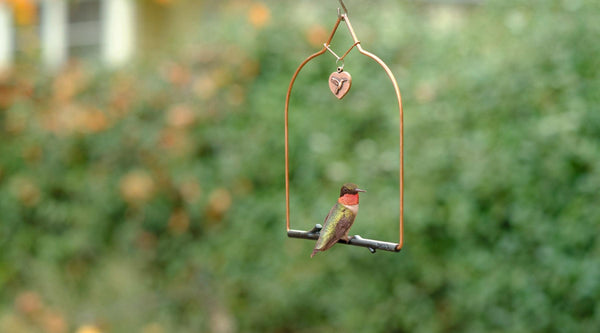
That's usually a resident claiming both the feeder and a nearby swing as its own guarded territory — Rufous is especially known for this. A second feeder and a second swing, spaced out of sight of each other, gives another bird — the incoming migrant or a displaced resident — its own station to guard instead of fighting over one.
Shop a second swing →August: Peak Migration Traffic
Rufous and Calliope both move through in numbers this month.
This is typically the busiest month at a Colorado feeder, with local Broad-taileds, southbound Rufous, and the smaller, less predictable Calliope Hummingbird all potentially present at once.
This is the month to be generous, not economical.
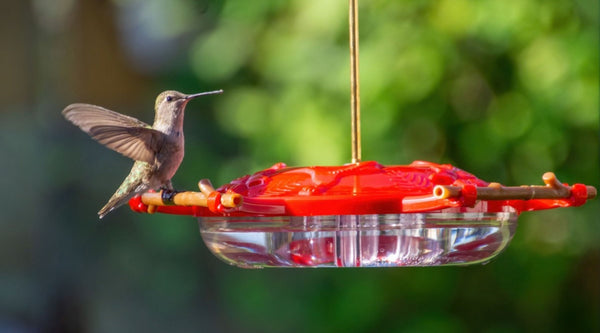
Birds fueling for a long flight need feeders topped up more often — the large 2lb Nectarlyte® powder or the Nectarade® liquid concentrate keeps you from running out mid-surge.


September: Most Birds Depart
Rufous and Calliope finish passing through, and Broad-taileds thin out fast. The high mountains are nearly empty by mid-month.
By the end of September, most of Colorado’s hummingbirds — resident and migrant alike — leave, heading south through New Mexico toward their Mexican and Central American wintering grounds. Scarlet gilia blooming as late as mid-September in high mountain meadows gives the last young birds fuel right before their first migration south.
October: The Last Stragglers
Occasional late Broad-taileds and Rufous may still turn up, especially at lower elevations.
Most birds leave by early October. If you keep a feeder up, take it down about two weeks after your last sighting — a full October without activity is a safe sign the season is over.

This is the planting month.
Sow now and native wildflowers get the cold, moist period most varieties need to bloom reliably next spring.
Shop the Perfect Little Sanctuary® blend →November & December: The Season Ends
Colorado’s hummingbird season is over — take feeders down if you haven’t already.
By November, every Colorado hummingbird species has departed. The last Broad-taileds and Rufous typically leave in October; any report past that point is a genuine rarity worth documenting for the Colorado Bird Records Committee. There is nothing to gain from keeping feeders out through freezing temperatures — it can damage plastic feeders and the birds aren’t there to use them. Clean and store your feeder until April.
The Year at a Glance, by Elevation
| Region (proxy county) | Broad-tailed Arrive | Broad-tailed Leave By |
|---|---|---|
| Western Slope (Mesa) Grand Junction |
Mid-April | Late September |
| SW Canyons (Montezuma) Durango, Mesa Verde |
Late April | Early October |
| High Mountain (Summit) Breckenridge, Frisco |
Late April | Mid-September |
| Front Range (Denver) Denver, Boulder |
Late April | Early October |
| Eastern Plains (Yuma) far eastern CO |
Too scarce and irregular to measure reliably | |
Frequently Asked Questions
When do hummingbirds arrive in Colorado?
Mid-April on the Western Slope, where Mesa County sees the earliest arrivals of any part of the state. Everywhere else, from Denver and the southwest canyons to high mountain counties like Summit, the first Broad-taileds show up in late April.
When do hummingbirds leave Colorado?
Most leave through September. Rufous and Calliope, which pass through as migrants rather than local breeders, are mostly gone by mid-September. Broad-taileds go last: the high mountains empty out by mid-September, while Denver and the southwest canyons keep a few into early October.
Why do high mountain areas get hummingbirds so early?
Because Broad-tailed Hummingbirds are mountain-meadow breeding specialists whose arrival tracks snowmelt and early wildflower bloom, not elevation itself. High mountain valleys are the destination, not a late stop along the way — which is why places like Summit County can see birds as early as the Front Range.
Is it bad to leave my feeder up into fall?
No — it’s a myth that a feeder left up delays migration. Hummingbirds migrate on daylight and instinct, not food availability. A feeder up into October just gives late migrants a reliable stop.
When is the best time to see hummingbirds in Colorado’s mountains?
Late June through August is the richest window in high-elevation meadows, when nesting Broad-taileds overlap with southbound Rufous and Calliope moving through.
Why We Built This Calendar
Pop’s Birding has been helping hummingbird lovers for three generations. One of the questions we hear most often is “When do hummingbirds arrive and leave Colorado?” — and the honest answer is: it depends entirely on where in the state you live. Most timing guides give one statewide date, which is exactly wrong for a state where Grand Junction sees its first Broad-tailed Hummingbirds in mid-April, Denver and the high mountain valleys in late April, and the mountains empty out in fall weeks before Denver does. A single statewide date is wrong for most of the state. We wanted a calendar that tells you the truth for where you actually live, not an average that fits nowhere well.
How We Built This Calendar
We pulled our own eBird checklist data (2016–2025) for Colorado statewide and for five counties spanning the state’s elevation range — Mesa, Montezuma, Summit, Denver, and Yuma — and read the seasonal pattern directly off the reporting rates ourselves. Percentages describe how often a species appears on birdwatchers’ submitted checklists, not a population count.
Sources
- eBird bar chart data, Cornell Lab of Ornithology — Colorado statewide and county-level, 2016–2025. Source for all monthly timing and the elevation-arrival pattern.
- All About Birds, Broad-tailed Hummingbird (Cornell Lab of Ornithology). Source for breeding elevation and montane-specialist framing.
- 73rd Report of the Colorado Bird Records Committee (Colorado Field Ornithologists). Source for Rivoli’s Hummingbird’s accepted Colorado status.
- des Lauriers, J. R. (1994). Hummingbirds eating ashes. The Auk, 111(3), 755–756. Documents five nesting female hummingbirds eating wood ash; no males were seen doing so in that study.
- Adam, M. D., & des Lauriers, J. R. (1998). Observations of hummingbirds ingesting mineral-rich compounds. Journal of Field Ornithology, 69, 257–261. Source for hummingbirds' greatly reduced medullary bone and for the mineral-rich materials they eat.
- Werning, S. (2018). Medullary bone is phylogenetically widespread and its skeletal distribution varies by taxon. Journal of Ornithology, 159, 527–543. Source for medullary bone being confirmed in hummingbirds.
Know before they arrive
You don't have to keep this calendar taped to the fridge. Insider Birding Access members get seasonal notes timed to your region — when to have feeders out, what the birds are doing right now, and what's worth doing in your yard this season. We take the guesswork out of the calendar. Joining takes about thirty seconds, and there's 10% off your first order in it.
Join Insider Birding Access →Free to join. 10% off your first order.
Shop Colorado's Hummingbird Favorites


Bethany Sloan has served as General Manager of Pop's Birding since 2010, continuing the legacy of her grandfather, William "Pops" Sloan, inventor of the Original Hummingbird Swing. A lifelong hummingbird enthusiast, educator, and independent researcher, she leads the company's educational content, including its 50-State Hummingbird Guide series, Regional Guide, Species Guide and Hummingbird Learning Center. Bethany combines scientific research, regional migration data, and more than 16 years of hands-on experience to create trusted educational resources for bird enthusiasts across North America.