Sep 04, 2026
Hummingbirds in Nebraska: The Complete Guide to All 8 Species
Nebraska's documented hummingbird list runs to eight species — tied with South Dakota, ahead of Wyoming's six and Iowa's five, but trailing Kansas's eleven and Colorado's twelve. Ruby-throated Hummingbird is the only regular breeder, dominating the state almost everywhere. But drive out to the far-western Panhandle, and the picture changes completely: Scotts Bluff County alone sees real, recurring numbers of four different species that barely register anywhere else in the state.
Free download
All 8 species, one page
A one-page reference to every hummingbird documented in Nebraska — Ruby-throated Hummingbird plus seven rarer visitors, with each species' status and record history at a glance.
Download the Nebraska species guideOne page · PDF · free to print and share

All 8 documented Nebraska hummingbird species, grouped by tier — statewide eBird data, 2016–2025, cross-checked against Birds of Nebraska – Online, the Nebraska Ornithologists' Union Records Committee's authoritative reference.
The Hummingbird You're Most Likely to See
Ruby-throated Hummingbird Breeds Here
Nebraska's only regular breeding species, nesting mostly in the Missouri and lower Platte River valleys and across the southeastern part of the state, with summer records extending west along the Niobrara, Elkhorn, and Platte rivers as far as Keith County — though not yet into the Panhandle itself. It dominates the state's hummingbird activity almost completely, with a statewide eBird peak near 14% in mid-September, nearly twenty times higher than the next most frequent species. Documented nest records include Smith Falls State Park (2016) and a female feeding nestlings near Valentine (July 2024).

Quick ID: Males flash a brilliant ruby-red throat in good light, but it reads as solid black most of the time — the forked black tail is the more reliable everyday mark. Females have a plain whitish throat and a more rounded, white-tipped tail.
Black-chinned Hummingbird Breeds Here
A genuine, if recent, western Nebraska breeder — not just a wanderer. Birds of Nebraska calls the 2025 evidence "convincing": a female was tracked with two juveniles at feeders in Scotts Bluff County in August 2025, following observed copulation at the same site in May, after two earlier years of suggestive but unconfirmed activity there. About 80 total Nebraska records exist, almost all from 2019 onward, part of a documented range-expansion pattern shared with Oklahoma and Colorado.


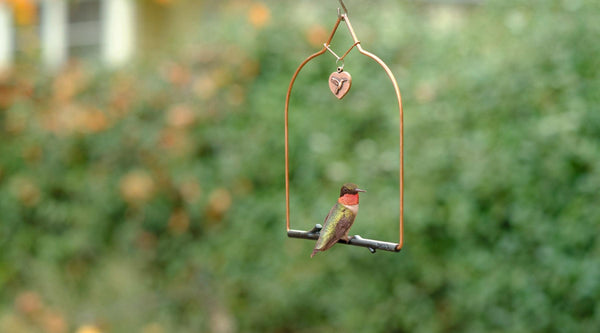
A Little Throne for Your Nebraska Breeders
Ruby-throated holds territory statewide all summer, and Black-chinned is now doing the same in the Panhandle. A perch nearby gives either breeder a vantage point to watch over its territory and rest between chases.
Shop Charm Redwood Swing →The Panhandle's Real Migrant Cluster
This is the pattern most general references miss entirely. Three more species aren't rare wanderers in Nebraska — they're regular, recurring fall migrants, but almost exclusively in the far-western Panhandle, where Scotts Bluff County alone accounts for the overwhelming majority of their state records.
Calliope Hummingbird Migrant/Winter
A genuinely regular fall migrant in western Nebraska — not merely casual — per Birds of Nebraska's own status line: "Uncommon regular fall migrant west, rare casual central and east." Scotts Bluff County shows a real peak near 15.5% in late August, compared to a thin 0.73% statewide.

Quick ID: North America's smallest breeding hummingbird, with a hunched posture and short tail. Males have a unique streaked, ray-like magenta throat unlike any other species' solid gorget. Females are tiny even by hummingbird standards, with very little rufous in the tail.
Rufous Hummingbird Migrant/Winter
Documented every single year from 2016 through 2025, with high counts of 10 to 12 birds near Mitchell in Scotts Bluff County — genuinely regular, not the occasional stray the phrase "rare visitor" sometimes implies elsewhere. Birds of Nebraska's own status line: "Uncommon regular fall migrant west and central, rare regular east."

Quick ID: Males glow with a fiery orange-red throat and a coppery-orange body — one of the most recognizable hummingbirds in North America. Females and immatures are green above with rusty flanks and rufous patches at the base of the tail.
Broad-tailed Hummingbird Migrant/Winter
Worth being precise about: this species breeds commonly just to the west in Colorado and Wyoming, and some recent Scotts Bluff County summer sightings are suggestive — but Nebraska's own bird records authority is explicit that in-state breeding is "none as yet proven." It's tracked here as a regular migrant, not a breeder, with a real Scotts Bluff County peak near 9.5% in late summer.


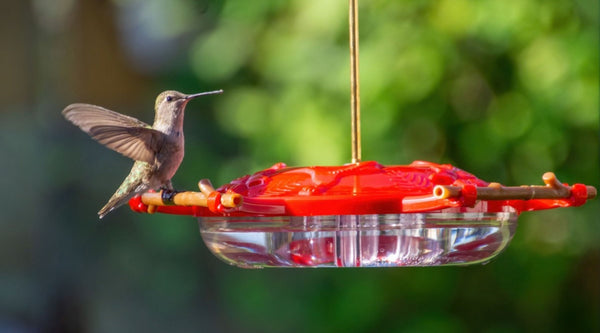
An Extra Feeder for Your Panhandle Visitors
Calliope, Rufous, and Broad-tailed all pass through Scotts Bluff County in real numbers every fall. A second feeder gives a visiting migrant a station of its own instead of fighting Ruby-throated for the one you've already got up.
Shop AspenPerch® Feeder →Nebraska's Recurring Rarities
Anna's and Costa's Hummingbird are both genuine, recurring rarities — Anna's considerably more so.
Anna's Hummingbird Rare / Casual Visitor
9 accepted records, the most recent from June 2025 — Birds of Nebraska's own term is "Rare casual," but with a real, documented recurring pattern and a striking backstory: a 2021 study found the species' range expanded at 2.7% per year from 1970 to 2019. First recorded in Nebraska as recently as 2016.

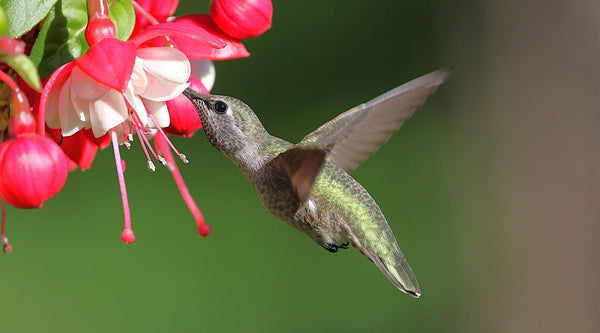
Quick ID: The only North American hummingbird with a fully colored crown as well as throat — males glow rose-pink from head to throat. Females show a central patch of rose-red spotting on an otherwise plain throat, with a stocky, broad-tailed build.
Costa's Hummingbird Rare / Casual Visitor
A meaningfully thinner pattern than Anna's — just 4 dated records spanning 24 years (2001, 2010, 2013, and most recently October–November 2025 in Lincoln), genuinely sporadic single-bird vagrancy rather than a recurring seasonal visitor. Birds of Nebraska's own words: "Rare casual fall visitor."


Make Your Sanctuary Worth a Detour
Anna's keeps turning up with a real, documented pattern, and Costa's has shown four times in 24 years. A real nectar recipe with electrolytes and calcium gives a hummingbird that's already come hundreds of miles off course a reason to stick around and get documented.
Shop Nectarlyte® Powder →If You're Lucky: Nebraska's Historic Rarities
Broad-billed Hummingbird is down to a single record, with nothing before or since — the clearest possible one-off among Nebraska's rare hummingbirds.
Broad-billed Hummingbird Historic / Accidental
Nebraska's only record, ever — a female found and photographed at Wilderness Park, Lancaster County, in May 2021, seen by two other observers that same day but never again. A single isolated occurrence, the clearest possible Historic/Accidental case among Nebraska's rare hummingbirds.


Give Every Visitor a Reason to Stay
Whether it's Nebraska's next Broad-billed, or just a hungry migrant passing through, real nectar sources are what turn a passerby into a repeat visitor. Wildflower Seed gives any hummingbird — common or exceptionally rare — a reason to stay.
Shop Wildflower Seed →Nebraska Hummingbirds at a Glance
Ruby-throated Hummingbird's statewide dominance isn't a close call — its eBird frequency peaks near 14% and clears the next-highest species by nearly twenty times. A bar chart built from statewide numbers alone would flatten the Panhandle's real diversity into invisibility, so this section sticks to the table below instead, which keeps each species' regional pattern intact.
| Species | Status | Nebraska Records |
|---|---|---|
| Ruby-throated Hummingbird | Breeding | Nebraska's only regular breeder, mostly southeastern; statewide eBird frequency peaks near 14%, dwarfing every other species. |
| Black-chinned Hummingbird | Breeding | Genuine, recent western breeder — female tracked with 2 juveniles, Scotts Bluff Co, Aug 2025. |
| Calliope Hummingbird | Migrant / Winter Visitor | Regular fall migrant in the west; Scotts Bluff Co peak near 15.5%, vs. 0.73% statewide. |
| Rufous Hummingbird | Migrant / Winter Visitor | Recorded every year 2016–2025; Scotts Bluff Co peak near 13%, high counts of 10–12 birds. |
| Broad-tailed Hummingbird | Migrant / Winter Visitor | Regular western migrant; breeding "none as yet proven" despite suggestive summer sightings. |
| Anna's Hummingbird | Rare / Casual Visitor | 9 accepted records, most recent 2025 — a real recurring pattern amid documented range expansion. |
| Costa's Hummingbird | Rare / Casual Visitor | 4 records over 24 years — genuinely sporadic, a thinner pattern than Anna's. |
| Broad-billed Hummingbird | Historic / Accidental | 1 accepted record ever (Lancaster Co, May 2021), nothing since. |
Frequently Asked Questions
How many hummingbird species have been recorded in Nebraska?
Eight — tied with South Dakota, more than Wyoming's six or Iowa's five, but fewer than Kansas's eleven or Colorado's twelve. Two species breed here, three are regular western migrants, and three are documented rarities.
Is Rufous Hummingbird rare in Nebraska?
Not exactly — it's a genuinely regular fall migrant in western and central Nebraska, not just an occasional stray. Birds of Nebraska describes it as an "uncommon regular fall migrant west and central," with records documented every single year from 2016 through 2025.
Which part of Nebraska has the most hummingbird diversity?
The Panhandle, by a wide margin. Scotts Bluff County in far-western Nebraska sees real, recurring numbers of Calliope, Rufous, Broad-tailed, and Black-chinned Hummingbird every summer and fall — a level of diversity the rest of the state simply doesn't have, tied to the region's proximity to Rocky Mountain breeding range.
Does Broad-tailed Hummingbird breed in Nebraska?
Not confirmed, despite some promising recent sightings. Nebraska's own bird records authority states plainly that breeding here is "none as yet proven," even with suggestive summer activity in Scotts Bluff County — it's tracked as a regular migrant, not a breeder.
What's the difference between Anna's and Costa's Hummingbird's rarity in Nebraska?
Anna's has the stronger pattern — 9 accepted records with the most recent from 2025, part of a documented long-term range expansion. Costa's is thinner: only 4 records total, spanning 24 years, with real gaps of a decade or more between sightings.
Why We Created This Guide
Pop's Birding has been helping hummingbird lovers for three generations. One of the questions our customers ask most often is "what hummingbirds actually show up in my state" — we built this guide to give a direct, sourced answer, not a generic one. Nebraska's Panhandle holds a real, documented hummingbird diversity that most general references collapse into a single "rare visitor" label for the whole state — this page draws that regional line explicitly, using Nebraska's own bird records authority.
How We Created This Guide
We started with eBird checklist data for Nebraska from the Cornell Lab of Ornithology, covering 2016 through 2025, pulled statewide plus four counties — Omaha's Douglas, Lincoln's Lancaster, North Platte's Lincoln County, and the far-western Scotts Bluff Panhandle, where the real migrant diversity concentrates. Since raw eBird numbers alone can make a species look more established than it is, we checked every species against Birds of Nebraska – Online, the Nebraska Ornithologists' Union Records Committee's authoritative species-account reference, rather than reading eBird magnitude as confirmation on its own. That check mattered for two species: the state's own records authority is explicit that Broad-tailed Hummingbird's in-state breeding is "none as yet proven," despite suggestive summer activity in Scotts Bluff County, so it's tracked here as a migrant rather than a breeder, and Costa's Hummingbird's own status language — "rare casual fall visitor," with only four records in 24 years — places it in the Rare tier rather than the more frequent pattern its western neighbors show. Ruby-throated's statewide lead is real and enormous, nearly twenty times the next species, but Scotts Bluff County's genuinely rich late-summer migrant cluster is invisible in that statewide number, which is why this page gives the Panhandle its own section instead of folding it into generic rare-visitor language.
Sources
- eBird bar chart data, Cornell Lab of Ornithology — Nebraska statewide, 2016–2025.
-
Birds of Nebraska – Online, Nebraska Ornithologists' Union Records Committee — source for every species' status and record history on this page.
Know before they arrive
You don't have to keep this calendar taped to the fridge. Insider Birding Access members get seasonal notes timed to your region — when to have feeders out, what the birds are doing right now, and what's worth doing in your yard this season. We take the guesswork out of the calendar. Joining takes about thirty seconds, and there's 10% off your first order in it.
Join Insider Birding Access →Free to join. 10% off your first order.
Shop Nebraska's Hummingbird Favorites


Bethany Sloan has served as General Manager of Pop's Birding since 2010, continuing the legacy of her grandfather, William "Pops" Sloan, inventor of the Original Hummingbird Swing. A lifelong hummingbird enthusiast, educator, and independent researcher, she leads the company's educational content, including its 50-State Hummingbird Guide series, Regional Guide, Species Guide and Hummingbird Learning Center. Bethany combines scientific research, regional migration data, and more than 16 years of hands-on experience to create trusted educational resources for bird enthusiasts across North America.