Aug 02, 2026
Violet-crowned Hummingbird: One Yard Made It Famous
Most hummingbirds are famous for a flash of color at the throat — a gorget that flares red, or green, or violet in the right light. The Violet-crowned Hummingbird skips that entirely: it's the only hummingbird in the United States with no colorful throat patch at all, relying instead on clean white underparts, a glittering violet crown, and a long orange bill to stand out. And stand out it does, mostly in one specific place: according to Tucson Bird Alliance, more people have first laid eyes on this species at the Paton Center for Hummingbirds in Patagonia, Arizona, than anywhere else on the planet.
Quick Facts
- Scientific name: Ramosomyia violiceps (Gould, 1859) — see the Origin Story below for why this name has changed twice
- Length: approximately 4.3–5 inches (11–12 cm)
- Weight: approximately 0.2–0.3 oz (5–8 g)
- Wingspan: approximately 4–6 inches (10–15 cm)
- Lifespan: oldest banded record at least 6 years, 1 month — recaptured during banding operations in Arizona
- Conservation status: Least Concern (IUCN); a global population of roughly 2 million mature individuals with a stable trend, per BirdLife International; listed as threatened at the state level in New Mexico, where the breeding population numbers only in the dozens
- US range: genuinely narrow — southeastern Arizona and a single known breeding site in southwestern New Mexico
- Claim to fame: the only hummingbird in the US with no colorful throat gorget, one of the only species where males and females look essentially alike, and the star attraction of a single famous Arizona backyard
The Origin Story: A Scientific Name That's Changed Twice
The Violet-crowned Hummingbird was formally described in 1859 by English ornithologist John Gould, who gave it the name Cyanomyia violiceps, based on a specimen from Atlixco, in the Mexican state of Puebla, according to Cornell's Birds of the World. The species epithet violiceps comes from the Latin viola ("violet") and -ceps ("-crowned," from caput, "head") — a straightforward nod to the male and female's shared glittering violet crown.
The genus name has had a genuinely eventful history since then. For decades the species was classified in the large tropical genus Amazilia, alongside dozens of other Central and South American hummingbirds. That changed in 2014, when a molecular phylogenetics study by McGuire and colleagues, published in Current Biology, found that Amazilia as traditionally defined wasn't a natural grouping at all — several species, including this one, were moved into a resurrected genus called Leucolia. That name didn't last either: a 2021 paper by Bruce and Stiles, published in Zootaxa, showed that Leucolia had actually already been used for a different bird decades earlier and wasn't technically available under naming-priority rules. The replacement name proposed was Ramosomyia — honoring Mexican ornithologist and conservationist Mario Alberto Ramos Olmos (1949–2006), combined with the Greek muia, "a fly," a common suffix in hummingbird genus names. The American Ornithological Society officially adopted Ramosomyia in 2022, and Cornell, eBird, and the International Ornithological Committee all use it today.
Worth knowing if you're cross-referencing other sources: not every authority has caught up. The IUCN Red List and BirdLife International still list the species under Leucolia violiceps, while the US Fish and Wildlife Service and ITIS still use the older Amazilia violiceps. All three names refer to the exact same bird — a genuinely useful reminder that hummingbird taxonomy, even for a well-known US species, is still actively being sorted out. Two subspecies are recognized: the northern R. v. ellioti, found from southeastern Arizona and southwestern New Mexico south through central Mexico, and the nominate R. v. violiceps, found farther south in southwestern Mexico.
Where the Violet-crowned Hummingbird Lives: A Genuine US Range-Expansion Story
This is fundamentally a Mexican species, ranging along the Pacific slope from Sonora south to Oaxaca and through the interior highlands from Chihuahua south to Puebla, where the Audubon Field Guide describes it as fairly common. In the United States, it barely crosses the border at all: it's found regularly only in southeastern Arizona, with a single known breeding location in southwestern New Mexico's Guadalupe Canyon, where New Mexico's Avian Conservation Partners estimate the entire local population at only around a dozen birds.
What makes this species' US story genuinely interesting is how recent it is. According to the Audubon Field Guide, this hummingbird wasn't documented nesting in the United States at all until 1959. Since then, it has become a regular, if low-density, breeder in southeastern Arizona, and Cornell's Birds of the World describes it as best understood as "a wanderer that is expanding its range northward" — with increasing numbers now overwintering at Arizona feeders rather than migrating south, likely helped along by the reliable food source those feeders provide.
If you want to see one yourself, there's a clear best answer: according to Tucson Bird Alliance, the Paton Center for Hummingbirds in Patagonia, Arizona, is by far the most reliable and accessible site anywhere, to the point that the organization states plainly that more people have first seen this species there than anywhere else on Earth. Within Arizona, the species is most numerous in Guadalupe Canyon in the state's extreme southeastern corner, and it's also regularly reported at Beatty's Guest Ranch in Miller Canyon, Ramsey Canyon, Ash Canyon, and Madera Canyon.
How to Identify the Violet-crowned Hummingbird
This is one of the few North American hummingbirds where males and females look essentially alike — a genuine identification quirk, since most hummingbird species show a dramatic difference between the sexes. According to Cornell's All About Birds, both show the same clean white underparts, bronzy-green upperparts, a glittering iridescent violet crown, a small white spot behind the eye, and a long, nearly straight bill that's reddish-orange with a black tip. The tail is plain brown, without the white flashes or forked shape seen in several similar species. Immatures show a duller, sometimes cinnamon-tinged crown.

Similar Species
According to Cornell's species-comparison guide, the most likely confusion species are female Rivoli's Hummingbird, female Costa's Hummingbird, and female or immature male Black-chinned Hummingbird — all of which show a dark bill and dingier underparts, unlike the Violet-crowned's distinctive orange, black-tipped bill and clean white belly.
A Note on Sound
According to Cornell's All About Birds, the song is a series of four to six very high, thin notes that descend in pitch. Calls include a dry "chap," a hard "stik" sometimes repeated rapidly, a high "weep," and a shrill "zeek."
Behavior: Surprisingly High in the Pecking Order
According to Cornell's All About Birds, a study tracking feeder dominance among Southwest hummingbird species found that as nectar grew scarcer, larger species consistently chased off smaller ones — and the Violet-crowned Hummingbird landed near the very top of that hierarchy, ranked above Rufous, Broad-billed, Broad-tailed, Black-chinned, and Costa's Hummingbirds. That said, it isn't unbeatable: both the Blue-throated Mountain-gem and Rivoli's Hummingbird, both larger still, will displace Violet-crowned Hummingbirds from a favored nectar source. At feeders specifically, Tucson Bird Alliance notes the species will readily and aggressively guard a favorite one, chasing off both Anna's and Broad-billed Hummingbirds.
Feeding and Diet
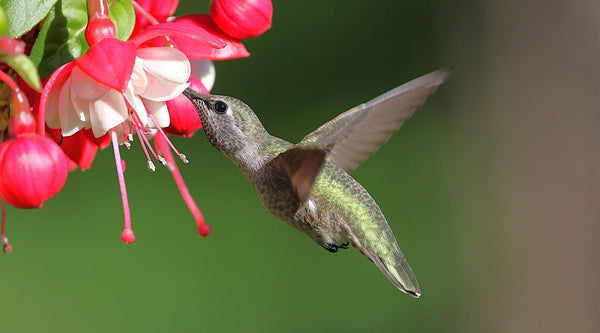
Like other hummingbirds, the Violet-crowned Hummingbird feeds on nectar and small insects, typically foraging in the middle and upper parts of trees rather than low shrubs. Cornell's All About Birds lists a genuinely long roster of documented nectar sources, including giant agave, tree ocotillo, tree morning glory, tree tobacco, honeysuckle, firecracker bush, Indian paintbrush, bougainvillea, pineapple sage, desert ironwood, prickly pear, and coral bean tree, among others. In New Mexico's Guadalupe Canyon specifically, the species' June arrival lines up closely with the blooming of Schott's agave, according to New Mexico's Avian Conservation Partners — a strong seasonal food source right when the birds need it most.
Courtship and Mating
This is a species whose courtship behavior is genuinely, honestly poorly documented — worth stating plainly rather than filling in gaps with guesswork. According to Cornell's All About Birds, males sing persistently at dawn, sometimes gathered in a loose group, and perform aerial displays that involve rising into the air and then diving, sometimes chasing other birds, presumed to be females, while calling. Beyond that, no detailed courtship display has been reliably recorded for this species. As with virtually all hummingbirds, the female alone builds the nest, incubates the eggs, and raises the young without help from the male.
Nesting and Family Life
According to Cornell's All About Birds, the nest is typically placed near the end of a branch — often on an Arizona sycamore — sometimes as high as 40 feet above the ground, though the Audubon Field Guide notes nests around 20 feet are more typical. The female builds the nest alone from white plant down bound together with spiderweb, decorated on the outside with lichens, seeds, and leaves.
Clutch size is two white eggs. The female incubates alone for probably two weeks or more, according to Audubon. In New Mexico's Guadalupe Canyon, the species typically raises just one brood per season, with nesting running from mid-June into September.
Migration
Cornell's range map classifies the Violet-crowned Hummingbird as "resident to medium-distance migrant" — a fitting description for a species whose migratory habits genuinely shift across its range. In the US and northern Mexico, birds have traditionally been considered migratory, but increasing numbers now overwinter at Arizona feeders, a pattern that has grown alongside the increase in confirmed local breeding. Farther south, in Sonora and Chihuahua and beyond, the species is essentially non-migratory, with birds making only local movements to follow flowering plants.
Habitat
According to Cornell's All About Birds, this species has a genuinely strong association with riparian corridors in the US, nesting almost exclusively along canyon streams lined with Arizona sycamore, Fremont cottonwood, and willow, typically between about 3,940 and 5,600 feet in elevation, and ranging higher into pine-oak-juniper forest, especially in summer. In Mexico, the habitat picture is considerably broader, spanning a wider elevation range and including thorn forest, deciduous forest, scrub oak, wooded parks, orchards, and even cities.
Violet-crowned Hummingbird by Region: Where and When to Find Them
| Region | Status | Best Time to See Them |
|---|---|---|
| Southeastern Arizona (Patagonia, Guadalupe Canyon, and nearby canyons) | Regular low-density breeder; increasingly overwinters at feeders | Year-round at the Paton Center; spring through fall elsewhere |
| Southwestern New Mexico (Guadalupe Canyon) | Small, localized breeding population (roughly a dozen birds); state-listed as threatened | Mid-June through September |
| Texas | Very rare vagrant, not a regular resident | Any season |
| Mexico (Pacific slope and interior highlands) | Core range; fairly common | Year-round |
If You're Hoping to Spot (or Attract) a Violet-crowned Hummingbird
Because this species' US range is so narrow, a visit to a known hotspot will almost always beat trying to attract one cold to a home feeder outside its range.
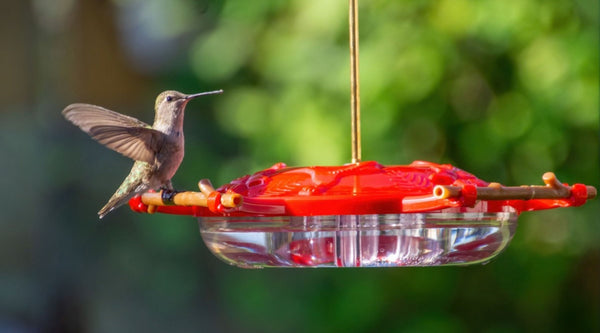
- If your property sits along a canyon stream in southeastern Arizona, a leak-proof feeder like the AspenPerch® Hummingbird Feeder filled with fresh Pop's Nectar gives you a genuine chance, especially given how readily this species takes to feeders.
- Expect this species to hold its own at the feeder — despite its relatively plain appearance, it ranks surprisingly high in the local hummingbird pecking order and will chase off several other species, though it will itself give way to the larger Blue-throated Mountain-gem and Rivoli's Hummingbird.
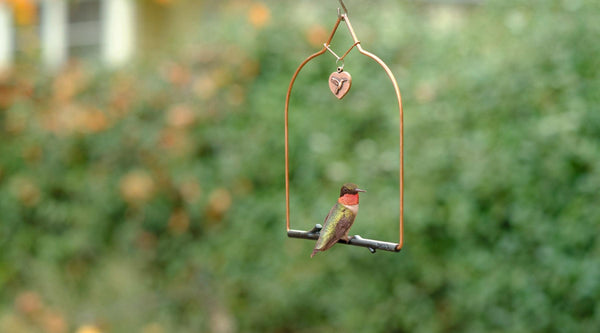
- Add a swing near your feeder — a Pop's Original Hummingbird Swing gives any visiting hummingbird a place to rest and be observed up close.
- Plant true riparian and desert natives like agave and ocotillo — genuine documented food sources for this species, not just casual nectar stops.
- Skip the insecticide, since insects are a real part of this species' diet. Use HummGuard™ nectar tips instead to manage bees and wasps without removing food this bird depends on.
- Consider a visit to the Paton Center for Hummingbirds. For most people hoping to see this species, a trip to Patagonia, Arizona, is simply a far more realistic path than attracting one to a home feeder outside its narrow natural range.
For general feeder timing, native plant lists, and wildflower planting guidance for the region, see our companion guides for Arizona and New Mexico, or find your own state in our full hummingbird guide by state series.
Frequently Asked Questions
How can you identify a Violet-crowned Hummingbird?
Look for clean white underparts, a glittering violet crown, bronzy-green upperparts, and a long, mostly orange bill with a black tip. It's the only US hummingbird without a colorful throat patch, and males and females look essentially alike.
Where is the best place to see a Violet-crowned Hummingbird?
The Paton Center for Hummingbirds in Patagonia, Arizona, is by far the most reliable and accessible spot anywhere — more people have first seen this species there than anywhere else on Earth. Other good spots in southeastern Arizona include Guadalupe Canyon, Miller Canyon, Ramsey Canyon, Ash Canyon, and Madera Canyon.
Why does this species have more than one scientific name?
Genetic research in 2014 showed the traditional genus, Amazilia, wasn't a natural grouping, and this species was moved to a genus called Leucolia. A 2021 study found that name wasn't actually valid under naming-priority rules, so the species was moved again, to its current genus, Ramosomyia, officially adopted in 2022. Some sources, including the IUCN and US Fish and Wildlife Service, haven't caught up yet and still use the older names.
Do males and females look different?
Not really — this is one of the few North American hummingbirds where the sexes look essentially alike, both showing the same white underparts and violet crown, unlike most hummingbirds where males and females are dramatically different.
Is the Violet-crowned Hummingbird rare or endangered?
Globally it's rated Least Concern by the IUCN, with a stable population of roughly 2 million mature individuals. In the US, though, it's genuinely rare and local, and it's officially listed as threatened in New Mexico, where the breeding population numbers only in the dozens.
Does it visit backyard feeders?
Yes, readily — and despite its relatively understated appearance, it ranks surprisingly high in the local feeder pecking order, aggressively guarding favorites and chasing off species like Anna's and Broad-billed Hummingbirds.
What could it be confused with?
Female Rivoli's Hummingbird, female Costa's Hummingbird, and female or immature male Black-chinned Hummingbird are the most likely mix-ups — all show a dark bill and dingier underparts, unlike this species' distinctive orange, black-tipped bill and clean white belly.
Is the Violet-crowned Hummingbird migratory?
Partially. Birds in the US and northern Mexico have traditionally migrated, but a growing number now overwinter at Arizona feeders instead. Farther south in Mexico, the species is largely non-migratory year-round.
How long do Violet-crowned Hummingbirds live?
The oldest recorded individual was recaptured during banding operations in Arizona at least 6 years, 1 month after first being banded.
How can I attract a Violet-crowned Hummingbird to my yard?
Realistically, only if you're along a canyon stream in southeastern Arizona. A feeder can genuinely help within that narrow range, but a visit to a known hotspot — especially the Paton Center for Hummingbirds — is a far more reliable way to see this species than attracting one to a home feeder outside its range.
At Pop's Birding, we believe every backyard — big or small — has room for a little more wonder. Explore our feeders, nectars, swings, and wildflower seed blends to start building your own hummingbird sanctuary today.

Bethany Sloan has served as General Manager of Pop's Birding since 2010, continuing the legacy of her grandfather, William "Pops" Sloan, inventor of the Original Hummingbird Swing. A lifelong hummingbird enthusiast, educator, and independent researcher, she leads the company's educational content, including its 50-State Hummingbird Guide series, Regional Guide, Species Guide and Hummingbird Learning Center. Bethany combines scientific research, regional migration data, and more than 16 years of hands-on experience to create trusted educational resources for bird enthusiasts across North America.