Sep 02, 2026
Arkansas Hummingbird Season: A Month-by-Month Calendar
Somewhere around Hot Springs, in the last week of March, a Ruby-throated Hummingbird lands on a feeder that has been hanging empty for five months. A day or two later the same thing happens in Little Rock. Fayetteville waits another week or two. And by the end of April, the whole of Arkansas is in season at once — which makes the fall all the more surprising, because the state does not leave the way it arrived.
The short answer: Ruby-throated Hummingbirds come back to Arkansas in the last week of March, starting in the Ouachitas and central Arkansas, and the whole state has them by mid-to-late April. The busiest stretch is late August through September. Northwest Arkansas empties out by mid-October, Hot Springs by late October, and Little Rock holds birds into the first week of November. Then a different hummingbird — the Rufous Hummingbird — takes over the winter, mostly around Little Rock.
| Question | Answer |
|---|---|
| When do they come back? | Last week of March around Hot Springs, Little Rock and the Delta; first half of April in Northwest Arkansas |
| When should feeders go up? | Mid-March statewide — the first scouts are already moving through by then |
| When do they nest? | Late April into August, with the quietest feeders in June while females sit on eggs |
| Busiest month? | September, especially the middle of the month — and Hot Springs is the busiest spot in the state |
| When do they leave? | Mid-October in Northwest Arkansas; late October around Hot Springs; first week of November around Little Rock |
| Any in winter? | Yes — Rufous Hummingbirds winter here most years, concentrated around Little Rock, from November into March |
Free download
The whole year on one page
Every arrival and departure window in this guide, for all four regions of Arkansas, on a single sheet — including the winter months when Rufous takes over around Little Rock. Sized 8.5" x 11" for easy reference and printing.
Download the printable calendarOne page · PDF · free to print and share
Arkansas's Hummingbird Season at a Glance
Two charts, because Arkansas has two hummingbird seasons that barely overlap — the summer one almost everyone sees, and a winter one most people never notice.

How often birdwatchers across Arkansas report a Ruby-throated Hummingbird, week by week, from eBird checklists (Cornell Lab of Ornithology), 2016–2025.
That chart tells you who is biggest, but it hides who is smallest. Ruby-throated's September peak would flatten every other hummingbird in Arkansas into what looks like a line along the bottom — even though three of them have a real, repeating season of their own. Here they are on their own chart, at their own scale, so you can see the shape of a winter that the chart above cannot show.

Rufous, Anna's and Black-chinned Hummingbirds, statewide, on their own scale. Same eBird data, 2016–2025.
The four regions behind this page's detail
Arkansas is built out of very different country — the Ozark Mountains, the Ouachita Mountains, the Arkansas River Valley between them, and the flat Delta along the Mississippi — so we followed one county in each, chosen for landscape rather than population: Washington around Fayetteville for the Ozarks and Northwest Arkansas, Garland around Hot Springs for the Ouachitas, Pulaski around Little Rock for the River Valley and central Arkansas, and Crittenden around West Memphis for the Delta. One honest caveat: the Delta gets a fraction of the birding traffic the other three do, so its dates are the least precise on this page, and we say so wherever it matters. Southern Arkansas — Texarkana, El Dorado, Pine Bluff — has no tracked county here; Hot Springs and Little Rock are the closest references.

Arrival and departure windows by region, based on eBird checklist data (Cornell Lab of Ornithology), 2016–2025.
January & February: The Winter Hummingbird
Ruby-throated is gone, and has been since November. But Arkansas is not empty. Rufous Hummingbird — a western bird that breeds as far north as Alaska — spends part of the winter here most years, and January and February are the heart of it. The pattern is real and recurring across the decade of data, but it is thin, and it is lopsided: sightings cluster heavily around Little Rock, with only scattered single birds anywhere else. Arkansas's own bird records committee treats Rufous as a regular occurrence rather than a rarity, which is exactly what this winter cluster shows.
Two rarer birds share these months. Anna's Hummingbird has wintered at Arkansas feeders in recent years, including one that turned up in the same Vilonia yard on the same January date two winters running. And Black-chinned Hummingbird, with thirteen accepted state records, shows a small but genuine mid-winter cluster in the Little Rock area — thin enough that we would not tell you to expect one, real enough that it belongs on the chart above.
What to do: if you live in or near Little Rock and are willing to keep one feeder going through the cold, this is the one part of Arkansas where that has a real chance of paying off. Everywhere else, a midwinter hummingbird is a genuine event worth reporting to the state's rare bird database. Our winter hummingbird feeder care guide covers heated feeders and the two-feeder swap.
March: The Ouachitas Go First
The first scouts cross into Arkansas in the third week of March — just a handful of sightings, after ten straight weeks with none. Then, in the last week of the month, the season really starts. Hot Springs gets going first, with the strongest start anywhere in the state, and Little Rock is only a step behind. Fayetteville and the Delta are still waiting.
Meanwhile, at the other end of the year's story, the winter Rufous are leaving. The last of them slip out of the Little Rock area in late March, just as the first Ruby-throated arrive — the two seasons touch, but barely overlap.

Get your feeder up before the first bird arrives, not after.
Arkansas's arrival runs from the Ouachitas up to the Ozarks across about two weeks, so a feeder that goes out in mid-March costs you nothing — one that's still in the garage when the first scout turns up costs you the sighting. March is also the month to check last year's feeder for cracked seals and worn ports before the season depends on it. AspenPerch® has a built-in ant moat and a Polyperch® comfort perch, so birds rest between sips instead of hovering through the whole meal.
Shop AspenPerch® →April: The Whole State Fills In
April is when Northwest Arkansas catches up. Fayetteville sees its first birds in the opening week and real numbers by the second, and by mid-month every region has them. The Delta around West Memphis shows its first bird in late March like Hot Springs and Little Rock, but so few people go birding there compared with the rest of the state that good numbers don't show up until the last week of April — treat the Delta's dates as "about then" rather than a specific week.
By the last week of April, about one in four Arkansas birdwatchers is reporting a Ruby-throated, and in Hot Springs it's already more than one in three. Nesting begins before the month is out: the Arkansas Game and Fish Commission puts nesting activity from late April through mid-August.
| Region | First birds arrive |
|---|---|
| Hot Springs (Garland) | Last week of March |
| Little Rock (Pulaski) | Last week of March |
| Fayetteville (Washington) | First week of April, in good numbers by the second |
| West Memphis (Crittenden) | First bird in late March, in good numbers by late April |
"First birds" means the week sightings pick up and keep coming, not a single early stray. The Delta gets far fewer birdwatchers than the rest of the state, so its dates are the roughest on this page.
Why nesting season is the demanding one
There's a wrinkle specific to hummingbirds. Most female birds build up a temporary calcium store in their bones, called medullary bone, and draw on it to make eggshell. Hummingbirds have very little of it, so a laying female has less in reserve. Researchers have seen nesting females eating wood ash and other mineral-rich materials, which they think helps replace the calcium that goes into eggs. In one 1994 study, every bird seen eating ash was a female tending a nest.

It's part of why Pop's Nectar includes calcium and electrolytes rather than sugar alone. Nesting females need extra calcium during egg-laying, and plain sugar water has essentially none. Read more on the research behind it.
Shop Nectarlyte® 8 oz →May: The Spring High
Statewide, the first week of May is the top of the spring — about one in four birdwatchers is reporting a hummingbird — and it holds there for two weeks before easing. Northwest Arkansas has its busiest spring week in the second week of May, when nearly a third of birdwatchers there see one, and the Delta has its best week of the whole year at the same time.
It feels like the peak. It is not. Numbers dip through June and then climb to a much higher late-summer high. If your feeder quiets down in a few weeks, nothing has gone wrong.
June: The Nesting Lull
The quietest month of the active season, and the most misread. Around Little Rock, sightings hit their lowest point between April and October in the third week of June, when only about one birdwatcher in seven reports one. Fewer birds at the feeder in June usually means more birds sitting on nests nearby: females are incubating, not gone. Hot Springs and Fayetteville hold up better through the lull, but every region has its birds.
What to do: keep the nectar fresh even when traffic is light. The birds that are visiting are feeding young, and July's surge is coming whether the feeder looks busy now or not.
July: Numbers Climb Hard
Fledglings are out, and it shows. In Hot Springs, sightings jump by more than half in just two weeks, and by the third week of July more than half of birdwatchers there are seeing hummingbirds. Fayetteville passes two in five. Statewide, July ends almost as busy as September will be, and busier than any week in spring.
One small thing worth knowing: that little bump on the winter-visitors chart in late July and August is Rufous. A handful pass through Arkansas on the early edge of their southbound migration each year — real, but a few birds across the whole state, and nothing like the winter presence around Little Rock that begins in November.
August: The Ozarks Peak First
Northwest Arkansas reaches its high point for the year in the first week of August, when nearly half of Fayetteville birdwatchers report a hummingbird, and it stays busy all month. Hot Springs is busier still: by the second week, nearly two of every three birdwatchers there are seeing them, a level it matches again in September. Little Rock keeps climbing toward a peak that's still a month away.
Arkansas summers are hot, and heat spoils nectar faster than anything else. If you change it every two days in September, change it every day in August.

Keep pests off without pesticides.
AspenPerch®'s built-in ant moat blocks ants with a water barrier, and HummGuard® Nectar Tips keep bees and wasps out without changing anything for the birds.
Shop HummGuard® →September: The Busiest Month, and Then They Leave
Statewide, this is the top of the year, in the second week of September. Little Rock and Hot Springs both peak a week later — about half of Little Rock birdwatchers and nearly two of every three in Hot Springs are reporting hummingbirds — and the birds you are seeing now are increasingly not the ones that nested in your yard. They are moving through from farther north, and everything they take on is fuel for a long flight.
Then the turn. Fayetteville and Northwest Arkansas are the first to leave: in the last week of September, sightings there fall to less than half of the week before. Hot Springs and Little Rock are still busy as the month ends, but the direction is set.
This is the month to be generous, not economical.
Birds fueling for a long flight need feeders topped up more often — the large 2lb Nectarlyte® powder or the Nectarade® liquid concentrate keeps you from running out mid-surge.


October: Most of Arkansas Empties Out, and It's the Planting Month
The state leaves in the same order it arrived, only stretched out. Northwest Arkansas is first: by the second week of October Fayetteville is down to a trickle, and by the third it's essentially empty. Hot Springs follows about a week later, with its last real numbers in the fourth week of October. Little Rock is last, still holding birds through the end of the month. The Delta thins out through October and is done by the end of the month, though its data is too light to call a specific week.
What to do: do not pull your feeders the moment your regular birds leave. Late October is exactly when a straggler or a western rarity turns up, and an empty hook is a missed one.

This is the planting month.
Sow now and native wildflowers get the cold, moist period most varieties need to bloom reliably next spring.
Shop the Perfect Little Sanctuary® blend →November & December: The Handoff
Little Rock's last Ruby-throated linger into the first week of November — the latest regular sightings anywhere in the state — and a straggler or two turn up into late November. At almost exactly the same moment, the winter bird arrives: Rufous Hummingbirds begin showing up in the second week of November, and by December the Little Rock area has a small, recurring winter population that will stay into March. Black-chinned and Anna's both put in their first winter appearances in December as well.
This is also the window for Arkansas's rarest hummingbirds. Of the seven hummingbird species on the state's review list, four have turned up mainly in late autumn or winter, and several at ordinary backyard feeders — including a Broad-tailed Hummingbird that stayed in Wynne from December 2020 into January 2021, and a Calliope Hummingbird that wintered near Ferndale from November 2003 to April 2004. Those birds were found by people who simply had not taken their feeders down.

Seeing one bird chase everyone else off?
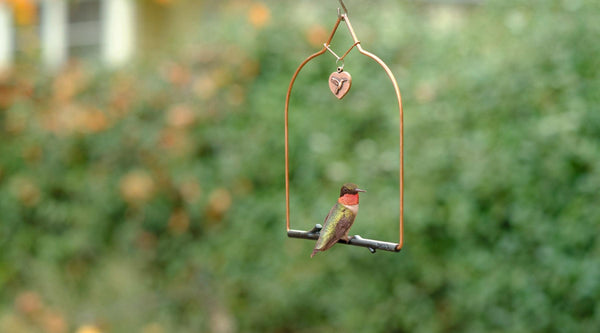
That's usually a resident claiming both the feeder and a nearby swing as its own guarded territory — and Rufous, arriving now, is famous for it. A second feeder and a second swing, spaced out of sight of each other, gives the incoming migrant its own station to guard instead of fighting over one.
Shop a second swing →The Year at a Glance
| Month | What's happening |
|---|---|
| January & February | Ruby-throated gone; Rufous wintering around Little Rock, with occasional Anna's and Black-chinned |
| March | First scouts mid-month; Hot Springs and Little Rock arrive in real numbers the last week; winter Rufous leave |
| April | Fayetteville fills in early in the month; the Delta reaches real numbers late; nesting begins |
| May | Spring high — about one in four birdwatchers statewide report one in the first week |
| June | The nesting lull. Quieter feeders, same number of birds |
| July | Fledglings out; more than half of Hot Springs birdwatchers seeing them by the third week |
| August | Northwest Arkansas peaks in the first week; Hot Springs reaches nearly two in three birdwatchers in the second |
| September | Busiest month statewide, peaking in the second week; Northwest Arkansas starts to leave by the fourth |
| October | Fayetteville empty by mid-month, Hot Springs by late month, Little Rock holding on. Wildflower planting month |
| November & December | Little Rock's last Ruby-throated leave in the first week of November as the first Rufous arrive; rarity season |
Frequently Asked Questions
When do hummingbirds come back to Arkansas?
The last week of March, starting around Hot Springs and Little Rock — with the very first scouts crossing the state line a week earlier than that. Fayetteville and Northwest Arkansas see their first birds in the first week of April and real numbers by the second. The Delta around West Memphis sees its first bird in late March too, but real numbers there take until late April. If you want one date to plan around, have a feeder out by mid-March anywhere in Arkansas.
When do hummingbirds leave Arkansas?
It depends on where you are, and the spread is two to three weeks. Northwest Arkansas is first: Fayetteville is nearly empty by the middle of October. Hot Springs and the Ouachitas follow in the last week of October. Little Rock is last, holding birds into the first week of November, with a straggler or two into late November. If you are anywhere in the state and still seeing hummingbirds on Halloween, you are most likely in central Arkansas.
How long do hummingbirds stay in Arkansas?
About seven months in central Arkansas — late March to early November around Little Rock — and closer to six and a half in Northwest Arkansas, where they arrive a week or two later and leave a few weeks earlier. That is the Ruby-throated season. If you count the winter Rufous around Little Rock, some part of Arkansas has a hummingbird in it nearly all year, with only a short gap in early-to-mid March when the last winter birds have left and the first summer birds are just arriving.
When should I put my hummingbird feeder out in Arkansas?
Mid-March, anywhere in the state. The first Ruby-throated are already moving through by the third week of March, and Hot Springs and Little Rock have them in real numbers by the last week. Being a week or two early costs nothing; being a week late costs you the first arrivals, and a feeder that is already out when a bird passes through is what turns a yard into a stop on the route.
When should I stop feeding hummingbirds in Arkansas?
Later than most people do. Leaving a feeder up does not hold birds back from migrating — that is driven by daylight, not by whether your feeder is full — and late birds moving through still need the fuel. Keep at least one feeder going through November. Around Little Rock, there is a real case for never taking it down: that is where Arkansas's winter Rufous are, and where most of the state's rarest hummingbirds have been found.
Do any hummingbirds stay in Arkansas for the winter?
Ruby-throated does not — the last leave central Arkansas in early November. But Rufous Hummingbird spends part of the winter in Arkansas most years, arriving as Ruby-throated is departing and staying into March, with sightings concentrated heavily around Little Rock. Anna's and Black-chinned have both wintered here in small numbers as well. None of these is a bird to expect at any given feeder, but a hummingbird in a central Arkansas yard in January is no longer a surprise to the people who track them.
Why We Built This Calendar
Pop's Birding has been helping hummingbird lovers for three generations, and one of the questions our customers ask most often is simply "when do they leave?" For Arkansas, almost every answer online gives a single date for the whole state. That is closer to right here than in a lot of states — the whole of Arkansas arrives within about two weeks — but it falls apart in the fall, when Northwest Arkansas is empty two to three weeks before Little Rock is. A single statewide departure date would have Fayetteville readers waiting on birds that have already gone, and Little Rock readers pulling feeders while birds are still coming through. We built a calendar that tells you the truth for where you actually live.
How We Built This Calendar
The timing on this page comes from ten years of eBird checklists (2016–2025) for Arkansas and four counties, one in each of the state's natural regions: Washington in the Ozarks, Garland in the Ouachitas, Pulaski in the Arkansas River Valley and Crittenden in the Delta. We checked rare species against the Arkansas Records Committee's review list and a 2023 survey in the Journal of the Arkansas Academy of Science. We only counted an arrival or departure once sightings held steady for several weeks, and because the Delta gets so few birdwatchers, we give it a range instead of a single week. The biggest finding: Arkansas arrives together but leaves apart, with Northwest Arkansas empty by mid-October while Little Rock holds birds into November.
Sources
- eBird bar chart data, Cornell Lab of Ornithology — Arkansas statewide and county-level (Washington, Garland, Pulaski, Crittenden), 2016–2025. Source for all seasonal timing and the regional arrival and departure pattern.
- Arkansas Records Committee, Rare Birds of Arkansas review list (Arkansas Audubon Society). Source for which hummingbird species are review species with ten or fewer state records, and for Rufous's status as a regular occurrence.
- Tumlison, R. and Kannan, R. (2023). "Rare Birds in Arkansas: Historical Observations and New Records." Journal of the Arkansas Academy of Science 77, Article 17. Source for the individual records of Broad-billed, Broad-tailed, Calliope, Black-chinned, Mexican Violetear, Rivoli's and Buff-bellied Hummingbirds in Arkansas.
- Tumlison, R. and Kannan, R. (2023). "New Species of Birds Reported in Arkansas Since 2009." Journal of the Arkansas Academy of Science 77, Article 16. Source for Arkansas's single Allen's Hummingbird record.
- des Lauriers, J. R. (1994). Hummingbirds eating ashes. The Auk, 111(3), 755–756. Documents five nesting female hummingbirds eating wood ash; no males were seen doing so in that study.
- Adam, M. D., & des Lauriers, J. R. (1998). Observations of hummingbirds ingesting mineral-rich compounds. Journal of Field Ornithology, 69, 257–261. Source for hummingbirds' greatly reduced medullary bone and for the mineral-rich materials they eat.
- Werning, S. (2018). Medullary bone is phylogenetically widespread and its skeletal distribution varies by taxon. Journal of Ornithology, 159, 527–543. Source for medullary bone being confirmed in hummingbirds.
- Arkansas Game and Fish Commission, Ruby-throated Hummingbird brochure (Free Publications). Source for Ruby-throated as the only hummingbird that nests in Arkansas and for the late-April-to-mid-August nesting window.
- Arkansas Natural Heritage Commission, A Study Guide for the Natural Divisions of Arkansas. Source for the Ozark, Ouachita, Arkansas River Valley and Mississippi Alluvial Plain divisions used to choose the four regions.
Know before they arrive
You don't have to keep this calendar taped to the fridge. Insider Birding Access members get seasonal notes timed to your region — when to have feeders out, what the birds are doing right now, and what's worth doing in your yard this season. We take the guesswork out of the calendar. Joining takes about thirty seconds, and there's 10% off your first order in it.
Join Insider Birding Access →Free to join. 10% off your first order.
Shop Arkansas's Hummingbird Favorites


Bethany Sloan has served as General Manager of Pop's Birding since 2010, continuing the legacy of her grandfather, William "Pops" Sloan, inventor of the Original Hummingbird Swing. A lifelong hummingbird enthusiast, educator, and independent researcher, she leads the company's educational content, including its 50-State Hummingbird Guide series, Regional Guide, Species Guide and Hummingbird Learning Center. Bethany combines scientific research, regional migration data, and more than 16 years of hands-on experience to create trusted educational resources for bird enthusiasts across North America.