Aug 21, 2026
Ruby-throated Hummingbird Migration & Range: The Gulf of Mexico Crossing
There's a bird barely outweighing a penny that will, this fall, fly nonstop across 500 miles of open ocean — no rest stops, no islands, just open Gulf of Mexico water the entire way — using nothing but fat reserves it built up in the two weeks before departure. That's the Ruby-throated Hummingbird's migration, and it's backed by real field research, not just a striking claim.
This guide covers where the Ruby-throated Hummingbird goes and when — the Gulf crossing itself, the region-by-region breakdown across all eight U.S. birding regions, and the conservation picture behind its numbers. Looking for a different species? Start with our full overview of hummingbird species found in the United States.
Quick answer: Ruby-throated Hummingbirds breed across virtually the entire eastern US, arriving as early as late February on the Gulf Coast and reaching northern New England by May. In fall, many fly nonstop across the Gulf of Mexico — up to 500 miles in 18 to 22 hours — after nearly doubling their body weight beforehand. Rare individuals also show up as far west as California and Washington most years.
Quick Facts
- Migration distance: many individuals travel over 3,000 miles round trip between the eastern US/Canada and Mexico/Central America
- The Gulf crossing: up to 500 miles nonstop over open water, roughly 18 to 22 hours under favorable conditions
- Pre-migration weight gain: nearly doubles its body weight in the 1–2 weeks before departure, going from about 3.25 g to 6 g
- Breeding range: the largest breeding range of any North American hummingbird species — nearly all of eastern Canada and the US east of roughly the 100th meridian
- Wintering range: primarily southern Mexico and Central America, south to Costa Rica and Panama; smaller numbers along the U.S. Gulf Coast and southern Florida
- Population: an estimated 36 million (Partners in Flight), rated 8 out of 20 on the Continental Concern Score
- Conservation status: Least Concern (IUCN Red List), though a 2021 analysis found the eastern population has been declining since roughly 2004
How the Gulf of Mexico Crossing Works
This is the single most remarkable fact about the Ruby-throated Hummingbird, and it's backed by real field research: in the one to two weeks before fall migration, the species enters a state called hyperphagia, feeding intensively enough to nearly double its entire body weight. The USDA Forest Service documents birds going from about 3.25 grams to 6 grams, storing visible bands of fat across the back, belly, and throat.
That stored fat fuels a genuinely extraordinary journey. Many individuals fly directly across the Gulf of Mexico — the Forest Service describes a nonstop flight of up to 500 miles over a period of 18 to 22 hours under favorable conditions. No rest, no food, no water, the entire way.
Just how much fuel do they carry? More than the crossing actually requires, it turns out. Theodore Zenzal Jr. and Frank Moore of the University of Southern Mississippi spent five fall seasons (2010–2014) at Bon Secour National Wildlife Refuge on the Alabama coast, banding and measuring roughly 2,700 Ruby-throated Hummingbirds as they staged for the crossing. Using each bird's fat load and wing measurements, they modeled how far it could theoretically fly without stopping: an average potential range of roughly 1,200 to 1,400 miles in still air, with the best-fueled individuals carrying enough for well over twice the crossing distance. Older birds and males came out ahead of younger birds and females.
It's worth being precise about what that number is and isn't. These are fuel-based estimates, not tracked flights — a 3-gram bird is far too small to carry a satellite transmitter, so no one has followed an individual across the Gulf. The estimates assume still air, and real Gulf conditions in autumn rarely oblige. What the research establishes is that a well-fueled Ruby-throat carries a comfortable margin over the crossing distance — which is exactly why fall feeding matters so much.
This is the exact window your feeder matters most. The one to two weeks before departure are when a Ruby-throat is trying to build the fat reserves described above — keep feeders full and nectar fresh through this stretch, and a second feeder spaced well apart from the first means more staging birds actually get to fuel up instead of just the one guarding the only station.
Not every bird takes the water route. Others follow a longer but safer overland alternative, skirting the western Gulf by following the Texas coastline south into Mexico. Zenzal and Moore found that older birds arrive at the coast earlier, in better condition, and with larger fuel loads than juveniles on their first migration — suggesting experience and body condition both shape what a given bird can attempt. A related 2018 study used stable-hydrogen isotope analysis of tail feathers to trace individual migrants back to their probable natal latitudes, confirming that hummingbirds from across the entire eastern breeding range funnel through the same Gulf Coast stopover sites in a chain migration pattern.
The risk is real. Ruby-throated Hummingbirds migrate during peak Atlantic hurricane season, and strong headwinds over open water can deplete fat reserves faster than a bird can replace them.
Key papers: Zenzal, T. J., Jr. & Moore, F. R. (2016). "Stopover biology of Ruby-throated Hummingbirds (Archilochus colubris) during autumn migration." The Auk: Ornithological Advances 133(2):237–250. — Zenzal, T. J., Jr., Contina, A. J., Kelly, J. F. & Moore, F. R. (2018). "Temporal migration patterns between natal locations of Ruby-throated Hummingbirds and their Gulf Coast stopover site." Movement Ecology 6:2.

How we made this map: each state's status is based on a decade of eBird observations, verified against state wildlife agencies and bird records committees. Darker shading marks where the species is reported more often. The four status tiers reflect whether Ruby-throated breeds, resides year-round, passes through, or turns up only rarely in each state.
Following the Ruby-throated Across the Regions
No other North American hummingbird passes through as much of the country as this one. All eight U.S. birding regions see Ruby-throats — as the breeding default across most of the East, and as a genuine (if rare) vagrant clear across the West. The calendar shifts by weeks as you move north through the breeding range, and the western regions are worth taking seriously even though the numbers there are small: this is the one species that turns "eastern hummingbird" into a nationwide identification question.

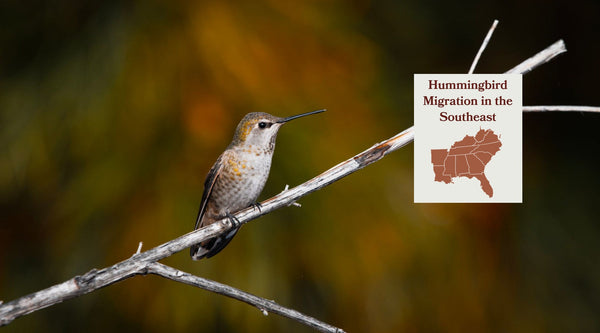
Gulf Coast arrivals in late February and early March are the first Ruby-throats of the year to reach the United States, many straight off a nonstop Gulf crossing. A handful of southeastern states also host a real, if modest, wintering population beyond just occasional stragglers — Florida, Georgia, Alabama, Louisiana, Mississippi, South Carolina, and North Carolina — the last of these backed by a dedicated winter-hummingbird research program running since 1999 that's banding-confirmed a real coastal wintering population in Dare County. Worth knowing before assuming every winter hummingbird here is a Ruby-throated that simply stayed put: banding studies at Gulf Coast winter sites have actually found Rufous Hummingbirds outnumbering Ruby-throated among wintering birds — this is a genuinely mixed-species phenomenon, not one bird choosing to skip migration. Florida nests in the north and center of the state, with a separate wintering population in the far south. Males arrive about a week ahead of females everywhere in the region.
Late Feb / early March means planting happens now, not then. If you want blooms already established when those first Gulf Coast arrivals show up, native wildflower seed needs to go in the ground this fall — most natives require a real winter chill to germinate, so seed sown after arrivals begin is already too late for that first wave.


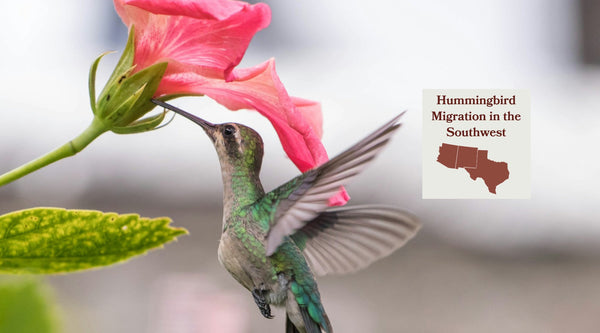
Birds that skip the Gulf crossing follow the Texas coast instead, which makes Texas a corridor as much as a destination — nearly all of its actual nesting happens in the eastern Pineywoods and coastal prairies, and the rest of the state sees Ruby-throats mostly in passing. New Mexico sees a real, recurring fall-only presence — New Mexico's own bird records committee calls it "a scarce, possibly regular, primarily fall transient," with zero accepted winter records. Arizona is rarer still — a handful of accepted records, genuinely worth noting rather than dismissing, but not an annual expectation the way New Mexico's fall pattern is.
Southwest guide →
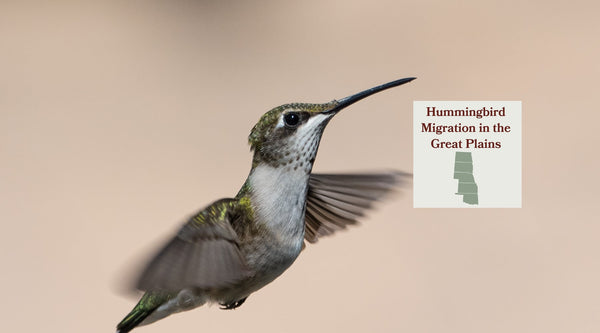
Ruby-throats breed east to roughly the 100th meridian and then stop along that remarkably straight north-south line. In practice that splits every state in the region: Kansas and Nebraska nest east of about their centers, the Dakotas in their eastern portions, and Oklahoma in its eastern half, where the far west belongs to the Black-chinned Hummingbird instead. Arrival runs mid-April in the south to May up north.
Great Plains guide →
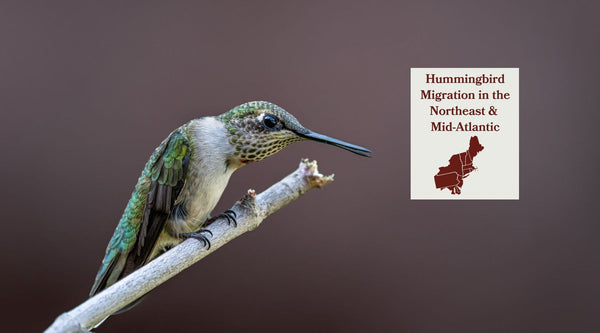
Maryland, Delaware, and Virginia see birds in April, but northern New England waits until May, giving those states the shortest breeding window of the entire range.
Northeast & Mid-Atlantic guide →
This far from the breeding range, every state here is a genuine rarity — but two have an actual recurring pattern rather than one-off records. Colorado has enough accepted records, clustering in late August and September, to represent a real recurring fall pattern rather than isolated vagrancy, and Montana shows a real 4-week window in the same late-summer stretch. Idaho, Nevada, Utah, and Wyoming each have only a handful of accepted records — Utah's own records committee specifically codes it "Accidental."
Mountain West guide →
Washington and Oregon both carry confirmed records, and both are equally stale — Washington's sole accepted record dates to 2017, while Oregon's three accepted records (2006, 2008, 2012) haven't been joined by a new one since, despite committee compilations checked as recently as 2025. Worth knowing this bird can theoretically appear here; not worth expecting it.
Pacific Northwest guide →
The most surprising entry on this map. California has 31 accepted records per the California Bird Records Committee's 49th annual report (covering records through 2022) — real, but scattered individuals, not a pattern worth planning around. Alaska is rarer still — the University of Alaska Museum's official state checklist codes it "Casual," meaning it turns up at irregular intervals but isn't annual, roughly the same tier as most of the other states in this section.
Pacific & West guide →Read the eastern regions in order and you're tracking one wave of birds moving north from February to May. The three western regions aren't part of that wave at all — they're the small number of individuals each year that end up somewhere no Ruby-throated Hummingbird is expected to be.
Ruby-throated Hummingbird by Region: Where and When to Find Them
Conservation: A Healthy Population With a Recent Warning Sign
The Ruby-throated Hummingbird is rated Least Concern on the IUCN Red List, and Breeding Bird Survey data show a steady long-term increase from 1966 through 2019. Partners in Flight estimates a healthy global population of 36 million, rating the species 8 out of 20 on the Continental Concern Score. But a 2021 analysis in Scientific Reports found the eastern population has been declining since roughly 2004 across most of its breeding range — so the long-term picture is strong while the recent trend bears watching.
That's a genuinely different conservation story than a species already in trouble. This is a common, healthy bird by any current measure — but "healthy today" and "trending downward for the past two decades" aren't contradictory, and it's worth tracking rather than assuming the long-term increase is still the whole picture.
Habitat
During the breeding season, Ruby-throated Hummingbirds favor deciduous and pine forests, forest edges, orchards, and gardens — anywhere offering a mix of nectar sources and suitable nesting cover, along with coasts and shorelines, shrublands, savannas, thickets, and urban and suburban habitats. In winter, the same birds shift into tropical deciduous forest and open, fairly dry tropical scrub, along with citrus groves, forest edges, hedgerows, river and marsh corridors, and old fields across their Mexican and Central American wintering range.
Frequently Asked Questions
How far do Ruby-throated Hummingbirds migrate?
Many travel over 3,000 miles round trip between breeding grounds in the eastern US and Canada and wintering grounds in Mexico and Central America, including a nonstop flight across the Gulf of Mexico of up to 500 miles that can take roughly 18 to 22 hours.
Do Ruby-throated Hummingbirds really fly across the Gulf of Mexico without stopping?
Yes, many of them do. No one has tracked an individual across the water — the birds are far too small to carry a transmitter — but researchers at the University of Southern Mississippi measured the fat loads of thousands of birds staging on the Alabama coast and calculated that an average well-fueled bird carries enough fuel for a potential nonstop flight of roughly 1,200 to 1,400 miles in still air, comfortably more than the crossing requires. Others take a longer overland route around the Gulf via the Texas coastline instead.
How do Ruby-throated Hummingbirds prepare for migration?
They enter a state called hyperphagia, nearly doubling their body weight in the one to two weeks before departure by feeding heavily on nectar and insects — going from roughly 3.25 grams to 6 grams — and storing the extra weight as fat.
Can Ruby-throated Hummingbirds show up in the western United States?
Yes, though rarely. Colorado and Montana see a genuine recurring fall pattern with dozens of accepted records between them, while California, Idaho, Nevada, Utah, Wyoming, Washington, and Alaska each have only a handful of confirmed records — real, but not something to expect in any given year.
Are Ruby-throated Hummingbird numbers going up or down?
It depends on the window. Breeding Bird Survey data show a steady long-term increase from 1966 through 2019, and Partners in Flight estimates a healthy global population of 36 million. But a 2021 analysis in Scientific Reports found the eastern population has been declining since around 2004 across most of its breeding range — so the long-term picture is good while the recent trend bears watching.
Why We Created This
Pop's Birding is a third-generation, Idaho-based family business that invented the hummingbird swing. One of the questions our customers ask us most often is "when will I actually see a Ruby-throated Hummingbird where I live?" Most migration content on this species stops at "it's the eastern hummingbird" and treats the West as irrelevant. We built the full eight-region breakdown — including the rare-but-real western presence — specifically because "irrelevant" isn't accurate: this bird has confirmed, cited records in every state in the country, and a reader in Colorado or Washington deserves an honest answer, not silence.
How We Created This
Every population, migration, and range figure on this page is checked directly against its primary source — the actual peer-reviewed paper, government agency page, or state bird records committee, not a secondhand summary. State-by-state range claims are cross-checked against our own verified species-status data, built from named records committees for every state rather than composite eBird data alone, so the narrative text and the underlying classification stay consistent with each other.
Looking for the rest of the picture on this bird? See our Identification guide and Behavior & Family guide, or browse every species in our full U.S. hummingbird guide. At Pop's Birding, we believe every backyard — big or small — has room for a little more wonder. Explore our feeders, nectars, swings, and wildflower seed blends to start building your own hummingbird sanctuary today.

Bethany Sloan has served as General Manager of Pop's Birding since 2010, continuing the legacy of her grandfather, William "Pops" Sloan, inventor of the Original Hummingbird Swing. A lifelong hummingbird enthusiast, educator, and independent researcher, she leads the company's educational content, including its 50-State Hummingbird Guide series, Regional Guide, Species Guide and Hummingbird Learning Center. Bethany combines scientific research, regional migration data, and more than 16 years of hands-on experience to create trusted educational resources for bird enthusiasts across North America.