Aug 21, 2026
Ruby-throated Hummingbird Behavior: Diet, Courtship, Nesting & Family
Ruby-throated Hummingbirds live almost entirely alone. They migrate alone, feed alone, and — for males — take no part whatsoever in nesting or raising young once mating is over. That solitary, endlessly territorial temperament is the thread running through everything this bird does: how it eats, how it courts, and how it defends a feeder against birds many times its own size.
This is the guide to everything that isn't about identifying the bird or tracking its migration — the diet, the courtship, the nesting, and the one relative this species calls family. Looking for a different species entirely? Start with our full overview of hummingbird species found in the United States.
Quick answer: Ruby-throated Hummingbirds are solitary and fiercely territorial, feeding on nectar plus small insects and spiders for protein. Females handle nest-building and raising young entirely alone. They belong to the genus Archilochus, alongside just one other species — the Black-chinned Hummingbird — and both use torpor to survive cold nights and bank fat for migration.
Quick Facts
- Typical wild lifespan: most live only a few years; the oldest known individual was a female of at least 9 years, 2 months, recaptured in West Virginia in 2014
- Clutch size: 2 pea-sized eggs, incubated 12–16 days
- Nestling period: 18–23 days typically, though it can stretch from 14 to 31 days depending on food availability
- Diet: nectar from red or orange tubular flowers, plus insects and spiders for protein
- Claim to fame: lives an almost entirely solitary life — no flocking, no pair bond beyond mating, no male involvement in raising young
Behavior: Solitary, Territorial, and Endlessly Busy
Ruby-throated Hummingbirds are solitary for virtually their entire lives outside of the brief mating encounter — they migrate alone, feed alone, and, for males, take no part whatsoever in nesting or raising young. Both sexes fiercely defend feeding territories, chasing off rivals, insects, and birds many times their own size from a favored patch of flowers or a feeder. Males will aggressively defend territory not just from other hummingbirds but from other bird species, bees, and wasps alike.

Feeding and Diet
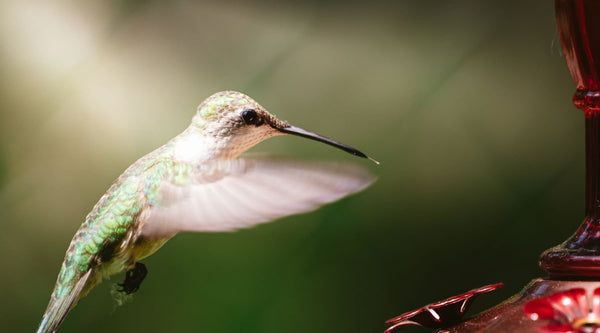
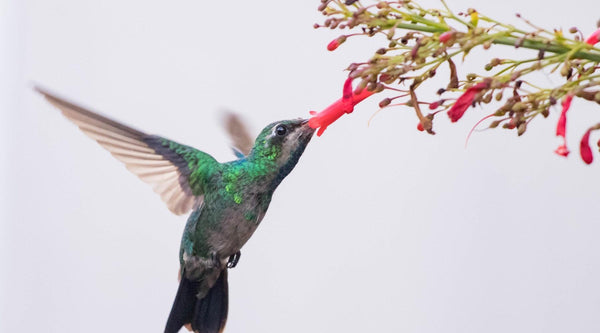
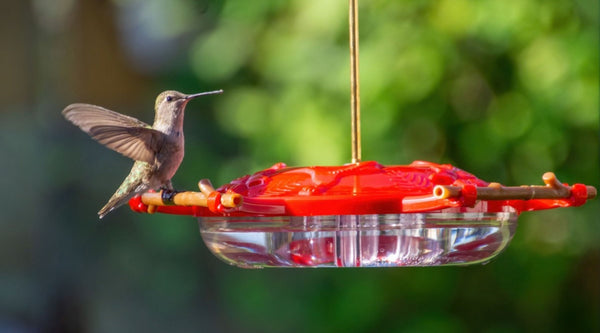
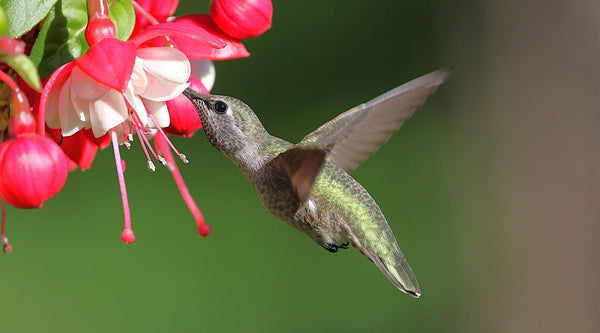
Ruby-throated Hummingbirds feed on the nectar of red or orange tubular flowers — trumpet creeper, cardinal flower, honeysuckle, jewelweed, bee balm, red buckeye, and red morning glory are all favorites — as well as feeders and, occasionally, tree sap.
Insects and spiders are just as essential to the diet as nectar, supplying protein nectar alone can't provide. Main prey includes mosquitoes, gnats, fruit flies, small bees, and spiders, caught either mid-air, gleaned directly from foliage, or pulled straight out of spider webs. Ruby-throated Hummingbirds will also visit sap wells drilled by Yellow-bellied Sapsuckers, picking off both the sap itself and the insects it attracts — an important food source for early spring migrants arriving before most flowers have opened.

Courtship and Mating
Males typically arrive at breeding grounds 7 to 10 days before females, immediately establishing and defending a territory. When a female enters that territory, the male performs an elaborate courtship display: a looping, U-shaped dive starting from as high as 50 feet above her, followed by shorter horizontal passes flown directly in front of her, flashing his red gorget with each pass. The display is accompanied by an audible whirring produced by the bird itself — unlike western species such as Anna's and Black-chinned, where the dive sound has been traced to specially modified tail feathers, that mechanism hasn't been demonstrated in Ruby-throated.
Mating is brief, and the male's involvement ends there entirely — females handle every subsequent stage, from nest-building through raising the young, entirely alone. Males typically go on to mate with multiple females across a single breeding season.

Nesting and Raising Young
Females alone select the nest site, build the nest, incubate the eggs, and raise the young. Favored sites are a slender, often descending branch of a deciduous tree — oak, hornbeam, birch, poplar, or hackberry are all documented choices, sometimes pine — usually 10 to 40 feet above the ground, though nests have also turned up on unlikely human-made supports like loops of chain, wire, and extension cords. The nest is often placed over a stream or another opening.
The nest itself is a real engineering feat: a walnut-sized cup about 2 inches across and 1 inch deep, with an inner cup roughly the size of a large thimble. It's built from thistle or dandelion down held together with spider silk and sometimes pine resin, and it sits directly on top of the branch rather than in a fork. The female stamps on the base to stiffen it and shapes the rim by pressing and smoothing it between her neck and chest — but the walls stay pliable, which is what lets the whole structure stretch as the chicks grow. Construction takes 6 to 10 days, and she finishes by decorating the exterior with bits of lichen and moss.
Clutch size is two pea-sized eggs, rarely one or three. She lays the first egg, then typically waits a day before laying the second, with incubation beginning only once both are laid. Incubation lasts 12 to 16 days per Tennessee Wildlife Resources Agency (Cornell's own figure runs slightly narrower, 12 to 14 days), and hatchlings emerge with their eyes closed and naked apart from two small tracts of gray down along the back — under an inch long and entirely helpless.
The nestling period normally runs 18 to 23 days per Tennessee Wildlife Resources Agency (Cornell gives a slightly narrower 18 to 22 days), though TWRA notes it can stretch anywhere from 14 to 31 days depending on food availability. By the time they leave, the young are noticeably larger than their mother, and she keeps feeding them for another ten days or so. Females in the southern US may raise one or two broods, occasionally three, sometimes starting a second nest while still feeding chicks from the first; females farther north typically have time for only one brood before migration season arrives.

Meet the Family: The Black-chinned Hummingbird
The Ruby-throated Hummingbird was formally described for science in 1758 by Carl Linnaeus himself — the Swedish naturalist who created the entire system of binomial nomenclature still used to name species today. In the tenth edition of his landmark work Systema Naturae, Linnaeus classified the species as Trochilus colubris, basing his description on two earlier accounts: naturalist Mark Catesby's The Natural History of Carolina, Florida and the Bahama Islands (1729) and George Edwards's A Natural History of Uncommon Birds (1743). The species name colubris comes from colibrí, the Spanish word for "hummingbird" — itself thought to derive from a Carib or Galibi word carried back to Europe from the Caribbean.
Nearly a century after Linnaeus, in 1854, German naturalist Ludwig Reichenbach moved the species into a new genus, Archilochus, where it remains today alongside its only congener and closest relative, the Black-chinned Hummingbird — the western counterpart to this bird in almost every sense. Between them, the two species divide most of North America: Ruby-throated across the East, Black-chinned across the West, meeting only in a narrow overlap zone centered on central Texas.

Torpor: Nightly Survival Mode — and a Migration Strategy
Like other hummingbirds, Ruby-throated Hummingbirds can enter torpor: a dramatic, controlled drop in both body temperature and metabolic rate that carries them through cold nights and lean stretches. The numbers are startling. A 2024 study in the Journal of Experimental Biology measured torpid Ruby-throats whose body temperature fell by nearly 25°C — from roughly 37°C down to about 13°C — while whole-animal metabolic rate dropped by 95%. That's a bird running at one-twentieth of its normal energy burn, essentially idling until sunrise.
The more surprising finding is that torpor isn't only an emergency measure. A 2021 study in eLife (Eberts, Guglielmo & Welch) tracked captive Ruby-throated Hummingbirds across a full summer and found the rules change as fall approaches. In midsummer, birds went torpid when they went to sleep with low fat stores — classic survival behavior. By late summer, the same birds were entering torpor on a consistent schedule and with high fat stores, and the more time they spent torpid, the more fat they gained. As migration nears, torpor flips from a way to survive the night into a way to bank fuel for the Gulf crossing.
Which is a useful thing to know if you keep a feeder: the calories a Ruby-throat takes on at your yard in August aren't just getting it to morning. They're going into the tank.
Key papers: Hutchinson, A. J., Staples, J. F. & Guglielmo, C. G. (2024). "The mitochondrial physiology of torpor in ruby-throated hummingbirds, Archilochus colubris." Journal of Experimental Biology 227(21):jeb248027. — Eberts, E. R., Guglielmo, C. G. & Welch, K. C. (2021). "Reversal of the adipostat control of torpor during migration in hummingbirds." eLife 10:e70062.
This bird's real story is the migration, not conservation concern. Ruby-throated Hummingbirds are common and Least Concern overall — but a nonstop 500-mile crossing of the Gulf of Mexico, fueled entirely by fat reserves built in the two weeks before departure, is the reason this species gets its own chapter in hummingbird research. That full story lives on our Migration & Range guide.
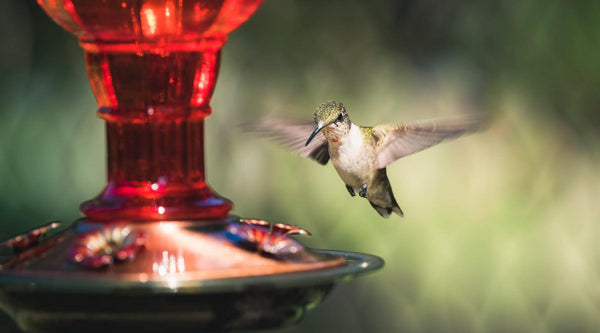
Given how much fat-building a Ruby-throated Hummingbird has to do — nearly doubling its body weight before migration — a reliable feeder is a genuine contribution, not just a nice-to-have. A leak-proof feeder with a comfort perch lets a territorial bird feed without spending extra energy hovering, and Pop's Nectar supports exactly the kind of intense energetic demand this species faces every fall. Skip the insecticide, too — insects and spiders are a critical part of this bird's diet, not an occasional snack.
Frequently Asked Questions
Why are Ruby-throated Hummingbirds so territorial?
They live almost entirely solitary lives — no flocking, minimal social contact beyond a brief mating encounter — and fiercely defend feeding territories against rivals, other bird species, bees, and wasps alike. With no partner to share resources, a defended patch of flowers or a feeder is the difference between having enough fuel and not.
What does a Ruby-throated Hummingbird eat?
Mostly nectar from red or orange tubular flowers like trumpet creeper, cardinal flower, and bee balm, supplemented with insects and spiders — mosquitoes, gnats, fruit flies, small bees — caught in the air, gleaned from foliage, or pulled from spider webs.
How long do Ruby-throated Hummingbirds live?
Most live only a few years, but the oldest known individual was a female of at least 9 years, 2 months old, recaptured and rereleased during banding operations in West Virginia in 2014.
Is the Ruby-throated Hummingbird related to other hummingbirds I might see?
Yes — its only close relative is the Black-chinned Hummingbird, the western counterpart that shares its genus, Archilochus. Their ranges meet in a narrow overlap zone centered on central Texas.
What is torpor, and why does it matter for this species?
Torpor is a controlled overnight drop in body temperature and metabolic rate that saves energy on cold nights. For Ruby-throated Hummingbirds, research shows it does double duty: an emergency energy-saving measure in summer, and a way to actively bank fat for migration as fall approaches.
Why We Created This
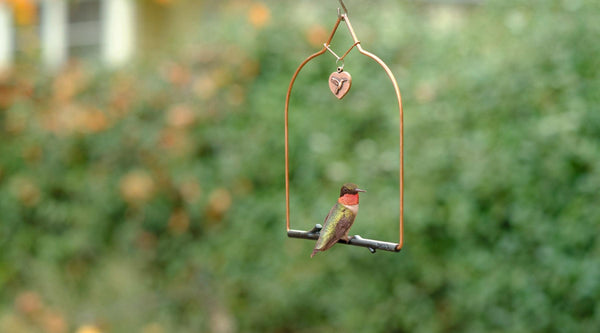
Pop's Birding is a third-generation, Idaho-based family business that invented the hummingbird swing. One of the questions our customers ask us most often is some version of "why won't this hummingbird share the feeder with anything?" — along with the diet, nesting, and family-tree questions that don't fit naturally into an identification or migration page. We built this guide to answer those directly, with real sourcing behind the behavior claims.
How We Created This
Every behavior on this page is checked against original research and named agency sources, not repeated from generic field-guide summary language. The torpor section in particular draws on two separate peer-reviewed studies — one on the physiological mechanism, one on how that mechanism's use changes seasonally — rather than treating torpor as a single undifferentiated fact.
Looking for the rest of the picture on this bird? See our Identification guide and Migration & Range guide, or browse every species in our full U.S. hummingbird guide. At Pop's Birding, we believe every backyard — big or small — has room for a little more wonder. Explore our feeders, nectars, swings, and wildflower seed blends to start building your own hummingbird sanctuary today.

Bethany Sloan has served as General Manager of Pop's Birding since 2010, continuing the legacy of her grandfather, William "Pops" Sloan, inventor of the Original Hummingbird Swing. A lifelong hummingbird enthusiast, educator, and independent researcher, she leads the company's educational content, including its 50-State Hummingbird Guide series, Regional Guide, Species Guide and Hummingbird Learning Center. Bethany combines scientific research, regional migration data, and more than 16 years of hands-on experience to create trusted educational resources for bird enthusiasts across North America.