Aug 24, 2026
Hummingbirds in Washington: The Complete Guide to All 9 Species
Washington's nine documented hummingbird species tie the state with Oregon for the most in the Pacific Northwest — well ahead of Idaho's six, though still short of California's eleven. That's a genuinely diverse list for a state most people associate with just one backyard bird, and it includes a real split most guides gloss over: four species you can actually expect to see, and five that show up so rarely they're each backed by a specific, named accepted record.
For when each species shows up through the year, see our Washington hummingbird calendar; for feeder setup and attracting them to your yard, see how to attract hummingbirds in Washington.
Free download
All 9 species, one page
Every Washington hummingbird species with its status — from Anna's, present all year, down to the state's five documented one-off rarities.
Download the Washington species guideOne page · PDF · free to print and share

All 9 documented Washington hummingbird species, grouped by tier — statewide eBird data, 2016–2025, cross-checked against the Washington Bird Records Committee's own accepted-record history.
The Hummingbirds You're Most Likely to See
Anna's Hummingbird Resident
Anna's is Washington's only true year-round resident hummingbird, and by a wide margin its most common — a statewide peak frequency of 34%, more than double every other species on this list combined. Seattle Audubon's BirdWeb dates the state's first confirmed breeding record to 1976, in Tacoma; the species has since spread through the lowlands of southeastern Puget Sound and continues expanding into eastern Washington via community-science reporting. If you keep a feeder up through a Puget Sound winter, this is almost certainly the bird visiting it — it's the only Washington hummingbird equipped to do that at all.

Quick ID: Males show an iridescent rose-pink to magenta crown and throat together — the only Washington hummingbird with a colored crown, not just a colored throat. Both sexes have a stocky build and a mostly green back.

An Extra Feeder for Your Year-Round Resident
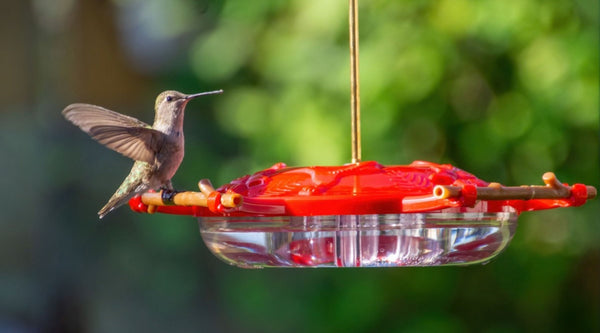
Anna's is the only Washington hummingbird holding down a yard through the winter, and freezing temperatures can turn a single feeder unreliable overnight. A second AspenPerch Feeder gives your resident a backup station, and one that's easier to keep from icing over closer to the house.
Shop AspenPerch® Feeder →Rufous Hummingbird Breeds Here
Rufous is Washington's common summer breeder — BirdWeb calls it flatly a "common summer resident," arriving late February to early March and departing late July through September, with most gone by August. This is a real, verified correction from an earlier internal classification: Rufous had briefly been mistiered as a year-round resident based on a misread of population turnover through the season, but BirdWeb's own month-by-ecoregion table shows November, December, and January blank across all nine Washington ecoregions — the only near-winter entry statewide is a single "rare" designation for February in the Puget Trough. Among Washington's hummingbirds, only Anna's genuinely overwinters here.

Quick ID: Adult males are almost entirely rufous-orange on the back, tail, and flanks, with an iridescent orange-red throat. Females and immatures are green-backed with a rufous wash on the flanks and tail base — and genuinely difficult to separate from female Allen's without care.
Black-chinned Hummingbird Breeds Here
Black-chinned is Washington's least common regular breeder. BirdWeb is explicit about this ranking, and about where to actually find one: east of the Cascades at low elevations, in the steppe and Ponderosa pine zones, with the highest concentrations around Spokane and the Turnbull National Wildlife Refuge in Spokane County. It nests low — typically three to ten feet up in a tree fork, often directly over a small creek bed. A confirmed breeding range extending north into southern British Columbia is consistent with a real eastern Washington population rather than an edge-of-range fluke.

Quick ID: Males show a black throat with just a thin iridescent purple band at the very bottom — often looking entirely black unless the light hits it right. Overall plumage is plain green-and-white, the least flashy of Washington's regular breeders.
Calliope Hummingbird Breeds Here
North America's smallest breeding bird, and a genuine Washington mountain specialist. BirdWeb places most breeders in the Ponderosa pine zone, in mixed brushland, forest edges, and open woodland, with a small outlying western-Cascades population along the upper Skagit River near Newhalem. The Washington Department of Fish and Wildlife's own species page documents breeding-range sightings in the Blue Mountains near Walla Walla, the Wells Wildlife Area, and around Leavenworth in Chelan County — a species that survives and breeds successfully in genuinely chilling high-elevation northwestern environments.

Quick ID: North America's smallest bird species. Males show streaky magenta rays on a white throat rather than a solid gorget — unique among Washington's hummingbirds — and a short tail that doesn't extend past the wingtips at rest.

A Little Throne for Washington's Regulars
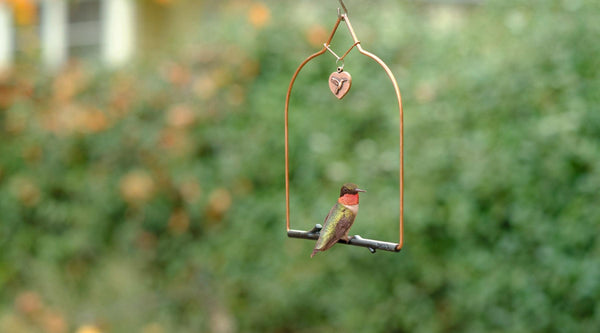
Anna's, Rufous, Black-chinned, and Calliope all need a place to perch and hold territory between visits to the feeder — especially with four species sometimes sharing the same yard. A Charm Redwood Swing gives your regulars somewhere to rest and defend without crowding the feeder itself.
Shop Charm Redwood Swing →Washington Hummingbirds in Winter
Once Rufous, Calliope, and Black-chinned head south for the season, Washington's hummingbird story doesn't end — it just narrows to a single species. Only Anna's Hummingbird stays through the cold months, and it does so as a genuine non-migratory resident, not a handful of late stragglers. If you see a hummingbird at a Washington feeder in December, it's Anna's — nothing else on this state's list is built for that.
If You're Lucky: The Pacific Northwest Rarities
Costa's Hummingbird Rare / Casual Visitor
Costa's is the one genuine exception among Washington's five rare species — not a one-off, but a real, if infrequent, recurring vagrant. The Washington Bird Records Committee has accepted 18 records through November 2025, all dating from 1989 onward, with roughly annual activity in the most recent five years. The eBird signal behind that number resolves almost entirely (98.6%) to a single returning bird at a private yard in Ellensburg, Kittitas County — first present in June 2021, returning again in April–June 2022 — a textbook example of one known individual driving a statistic that looks, at a glance, like a small population. Washington remains on the WBRC's active review list; Oregon, by contrast, is no longer a review species there, with over 40 records and a confirmed breeding record, which is part of why Washington's status still reads as genuinely rare rather than an emerging population.

Quick ID: Males show an extensive violet-purple crown and throat with long gorget feathers that flare out past the sides of the neck like a mustache. Build is stockier and shorter-tailed than Black-chinned.
Ruby-throated Hummingbird Historic / Accidental
Washington's only accepted Ruby-throated record is a single bird photographed at Ridgefield, Clark County, October 24–25, 2017 — the WBRC's most recent full checklist review, current through November 2025, confirms nothing has been added since. An earlier 1992 Kittitas County claim was formally reviewed and not accepted. This eastern species has no business in the Pacific Northwest under normal circumstances, and the record is treated accordingly — a genuine, single, well-documented accidental, not the start of a pattern.

Quick ID: Males have an iridescent red throat (looks black without direct light) and an entirely green back with no rufous coloring anywhere — that total absence of rufous is the key separator from every species Washington actually expects.
Broad-tailed Hummingbird Historic / Accidental
Four accepted Washington records exist for Broad-tailed, all clustered between 2000 and 2005 in the state's southeastern corner — Asotin and Walla Walla counties — consistent with edge-of-range overshoot from the established Idaho/Oregon Blue Mountains breeding population just across the border, rather than any Washington breeding presence of its own. Nine additional historical reports, mostly from the Spokane area, were reviewed and not accepted. Nothing has been recorded since 2005.

Quick ID: Males show a rose-pink throat similar to Anna's but with a green crown, not pink. In flight, their wings produce a distinctive high, metallic trilling sound unlike any other Washington species.
Allen's Hummingbird Historic / Accidental
Washington's two accepted Allen's records are both 19th-century: Fort Steilacoom, Pierce County, in 1856, and a specimen collected in Seattle in 1894. Every modern-era report since — including sightings in 2009 and 2017 — has been reviewed and not accepted, and for a specific, honest reason worth stating plainly: Allen's is genuinely difficult to separate from Rufous Hummingbird in the field, especially in female and immature plumage, and neither modern report cleared that identification bar. This is the same field-mark limitation several state records committees recognize formally — it isn't a knock on the observers, it's a real constraint of the birds themselves.

Quick ID: Nearly identical to Rufous. Adult males can be separated by a green back (Rufous shows rufous-orange), but females and immatures are essentially inseparable in the field without a bird in hand.
Broad-billed Hummingbird Historic / Accidental
Washington's only Broad-billed record — and the record that added the species to the state's official checklist at all — is an immature male photographed at Carson, Skamania County, October 25–26, 2014. Nothing has been recorded since. This is a Mexico-and-southwest-borderlands species with no expected presence this far north or west; the 2014 bird was a genuine, well-documented one-off.

Quick ID: A coral-red bill with a black tip sets this species apart from every other Washington hummingbird at a glance. Males show a glittering blue-green throat and body.
Give Every Visitor a Reason to Stay
Costa's, Ruby-throated, Broad-tailed, Allen's, and Broad-billed are Washington's five rare species — one genuine recurring vagrant and four single-record accidentals. Nectarlyte's electrolytes and calcium give whichever one shows up a real reason to linger long enough to be documented, and a real wildflower planting gives it a reason to come back.


Washington Hummingbirds at a Glance

Statewide eBird data, 2016–2025 (Cornell Lab of Ornithology). Also documented but too rare to chart reliably: Allen's, Broad-billed, Broad-tailed, Costa's, and Ruby-throated Hummingbird — see each species' Washington Bird Records Committee history below.
| Species | Status | Washington Records |
|---|---|---|
| Anna's Hummingbird | Year-Round Resident | Statewide peak 34%; only species present in winter |
| Rufous Hummingbird | Breeding | Statewide peak 16%; arrives late Feb, gone by September |
| Calliope Hummingbird | Breeding | Statewide peak 2.6%; Ponderosa pine highlands, mainly east of the Cascades |
| Black-chinned Hummingbird | Breeding | Statewide peak 2.4%; least common regular breeder, concentrated near Spokane |
| Costa's Hummingbird | Rare/Casual | 18 accepted records through Nov 2025, roughly annual since 2021 |
| Ruby-throated Hummingbird | Historic/Accidental | 1 accepted record — Ridgefield, Clark Co., Oct 2017 |
| Broad-tailed Hummingbird | Historic/Accidental | 4 accepted records, 2000–2005, none since |
| Allen's Hummingbird | Historic/Accidental | 2 accepted records, both 19th-century (1856, 1894) |
| Broad-billed Hummingbird | Historic/Accidental | 1 accepted record — Carson, Skamania Co., Oct 2014 |
Frequently Asked Questions
How many species of hummingbirds are in Washington?
Nine, per the Washington Bird Records Committee's accepted-record history and statewide eBird data: four you can realistically expect to see (Anna's, Rufous, Calliope, and Black-chinned) and five documented only as rare, one-off, or historic records (Costa's, Ruby-throated, Broad-tailed, Allen's, and Broad-billed).
What is the most common hummingbird in Washington?
Anna's Hummingbird, by a wide margin — a statewide peak frequency of 34%, more than double every other species combined, and the only one present through the winter.
Do hummingbirds stay in Washington all winter?
Only Anna's Hummingbird does. It's a genuine year-round, non-migratory resident, concentrated in western Washington's lowlands. Every other species on the state's list migrates out by fall.
Can you see a Rufous and an Allen's Hummingbird in Washington?
Rufous, regularly — it's one of the state's four common breeders. Allen's Hummingbird is a genuine rarity, with only two accepted Washington records, both from the 1800s, and every modern report since has failed identification review specifically because Allen's is extremely difficult to distinguish from Rufous in the field without a bird in hand.
Why We Created This Guide
Pop's Birding has been helping hummingbird lovers for three generations. One of the questions our customers ask most often is "what hummingbirds am I actually looking at?" — we built this guide to give a direct, sourced answer, not a generic one. Most hummingbird content treats every state's list the same way, listing species without distinguishing a bird you'll see every summer from one documented exactly once in over a century. Washington's list needed that distinction more than most: five of its nine species are single-digit-record rarities, and lumping them in with Anna's and Rufous would badly overstate how likely you are to see one.
How We Created This Guide
We started with statewide eBird bar chart data from the Cornell Lab of Ornithology, covering 2016 through 2025, cross-checked against the Washington Bird Records Committee's full accepted-record history through its November 2025 checklist update. Since raw weekly numbers can make one well-documented bird look like a broader pattern, we checked every species clearing measurable statewide frequency for multi-year recurrence rather than single-season clustering — that's how Costa's Hummingbird's 18 accepted records, which looked at a glance like a modest population presence, turned out to resolve almost entirely to one returning individual at a single Ellensburg yard. Only species with real, measurable statewide signal are plotted on the frequency chart; Washington's five rare species either sit at the practical measurement floor or produced no statewide eBird signal at all in this window, and the chart's caption says so rather than omitting them silently.
Sources
- eBird bar chart data, Cornell Lab of Ornithology — Washington statewide, 2016–2025.
- Washington Bird Records Committee, Washington Ornithological Society — source for every rare-species record count and status on this page.
Know before they arrive
You don't have to keep this calendar taped to the fridge. Insider Birding Access members get seasonal notes timed to your region — when to have feeders out, what the birds are doing right now, and what's worth doing in your yard this season. We take the guesswork out of the calendar. Joining takes about thirty seconds, and there's 10% off your first order in it.
Join Insider Birding Access →Free to join. 10% off your first order.
Shop Washington's Hummingbird Favorites


Bethany Sloan has served as General Manager of Pop's Birding since 2010, continuing the legacy of her grandfather, William "Pops" Sloan, inventor of the Original Hummingbird Swing. A lifelong hummingbird enthusiast, educator, and independent researcher, she leads the company's educational content, including its 50-State Hummingbird Guide series, Regional Guide, Species Guide and Hummingbird Learning Center. Bethany combines scientific research, regional migration data, and more than 16 years of hands-on experience to create trusted educational resources for bird enthusiasts across North America.