Aug 09, 2026
Hummingbirds in Pennsylvania: The Complete Guide to All 8 Species
Pennsylvania's hummingbird checklist runs to eight species — one dependable breeder, one regular fall visitor, and six genuine rarities, two of which sit at the center of one of the hardest identification problems in North American birding. Pennsylvania is one of the few eastern states where a birder might genuinely need to separate Ruby-throated from Black-chinned, or wrestle with the notoriously difficult Rufous-versus-Allen's problem that even licensed banders sometimes can't resolve without the bird in hand.
Free download
All 8 species, one page
This page covers every hummingbird confirmed in Pennsylvania, rarities included. The printable species guide is the practical companion — every species, its status, and how many records it has on file, sorted by how likely you are to actually see it.
Download the Pennsylvania species guideOne page · PDF · free to print and share

All 8 documented Pennsylvania hummingbird species, grouped by tier — cross-checked against the Pennsylvania Ornithological Records Committee's official state list and Review List, revised 2024-2025.
The Hummingbird You're Most Likely to See
Ruby-throated Hummingbird Breeds Here
Pennsylvania's only officially native hummingbird, and the only established breeding hummingbird anywhere east of the Great Plains. The Pennsylvania Game Commission confirms it breeds statewide, with males defending territories of about a quarter acre each.
Pennsylvania's season runs unusually late for a Mid-Atlantic state — the statewide peak lands in the first week of September at nearly 34% of checklists, driven as much by fall migrants passing through as by local breeders. Where you are matters: arrival doesn't run south-to-north the way you'd expect. Philadelphia and the Poconos see first arrivals in the same week, while Pittsburgh and Erie in the west lag about a week behind. See the Pennsylvania hummingbird calendar for the full regional breakdown.

Quick ID: An emerald or golden-green back and crown over grayish-white underparts identify both sexes; adult males add a brilliant iridescent ruby-red throat that can look flat black until light hits it, and a dark, forked tail. Females and immatures carry a plain whitish throat and a rounded, black-and-white-banded tail — no red at all.

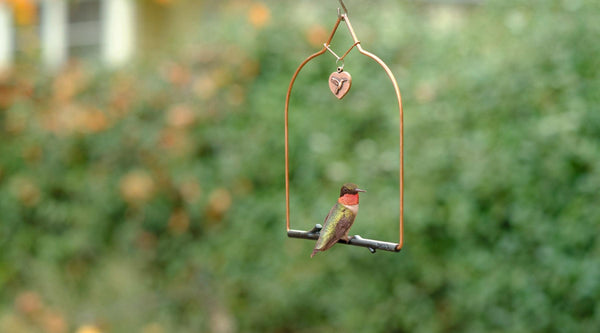
A Little Throne for Your Ruby-throated
Pennsylvania's Ruby-throated males spend the whole breeding season defending a quarter-acre territory. Give yours a favorite perch to watch it from, right beside the feeder he's already claiming.
Shop Charm Redwood Swing →Ruby-throated vs. Black-chinned: Where Identification Actually Breaks Down
Adult male Ruby-throated and Black-chinned Hummingbirds are usually easy to tell apart in good light — one shows a red gorget, the other a black one edged in violet-purple. But females and immatures of the two species are close to identical in the field. The one reliable field mark on a perched bird is wing-to-tail proportions: Ruby-throated has a longer tail that extends visibly past the wingtips at rest, while Black-chinned has longer wings that reach the tip of the tail or extend just slightly beyond it. Some birders also watch for tail-pumping — Black-chinned habitually pumps its tail while hovering, Ruby-throated tends to hold its tail still.

Black-chinned is a genuine but accidental Pennsylvania record — see below for the details — so an unusual-looking female hummingbird here is worth a second look, even though Ruby-throated remains the far more likely explanation by a wide margin.
Pennsylvania's Fall and Winter Visitor
Rufous Hummingbird Migrant/Winter
A fiery orange western species that turns up most years, mostly October through December, occasionally with a real presence lingering into January. It's regular enough that the Pennsylvania Ornithological Records Committee (PORC) classifies it as Regular rather than a species requiring documentation for every report. If a hummingbird shows up at your feeder in November, there's a real chance it's this species rather than a lingering Ruby-throated — statewide activity peaks in the third week of November.
Adult males are unmistakable — fiery coppery-orange overall with an iridescent orange-red throat — and famously aggressive, chasing off other hummingbirds regardless of size difference. Females and immatures are trickier: green-backed above, with rufous-washed flanks and a rusty patch at the base of the tail.

Quick ID: Adult males are almost entirely coppery-orange with a glowing orange-red throat, and the only largely rufous-backed hummingbird in North America; females and immatures are green-backed with rufous-washed flanks.

An Extra Feeder for Your Rufous
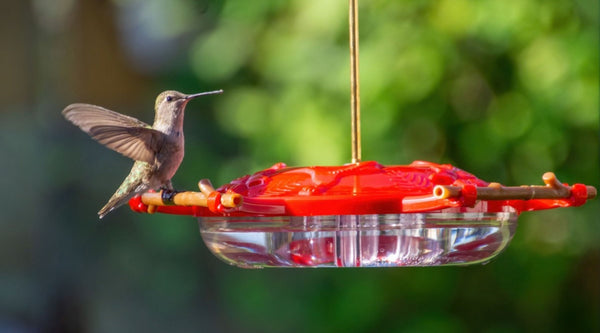
A Rufous showing up in October or November won't share a feeder with anything else, Ruby-throated included. A second feeder well away from the first gives both birds a station of their own.
Shop AspenPerch Feeder →Rufous vs. Allen's: A Problem Even Banders Struggle With
This is Pennsylvania's hardest identification call, and it's worth understanding why rather than guessing. Adult male Allen's shows a bronze-green back against a coppery tail, eye patch, and belly, while adult male Rufous is typically solid copper overall — but a meaningful minority of male Rufous also show green backs, which wipes out that shortcut for many birds. A more useful rule of thumb: if the back is less than half green, it's almost certainly Rufous.
Beyond that, it gets genuinely difficult. Females and immatures of the two species are close to identical by eye. Pennsylvania's own bird records journal is direct about the practical implication: unless a bird shows a completely solid orange back, positively distinguishing Rufous from Allen's can only be done through a thorough, in-hand examination by a licensed bander measuring specific feather and wing dimensions. Sight-only reports of either species, absent that solid-color field mark, are properly called "Rufous/Allen's-type" rather than assigned to a species.
Pennsylvania's own accepted Allen's records include a 2012 Bucks County bird, initially assumed to be a Rufous when it arrived, that was banded and correctly identified as the state's third record. If you're hosting an unusually orange hummingbird this fall, the honest answer to "which one is it" is often "we won't know for certain unless someone bands it."
If You're Lucky: Pennsylvania's Rare and Historic Visitors
Every species below carries the Pennsylvania Ornithological Records Committee's Review List requirement — genuine documented rarities. Two have a real recurring pattern across multiple years; four are either single records or thin, dated clusters. Both kinds are worth knowing.
Allen's Hummingbird Rare / Casual Visitor
Approximately six accepted Pennsylvania records spanning 2009 to 2021 — Lancaster, Bucks, Montgomery, Dauphin, and Delaware counties — with the most recent a banded bird documented across two locations in one season: a female in Springfield, Delaware County in December 2020, the same individual re-sighted in Philadelphia's East Falls neighborhood the following January. Real, multi-year activity, which is why this one earns a Rare Visitor rather than Historic label despite PORC's own numeric code reading Accidental. One honest caveat: the eBird signal behind this species is thin and geographically concentrated around that one known bird's stay — it doesn't reflect a broad, spread-out statewide presence, and every accepted record required banding to confirm.

Quick ID: Males glow with a reddish-orange throat and typically a solid green back, giving a mixed orange-and-green look — but reliable separation from Rufous requires banding, not color alone. Females and immatures are green above with rufous-washed flanks and rufous patches at the base of the tail.
Calliope Hummingbird Rare / Casual Visitor
Roughly five to six accepted records spanning 2002 to 2021, the first near Philadelphia in November 2002, the most recent in Berks County in 2021. North America's smallest breeding bird, with a compact, hunched posture that makes it look even tinier than its roughly 3-inch length.

Quick ID: Adult males have a truly unique field mark: a gorget of magenta streaks radiating out from the throat like a starburst, a pattern no other North American hummingbird shows. Females and immatures are far plainer — green above, peachy-washed underparts, with fine dark stippling on the throat rather than solid color.
Anna's Hummingbird Historic / Accidental
Pennsylvania's first record: an adult female near Shartlesville, Berks County, that began visiting a feeder in late October 2010, was banded and identification-confirmed in November by two experienced banders, and stayed through the following March 16 — the first western hummingbird species ever documented fully overwintering in Pennsylvania. A second Berks County record is separately confirmed through the state ornithological society's own records, though its exact date wasn't available for this page.

Quick ID: Adult males show an iridescent rose-red gorget that extends up over the crown, not just the throat — no other species on this list shows color on the head itself. Females and young are green above with a whitish throat, sometimes flecked with a few red spots.
Bahama Woodstar Historic / Accidental
Pennsylvania's only accepted record: an adult male at a feeder in Denver, Lancaster County, present April 20-24, 2013, photographed and banded in hand. A species normally found in the Bahamas and southern Florida, genuinely far outside its expected range. Nothing has been recorded since — over a decade now.

Quick ID: Adult males show an elongated, deeply forked reddish-orange tail and an iridescent rose-pink throat; females and immatures are duller, with a shorter, more rounded tail and pale rufous flanks — genuinely distinctive among Pennsylvania's hummingbirds for that tail shape alone.
Black-chinned Hummingbird Historic / Accidental
Three accepted records, all in a tight cluster: Bucks County (2012), Franklin County (2013), and Lycoming County (2016) — explicitly logged as the state's "third documented record" at the time. Nothing has been accepted since, a confirmed gap of more than nine years as of this page's research. A short, concentrated run rather than an ongoing pattern — likely tied to a broader early-2010s surge in winter-hummingbird banding effort across the region, not a sign the species shows up regularly here now.

Quick ID: Adult males show a velvety black throat with a thin band of iridescent purple visible only at the right angle — otherwise it reads as solid black. Females are essentially identical to female Ruby-throated except for longer wings that reach nearly to the tail tip.
Broad-billed Hummingbird Historic / Accidental
Pennsylvania's only accepted record: a photographed bird in Allegheny County in 2023, a normal range centered on Arizona and Mexico. A genuine rarity with nothing before or since.

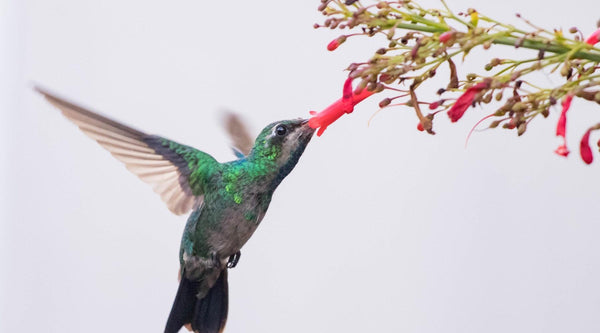
Quick ID: A vivid red bill tipped in black is diagnostic on both sexes; adult males add an emerald body and a glittering blue throat — no other North American hummingbird combines a red bill with a blue gorget. Females are duller, with grayish underparts and the same telltale red-and-black bill.
Give Every Visitor a Reason to Stay
Whether it's a wandering Allen's or Pennsylvania's next Historic/Accidental record, real nectar sources and a calcium boost give any visiting rarity a reason to stick around long enough to be documented.


Pennsylvania Hummingbirds at a Glance
| Species | Pennsylvania Records | Best Chance |
|---|---|---|
| Ruby-throated | Only regular breeder; nearly every sighting | Late April through September, statewide |
| Rufous | Regular fall/winter visitor | October through December, peaking mid-to-late November |
| Allen's | ~6 accepted records (2009-2021), banding-confirmed | Not expected — thin, geographically concentrated signal |
| Calliope | ~5-6 accepted records (2002-2021) | Not expected — genuine but infrequent rarity |
| Anna's | 2 accepted records, both Berks Co. | Not expected — genuine rarity |
| Bahama Woodstar | 1 accepted record (Apr 2013), state's only-ever | Not expected — genuine one-off |
| Black-chinned | 3 accepted records (2012-2016); none in 9+ years since | Not expected — thin, dated record |
| Broad-billed | 1 accepted record (2023, Allegheny Co.), state's only-ever | Not expected — genuine one-off |
Frequently Asked Questions
How many species of hummingbirds are in Pennsylvania?
Eight species have been documented in Pennsylvania, per the Pennsylvania Ornithological Records Committee's official checklist. Ruby-throated is the only regular breeder, Rufous is the regular fall/winter visitor, and Allen's, Calliope, Anna's, Bahama Woodstar, Black-chinned, and Broad-billed are all genuine rarities requiring committee review.
Are there hummingbirds in Pennsylvania in winter?
Yes, more reliably than you might expect. Rufous is the regular fall/winter visitor, most common October through December and peaking in mid-to-late November. Genuine winter rarities are less common but real — Pennsylvania has a confirmed full-winter overwintering record for Anna's Hummingbird, from October 2010 into the following March.
How do I tell Ruby-throated and Black-chinned Hummingbirds apart?
Adult males are the easy case: Ruby-throated shows a red gorget, Black-chinned shows a black throat with a thin violet-purple band at the base. Females and young are effectively inseparable in the field — wing-to-tail proportions on a perched bird are the most useful mark.
How do I tell Rufous and Allen's Hummingbirds apart?
Reliably? Often you can't, without a bander in hand. The one usable field mark is the back: a bird with any solid-rufous back feathers is a Rufous, not an Allen's, while a solid green back points to Allen's. Beyond that mark, females and immatures of the two species are nearly identical, and every one of Pennsylvania's accepted Allen's records was confirmed through banding, not photographs.
What is that orange hummingbird I saw in Pennsylvania in the fall?
Almost certainly Rufous Hummingbird — it's Pennsylvania's regular fall and winter visitor, most active October through December. There's a small chance it's the much rarer Allen's Hummingbird, but that can only be confirmed with the bird in hand.
For feeder setup, nectar ratios, and native plants that support these species, head back to our how-to-attract-hummingbirds-in-Pennsylvania guide. For region-by-region arrival and departure windows, see the Pennsylvania hummingbird calendar.
Why We Created This
Pop's Birding has been helping hummingbird lovers for three generations. One of the questions our customers ask most often is "What hummingbirds are actually in my state?" — and for Pennsylvania, most answers online stop at "Ruby-throated, plus the occasional Rufous," without ever mentioning the six other accepted species or the genuine identification problems some of them create. We built this page to give a direct, sourced answer: the complete, officially documented list, with real identification detail for every species on it — including an honest account of where field ID simply isn't reliable, rather than pretending every hummingbird can be confidently named from a photo.
How We Created This
We pulled eBird bar chart data for Pennsylvania statewide to see which species show a real, measurable presence at genuine statewide scale, rather than a handful of local checklists — only Ruby-throated cleared that bar, with every rare species, including Allen's and Rufous, peaking under half a percent once measured properly. Allen's Hummingbird appeared to reach over 2% in one narrow window, but that figure came from roughly 2,000 checklists concentrated around a single known bird's documented stay, not a broad statewide pattern, so we didn't build a chart around it. For every rare species we cross-checked against the Pennsylvania Ornithological Records Committee's official state checklist and its published records journal rather than relying on eBird frequency alone, drawing a real distinction between species with genuine multi-year activity, like Allen's and Calliope, and species whose entire Pennsylvania record is a single sighting or a tight, dated cluster, like Anna's, Bahama Woodstar, Black-chinned, and Broad-billed — and because sight-only identification of Rufous versus Allen's is unreliable outside one narrow field mark, the state's own accepted Allen's records were confirmed by banders measuring wing and tail dimensions, not from photographs alone.
Sources
- Pennsylvania Ornithological Records Committee, official state list and Review List, revised 2024-2025. Source for every species' status and accepted-record history on this page.
- Pennsylvania Birds, Pennsylvania Ornithological Records Committee journal, Vol. 17 No. 1 and Vol. 32 No. 3. Source for the Rufous/Allen's in-hand-only identification standard and specific Pennsylvania vagrant record details.
- eBird bar chart data, Cornell Lab of Ornithology — Pennsylvania statewide.
Know before they arrive
You don't have to keep this calendar taped to the fridge. Insider Birding Access members get seasonal notes timed to your region — when to have feeders out, what the birds are doing right now, and what's worth doing in your yard this season. We take the guesswork out of the calendar. Joining takes about thirty seconds, and there's 10% off your first order in it.
Join Insider Birding Access →Free to join. 10% off your first order.
Shop Pennsylvania's Hummingbird Favorites


Bethany Sloan has served as General Manager of Pop's Birding since 2010, continuing the legacy of her grandfather, William "Pops" Sloan, inventor of the Original Hummingbird Swing. A lifelong hummingbird enthusiast, educator, and independent researcher, she leads the company's educational content, including its 50-State Hummingbird Guide series, Regional Guide, Species Guide and Hummingbird Learning Center. Bethany combines scientific research, regional migration data, and more than 16 years of hands-on experience to create trusted educational resources for bird enthusiasts across North America.