Sep 03, 2026
Hummingbirds in Maryland: The Complete Guide to All 7 Species
On December 1, 2025, a hummingbird with a velvety black throat and no green anywhere on it turned up at a Calvert County feeder — and the eBird checklists that week tell the story on their own. In a county that normally logs a scattering of hummingbird reports, nearly one in ten checklists that week mentioned it. It was Maryland's third documented Black-chinned Hummingbird, and the first in four years.
Seven hummingbird species are on the Maryland/District of Columbia Records Committee's official state checklist. One breeds here every summer. One is common enough that the Committee doesn't require review of it anywhere in the state. The other five are all formal review species, each with its own accepted-record history — from a pattern recurring across three separate years to two species Maryland has recorded only a handful of times ever.
Free download
All 7 species, one page
Every Maryland hummingbird with its status — from Ruby-throated, on nearly a third of statewide checklists at its September peak, down to species with just a handful of accepted records ever — sized 8.5" x 11" for easy reference and printing.
Download the Maryland species guideOne page · PDF · free to print and share

All 7 documented Maryland hummingbird species, grouped by tier — statewide eBird data, 2016–2025, cross-checked against the Maryland/DC Records Committee's official state checklist and record documentation.
The Hummingbird You're Most Likely to See
Ruby-throated Hummingbird Breeds Here
Maryland's only nesting hummingbird, and it's the only one of the state's seven species the Records Committee doesn't require review for anywhere in the state. Statewide frequency peaks near 34% of checklists in early September, and the pattern holds up county by county — Bethesda at 35%, Southern Maryland's Calvert County past 47%, Deep Creek Lake in the far-western mountains near 40%. One honest exception: Worcester County, on the Atlantic coast around Ocean City, shows a much flatter, lower-level pattern that never climbs past 10% but never fully disappears either — a real signal, but a coastal one. Maryland DNR states plainly that Ruby-throateds "travel to Mexico and Central America" for winter, and the handful of coastal winter reports each year trace to individually documented birds, not a resident population — one confirmed overwintering bird in Worcester County in February 2021 is the kind of record behind that pattern, not evidence of a bigger one.

Quick ID: Adult males show a brilliant ruby-red throat that reads black without direct light, an emerald crown and back, and a short forked black tail. Females and immatures are green above and whitish-gray below, with white-tipped outer tail feathers and no rufous anywhere. From April through September in Maryland, a hummingbird is essentially always this one.

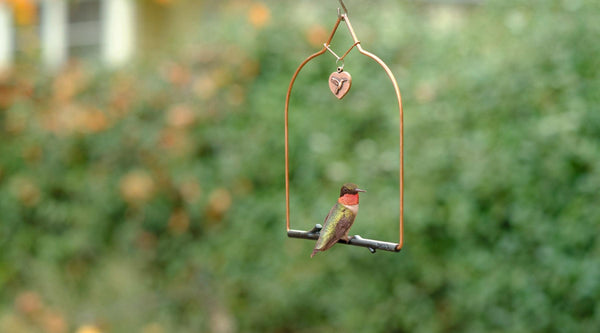
A Little Throne for Your Ruby-throated
Maryland's only breeder nests statewide each summer. A stable perch gives it somewhere to watch from besides your feeder port — a place to hold territory before Rufous and the season's rarities start filtering through each fall.
Shop Charm Redwood Swing →Maryland's Regular Fall Visitor
Once Ruby-throated thins out in October, one western species keeps a genuine, low-density presence going for the rest of the year.
Rufous Hummingbird Migrant/Winter
The only western hummingbird on Maryland's list the Records Committee doesn't require review for — every other vagrant species here, Black-chinned included, carries a review code, but Rufous doesn't. The Maryland Biodiversity Project describes it as a "rare but increasingly regular vagrant from the western U.S., usually in late fall and winter," and cautions that any hummingbird at a Maryland feeder after the Ruby-throateds have left "is more likely to be a western vagrant than a Ruby-throated." The Bethesda area (Montgomery County) shows the clearest pattern: real activity building through November into a December peak near 0.5% of checklists, then a second stretch of scattered January–February reports most years — a genuine late-fall-into-winter presence, not a single well-photographed bird.

Quick ID: Adult males are almost entirely orange-rufous with a glowing orange-red throat — the only largely rufous-backed hummingbird in North America. Females and immatures are green above with cinnamon-washed flanks, a coppery rump, and rufous at the base of the tail feathers, which no Ruby-throated ever shows.

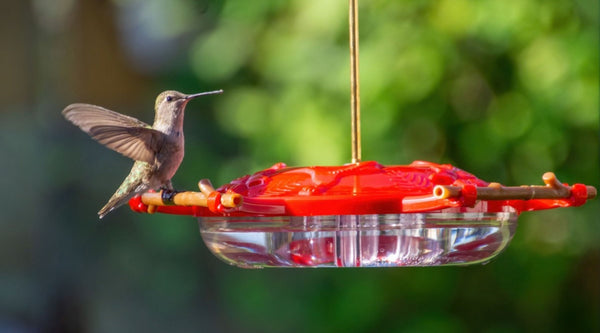
An Extra Feeder for Your Rufous Visitor
Rufous is famously aggressive at a feeder and will chase off anything else in the yard, regardless of size. A second station spread across the yard gives a lingering Ruby-throated or a passing rarity room of its own instead of one bird claiming the whole supply.
Shop AspenPerch Feeder →Maryland's Recurring Rarities
Two more species are formal review birds with recurring, multi-year record histories — genuine, if infrequent, visitors rather than one-off flukes.
Black-chinned Hummingbird Rare / Casual Visitor
Maryland's first record didn't come until January 2020 — the Maryland Biodiversity Project calls it the species that "had been voted our #1 most expected new state bird for many years" before it finally showed up, banded by Bruce Peterjohn as an immature male in St. Mary's County. Documented individuals have followed in two more separate years since: Calvert County in October 2021, and the Calvert County bird from the top of this page in December 2025. The eBird data for that most recent bird is dramatic and precise — Calvert County spikes to over 10% of checklists the exact week it was present, one of the strongest single-species signals anywhere in this state's data, entirely attributable to that one documented individual drawing repeat visits.

Quick ID: Adult males show a velvety black chin and upper throat, bordered below by a thin band of iridescent purple visible only in good light — from most angles it just reads black. Look for a small white spot behind the eye and a long, straight black bill. Females have a plain, essentially unmarked pale throat and aren't reliably separable from female Ruby-throated by sight alone.
Calliope Hummingbird Rare / Casual Visitor
Maryland's first accepted record dates to November 2004, a hatch-year female in Prince George's County. The Maryland Biodiversity Project describes the species as a "rare vagrant to Maryland with seven records as of November 2018," and documented sightings have continued since, including birds in Garrett County — the state's far-western mountain county — through 2021 and 2022. That western-county pattern shows up in the eBird data too: Garrett County carries a real, if thin, signal building through October into a November peak, on the same order of checklist activity as the county's own Rufous sightings that same season.

Quick ID: North America's smallest hummingbird, and identifiable by that alone in most cases — hunched posture, short bill and tail. Adult males show a gorget of separate magenta rays radiating outward against a white throat, rather than a solid patch, unique among North American hummingbirds. Females are green above with fine dark streaking on a whitish throat.

Make Your Sanctuary Worth a Detour
Black-chinned and Calliope are both genuinely recurring here, not one-time flukes — real electrolytes beyond plain sugar water give a documented rarity a reason to linger instead of just passing through.
Shop Nectarlyte® Powder →If You're Lucky: Maryland's Historic Rarities
The remaining three species are also formal review birds, but each has only a handful of accepted Maryland records, and two haven't recurred since 2011.
Allen's Hummingbird Historic / Accidental
One formally accepted Maryland record: an immature female in Calvert County, December 24, 2008, confirmed through DNA testing after a tail feather was removed for genetic analysis — the only method that reliably separates Allen's from female and immature Rufous. The Maryland Biodiversity Project also documents a distinct, photographed individual in Washington County in November 2011, though that sighting's own committee accession number wasn't independently confirmed for this page. Either way, nothing has followed since 2011, and the eBird data reflects that: a single-checklist blip is the entire statewide signal across the 2016–2025 window, nowhere near enough to represent a real pattern.

Quick ID: A Rufous look-alike. Adult males show a deep reddish-orange gorget and a coppery eye patch contrasting against a green back — but some male Rufous are green-backed too, so the back alone isn't conclusive. Females and immatures are essentially identical to female Rufous in the field; separating them reliably takes lab-grade confirmation, exactly how Maryland's one formal record was settled.
Anna's Hummingbird Historic / Accidental
Two accepted records, both well over a decade old: the first added to the state list in 2007, and a second documented by the Maryland Biodiversity Project as "Maryland's second record of Anna's Hummingbird, a hatch-year male visiting a feeder in Middletown, Frederick County" on December 9, 2010. Both records predate the eBird data this page draws on, so there's no checklist signal behind either one — an honest gap rather than a pattern to paper over.

Quick ID: The only North American hummingbird with an iridescent crown as well as throat — adult males glow rose-pink from the top of the head down, unlike anything else on Maryland's list. Females carry a small central patch of rose-red spotting on an otherwise pale throat.
Mexican Violetear Historic / Accidental
Exactly two accepted records, and both fell inside a single two-week window: the Maryland Biodiversity Project documents them as "Cecil Co. from 10/10 to 10/12 and Howard Co. from 10/24 to 10/26," both in October 2011. Nothing has been accepted since. Worth noting honestly: the eBird data for this species does show a separate, later signal — a real but thin November spike in Worcester County within the 2016–2025 window — that doesn't correspond to either accepted record by date or county. It hasn't been formally reviewed or accepted by the Records Committee, so this page treats it as an interesting data point rather than a third record.

Quick ID: An all-glittering-green bird, larger than any of Maryland's regular species, with a violet-blue ear patch and a violet-blue band across the chest, and a straight black bill. Both sexes look alike, though females average slightly duller.

Give Every Visitor a Reason to Stay
Whether it's your breeding Ruby-throated or a genuine one-off like Mexican Violetear, real nectar sources give any visitor, common or rare, more reason to stick around your yard.
Shop Wildflower Seed →Maryland Hummingbirds at a Glance
One species accounts for nearly all of Maryland's hummingbird activity: Ruby-throated peaks near 34% of statewide checklists, while every other confirmed species tops out under a single percentage point at the statewide scale. That gap is too wide for a shared bar chart to show anything useful, so here's the same information as a table instead.
| Species | Status | Maryland Records |
|---|---|---|
| Ruby-throated Hummingbird | Breeding | Confirmed statewide breeder; non-review species; statewide peak 34% in September |
| Rufous Hummingbird | Migrant / Winter Visitor | Non-review species; real late-fall/winter pattern in Montgomery Co. |
| Black-chinned Hummingbird | Rare / Casual | Documented in 3 separate years: 2020, 2021, 2025 |
| Calliope Hummingbird | Rare / Casual | 7 records as of 2018; recurring through 2022 |
| Allen's Hummingbird | Historic / Accidental | 1 formally accepted record (2008) plus 1 documented individual (2011) |
| Anna's Hummingbird | Historic / Accidental | 2 accepted records — 2006–07 and 2010 |
| Mexican Violetear | Historic / Accidental | 2 accepted records, both within a 2-week window in Oct 2011 |
Frequently Asked Questions
How many kinds of hummingbirds have been documented in Maryland?
Seven, all on the Maryland/DC Records Committee's official state checklist. Ruby-throated is the only one that nests here; Rufous is the state's only other non-review species, with a real late-fall and winter presence; and the other five are all formal review birds, ranging from Black-chinned, documented across three separate recent years, down to species with just a couple of accepted records ever.
What is the most common hummingbird in Maryland?
Ruby-throated Hummingbird, by an enormous margin. It peaks near 34% of statewide checklists in early September, and no other confirmed species tops a single percentage point anywhere in the state. From April through September, a Maryland hummingbird is almost certainly this one.
Are there hummingbirds in Maryland in the winter?
A small number of Ruby-throateds get reported along the Atlantic coast near Ocean City each winter, but Maryland DNR is direct that the species normally leaves for Mexico and Central America — that coastal pattern traces to individually documented birds, not a resident population. Rufous Hummingbird is the more likely candidate for any hummingbird seen after October, especially around Bethesda.
How do I tell a Rufous from an Allen's Hummingbird in Maryland?
In practice, you probably can't without a bird in the hand. For an adult male, the back is the shortcut: Rufous is typically solid copper, Allen's shows a green back — but some male Rufous are green-backed too, which erases the shortcut. Females and immatures of the two are essentially identical in the field. Maryland's one formally accepted Allen's record was only confirmed through DNA testing.
Where was Maryland's most recent hummingbird rarity found?
Calvert County, in Southern Maryland, twice in recent years — a Black-chinned Hummingbird in October 2021, and another in December 2025. The county's eBird checklists spike dramatically each time, a clear sign of a documented bird drawing repeat visits rather than an ongoing population.
Why We Created This Guide
Pop's Birding has been helping hummingbird lovers for three generations. One of the questions our customers ask most often is "what hummingbirds are actually in my state?" — we built this guide to give a direct, sourced answer for Maryland specifically, not a generic one. Most identification content treats the Mid-Atlantic as a one-species region and stops there, and that misses what makes Maryland distinctive: a genuine, non-review-status winter visitor in Rufous Hummingbird, a records committee whose review codes map cleanly onto real record histories, and a Black-chinned Hummingbird pattern recent enough that its most dramatic eBird spike happened within the past year.
How We Created This Guide
We started with statewide eBird checklist data from the Cornell Lab of Ornithology, covering 2016 through 2025, then added four counties chosen for what they could show us — the core Ruby-throated and Rufous pattern in the DC suburbs, Southern Maryland's rarity records, the Atlantic coastal pattern, and the far-western mountain counties. Since checklist data alone doesn't cover everything, we checked every species against the Maryland/DC Records Committee's Official List of the Birds of Maryland and the Maryland Biodiversity Project's documented record histories. One thing worth explaining: Worcester County posts Ruby-throated checklists nearly every week of the year, which could look like a real wintering population, but Maryland DNR notes the species migrates south for winter, and the county's peak frequency runs far below every inland county's summer peak — a real but modest coastal pattern tied to a few individual birds people have documented over the years, not a lasting population. The tier grouping here follows the Records Committee's own review codes, which lined up cleanly with the record pattern for every species on this page.
Sources
- eBird bar chart data, Cornell Lab of Ornithology — Maryland statewide plus Montgomery, Calvert, Worcester, and Garrett counties, 2016–2025.
- Maryland/DC Records Committee, Official List of the Birds of Maryland (as of 28 July 2021) — source for all 7 species and their review codes.
- Maryland/DC Records Committee (Maryland Ornithological Society) — source for record review status and documentation standards.
- Maryland Biodiversity Project — source for individual record dates, counties, and finder details not itemized on the official checklist.
Know before they arrive
You don't have to keep this calendar taped to the fridge. Insider Birding Access members get seasonal notes timed to your region — when to have feeders out, what the birds are doing right now, and what's worth doing in your yard this season. We take the guesswork out of the calendar. Joining takes about thirty seconds, and there's 10% off your first order in it.
Join Insider Birding Access →Free to join. 10% off your first order.
Shop Maryland's Hummingbird Favorites


Bethany Sloan has served as General Manager of Pop's Birding since 2010, continuing the legacy of her grandfather, William "Pops" Sloan, inventor of the Original Hummingbird Swing. A lifelong hummingbird enthusiast, educator, and independent researcher, she leads the company's educational content, including its 50-State Hummingbird Guide series, Regional Guide, Species Guide and Hummingbird Learning Center. Bethany combines scientific research, regional migration data, and more than 16 years of hands-on experience to create trusted educational resources for bird enthusiasts across North America.