Aug 09, 2026
Pennsylvania Hummingbird Season: A Month-by-Month Calendar
Timing derived from eBird data, 2016–2025 (sourced Aug 2026)
Pennsylvania's hummingbird year doesn't follow the simple south-to-north pattern you'd expect from a state this shape. Philadelphia and the Poconos — opposite corners of the state — actually see their first arrivals in the same week. The real gap is east-and-central versus west: Pittsburgh and Erie both lag about a week behind everywhere else. Statewide, the season also peaks unusually late for a Mid-Atlantic state — nearly 30% of eBird checklists report Ruby-throated in the first week of September, not August, driven as much by fall migrants passing through as by local breeders. Here's how the whole year actually unfolds, month by month.
The short answer: late April in Philadelphia, central PA, and the Poconos; the first week of May in Pittsburgh and Erie; peaking in early September; nearly gone by early October.
| Question | Answer |
|---|---|
| When do they arrive? | Late April in Philadelphia, central PA, and the Poconos; early May in Pittsburgh and Erie |
| When should feeders go up? | Late April statewide, first week of May in the west, as a buffer ahead of first arrivals |
| When do they nest? | Late May through July, statewide |
| When do they leave? | Sharp decline through September; nearly all gone by early October |
| Any in winter? | Rufous is a regular fall/winter wanderer; genuine rarities (Black-chinned, Anna's, Calliope, Allen's, Broad-billed, Bahama Woodstar) have all been officially documented too |
Free download
The whole year on one page
Arrival windows region by region, when to hang feeders in your part of the state, and when to watch for Rufous — printed small enough to tape inside the shed door.
Download the Pennsylvania cheat sheetOne page · PDF · free to print and share
Pennsylvania's Hummingbird Season at a Glance
Before the month-by-month detail below, here's the whole season in two pictures — Ruby-throated's full-season curve, and the winter visitors worth watching for, shown at their own scale since they're a small fraction of Ruby-throated's numbers.


How often each species turns up on eBird checklists, week by week — statewide, 2016–2025. Source: eBird bar chart data (Cornell Lab of Ornithology), 2016–2025 (pulled Aug 2026).
Regions used below
We track five counties chosen to span Pennsylvania's real geographic and climate range: Southeast — Philadelphia; Southwest — Allegheny County (Pittsburgh); Northwest — Erie County; Central — Centre County (State College); Northeast — Monroe County (the Poconos). Statewide figures cover the whole state; the five counties show how much that average hides.
Regional Arrival and Departure Snapshot
| Region | First Arrivals | Reliably Common By | Fall Departure |
|---|---|---|---|
| Statewide | Late April | Early May | Late September–early October |
| Southeast — Philadelphia | Late April | Early May | Late September–early October |
| Southwest — Allegheny (Pittsburgh) | Early May | Mid-May | Late September |
| Northwest — Erie | Early May | Mid-May | Late September |
| Central — Centre (State College) | Late April | Mid-May | Late September–early October |
| Northeast — Monroe (Poconos) | Late April | Early May | Late September |
Windows derived from eBird bar chart data (Cornell Lab of Ornithology), 2016–2025, for Philadelphia, Allegheny, Erie, Centre, and Monroe counties.
One thing to know before you start
Don't assume Pennsylvania runs south-to-north. Our data shows the Poconos (Monroe County) arriving right alongside Philadelphia in late April, while Pittsburgh and Erie in the west both lag about a week behind — the opposite of what a simple latitude-based guess would predict. If you're in western PA, that extra week of patience is normal, not a sign something's wrong.
January, February & March: Quiet, With Rufous Tapering and Rare Records Possible
Ruby-throated is completely absent statewide across all three months. Rufous, though, shows a small, real signal even in January — the tail end of the fall wave rather than new arrivals — before tapering to its lowest point in February and staying quiet through March. If you spot any hummingbird during this stretch, photograph it and report it to PORC — genuine winter rarities like Black-chinned and Anna's have both been documented in Pennsylvania in the colder months.
Treat these three months as prep time rather than watch time. February is a good point to give your feeders a thorough off-season cleaning; by March, check for cracks or degraded seals over winter, and stock up on sugar for the season ahead.
April: The First Real Scouts
April is when Pennsylvania's season actually begins, though barely at first — real signal doesn't show up until the very end of the month, when statewide reports jump to roughly 3% in the last week. This is scout-bird territory: the earliest, most adventurous males pushing north ahead of the main wave. Males typically arrive one to two weeks before females, so a quiet feeder in the first days is completely normal.

Get your feeder up before the first scout arrives, not after.
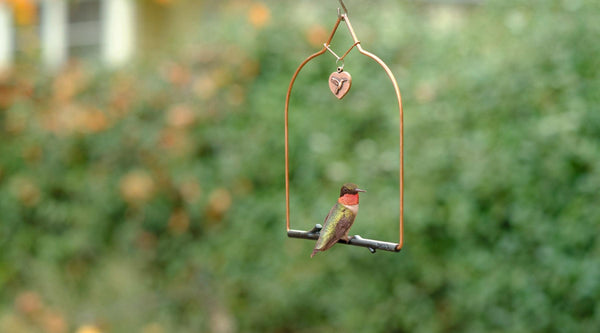
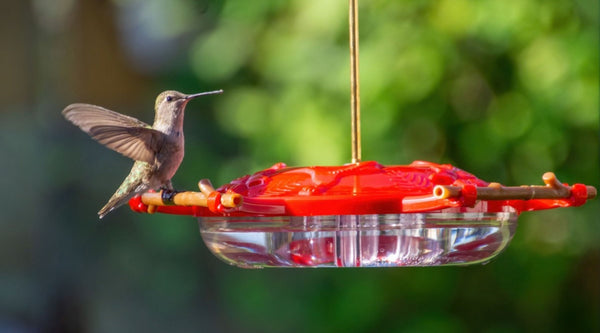
Late April statewide, about a week later if you're in Pittsburgh or Erie. AspenPerch® has a built-in ant moat and a Polyperch® comfort perch, so birds rest between sips instead of hovering through the whole meal.
Shop AspenPerch® →May: The Wave Arrives, East and West Alike
May is Pennsylvania's real arrival month. Statewide reports jump from about 10% in the first week to over 13% by mid-month. Unlike many states, there's no dramatic late-month surge here — Pennsylvania's spring wave lands fast and levels off quickly, holding in the 10–13% range through most of the month as birds settle into breeding territories.
June: Nesting Season Settles In
Ruby-throated activity holds steady through June, in the 10–13% range statewide, as birds settle into nesting. Females become secretive around the nest during this stretch, which can make feeder activity look quieter even though the birds haven't gone anywhere. Males, uninvolved in nest duties, remain visible and territorial.
Why nesting season is the demanding one
There's a wrinkle specific to hummingbirds. Most female birds build up a temporary calcium store in their bones, called medullary bone, and draw on it to make eggshell. Hummingbirds have very little of it, so a laying female has less in reserve. Researchers have seen nesting females eating wood ash and other mineral-rich materials, which they think helps replace the calcium that goes into eggs. In one 1994 study, every bird seen eating ash was a female tending a nest.

It's part of why Pop's Nectar includes calcium and electrolytes rather than sugar alone. Nesting females need extra calcium during egg-laying, and plain sugar water has essentially none. Read more on the research behind it.
Shop Nectarlyte® 8 oz →July: Building Toward the Peak
Activity climbs steadily through July, from about 14% early in the month to 19% by month's end, as broods fledge and juveniles join adults at feeders and flowers. This is a genuine ramp, not a plateau — Pennsylvania's real peak is still a month away.
July's heat also brings the first real ant and wasp pressure of the season — worth getting ahead of now, since fledglings are still learning where to find food and a disrupted feeder costs them more than it costs an established adult.

Keep pests off without pesticides.
AspenPerch®'s built-in ant moat blocks ants with a water barrier, and HummGuard® Nectar Tips keep bees and wasps out without changing anything for the birds.
Shop HummGuard® →August: Approaching the Peak
August keeps climbing hard, from roughly 22% early in the month to over 29% by the last week — already near the eventual statewide peak. Birds are deep into hyperphagia, the intensive pre-migration feeding phase that can nearly double a hummingbird's fat reserves ahead of the trip south.
This is the month to be generous, not economical.
Birds fueling for a long flight south need feeders topped up more often — the large 2lb Nectarlyte® powder or the Nectarade® liquid concentrate keeps you from running out mid-surge.


September: The Statewide Peak, Then the Fast Exit
September is Pennsylvania's busiest hummingbird month, and its shortest-lived one. Statewide reports peak at nearly 30% in the first week — the single highest point of the entire year, and notably later than many neighboring states — then collapse to under 7% by the last week. That's more than a three-quarters drop in a single month. Rufous also starts to show real signal for the first time this month, right as Ruby-throated is leaving.
October: Last Stragglers, Real Rufous Season
By October, most Ruby-throated Hummingbirds have already left Pennsylvania — statewide reports fall from about 2% in the first week to nearly zero by month's end, with only isolated stragglers anywhere in the state. October is also when Rufous activity becomes genuinely substantial, climbing toward its own fall peak. Pop's tip: keep your feeder up for two to three weeks after your last Ruby-throated sighting to support late-season stragglers, and consider leaving at least one feeder up into November if you'd like a shot at Rufous.

This is the planting month.
Nine of the Perfect Little Sanctuary® blend's 12 varieties need or benefit from a cold, moist stretch before they germinate well, and Pennsylvania's winter does that work on its own.
Shop the Perfect Little Sanctuary® blend →November: Peak Rufous-Watching
Ruby-throated is essentially absent statewide in November. This is instead the single best month of the year to watch for Rufous Hummingbird, Pennsylvania's most reliable rare visitor — statewide activity peaks in the third week of November, and the Pennsylvania Ornithological Records Committee classifies it as Regular precisely because it shows up in small numbers most years. If a hummingbird visits your feeder this month, there's a real chance it's a Rufous rather than a lingering Ruby-throated.

Seeing one bird chase everyone else off?
That's usually a resident claiming both the feeder and a nearby swing as its own guarded territory. Rufous is a famously territorial bird, so a second feeder and a second swing, spaced out of sight of each other, gives an arriving Rufous its own station instead of a fight over yours.
Shop a second swing →December: The Last of the Stragglers
December carries the tail end of Pennsylvania's Rufous season, with reports gradually tapering through the month but still present at meaningfully higher levels than the following January and February. Genuine winter accidentals are also possible — Pennsylvania's checklist includes real December and January records for species like Black-chinned and Anna's, so a feeder left up through the cold isn't wasted effort. Our winter hummingbird feeder care guide covers heated feeders and the two-feeder swap.
The Year at a Glance
| Months | Statewide Activity |
|---|---|
| January – March | Ruby-throated absent; Rufous present at low, tapering levels; genuine rarities possible |
| April | First scouts, late in the month, statewide |
| May | Fast statewide arrival; levels off by mid-month |
| June – July | Steady, then building; nesting through fledging |
| August | Sharp climb toward the statewide peak |
| September | Statewide peak (~30%) in week one, then a fast collapse |
| October – November | Ruby-throated gone; peak Rufous-watching window |
| December | Rufous tapering; rare winter accidentals still possible |
Frequently Asked Questions
When do hummingbirds come back to Pennsylvania?
Late April in Philadelphia, central Pennsylvania, and the Poconos; the first week of May in Pittsburgh and Erie. Our data shows real, sustained arrivals don't begin until the very end of April even in the earliest regions — earlier feeder setup is a safety buffer, not a sign the birds are already here.
When do hummingbirds leave Pennsylvania?
Fast, and later than you might expect: the statewide peak actually lands in the first week of September, then reports drop more than three-quarters by the end of the month. Nearly all Ruby-throated Hummingbirds are gone by early October, with only isolated stragglers into the month.
How long do hummingbirds stay in Pennsylvania?
Roughly five months for the typical Pennsylvania yard — arriving late April to early May and mostly gone by early October. Add the fall-into-winter Rufous season, which runs October through December most years with a real presence even into January, and the practical "hummingbird watching" window stretches closer to nine months.
Why is my feeder in Pittsburgh still empty in early May?
Because western Pennsylvania is genuinely the last part of the state to see activity. Our Allegheny and Erie county data both show real arrivals landing about a week later than Philadelphia, central PA, and the Poconos — the opposite of a simple south-to-north pattern, but a real, measured gap.
Should I keep a feeder up through a Pennsylvania winter?
If you want a real shot at Rufous, yes — October through December is your best window, and it's regular enough that the state records committee classifies it as Regular rather than a species requiring review. Genuine winter rarities like Black-chinned and Anna's are vanishingly unlikely in any given year, but both have real Pennsylvania records.
Why We Built This Calendar
Pop's Birding has been helping hummingbird lovers for three generations. One of the questions our customers ask most often is "When do hummingbirds arrive and leave my state?" — we built this calendar to give a direct, sourced answer, not a generic one. Most timing advice assumes Pennsylvania runs south-to-north like a simple latitude model would predict, and that assumption is genuinely wrong here: the Poconos arrive right alongside Philadelphia, while Pittsburgh and Erie lag behind. A reader in western Pennsylvania following south-to-north advice would be waiting on the wrong week.
How We Built This Calendar
We pulled eBird bar chart data for Pennsylvania statewide and for five counties — Philadelphia, Allegheny (Pittsburgh), Erie, Centre (State College), and Monroe (Poconos) — covering 2016 through 2025, and read the seasonal shape and regional pattern directly off the reporting rates ourselves; "first arrivals" marks the first week a region's rate clearly rises above its winter baseline and keeps climbing, and "reliably common" marks the first week it hits 25% of that region's own seasonal peak, since a rural county and a metro county don't share a baseline. We also checked every low-frequency data point against its shape across the year before charting it, dropping isolated spikes sitting at eBird's reporting floor rather than treating them as signal — which is why the two charts above stand on their own rather than needing a third, species-normalized one. The genuine finding worth calling out — that Pennsylvania doesn't run on a simple south-to-north gradient, with the Poconos arriving alongside Philadelphia while Pittsburgh and Erie lag a week behind — is original analysis on our part, not a rewrite of eBird's own bar charts.
Sources
- eBird bar chart data, Cornell Lab of Ornithology — Pennsylvania statewide and county-level (Philadelphia, Allegheny, Erie, Centre, Monroe), 2016–2025. Source for all month-by-month seasonal figures and the regional arrival pattern.
- des Lauriers, J. R. (1994). Hummingbirds eating ashes. The Auk, 111(3), 755–756. Documents five nesting female hummingbirds eating wood ash; no males were seen doing so in that study.
- Adam, M. D., & des Lauriers, J. R. (1998). Observations of hummingbirds ingesting mineral-rich compounds. Journal of Field Ornithology, 69, 257–261. Source for hummingbirds' greatly reduced medullary bone and for the mineral-rich materials they eat.
- Werning, S. (2018). Medullary bone is phylogenetically widespread and its skeletal distribution varies by taxon. Journal of Ornithology, 159, 527–543. Source for medullary bone being confirmed in hummingbirds.
- Estades, C. F., Vukasovic, M. A., & Tomasevic, J. A. (2008). Giant Hummingbirds (Patagona gigas) ingest calcium-rich minerals. The Wilson Journal of Ornithology, 120(3), 651–653.
Know before they arrive
You don't have to keep this calendar taped to the fridge. Insider Birding Access members get seasonal notes timed to your region — when to have feeders out, what the birds are doing right now, and what's worth doing in your yard this season. We take the guesswork out of the calendar. Joining takes about thirty seconds, and there's 10% off your first order in it.
Join Insider Birding Access →Free to join. 10% off your first order.
Shop Pennsylvania's Hummingbird Favorites


Bethany Sloan has served as General Manager of Pop's Birding since 2010, continuing the legacy of her grandfather, William "Pops" Sloan, inventor of the Original Hummingbird Swing. A lifelong hummingbird enthusiast, educator, and independent researcher, she leads the company's educational content, including its 50-State Hummingbird Guide series, Regional Guide, Species Guide and Hummingbird Learning Center. Bethany combines scientific research, regional migration data, and more than 16 years of hands-on experience to create trusted educational resources for bird enthusiasts across North America.