Sep 03, 2026
Hummingbirds in Delaware: The Complete Guide to All 5 Species
In late October 2020, a hummingbird that should have been in Texas or Mexico settled into a yard on Doddtown Road near Harbeson, in Sussex County, and stayed for more than two weeks. Bruce Peterjohn, a licensed bander who now chairs the Delaware Bird Records Committee, caught the bird, measured it, and banded it while the homeowner photographed the whole process — and the numbers said hatch-year female Black-chinned Hummingbird, Delaware's first. Almost nobody else saw it; the committee's report notes the pandemic kept the crowds away. That's how most of Delaware's hummingbird list has been written: one bird, one yard, one bander with calipers, usually in the months when there shouldn't be any hummingbirds here at all.
Five hummingbird species are on the Delaware Ornithological Society's official state list, maintained by its Bird Records Committee — fewer than Maryland's seven or the eight apiece in New Jersey and Pennsylvania. One breeds here every summer. One is a recurring winter visitor. The other three are review species, the committee's category for birds so rare it asks for documentation of every single one, and between them they have exactly five accepted records.
Free download
All 5 species, one page
Every Delaware hummingbird with its status — from Ruby-throated, on nearly half of Wilmington-area checklists in early September, down to three review-list rarities with five accepted records between them — sized 8.5" x 11" for easy reference and printing.
Download the Delaware species guideOne page · PDF · free to print and share

All 5 documented Delaware hummingbird species, grouped by tier — statewide eBird data, 2016–2025, cross-checked against the Delaware Bird Records Committee's official state list and its published annual reports.
The Hummingbird You're Most Likely to See
Ruby-throated Hummingbird Breeds Here
Delaware's only nesting hummingbird, and from April through early October, effectively its only hummingbird. The U.S. Fish and Wildlife Service's checklist for Bombay Hook National Wildlife Refuge marks it as a nesting species, common in spring, summer, and fall and absent in winter, and the 2nd Delaware Breeding Bird Atlas confirmed it across the state. The eBird numbers show how lopsided the season is. The first birds register in the second and third weeks of April, and by late April Ruby-throated is already on 7% of statewide checklists. It builds all summer and peaks in the first week of September, when the summer's young and the first southbound migrants pile up at feeders together: 32% of all Delaware checklists, and 49% around Wilmington in New Castle County — nearly one checklist in two. Sussex peaks the same week at 24%, and Kent County the week after at 20%. Then it collapses: 5% in the first week of October, 2% the week after, and nothing real after that. A hummingbird in Delaware in December is not this species.

Quick ID: Adult males show a brilliant ruby-red throat that reads black until the light hits it, a bright green crown and back, a dark mask through the eye, and a short forked black tail. Females and immatures are green above and grayish-white below, with white tips on the outer tail feathers, buffy flanks, and no rufous anywhere. The one Delaware look-alike is Black-chinned, below: on Ruby-throated, the tail extends clearly past the folded wingtips when the bird is perched, while Black-chinned's wings reach almost to the tail tip. From May through September in Delaware, any hummingbird is this one.

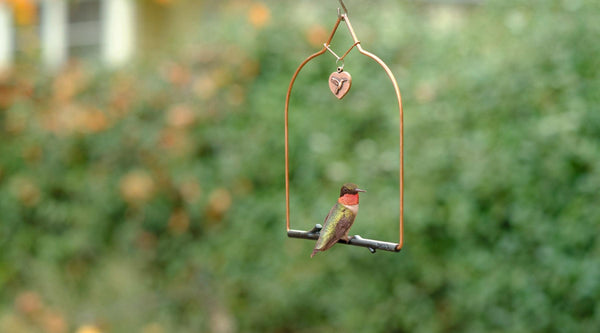
A Little Throne for Your Ruby-throated
From April through the September pile-up around Wilmington, every hummingbird holding a Delaware feeder is a Ruby-throated defending it. A Charm Redwood Swing gives your bird a perch to rest on and watch its territory from, right through the season's busiest week.
Shop Charm Redwood Swing →Delaware Hummingbirds in Winter
Once Ruby-throated clears out in October, Delaware's hummingbird story doesn't quite end — it narrows to one western species that the state's records committee has stopped asking about.
Rufous Hummingbird Migrant/Winter
The Pacific Northwest's hummingbird, and Delaware's winter one. The committee's treatment is the clearest signal of its status: Rufous is the only western hummingbird on the Delaware list that is not a review species. Black-chinned, Calliope, and Allen's all appear in boldface on the state list, meaning the committee wants documentation for every sighting; Rufous appears in plain type, because the committee expects it. The record behind that decision runs back to a specimen collected in New Castle County in November 1978, followed by nine more accepted records between 1996 and 2003 — Wilmington, Bellefonte, Hockessin, Lewes, Newark, Middletown — before the committee took the species off its review list. It has kept coming: in the fall of 2012 two hatch-year females were banded and stayed into winter — one in Lincoln from November 20 to December 5, the other at a home in Price's Corner, New Castle County, from November 8 to January 3. In the 2016–2025 eBird data the signal is almost entirely a Wilmington-area story, peaking at 2.6% of New Castle County checklists in the first week of December and holding at measurable levels from late November through mid-January. Statewide it tops out under 1%. Delaware's Rufous records are real and they recur, but they are one or two birds a winter, not a flock.

Quick ID: Adult males are almost entirely orange-rufous with a glowing orange-red throat — the only largely rufous-backed hummingbird in North America. Most Delaware birds aren't adult males, though. Females and immatures are green above with cinnamon-washed flanks, a coppery rump, and rufous at the base of the tail feathers, which a female Ruby-throated never shows. The catch is Allen's, below: outside the hand, female and immature Rufous and Allen's are for practical purposes the same bird. A rufous-flanked hummingbird at a Delaware feeder in December is worth photographs of the spread tail, and a call to a bander.

An Extra Feeder for Your Rufous
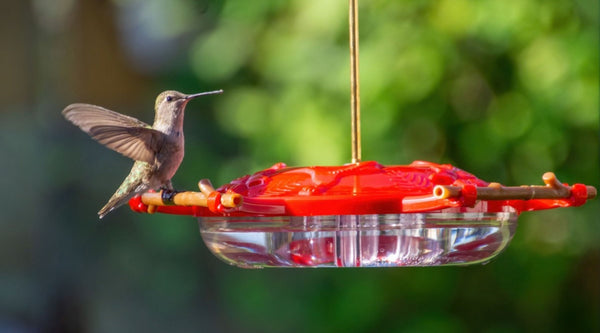
Delaware's Rufous Hummingbirds show up right as most feeders come down for the year, peaking around Wilmington in the first week of December and holding on into mid-January. A second AspenPerch Feeder, kept out through the cold months, gives a wintering visitor a station of its own.
Shop AspenPerch® Feeder →If You're Lucky: Delaware's Documented Rarities
Three more species are on the state list, every one of them a review species. The Delaware Bird Records Committee publishes its decisions in numbered annual reports in the Delaware Ornithologist, so each of these three comes with dates, places, and — in three of the five records — a band number. Every one of them was found between late October and February, and three of the five turned up in New Castle County.
Allen's Hummingbird Rare / Casual Visitor
Two accepted records, both confirmed in the hand. The first spent an entire winter in Wilmington — from November 1, 1997, to February 12, 1998 — and was banded; the second was banded at Woodland Beach Wildlife Area in Kent County on November 23, 2002. Both were identified by measurement, because that's the only way a female or immature Allen's can be told from a Rufous. Since then, eBird checklists around Wilmington have carried the species name in the 2016–2025 window, concentrated in November and December — about 2% of New Castle County checklists in the third week of November, roughly two dozen reports in the best week, tapering through January — but none of those birds appears among the committee's accepted records through its 2025 report. Given how hard this species is to separate from Rufous in the field, this page counts the two the committee has confirmed.

Quick ID: A Rufous look-alike. Adult males have a solid green back where most male Rufous show orange, with the same coppery flanks and a deep reddish-orange throat — but some male Rufous are green-backed too, so even that isn't conclusive. Females and immatures are, for field purposes, identical to Rufous. The one usable difference is the outer tail feather, narrow on Allen's and broad on Rufous, which takes a sharp spread-tail photograph or a bander's ruler to judge. Assume Rufous, document the bird, and let the measurements decide.
Black-chinned Hummingbird Rare / Casual Visitor
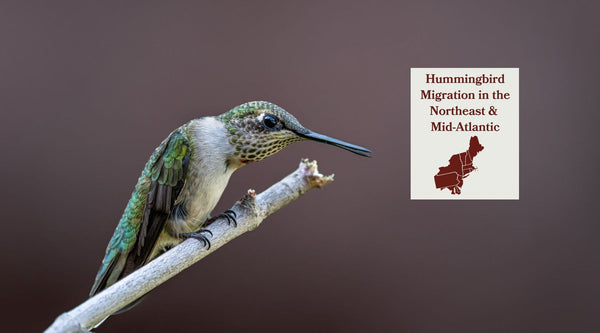
The bird at the top of this page — and the only accepted record. The Harbeson hatch-year female stayed from October 25 to November 9, 2020; the committee's 2021 report called the documentation outstanding and added the species to both the state list and the review list. An earlier report from Lincoln in July 2009 went three rounds of voting and was not accepted, which is the committee's polite way of saying the description couldn't rule out a Ruby-throated. That's the whole Delaware history, and it's why the species sits on the review list: female and immature Black-chinneds are close to inseparable from Ruby-throateds without the bird in hand, and the two even hybridize where their ranges meet. The 2020 bird is also the only thing behind Black-chinned's faint eBird signal here — a handful of Sussex County checklists in late October and early November, and nothing else in ten years.

Quick ID: Adult males have a velvety black chin and throat with a thin band of iridescent purple at the base that shows only in good light — in most views the whole throat simply reads black. Females and immatures are the problem: green above, whitish below, white-tipped outer tail feathers, just like Ruby-throated. The usable marks are structural. Black-chinned's folded wingtips reach nearly to the tip of the tail, its bill is slightly longer with a faint droop, and it pumps and flares its tail almost constantly while hovering. In Delaware, timing does most of the work: a Ruby-throated-type hummingbird after mid-October deserves a close look and a report.
Calliope Hummingbird Rare / Casual Visitor
Two accepted records, eight years apart, both in New Castle County in November. The first was photographed in Newark on November 9 and 11, 2012; the second was a hatch-year male at a feeder in Bear on November 19 and 20, 2020, identified from photographs by Michael Moore and written up in the committee's 2021 report as the state's second. Neither bird lingered, and neither drew a crowd. The smallest bird in the United States is also one of its most erratic wanderers — Calliope turns up along the entire Atlantic seaboard in late fall, almost always at a feeder — and Delaware's two records fit that pattern exactly. In the eBird data it barely exists: scattered single checklists at the rounding floor, none of them a real signal.

Quick ID: The smallest hummingbird in the United States, with a short bill, a hunched posture, and a short tail that sits about level with the wingtips when perched. Adult males show magenta rays streaking down a white throat rather than a solid gorget — no other North American hummingbird has that pattern. Females are told from female Rufous by size, the short tail, very little rufous in the tail, and a pale peachy wash spread evenly across the underparts rather than concentrated on the flanks.
Give Every Visitor a Reason to Stay
Delaware's three review-list rarities — Allen's, Black-chinned, and Calliope — have all turned up at feeders in that same late-October-to-February window. Nectarlyte® Powder gives a lingering visitor electrolytes and calcium beyond plain sugar water, and a Perfect Little Sanctuary® Wildflower Seed planting means real nectar is waiting whether the next documented rarity shows up this winter or years from now.


Two names we don't count
Broad-tailed Hummingbird. The Delaware Ornithological Society's state-list web page still shows this species in boldface, so you may see Delaware credited with six hummingbirds. It had one record — a bird banded at Rehoboth Beach on March 22, 1998. In its 2025 annual report the committee re-examined that record against banding data gathered since: the bird's tail measured 27.5 mm, and no Broad-tailed has ever been measured under 29 mm. The committee concluded it was most likely a Rufous and removed the species from the state list. This page follows the committee's current decision, not the older web page.
Anna's Hummingbird. A hummingbird that wintered at a feeder on Delaplane Road in Newark from November 2012 to April 2013 was banded, photographed, and watched by hundreds of people as a presumed first state record. The committee reviewed it under two reference numbers and listed it as not accepted in its 2019 report. It has never been added to the state list, and this page doesn't count it.
Delaware Hummingbirds at a Glance
One species accounts for nearly all of Delaware's hummingbird activity: Ruby-throated peaks at 32% of statewide checklists, Rufous and Allen's each under 1%, and the other two sit at eBird's rounding floor. That gap is too wide for a shared bar chart to show anything useful — it would be one bar and four slivers — and it hides the part that matters, which is that every one of Delaware's rarities is a late-fall or winter bird, most of them within a few miles of Wilmington. Here's the same information as a table instead.
| Species | Status | Delaware Records |
|---|---|---|
| Ruby-throated Hummingbird | Breeding | Not a review species; confirmed nester; statewide peak 32% in early September, 49% in New Castle County; absent November–March |
| Rufous Hummingbird | Migrant / Winter Visitor | Not a review species; 1978 specimen plus 9 accepted records 1996–2003, then removed from the review list; 2.6% of New Castle County checklists in early December |
| Allen's Hummingbird | Rare / Casual | Review species; 2 accepted records, both banded — Wilmington, Nov 1997–Feb 1998, and Woodland Beach, Nov 2002 |
| Black-chinned Hummingbird | Rare / Casual | Review species; 1 accepted record — near Harbeson, Oct 25–Nov 9, 2020, banded; a 2009 Lincoln report not accepted |
| Calliope Hummingbird | Rare / Casual | Review species; 2 accepted records — Newark, Nov 2012, and Bear, Nov 2020 |
Frequently Asked Questions
How many kinds of hummingbirds have been documented in Delaware?
Five, all on the Delaware Bird Records Committee's official state list. Ruby-throated is the only one that nests here; Rufous is a recurring winter visitor; and Allen's, Black-chinned, and Calliope are review-list rarities with five accepted records between them. A sixth name, Broad-tailed, was removed from the list in 2025.
What is the most common hummingbird in Delaware?
Ruby-throated Hummingbird, by an enormous margin. At its early-September peak it's on 32% of statewide checklists and 49% of checklists in New Castle County. No other species reaches 3% anywhere in the state, and from May through September any Delaware hummingbird is almost certainly this one.
How do I tell a Black-chinned from a Ruby-throated Hummingbird in Delaware?
In good light, the throat: Ruby-throated's is red, Black-chinned's is black with a thin purple band at the bottom. Both look solid black in shade, and females and immatures are close to inseparable. The most useful mark is wing length: Black-chinned's folded wingtips reach nearly to the tail tip, while Ruby-throated's tail extends clearly past the wings. Black-chinned also pumps its tail while hovering. In Delaware the calendar matters most — the state's one accepted Black-chinned arrived in late October, after nearly every Ruby-throated had left, and was confirmed only when a bander measured it.
Is a hummingbird at my Delaware feeder in December a Rufous or an Allen's?
Statistically, a Rufous — it has ten documented Delaware records to Allen's two, and the committee no longer even reviews Rufous sightings. But unless it's an adult male, you can't settle the question by looking. Females and immatures of the two are separated only by the width of the outer tail feathers, which means a spread-tail photograph or a bander's measurement. Both of Delaware's accepted Allen's were identified in the hand.
Has an Anna's Hummingbird ever been recorded in Delaware?
One was seen by hundreds of people. A hummingbird banded at a Newark feeder in November 2012 was announced as the state's first Anna's and stayed until April 2013 — but when the committee reviewed the record, it did not accept it, and the species has never been added to the Delaware state list. Anna's is on the lists of neighboring Maryland and Pennsylvania; in Delaware it remains a bird that has not been officially confirmed.
Why We Created This Guide
Pop's Birding has been helping hummingbird lovers for three generations. One of the questions our customers ask most often is "what hummingbirds are actually in my state?" — we built this guide to give a direct, sourced answer for Delaware specifically, not a generic one. Most identification content treats Delaware as a Ruby-throated state and stops there, or pads the list with birds that were never confirmed. What's distinctive here is that Delaware's committee publishes every decision in dated, numbered reports — including the ones where it changed its mind — so a reader can know exactly how solid each species on the list is. This page is built on those reports.
How We Created This Guide
We started with statewide eBird bar chart data from the Cornell Lab of Ornithology, covering 2016 through 2025, pulled across all three Delaware counties — New Castle, Kent, and Sussex. Since a few weeks of heavy reporting on one bird can look like a real recurring pattern in raw checklist data, we checked every species' checklist count and regional signal against the Delaware Bird Records Committee's official state list, its review-list status, and its annual reports in the Delaware Ornithologist — that's how the Sussex County Black-chinned Hummingbird signal shows up as what it is, half a dozen checklists built around one banded bird, and why Rufous Hummingbird's status rests on the committee's own decision to stop reviewing it rather than on eBird numbers alone. Where eBird carries reports the committee hasn't accepted, as with Allen's Hummingbird, the table counts only the committee's accepted records and the text says plainly that additional reports exist.
Sources
- eBird bar chart data, Cornell Lab of Ornithology — Delaware statewide plus New Castle, Kent, and Sussex counties, 2016–2025.
- Delaware Bird Records Committee, Delaware State List of Bird Species and Review List (July 2025), Delaware Ornithological Society — source for review-species status; and the committee's Bird Records Committee page — source for the 2021 and 2025 list changes.
- Peterjohn, B. (2025). Delaware Bird Records Committee 2025 Annual Report. Delaware Ornithologist 54(1), Article 6. Source for the removal of Broad-tailed Hummingbird and the current state-list total.
- Rohrbacher, F. (2021). Delaware Bird Records Committee Annual Report for 2021. Delaware Ornithologist 50:71–73. Source for the 2020 Black-chinned and Calliope records.
- Rohrbacher, F. (2019). Delaware Bird Records Committee Annual Report for 2019. Delaware Ornithologist 48:85–94. Source for the not-accepted 2012–13 Anna's Hummingbird record.
- Delaware Bird Records Committee, Summary of Completed Reviews (September 2018) — source for the Rufous, Allen's, Calliope, and Broad-tailed record histories through 2018.
- Delaware Ornithologist 42(1), Article 11 (2013), "The Passing Scene" — source for the 2012–13 Newark bird and the two banded Rufous of fall 2012.
- U.S. Fish and Wildlife Service, Bombay Hook National Wildlife Refuge bird checklist — Ruby-throated nesting status and seasonal abundance.
- Delaware Division of Fish and Wildlife with the Delaware Ornithological Society, 2nd Delaware Breeding Bird Atlas (2008–2012) — Ruby-throated breeding confirmation.
Know before they arrive
You don't have to keep this calendar taped to the fridge. Insider Birding Access members get seasonal notes timed to your region — when to have feeders out, what the birds are doing right now, and what's worth doing in your yard this season. We take the guesswork out of the calendar. Joining takes about thirty seconds, and there's 10% off your first order in it.
Join Insider Birding Access →Free to join. 10% off your first order.
Shop Delaware's Hummingbird Favorites


Bethany Sloan has served as General Manager of Pop's Birding since 2010, continuing the legacy of her grandfather, William "Pops" Sloan, inventor of the Original Hummingbird Swing. A lifelong hummingbird enthusiast, educator, and independent researcher, she leads the company's educational content, including its 50-State Hummingbird Guide series, Regional Guide, Species Guide and Hummingbird Learning Center. Bethany combines scientific research, regional migration data, and more than 16 years of hands-on experience to create trusted educational resources for bird enthusiasts across North America.