Aug 04, 2026
Hummingbirds in New Jersey: The Complete Guide to All 8 Species
New Jersey has exactly one hummingbird species that breeds here — and seven more that don't, ranging from a genuinely strong, decades-deep recurring pattern down to two birds that each made state birding news the day they were found. Cape May's reputation as one of the East Coast's great migrant funnels is most of the reason why: when something gets blown off course, this is one of the places it tends to land.
Free download
All 8 species, one page
This page covers every hummingbird confirmed in New Jersey, rarities included. The printable species guide is the practical companion — every species, its status, and how many records it has on file, sorted by how likely you are to actually see it.
Download the New Jersey species guideOne page · PDF · free to print and share

All 8 documented New Jersey hummingbird species, grouped by tier — cross-checked against the New Jersey Bird Records Committee's official checklist and accepted-record archive.
The Hummingbird You're Most Likely to See
Ruby-throated Hummingbird Breeds Here
New Jersey's only breeding hummingbird — and not just for New Jersey. It's the only hummingbird that breeds anywhere in eastern North America, found statewide across the Coastal Plain, Piedmont, and Highlands from mid-April through September.
Where you are matters for timing. The southern coast reaches reliable Ruby-throated activity about two to three weeks before northern and inland New Jersey catches up — Cape May and Atlantic County are reliably common by the last week of April, while Essex and Sussex counties don't get there until the second week of May. Ruby-throated does not overwinter in New Jersey under normal conditions; any hummingbird spotted in winter here is almost certainly one of the rarities below. See the New Jersey hummingbird calendar for the full county breakdown.

Quick ID: Adult males show a brilliant, iridescent ruby-red gorget that can look flat black without the right light hitting it, paired with an emerald-green back. Females and immatures lack the red throat entirely, showing a plain whitish throat and a rounded, white-tipped tail instead.

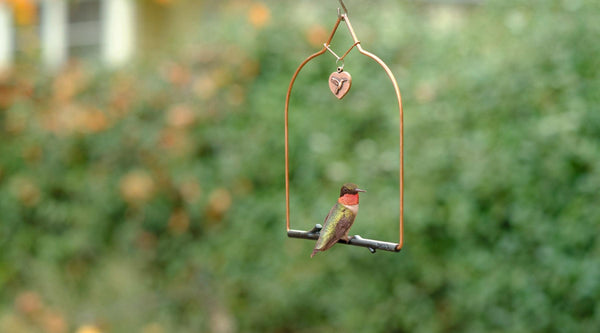
A Little Throne for Your Ruby-throated
New Jersey's only breeding hummingbird holds this territory alone from April through September — a dedicated perch nearby gives it a proper vantage point to guard the feeder without giving ground to whatever the Cape May funnel blows in next.
Shop Charm Redwood Swing →Ruby-throated vs. Black-chinned: Where Identification Actually Breaks Down
Adult male Ruby-throated and Black-chinned Hummingbirds are usually easy to tell apart in good light — one shows a red gorget, the other a black one edged in violet-purple. But females and immatures of the two species are close to identical in the field. The one reliable field mark on a perched bird is wing-to-tail proportions: Ruby-throated has a longer tail that extends visibly past the wingtips at rest, while Black-chinned has longer wings that reach the tip of the tail or extend just slightly beyond it.

Black-chinned is a genuine, recurring New Jersey rarity — detailed below — so an unusual-looking hummingbird here outside the core breeding season is worth a second look, even though Ruby-throated remains the far more likely explanation by a wide margin.
New Jersey's Recurring Rarities: The Cape May Funnel
Cape May's reputation as a migrant funnel isn't just for songbirds and raptors — it's the reason four hummingbird species turn up in New Jersey with enough regularity, across enough different years, that "rare" doesn't mean "once." All four remain genuine Review List rarities requiring documentation every time; none is a bird to expect at a feeder. Both kinds of pattern are covered honestly below.
Allen's Hummingbird Rare / Casual Visitor
Eight accepted records, most recently 2021, falling into two distinct clusters — 2000 to 2004, then 2017 to 2021 — rather than one continuous run. Like Rufous, records concentrate almost entirely in Cape May and Atlantic counties, consistent with the funnel effect.

Quick ID: Adult males show a coppery tail, eye patch, and belly against a bronze-green back, with a deep reddish-orange gorget. Females and immatures are extremely difficult to separate from female Rufous — see the dedicated comparison below.
Black-chinned Hummingbird Rare / Casual Visitor
Fourteen accepted records, most recently a bird photographed in Northfield, Atlantic County, October 22-27, 2025 — real recurring activity with clusters in 2015-2017 and 2019-2020, now extended by a fresh 2025 record. Genuine near-annual occurrence rather than an isolated incident.

Quick ID: Males show a velvety black throat, only revealing a thin purple band in direct light — otherwise it just looks solid black. Females are plain and pale-throated, best told apart from Ruby-throated by wing-to-tail proportions (see above).
Calliope Hummingbird Rare / Casual Visitor
Fourteen total accepted records. The pace has slowed from an earlier 2013-2016 cluster, but genuine activity continues into the recent past — one record in 2021, another in 2023. New Jersey's most notable recent Calliope didn't come from Cape May at all: a bird overwintered at a private feeder in Point Pleasant, Ocean County, from November 2020 through April 2021, a genuine event rather than a pattern to expect again.

Quick ID: North America's smallest breeding hummingbird, with a hunched posture and short tail. Males have a unique streaked, ray-like magenta throat unlike any other species' solid gorget. Females are tiny even by hummingbird standards, with a peachy wash across the underparts and fine green stippling on the throat.
Rufous Hummingbird Rare / Casual Visitor — the state's most frequent rarity
Fifty-nine total accepted records dating back to 1991, with near-continuous annual occurrence — including three separate records in December 2025 alone. It's one of the strongest recurring-rarity patterns found anywhere in this project, genuinely earning the "most frequent rare visitor" label even though it remains a full Review List species here, never a Migrant/Winter regular. Records run fall and sometimes into winter, almost entirely along the coast.

Quick ID: Adult males are unmistakably coppery-orange with an iridescent orange-red gorget; females and immatures are green-backed with rufous-washed flanks and rufous patches in the tail, virtually inseparable in the field from female Allen's without a close look at the spread tail.

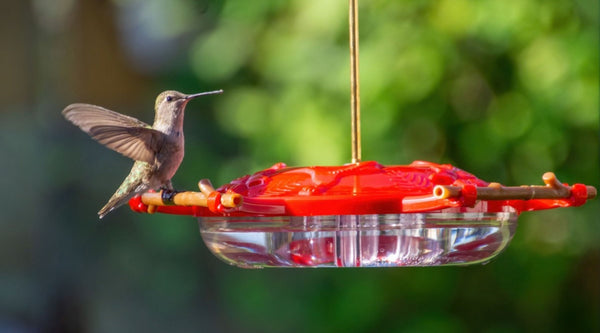
An Extra Feeder for Your Fall Visitors
Rufous is New Jersey's most frequent rare visitor by far, with real records running into December — a second feeder set well apart gives a fall or winter Rufous its own station instead of competing with whatever's left of your breeding Ruby-throateds.
Shop AspenPerch® Feeder →Rufous vs. Allen's: New Jersey's Hardest Identification Call
New Jersey's rarity list includes both Rufous and Allen's, and separating them — especially females and immatures — is widely regarded as one of the trickiest identification problems in the hobby. Adult males are the easier case: Allen's typically shows a bronze-green back where Rufous is solid copper, though a meaningful minority of male Rufous also show green backs, which wipes out that shortcut for some birds.
The reliable method is tail feather shape, visible only when the tail is spread: Allen's shows narrow outer tail feathers throughout, while Rufous shows broader ones with a distinctive notch on the second feather from center. This usually requires a photo of a fanned tail or a bird in the hand to check with confidence — which is also, simply on the numbers, worth weighing against Rufous being by far the more frequently recorded of the two in New Jersey.

Make Your Sanctuary Worth a Detour
Cape May's funnel effect means a genuinely rare bird could show up any fall — a real nectar recipe with electrolytes and calcium gives a hummingbird that's already gone hundreds of miles off course a real reason to stick around and get documented.
Shop Nectarlyte® Powder →If You're Lucky: New Jersey's Genuine One-Offs
Beyond the four Cape May regulars above, New Jersey has recorded three individual birds so far out of range that each one made state or national birding news. None is a species to expect — but all three prove a New Jersey feeder can occasionally produce something remarkable.
Broad-billed Hummingbird Historic / Accidental
New Jersey's only accepted record: a single bird at Heislerville, Cumberland County, in November 2022 — proof that truly rare birds can appear almost anywhere in the state, not just the Cape May corridor. Nothing has been recorded since.

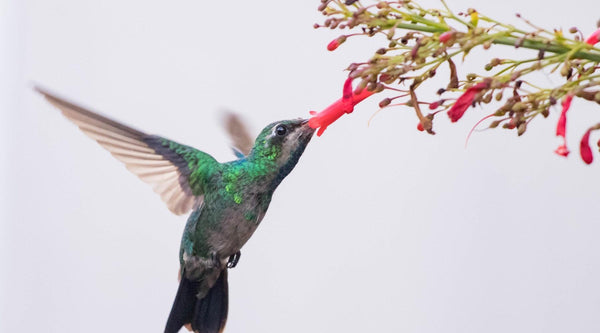
Quick ID: A vivid red bill tipped in black is diagnostic on both sexes; adult males add a shimmering blue throat and rich green body — a genuinely striking combination with nothing else in New Jersey to confuse it with. Females are golden-green above and gray below, with a white line behind the eye.
Broad-tailed Hummingbird Historic / Accidental
New Jersey's only accepted record: a bird documented in the 2011-12 season, banded and identification-confirmed. Nothing has been recorded since — a single isolated occurrence, not a pattern to expect.

Quick ID: Males have a rose-magenta throat and produce a loud, distinctive metallic wing trill in flight — often heard before seen. Females show green throat spotting rather than solid color, with a pale eyering that helps separate her from similar species.
Mexican Violetear Historic / Accidental
Two accepted records, twenty years apart — 2005 and 2025 — with no recurring pattern between them. Genuinely one of the most infrequent New Jersey rarities despite two confirmed occurrences.

Quick ID: Both sexes look essentially alike — an all-green hummingbird with a glittering violet patch across the ear coverts and upper chest, and a blackish band crossing the blue-green tail.

Give Every Visitor a Reason to Stay
Feeders bring them in, but real nectar sources are what make a yard worth staying in — a native wildflower mix keeps something blooming for every visitor New Jersey sees, from the reliable Ruby-throated breeder to the once-ever accidentals.
Shop Wildflower Seed →New Jersey Hummingbirds at a Glance
| Species | New Jersey Records | Best Chance |
|---|---|---|
| Ruby-throated | Only breeder, statewide | Mid-April through September |
| Allen's | 8 accepted records (2000-04, 2017-21) | Fall; Cape May & Atlantic Co. |
| Black-chinned | 14 accepted records, most recent Oct 2025 | Genuine near-annual pattern; Cape May area |
| Calliope | 14 accepted records; slowed since 2013-16 peak | Not expected — but genuinely recurring |
| Rufous | 59 accepted records; near-continuous since 1991 | Fall, sometimes winter; Cape May & Atlantic Co. |
| Broad-billed | 1 accepted record (Nov 2022), NJ's only | Not expected — genuine one-off |
| Broad-tailed | 1 accepted record (2011-12), NJ's only | Not expected — genuine one-off |
| Mexican Violetear | 2 accepted records (2005, 2025) | Not expected — genuine rarity |
Frequently Asked Questions
How many species of hummingbirds are in New Jersey?
Eight species have been documented in New Jersey. Ruby-throated is the only breeder; Allen's, Black-chinned, Calliope, and Rufous are all genuine recurring Review List rarities with multi-year records; and Broad-billed, Broad-tailed, and Mexican Violetear are each single or twice-ever accidentals.
Do hummingbirds stay in New Jersey year-round?
No. Ruby-throated Hummingbird, New Jersey's only breeding species, does not overwinter in the state under normal conditions. Any hummingbird spotted in winter is almost certainly a rare western vagrant — most often Rufous, which has real records running into December and January.
What is New Jersey's most common rare hummingbird?
Rufous Hummingbird, by a wide margin — 59 accepted records since 1991, including three in December 2025 alone. It's never been reclassified as a Migrant/Winter regular here, but its committee record is one of the strongest recurring-rarity patterns documented anywhere in this project.
Where in New Jersey am I most likely to see a rare hummingbird?
The southern coast, especially Cape May and Atlantic counties, accounts for the large majority of Allen's, Black-chinned, and Rufous records, consistent with Cape May's reputation as a migrant funnel. Calliope and the three historic accidentals are the exceptions — genuine rarities have turned up as far afield as Ocean, Cumberland, and other counties, so a truly unusual bird can appear almost anywhere.
How do I tell Rufous and Allen's Hummingbirds apart?
Adult males are the easier case: Allen's shows a bronze-green back where Rufous is typically solid copper, though some male Rufous also show green backs. Females and immatures are extremely difficult to separate — the reliable field mark is the shape of the spread outer tail feathers, narrow on Allen's and broader with a notch on Rufous, which usually requires a photo or a bird in the hand to check.
For feeder setup, nectar ratios, and native plants that support these species, head back to our how-to-attract-hummingbirds-in-New-Jersey guide. For region-by-region arrival and departure windows, see the New Jersey hummingbird calendar.
Why We Created This
Pop's Birding has been helping hummingbird lovers for three generations. One of the questions our customers ask most often is "What hummingbirds are actually in my state?" — and for New Jersey, most answers online stop at "Ruby-throated, plus the occasional rarity," without capturing just how strong some of those rarity patterns actually are, or how many species get left off the list entirely. We built this page to give a direct, sourced answer: the complete, officially documented list — all eight species, not five — with real identification detail and an honest account of which rarities are genuinely recurring versus which are true one-offs.
How We Created This
We pulled eBird bar chart data for New Jersey statewide to see which species show a real, measurable presence at genuine scale, rather than a handful of local checklists — only Ruby-throated cleared that bar, with every rare species, including Rufous despite its strong committee record, peaking under two-tenths of a percent. That's not a contradiction: eBird frequency measures how often a species shows up in random birdwatching checklists, while the New Jersey Bird Records Committee's own accepted-record archive measures confirmed, documented occurrences over decades, and we built this page around the committee data because it's the more honest measure of how established each rarity actually is. For every species we cross-checked against that committee archive rather than eBird frequency alone, drawing a real distinction between rarities with genuine multi-year activity — Allen's, Black-chinned, Calliope, and Rufous — and species whose entire New Jersey record is one or two isolated sightings, like Broad-billed, Broad-tailed, and Mexican Violetear.
Sources
- New Jersey Bird Records Committee, List of Accepted Records of Rare Birds in New Jersey, through December 2025. Source for every species' accepted-record count, dates, and counties on this page.
- New Jersey Bird Records Committee, Review List. Source for New Jersey's full 8-species hummingbird list and review status.
- New Jersey Audubon, Cape May Bird Observatory. Source for Cape May's migrant-funnel context.
- eBird bar chart data, Cornell Lab of Ornithology — New Jersey statewide.
Know before they arrive
You don't have to keep this calendar taped to the fridge. Insider Birding Access members get seasonal notes timed to your region — when to have feeders out, what the birds are doing right now, and what's worth doing in your yard this season. We take the guesswork out of the calendar. Joining takes about thirty seconds, and there's 10% off your first order in it.
Join Insider Birding Access →Free to join. 10% off your first order.
Shop New Jersey's Hummingbird Favorites


Bethany Sloan has served as General Manager of Pop's Birding since 2010, continuing the legacy of her grandfather, William "Pops" Sloan, inventor of the Original Hummingbird Swing. A lifelong hummingbird enthusiast, educator, and independent researcher, she leads the company's educational content, including its 50-State Hummingbird Guide series, Regional Guide, Species Guide and Hummingbird Learning Center. Bethany combines scientific research, regional migration data, and more than 16 years of hands-on experience to create trusted educational resources for bird enthusiasts across North America.