Aug 30, 2026
Wisconsin Hummingbird Season: A Month-by-Month Calendar
Wisconsin's hummingbird season runs from mid-May through mid-September almost everywhere in the state — Ruby-throated Hummingbird is the only species that breeds here, and it arrives on nearly the same week statewide, from the Apostle Islands to the Illinois border. The real variation shows up on the way out: most of Wisconsin empties out by mid-September, but Dane County sees a genuine second act, with Rufous Hummingbird — a species that breeds far to the west — showing up reliably enough there each fall to keep feeders busy into November.
The short answer: Ruby-throated arrives statewide by mid-May and is gone from most of the state by mid-September. Rufous is real, annual, and concentrated overwhelmingly in Dane County, where it keeps a genuine presence going into early November — the one real exception to the rest of the state's calendar.
| Question | Answer |
|---|---|
| When do they arrive? | Mid-May, nearly statewide at once |
| When should feeders go up? | Early May, ahead of the first arrivals |
| When do they nest? | Late May into June, shortly after arrival |
| Busiest month? | August |
| When do they leave? | Mid-to-late September most of the state; Dane County into November |
| Any in winter? | No — by December the state is empty |
Free download
The whole year on one page
Wisconsin's arrival week, feeder-up date, and the real Dane County exception that keeps hummingbirds around a month longer than the rest of the state — sized 8.5" x 11" for easy reference and printing.
Download the printable calendarOne page · PDF · free to print and share
Wisconsin's Hummingbird Season at a Glance
Before the region-by-region detail below, here's the whole season in one picture.

How often Ruby-throated Hummingbird — Wisconsin's only confirmed breeder — shows up on eBird checklists, week by week, statewide, 2016–2025. Seven more species have been documented in Wisconsin, but only one, Rufous Hummingbird, has a real seasonal pattern worth charting — see its own chart just below. The rest are true rarities, most with just one or a handful of accepted records and no reliable eBird trail behind them. Full details in the Sources section below.
That chart tells you who's biggest, but it can hide who's smallest — Ruby-throated's huge peak visually flattens a real species like Rufous Hummingbird into what looks like nothing next to it, even though Rufous has a genuine season of its own. Here's the same data again, but scaled to Rufous's own peak instead of Ruby-throated's, so a species you'd never spot on the chart above still shows its actual shape below.

Rufous Hummingbird alone, scaled to its own real range — the only Wisconsin species outside Ruby-throated with a genuine, recurring multi-week pattern. Source: same eBird pull as above.
The five regions behind this page's detail
Bayfield (Lake Superior's south shore, the far north) · Portage (the central sands, roughly the state's midpoint) · La Crosse (the Mississippi River bluff country in the west) · Dane (Madison and the south-central region — home to Wisconsin's real Rufous Hummingbird story) · Milwaukee (the Lake Michigan shore in the southeast) — five distinct climate zones, chosen for genuinely different timing, not just population.

Arrival and departure windows by region, based on eBird checklist data (Cornell Lab of Ornithology), 2016–2025.
January, February & March: The Quiet Season
Genuinely nothing to report. Statewide and in all five tracked counties, both Ruby-throated and Rufous sit at zero this entire stretch — Ruby-throated hasn't arrived yet, and Rufous's fall presence has already faded out well before winter sets in (more on that in November and December below). If you're seeing a "hummingbird" at a Wisconsin feeder in these three months, it's worth a second look and a photo — real winter records exist for the state, but they're single-digit rarities, not something to expect in your own yard.
What to do: Nothing hummingbird-specific. If you keep a feeder up anyway, there's no real data reason to.
April: Getting Ready
Still quiet for most of the month. The first few Ruby-throateds usually turn up in the last week of April, a couple of weeks ahead of the main wave, so this is the month to get everything ready.

Set up before the wave arrives, not after.
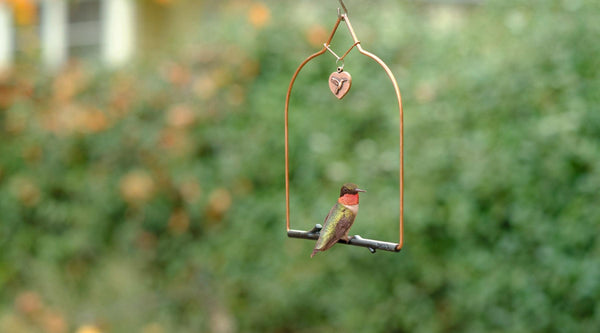
Wisconsin's hummingbirds show up within days of each other almost statewide, so there's a narrow window to have everything ready. Putting a swing out now gives returning birds a comfortable place to rest and claim as their own right from the start of the season.
Shop the Charm Redwood swing →May: The Season Begins
Wisconsin's real arrival, and the surprise in the data is how synchronized it is. Every one of the five tracked counties — from Bayfield on Lake Superior to Milwaukee on the Illinois line — reaches reliable Ruby-throated activity the same week, mid-May, give or take a few days. That's not what you'd expect from a state that spans nearly five degrees of latitude, and it's worth saying plainly: unlike many states, Wisconsin doesn't have a real north-to-south arrival gap.
What to do: Feeders up by early May, ahead of the wave rather than after it.
June: The Nesting Lull
Statewide sightings actually dip in June, falling by about a quarter from their mid-May level, before climbing again through the summer. That's not birds leaving; it's nesting settling in. Incubating and brooding females spend more time on the nest and less time visibly working a feeder, which shows up in the data as a real, temporary lull rather than a departure.
Why nesting season is the demanding one
There's a wrinkle specific to hummingbirds. Most female birds build up a temporary calcium store in their bones, called medullary bone, and draw on it to make eggshell. Hummingbirds have very little of it, so a laying female has less in reserve. Researchers have seen nesting females eating wood ash and other mineral-rich materials, which they think helps replace the calcium that goes into eggs. In one 1994 study, every bird seen eating ash was a female tending a nest.

It's part of why Pop's Nectar includes calcium and electrolytes rather than sugar alone. Nesting females need extra calcium during egg-laying, and plain sugar water has essentially none. Read more on the research behind it.
Shop Nectarlyte® 8 oz →July: Building Toward the Peak
Numbers climb steadily out of June's lull, and Wisconsin's summer heat brings the usual pest pressure right alongside the birds — ants and bees competing for the same nectar hummingbirds need.
Keep pests off without pesticides — hummingbirds rely on small insects for protein, so spraying near a feeder can cost them a food source, not just protect one.
AspenPerch®'s built-in ant moat blocks ants with a water barrier, and HummGuard® Nectar Tips keep bees and wasps out without changing anything for the birds.


August: The Season's Peak
Wisconsin's single busiest stretch of the year: Ruby-throated hits its statewide peak in the first week of August, when about three in ten birdwatchers report one. This is also the real pre-migration fueling window — birds are building fat reserves for the trip south, and feeder demand is at its highest of the year right before the sharp September decline.
This is the month to be generous, not economical.
Birds fueling for a long flight need feeders topped up more often — the large 2lb Nectarlyte® powder or the Nectarade® liquid concentrate keeps you from running out mid-surge.


September: The Big Departure
This is when most of Wisconsin's hummingbirds leave. Bayfield, La Crosse, and Portage all drop below reliable activity by mid-September; Milwaukee's birds leave a little later, into late September. Statewide, numbers fall from August's peak to near zero within about a month — the fastest single stretch of change all year.
What to do: Take your feeder down about two weeks after your last sighting, not by a fixed date — that accounts for your own yard and this year's weather better than any calendar can. If you're in Dane County, keep at least one feeder up regardless: it's the one region that doesn't follow the rest of the state's September exit.
October: Rufous Hummingbird's Real Season
Ruby-throated is gone from essentially the entire state by now. But October is when Rufous Hummingbird's real presence builds — Rufous sightings climb to their own small peak in early October, and they're concentrated overwhelmingly in Dane County. It's real and annual, not a fluke sighting: a genuine, recurring fall pattern, just a much smaller one than Ruby-throated's summer season.

This is the planting month.
Sow now and native wildflowers get the cold, moist period most varieties need to bloom reliably next spring.
Shop the Perfect Little Sanctuary® blend →November & December: The Last Stragglers
Dane County's real story continues into November — Rufous stays reliably present there into early November, a genuine extension backed by real checklist volume, not just a stray individual or two. By December, though, even Dane's birds have left for good. Unlike some states farther south or nearer the coast, Wisconsin's Rufous doesn't overwinter here; it builds through the fall and then leaves completely rather than settling in for the cold months. By the time December arrives, the whole state — Dane included — has returned to the same quiet stretch that opens this calendar.
What to do: If you're in Dane County, there's real reason to keep a feeder up through early November. Everywhere else, the season's effectively over by the time November starts.
The Year at a Glance
| Month | What's happening |
|---|---|
| Jan – Mar | The quiet season — no real signal anywhere in the state |
| April | First few birds in the last week; get feeders and swings ready |
| May | Arrival completes statewide, nearly all at once |
| June | A real dip as nesting settles in — not a sign birds have left |
| July | Numbers build back; pest season |
| August | Statewide peak (30%, first week); pre-migration fueling |
| September | The big departure — most of the state empties out |
| October | Ruby-throated gone; Rufous's real season, concentrated in Dane County |
| Nov – Dec | Dane's last stragglers into early November; fully quiet by December |
Frequently Asked Questions
When do hummingbirds arrive in Wisconsin?
Mid-May, and unusually evenly across the state — Bayfield in the far north and Milwaukee in the southeast both reach reliable activity the same week, which isn't the case in most states this size.
When do hummingbirds leave Wisconsin?
Most of the state's hummingbirds leave by mid-to-late September. The one real exception is Dane County, where Rufous Hummingbird keeps a genuine presence going into early November.
When do hummingbirds leave northern Wisconsin?
Earlier than the rest of the state, not later. Bayfield County — Wisconsin's real far-north region, on Lake Superior — is the first place in the state where hummingbirds leave, by mid-September, about a week to two weeks ahead of Milwaukee in the southeast.
Are there hummingbirds in Wisconsin in the winter?
No, not reliably. By December the entire state, including Dane County's Rufous population, has gone quiet. A hummingbird at a Wisconsin feeder in January or February would be a genuine rarity worth documenting, not something to expect.
Why does my Dane County feeder still have hummingbirds in October?
That's almost certainly Rufous Hummingbird, not a late Ruby-throated. Dane County carries the great majority of Wisconsin's real Rufous signal, and its real season — building through September, peaking in early October — runs a full month past when Ruby-throated has left the rest of the state.
Why We Built This Calendar
Pop's Birding has been helping hummingbird lovers for three generations. One of the questions our customers ask most often is "When do hummingbirds arrive and leave my state?" — we built this calendar to give a direct, sourced answer, not a generic one. Most timing advice online gives a single date for an entire state, and for Wisconsin the surprise isn't where that falls short on arrival — arrival really is close to a single date here — it's that departure genuinely isn't. Dane County keeps hummingbirds around a full month longer than the rest of the state, and a single "gone by September" answer would be wrong for that one real, checkable region.
How We Built This Calendar
Every date on this page comes from ten years of eBird checklists (2016–2025) for Wisconsin as a whole and five counties spread across the state: Bayfield, Portage, La Crosse, Dane and Milwaukee. We count a region's hummingbirds as reliably present from the first week its sightings reach a quarter of that region's own seasonal peak, and we checked the number of checklists behind every finding before trusting it. That check is why Dane County's fall Rufous season is on this page and similar-looking blips in Portage and Milwaukee are not. The biggest finding: the whole state arrives within the same week, and the real differences show up on the way out.
Sources
- eBird bar chart data, Cornell Lab of Ornithology — Wisconsin statewide plus Bayfield, Portage, La Crosse, Dane, and Milwaukee counties, 2016–2025. Source for all arrival, departure, and peak figures.
- Wisconsin Society for Ornithology, Official Checklist of Wisconsin Birds (updated 23 March 2025). Source for Wisconsin's full 8-species list and status codes for every rare visitor.
- Wisconsin Society for Ornithology, Rare Bird Records. Source for individual rare-species record counts and dates.
- des Lauriers, J. R. (1994). Hummingbirds eating ashes. The Auk, 111(3), 755–756. Documents five nesting female hummingbirds eating wood ash; no males were seen doing so in that study.
- Adam, M. D., & des Lauriers, J. R. (1998). Observations of hummingbirds ingesting mineral-rich compounds. Journal of Field Ornithology, 69, 257–261. Source for hummingbirds' greatly reduced medullary bone and for the mineral-rich materials they eat.
- Werning, S. (2018). Medullary bone is phylogenetically widespread and its skeletal distribution varies by taxon. Journal of Ornithology, 159, 527–543. Source for medullary bone being confirmed in hummingbirds.
Know before they arrive
You don't have to keep this calendar taped to the fridge. Insider Birding Access members get seasonal notes timed to your region — when to have feeders out, what the birds are doing right now, and what's worth doing in your yard this season. We take the guesswork out of the calendar. Joining takes about thirty seconds, and there's 10% off your first order in it.
Join Insider Birding Access →Free to join. 10% off your first order.
Shop Wisconsin's Hummingbird Favorites


Bethany Sloan has served as General Manager of Pop's Birding since 2010, continuing the legacy of her grandfather, William "Pops" Sloan, inventor of the Original Hummingbird Swing. A lifelong hummingbird enthusiast, educator, and independent researcher, she leads the company's educational content, including its 50-State Hummingbird Guide series, Regional Guide, Species Guide and Hummingbird Learning Center. Bethany combines scientific research, regional migration data, and more than 16 years of hands-on experience to create trusted educational resources for bird enthusiasts across North America.