Aug 24, 2026
The Birds That Actually Prey on Hummingbirds (Hint: Not the Big Hawks)
A Pop's Birding customer recently wrote to us worried after watching a red-tailed hawk circle lazily over her yard, feeder full of hummingbirds below it. She wanted to know if she should take the feeder down. We had good news for her — and it wasn't the answer she expected.
It turns out one of the most common hummingbird worries is aimed at the wrong bird entirely. So we went back to the peer-reviewed research and Cornell Lab's own species accounts to sort out which birds genuinely threaten hummingbirds, and which ones — despite their fearsome reputation — really don't.
Do Hawks Eat Hummingbirds? Mostly No — Here's the Exception
Large, soaring hawks like the Red-tailed Hawk hunt from a perch or on the wing, targeting rodents and larger birds — a hummingbird is simply too small, too fast, and too low-reward to chase. One researcher who has studied this closely put it memorably: a hawk is roughly 190 times the size of a hummingbird, so hunting one makes about as much sense as a person chasing down a single fly. It's rarely worth the effort.
There's an important exception, though, and it comes down to size within a single family. Cooper's Hawk and the Sharp-shinned Hawk are closely related — both are "bird hawks" in the genus Accipiter — but they're built very differently. A Cooper's Hawk is roughly crow-sized. A Sharp-shinned Hawk, the smallest hawk in North America, is roughly the size of a Blue Jay. That size difference matters enormously, and it's exactly why one of these two hawks is a genuine hummingbird predator and the other essentially isn't.
Sharp-shinned Hawk: The Best-Documented Threat
If one bird earns the title of "real hummingbird predator," it's the Sharp-shinned Hawk. Cornell Lab's All About Birds confirms songbirds make up roughly 90 percent of its diet, and researchers studying Ruby-throated Hummingbirds during fall migration on the Alabama coast directly witnessed and published an account of a Sharp-shinned Hawk flying straight at a hovering hummingbird, snatching it in its talons, and flying off. It's the clearest, most direct piece of published evidence in this entire guide.
Merlin: The Small, Fierce Falcon
Merlins are compact, fast falcons built for exactly this kind of hunting — Cornell describes them using surprise, high-speed attacks to take small birds in midair. The documentation here goes back further than you might expect: in 1937, a Ruby-throated Hummingbird was found in the stomach of a Merlin (then commonly called a "Pigeon Hawk") collected in Louisiana, a case published in the ornithological journal The Auk the following year and still cited by researchers today as one of the clearest confirmed records of Merlin predation on a hummingbird.
Loggerhead Shrike: The "Butcherbird"
The Loggerhead Shrike earns its nickname honestly. Lacking a raptor's talons, Cornell Lab explains, shrikes instead skewer their kills on thorns or barbed wire, or wedge them into tight crevices, to make them easier to eat and to build a stockpile for later. Cornell, Audubon, and the International Hummingbird Society all independently list hummingbirds among the small birds shrikes are documented to take — a genuinely striking image, and a good reminder that not every hummingbird threat looks like what you'd expect.
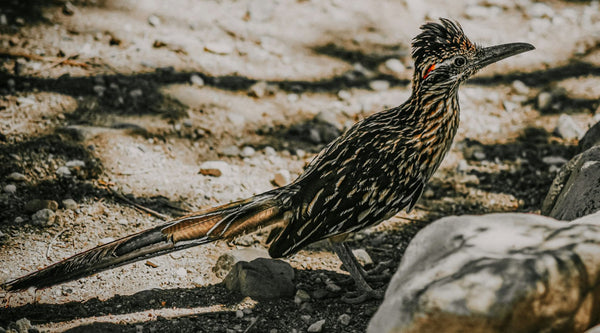
Greater Roadrunner: The Sneaky Southwest Threat
In the desert Southwest, there's one more bird worth knowing, and it's a genuine surprise to most people: the Greater Roadrunner. Cornell Lab confirms roadrunners can jump straight up to snag insects, bats, and yes, hummingbirds in flight, and they're documented ambushing hummingbirds directly at backyard feeders. One wildlife photographer's video, featured by Audubon, captured a roadrunner nabbing a hummingbird mid-feed at a yard hosting roughly 150 hummingbirds at peak season — though by his own account, the roadrunner only succeeds on about one attempt in ten. It's rare enough to be genuinely remarkable when it's caught on camera.

How We Built This Guide
Pop's Birding has been helping hummingbird lovers for three generations, and "should I worry about the hawk circling my yard?" is a question we hear constantly. We wanted a real, sourced answer rather than a blanket "yes, hawks eat hummingbirds" — so every claim here was checked against Cornell Lab of Ornithology, Audubon, state wildlife agencies, and peer-reviewed research before it made the page.
The most important thing we found is also the most reassuring: most hawks genuinely aren't a threat, and the ones that are turn out to be smaller and less obvious than most people assume. We'd rather correct that misconception clearly than let a big, visible hawk take the blame for something it almost never does. That's the same standard we bring to every guide in this Learning Center.
About Pop's Birding
Pop's Birding has been a family-owned, three-generation hummingbird company since the very beginning — the same family that invented the original hummingbird swing. Based in Idaho, with a second home in Atlanta, we've spent decades learning what actually helps backyard hummingbirds thrive, and we bring that same care to every guide we write.
What You Can Do to Help
You don't need to worry about every bird of prey that passes overhead — most aren't a real threat, and hawks in particular can quietly work in a hummingbird's favor. A few thoughtful habits still help with the predators that are genuine risks:
- Think about feeder placement. Open sightlines make it easier for a hummingbird to spot a fast-approaching Sharp-shinned Hawk or Merlin in time to escape. Our feeder placement guide covers exactly how to balance visibility with cover.
- Offer more than one feeding spot. Multiple feeders spread out around a yard make it harder for any single ambush predator, including a shrike or a roadrunner, to stake out one location.
- Don't take a hawk sighting as a bad sign. A soaring red-tail or a nesting Cooper's Hawk in the area is far more likely to be neutral, or even quietly helpful, than a real threat to your hummingbirds.
This rounds out our deep-dive guides on hummingbird predators, alongside egg predators, snakes, and spiders and other insects — plus cats, the single most significant threat overall (our Cats and Hummingbirds guide), and the invasive Chinese praying mantis, a genuine insect threat at feeders (our Praying Mantis guide). And sometimes the real danger isn't a predator at all — a feeder placed too close to a window can pose more risk than any animal on this list, which is exactly why we wrote a dedicated Window Strikes guide. In fact, the largest published study of hummingbird rehab admissions found predators weren't even the leading cause — being found on the ground, weak from exhaustion or bad weather, was. No study has ranked predators from most to least common, and we won't pretend otherwise. Between all of them, and our full, honestly caveated Hummingbird Predators: The Complete Guide, you'll have the complete, honest picture of what genuinely threatens hummingbirds — and just as importantly, what doesn't.
Hummingbird Bird Predators, at a Glance
| Bird | Real Threat? | The Evidence |
|---|---|---|
| Sharp-shinned Hawk | Yes — the strongest case | Directly witnessed and published capture of a Ruby-throated Hummingbird |
| Merlin | Yes | Confirmed via a documented case published in The Auk |
| Loggerhead Shrike | Yes | Listed by Cornell and Audubon among documented small-bird prey |
| Greater Roadrunner | Yes, in the Southwest | Cornell-documented feeder ambushes; rare but camera-confirmed |
| Cooper's Hawk / Red-tailed Hawk | Essentially no | Too large and slow to make the chase worthwhile; may indirectly protect nests |
Frequently Asked Questions
Do hawks eat hummingbirds?
Most hawks don't — they're too large and too slow to make chasing a hummingbird worth the effort. The exception is the Sharp-shinned Hawk, the smallest hawk in North America, which has been directly documented catching hummingbirds.
What eats an adult hummingbird?
The best-documented avian predators are the Sharp-shinned Hawk, the Merlin, and the Loggerhead Shrike, plus the Greater Roadrunner in the Southwest. All four have been directly documented by researchers or wildlife agencies.
Do sharp-shinned hawks eat hummingbirds?
Yes. It's the most directly documented case in this guide — researchers published a firsthand account of a Sharp-shinned Hawk catching a Ruby-throated Hummingbird in flight during fall migration.
Does a merlin eat hummingbirds?
Yes. A Ruby-throated Hummingbird was found in the stomach of a Merlin in a case documented in the ornithological journal The Auk in 1938, and Merlins remain a recognized small-bird predator.
Do roadrunners eat hummingbirds?
Yes, though it's uncommon and mostly documented in the Southwest. Roadrunners are known to ambush hummingbirds at feeders, but by most accounts they only succeed a small fraction of the time.

Bethany Sloan has served as General Manager of Pop's Birding since 2010, continuing the legacy of her grandfather, William "Pops" Sloan, inventor of the Original Hummingbird Swing. A lifelong hummingbird enthusiast, educator, and independent researcher, she leads the company's educational content, including its 50-State Hummingbird Guide series, Regional Guide, Species Guide and Hummingbird Learning Center. Bethany combines scientific research, regional migration data, and more than 16 years of hands-on experience to create trusted educational resources for bird enthusiasts across North America.