Jul 22, 2026
Ruby-throated Hummingbird: The East's Only Breeding Hummingbird
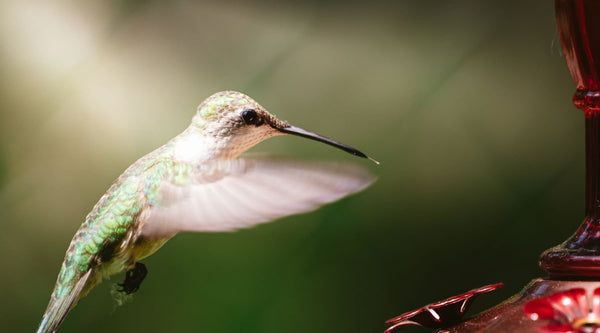
There's a bird barely outweighing a penny that will, this fall, fly nonstop across 500 miles of open ocean — no rest stops, no islands, just open Gulf of Mexico water the entire way — using nothing but fat reserves it built up in the two weeks before departure. That's the Ruby-throated Hummingbird: the only hummingbird that breeds across the eastern United States, familiar enough to be the default mental image most Americans have of "a hummingbird," and one of the toughest, most improbable small animals in North America once you look past the flash of red at its throat.
Quick Facts
- Scientific name: Archilochus colubris
- Length: 2.8–3.5 inches (7–9 cm)
- Weight: 0.1–0.2 oz (2–6 g) — adult females average about 3.5 grams, adult males just 3.0 grams
- Wingspan: 3.1–4.3 inches (8–11 cm)
- Lifespan: most live only a few years; the oldest known individual was a female of at least 9 years, 2 months, recaptured and released during banding operations in West Virginia in 2014
- Population: an estimated 36 million (Partners in Flight), rated 8 out of 20 on the Continental Concern Score
- Population trend: Breeding Bird Survey data show steady long-term increase from 1966 through 2019 — but a 2021 analysis in Scientific Reports found the eastern population has been declining since roughly 2004 across most of the breeding range
- Conservation status: Least Concern (IUCN Red List, assessed by BirdLife International)
- Claim to fame: the only hummingbird that breeds across the entire eastern United States, and holder of one of the most demanding migratory routes, pound for pound, of any bird in the world
The Origin Story: How the Ruby-throated Hummingbird Got Its Name
The Ruby-throated Hummingbird was formally described for science in 1758 by Carl Linnaeus himself — the Swedish naturalist who created the entire system of binomial nomenclature still used to name species today. In the tenth edition of his landmark work Systema Naturae, Linnaeus classified the species as Trochilus colubris, basing his description on two earlier accounts: naturalist Mark Catesby's The Natural History of Carolina, Florida and the Bahama Islands (1729) and George Edwards's A Natural History of Uncommon Birds (1743). The official type locality — the place tied to the original specimen description — is South Carolina, a detail preserved in Cornell Lab's Birds of the World account for Archilochus colubris.
The species name colubris comes from colibrí, the Spanish word for "hummingbird" — itself thought to derive from a Carib or Galibi word carried back to Europe from the Caribbean. Nearly a century after Linnaeus, in 1854, German naturalist Ludwig Reichenbach moved the species into a new genus, Archilochus, where it remains today alongside its only congener and closest relative, the Black-chinned Hummingbird. Between them, those two birds divide North America almost cleanly down the middle.
The common name itself is straightforward once you see an adult male in good light: an iridescent, ruby-red throat patch, or gorget, that can look brilliant crimson from one angle and nearly black from another — a hallmark of structural color, produced by the physical structure of the feathers rather than by pigment.
Where the Ruby-throated Hummingbird Lives: The Largest Breeding Range of Any North American Hummingbird
According to Cornell Lab's Birds of the World, the Ruby-throated Hummingbird occupies the largest breeding range of any hummingbird species in North America — an enormous swath of territory stretching from central Canada down to the Gulf Coast, and from the Atlantic seaboard west to a strikingly straight north-south boundary just east of the 100th meridian. That's the same rough line that divides the humid East from the arid West across the central United States, and it tracks closely with the western edge of the eastern deciduous and mixed boreal forest this species is built for.
In winter, most Ruby-throated Hummingbirds relocate to southern Mexico and Central America, as far south as Costa Rica and Panama. A smaller number skip the tropics entirely and overwinter along the U.S. Gulf Coast and in southern Florida — these are wintering birds rather than a resident breeding population, since Florida's nesting Ruby-throats are concentrated in the north and center of the state.
How to Identify the Ruby-throated Hummingbird: Males vs. Females
Adult Males
The gorget is the giveaway: a brilliant iridescent ruby-red throat patch, bordered by a thin band of black around the cheek area, that can appear to switch on and off entirely depending on the angle of light — brilliant crimson one moment, nearly black the next. The back and crown are bright emerald or golden-green, the underparts gray-white, and the tail is forked and mostly black. The bill is slender and very slightly downcurved. Males are somewhat smaller than females, with marginally shorter bills.

Adult Females
No red throat at all — instead, a plain whitish throat, sometimes lightly marked with faint dusky streaks or small dark stipples. The tail is notched rather than deeply forked, with white tips to the outer feathers, visible as pale corners in flight. Females average slightly larger than males, a reversal of the usual pattern in birds.

Juveniles and Immatures
Young birds of both sexes closely resemble adult females at first — plain or lightly marked white throats and green-backed plumage. Juvenile males typically show heavier throat markings than females, and by late summer many begin developing a handful of scattered iridescent red feathers in the gorget as it fills in toward its adult appearance.

A Quick Note on Sound
Ruby-throated Hummingbirds beat their wings an average of 53 times per second — the source of the low humming sound that gives the entire family its name — with the rate increasing further during chases and courtship displays. Sharp, metallic chip notes are used during close-range disputes and territorial encounters, along with rapid chattering or squeaky scolding sounds during feeder disputes.
Behavior: Solitary, Territorial, and Endlessly Busy
Ruby-throated Hummingbirds are solitary for virtually their entire lives outside of the brief mating encounter — they migrate alone, feed alone, and (for males) take no part whatsoever in nesting or raising young. Both sexes fiercely defend feeding territories, chasing off rivals, insects, and birds many times their own size from a favored patch of flowers or a feeder. According to Rutgers Cooperative Extension, males will aggressively defend territory not just from other hummingbirds but from other bird species, bees, and wasps alike.
Feeding and Diet
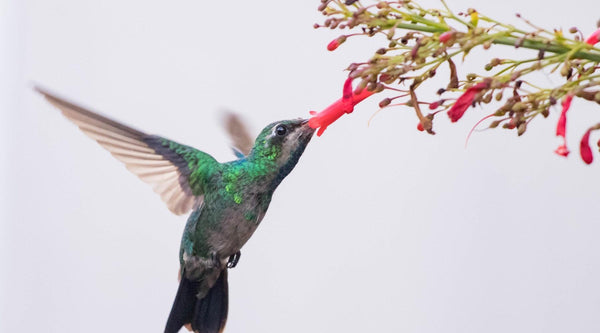
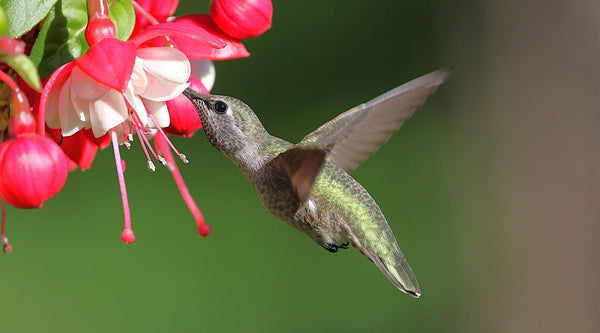
According to Cornell Lab's All About Birds, Ruby-throated Hummingbirds feed on the nectar of red or orange tubular flowers — trumpet creeper, cardinal flower, honeysuckle, jewelweed, bee balm, red buckeye, and red morning glory are all favorites — as well as feeders and, occasionally, tree sap.
Insects and spiders are just as essential to the diet as nectar, supplying protein nectar alone can't provide. Main prey includes mosquitoes, gnats, fruit flies, small bees, and spiders, caught either mid-air, gleaned directly from foliage, or pulled straight out of spider webs. Ruby-throated Hummingbirds will also visit sap wells drilled by Yellow-bellied Sapsuckers, picking off both the sap itself and the insects it attracts — an important food source for early spring migrants arriving before most flowers have opened.
Courtship and Mating
Males typically arrive at breeding grounds 7 to 10 days before females, immediately establishing and defending a territory. When a female enters that territory, the male performs an elaborate courtship display: a looping, U-shaped dive starting from as high as 50 feet above her, followed by shorter horizontal passes flown directly in front of her, flashing his red gorget with each pass. The display is accompanied by an audible whirring produced by the bird itself. (Worth noting: in western species like Anna's and Black-chinned, the dive sound has been traced specifically to specially modified tail feathers — a mechanism that has not been demonstrated in Ruby-throated.)
Mating is brief, and the male's involvement ends there entirely — females handle every subsequent stage, from nest-building through raising the young, entirely alone. Audubon's field guide notes that males typically go on to mate with multiple females across a single breeding season.
Nesting and Family Life
Females alone select the nest site, build the nest, incubate the eggs, and raise the young. According to Cornell Lab's All About Birds, favored sites are a slender, often descending branch of a deciduous tree — oak, hornbeam, birch, poplar, or hackberry are all documented choices, sometimes pine — usually 10 to 40 feet above the ground, though nests have also turned up on unlikely human-made supports like loops of chain, wire, and extension cords. The Tennessee Wildlife Resources Agency adds that the nest is often placed over a stream or another opening.
The nest itself is a real engineering feat: a walnut-sized cup about 2 inches across and 1 inch deep, with an inner cup roughly the size of a large thimble. It's built from thistle or dandelion down held together with spider silk and sometimes pine resin, and it sits directly on top of the branch rather than in a fork. The female stamps on the base to stiffen it and shapes the rim by pressing and smoothing it between her neck and chest — but the walls stay pliable, which is what lets the whole structure stretch as the chicks grow. Construction takes 6 to 10 days, and she finishes by decorating the exterior with bits of lichen and moss.
Clutch size is two pea-sized eggs, rarely one or three. She lays the first egg, then typically waits a day before laying the second, with incubation beginning only once both are laid. Incubation lasts 12 to 16 days, and hatchlings emerge with their eyes closed and naked apart from two small tracts of gray down along the back — under an inch long and entirely helpless.
The nestling period normally runs 18 to 23 days, though TWRA notes it can stretch anywhere from 14 to 31 days depending on food availability. By the time they leave, the young are noticeably larger than their mother, and she keeps feeding them for another ten days or so. Females in the southern US may raise one or two broods, occasionally three, sometimes starting a second nest while still feeding chicks from the first; females farther north typically have time for only one brood before migration season arrives.
Migration: One of the Most Demanding Journeys of Any North American Bird
This is the single most remarkable fact about the Ruby-throated Hummingbird, and it's backed by real field research: in the one to two weeks before fall migration, the species enters a state called hyperphagia, feeding intensively enough to nearly double its entire body weight. The USDA Forest Service documents birds going from about 3.25 grams to 6 grams, storing visible bands of fat across the back, belly, and throat.
That stored fat fuels a genuinely extraordinary journey. Many individuals fly directly across the Gulf of Mexico — the Forest Service describes a nonstop flight of up to 500 miles over a period of 18 to 22 hours under favorable conditions. No rest, no food, no water, the entire way.
Just how much fuel do they carry? More than the crossing actually requires, it turns out. Theodore Zenzal Jr. and Frank Moore of the University of Southern Mississippi spent five autumns at Bon Secour National Wildlife Refuge on the Alabama coast, banding and measuring 2,729 Ruby-throated Hummingbirds as they staged for the crossing. Using each bird's fat load and wing measurements, they modeled how far it could theoretically fly without stopping: an average potential range of about 2,262 kilometers (roughly 1,400 miles) in still air, with the best-fueled individuals carrying enough for well over twice that. Older birds and males came out ahead of younger birds and females.
It's worth being precise about what that number is and isn't. These are fuel-based estimates, not tracked flights — a 3-gram bird is far too small to carry a satellite transmitter, so no one has followed an individual across the Gulf. Zenzal himself has cautioned that the estimates assume still air, and real Gulf conditions in autumn rarely oblige. What the research establishes is that a well-fueled Ruby-throat carries a comfortable margin over the crossing distance — which is exactly why fall feeding matters so much.
Not every bird takes the water route. Others follow a longer but safer overland alternative, skirting the western Gulf by following the Texas coastline south into Mexico. Birds of the World is candid that the proportion of the population using the trans-Gulf versus the around-the-Gulf route is still largely unknown. What Zenzal and Moore did find is that older birds arrive at the coast earlier, in better condition, and with larger fuel loads than juveniles on their first migration — which suggests experience and body condition both shape what a given bird can attempt.
A related study used stable-hydrogen isotope analysis of tail feathers to trace individual migrants back to their probable natal latitudes, confirming that hummingbirds from across the entire eastern breeding range — from roughly 30° to 50° North — funnel through the same Gulf Coast stopover sites, in a sequence the authors describe as a type 1 chain migration pattern.
The risk is real. Ruby-throated Hummingbirds migrate during peak Atlantic hurricane season, and strong headwinds over open water can deplete fat reserves faster than a bird can replace them — under-fueled or unlucky individuals simply don't survive the crossing. The birds that do arrive on the Yucatan Peninsula often do so exhausted and severely depleted, and spend several days afterward feeding heavily before continuing on.
If you want to watch this unfold in real time, Journey North's migration tracking project maps citizen-reported first sightings as the wave moves north each spring.
Key papers: Zenzal, T. J., Jr. & Moore, F. R. (2016). "Stopover biology of Ruby-throated Hummingbirds (Archilochus colubris) during autumn migration." The Auk: Ornithological Advances 133(2):237–250. — Zenzal, T. J., Jr., Contina, A. J., Kelly, J. F. & Moore, F. R. (2018). "Temporal migration patterns between natal locations of Ruby-throated Hummingbirds and their Gulf Coast stopover site." Movement Ecology 6:2.
Following the Ruby-throated Across the Regions
No other North American hummingbird passes through as much of the country as this one. Five of the eight U.S. birding regions see Ruby-throats every year, and the calendar shifts by weeks as you move north:

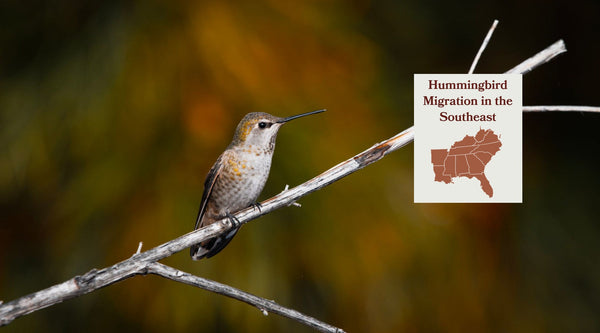
- Southeast — the front door. Gulf Coast arrivals in late February and early March are the first Ruby-throats of the year to reach the United States, many of them straight off a nonstop crossing of the Gulf of Mexico. Florida is the odd one out: birds nest in the north and center of the state, while a separate group of wintering birds stays in the far south rather than continuing to the tropics. Males arrive about a week ahead of females everywhere in the region.
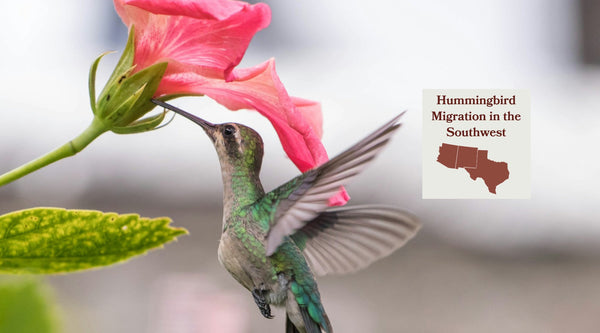
- Southwest — the overland detour. Birds that skip the Gulf crossing follow the Texas coast instead, which makes Texas a corridor more than a destination: nearly all of its nesting happens in the eastern Pineywoods and coastal prairies, and the rest of the state sees Ruby-throats only in passing. The first arrivals show up here as early as late February.
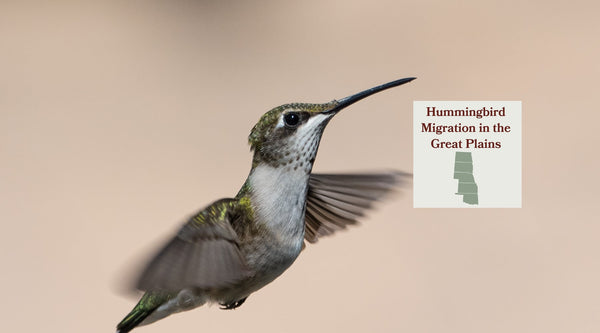
- Great Plains — the western wall. Ruby-throats breed east to roughly the 100th meridian and then stop along that remarkably straight north-south line. In practice that splits every state in the region: Kansas and Nebraska nest east of about their centers, the Dakotas in their eastern portions, and Oklahoma in its eastern half, where the far west belongs to the Black-chinned Hummingbird instead. Arrival runs mid-April in the south to May up north.
- Midwest — the heartland of the breeding range, and the only region where the answer is simply "everywhere." Birds fill in through April across Illinois, Indiana, Missouri, and Ohio, then into Michigan, Wisconsin, and Minnesota through May as the season moves north.
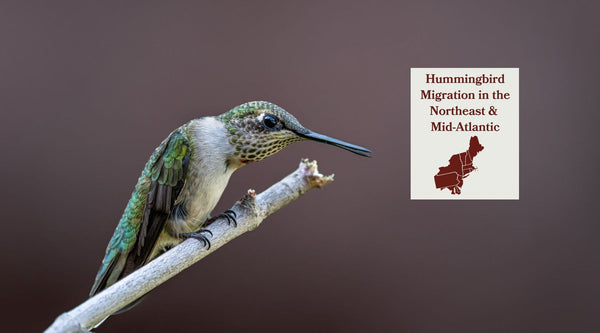
- Northeast & Mid-Atlantic — the last stop. Maryland, Delaware, and Virginia see birds in April, but northern New England waits until May, giving those states the shortest breeding window of the entire range.
Follow that sequence from February to May and you're tracking the same wave of birds moving north across the continent, one region at a time.
Torpor: Nightly Survival Mode — and a Migration Strategy
Like other hummingbirds, Ruby-throated Hummingbirds can enter torpor: a dramatic, controlled drop in both body temperature and metabolic rate that carries them through cold nights and lean stretches. The numbers are startling. A 2024 study in the Journal of Experimental Biology measured torpid Ruby-throats whose body temperature fell by nearly 25°C — from roughly 37°C down to about 13°C — while whole-animal metabolic rate dropped by 95%. That's a bird running at one-twentieth of its normal energy burn, essentially idling until sunrise.
The more surprising finding is that torpor isn't only an emergency measure. A 2021 study in eLife (Eberts, Guglielmo & Welch) tracked captive Ruby-throated Hummingbirds across a full summer and found the rules change as fall approaches. In midsummer, birds went torpid when they went to sleep with low fat stores — classic survival behavior. By late summer, the same birds were entering torpor on a consistent schedule and with high fat stores, and the more time they spent torpid, the more fat they gained. In other words, as migration nears, torpor flips from a way to survive the night into a way to bank fuel for the Gulf.
Which is a useful thing to know if you keep a feeder: the calories a Ruby-throat takes on at your yard in August aren't just getting it to morning. They're going into the tank.
Habitat
During the breeding season, Ruby-throated Hummingbirds favor deciduous and pine forests, forest edges, orchards, and gardens — anywhere offering a mix of nectar sources and suitable nesting cover. Audubon's field guide additionally lists coasts and shorelines, shrublands, savannas, thickets, and urban and suburban habitats among the environments where the species turns up regularly. In winter, the same birds shift into tropical deciduous forest and open, fairly dry tropical scrub, along with citrus groves, forest edges, hedgerows, river and marsh corridors, and old fields across their Mexican and Central American wintering range.
Ruby-throated Hummingbird by Region: Where and When to Find Them
Because this is the primary — often the only — hummingbird species across most of the eastern half of the country, the Ruby-throated Hummingbird is the featured species in the large majority of our state-by-state guides.
Build a Ruby-throated Hummingbird Sanctuary in Your Own Yard
Because this species undertakes one of the most physically demanding migrations of any North American bird, the single most valuable thing a backyard host can offer is a reliable, well-timed food source — both when hummingbirds first arrive hungry from a long spring journey, and again in late summer and fall, when they're building the fat reserves that will carry them across the Gulf of Mexico or around the Texas coast.
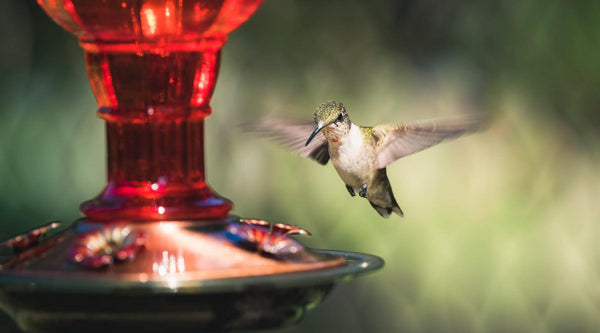
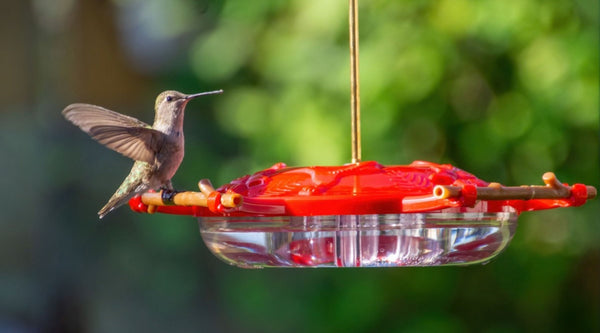
- Use a leak-proof, easy-to-clean feeder like the AspenPerch® Hummingbird Feeder, with a comfort perch so birds can rest between sips rather than hovering the entire time.
- Keep nectar fresh and available from spring arrival through fall departure — this is especially critical in the weeks before migration, when a Ruby-throated Hummingbird may be trying to nearly double its body weight. Pop's Nectar, with added electrolytes and calcium, supports exactly this kind of intense energetic demand.
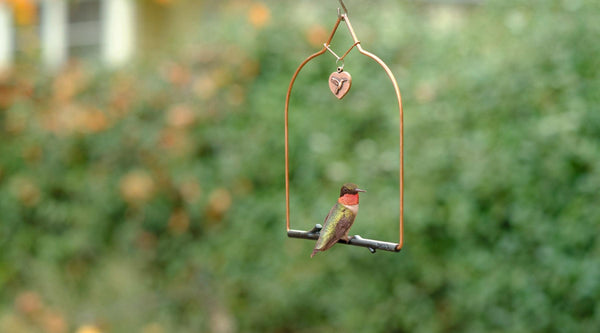
- Add a swing near your feeder — a Pop's Original Hummingbird Swing gives a territorial Ruby-throated Hummingbird a place to perch, rest, and watch over its feeding area between visits.
- Plant real native nectar sources, not just a feeder. Cardinal flower, trumpet creeper, bee balm, jewelweed, and red buckeye are all documented favorites, and timing a few of these to bloom in early spring and again in late summer directly supports both spring arrival and fall migration fueling.
- Skip the insecticide entirely. Since insects and spiders are a critical part of this species' diet — not an occasional snack — pesticide use removes food this bird depends on. Use HummGuard™ nectar tips instead to keep bees and wasps out of your feeder without harming anything else.
Timing is the part that changes most from state to state. Hummingbird feeding in Texas starts in February and doubles as a fall staging ground for birds rounding the Gulf, while Georgia and Ohio sit squarely in the breeding heartland with a long, steady season. Farther north, attracting hummingbirds in New York means a compressed window that doesn't open until May. Find your own state in the full hummingbird guide by state series.
Frequently Asked Questions
Why is it called the Ruby-throated Hummingbird if only males have a red throat?
The species was named for the male's gorget, the iridescent red throat patch that gives the bird its common name. Females and juveniles lack this feature entirely, but naming conventions for birds typically describe the more visually distinctive sex, which in hummingbirds is almost always the male.
How far do Ruby-throated Hummingbirds migrate?
Many travel over 3,000 miles round trip between breeding grounds in the eastern US and Canada and wintering grounds in Mexico and Central America, including a nonstop flight across the Gulf of Mexico of up to 500 miles that can take roughly 18 to 22 hours.
Do Ruby-throated Hummingbirds really fly across the Gulf of Mexico without stopping?
Yes, many of them do. No one has tracked an individual across the water — the birds are far too small to carry a transmitter — but researchers at the University of Southern Mississippi measured the fat loads of thousands of birds staging on the Alabama coast and calculated that an average well-fueled Ruby-throat carries enough fuel for a potential nonstop flight of roughly 1,400 miles in still air, comfortably more than the crossing requires. Others take a longer overland route around the Gulf via the Texas coastline instead.
How do Ruby-throated Hummingbirds prepare for migration?
They enter a state called hyperphagia, nearly doubling their body weight in the one to two weeks before departure by feeding heavily on nectar and insects — going from roughly 3.25 grams to 6 grams — and storing the extra weight as fat. Research also shows they shift how they use torpor in late summer, going into it on a schedule to bank additional fat rather than only to survive cold nights.
Is the Ruby-throated Hummingbird the only hummingbird in the eastern United States?
It's the only hummingbird that breeds across the eastern US as a whole. The Texas Breeding Bird Atlas puts it precisely: Ruby-throats are the only hummingbirds breeding regularly in eastern North America outside Texas and Oklahoma. The Buff-bellied Hummingbird's range overlaps theirs along the central and southern Texas coast, and rare western species like the Rufous Hummingbird occasionally show up in the East as vagrants, especially in fall and winter.
Are Ruby-throated Hummingbird numbers going up or down?
It depends on the window. Breeding Bird Survey data show a steady long-term increase from 1966 through 2019, and Partners in Flight estimates a healthy global population of 36 million. But a 2021 analysis in Scientific Reports found the eastern population has been declining since around 2004 across most of its breeding range — so the long-term picture is good while the recent trend bears watching.
How can I attract Ruby-throated Hummingbirds to my yard?
Keep a leak-proof feeder filled with fresh, dye-free nectar up from spring through fall, and plant native, tubular red or orange flowers like cardinal flower, trumpet creeper, and bee balm alongside it for a real food source, not just a supplement.
At Pop's Birding, we believe every backyard — big or small — has room for a little more wonder. Explore our feeders, nectars, swings, and wildflower seed blends to start building your own hummingbird sanctuary today.