Aug 24, 2026
All About Hummingbirds: An Introductory Guide to the Species
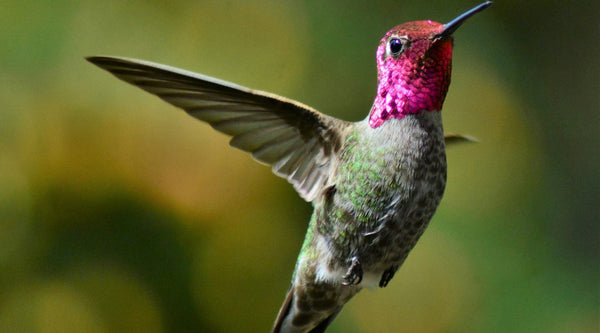
The first time you actually see one — not a blur at the edge of your vision, but a hummingbird holding still in midair three feet from your face, its throat flashing red one second and black the next — you understand why people build their whole yards around them. That's usually the moment someone starts searching for answers: what is this thing, how does it do that, and is there really only one kind, or a dozen?
There isn't just one kind, and what it's doing in midair is genuinely unlike anything else in the bird world. This guide covers what a hummingbird actually is, how many species you'll realistically encounter in the US and Canada, how they eat, fly, nest, and migrate, and — since a lot of what circulates about them online is folklore dressed up as fact — which common "facts" don't hold up once you check them against the actual research.
- Family: Trochilidae — closest living relatives are swifts
- Species worldwide: about 363, found only in the Americas
- Species in the US & Canada: 14 occur regularly
- Size range: from the 2-gram Bee Hummingbird of Cuba, the smallest bird species on Earth, up to hummingbirds several times that size
- Diet: flower nectar for energy, plus small insects and spiders for protein
- Heart rate: roughly 480–650 beats per minute at rest, over 1,200 in flight
- Direct flight speed: around 30 mph, with courtship dives well over that
- Range: Alaska to Tierra del Fuego — the Western Hemisphere only
- Typical lifespan: 3–5 years
What Makes a Hummingbird a Hummingbird
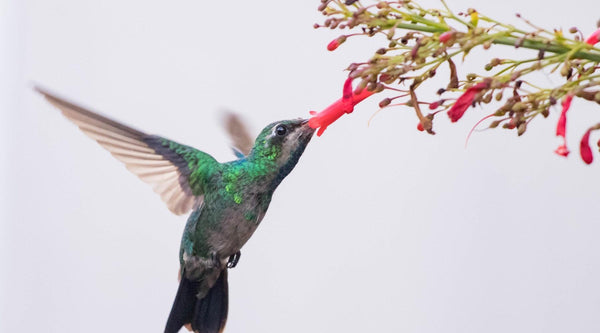
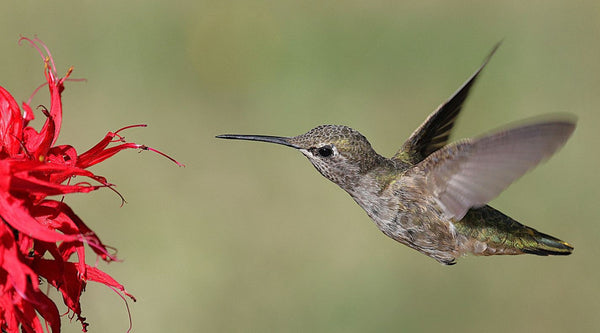
Hummingbirds make up the family Trochilidae, and their closest living relatives aren't the songbirds you'd guess — they're swifts. What actually sets a hummingbird apart is a shoulder joint no other bird has: it rotates almost a full circle, which is what lets the wing trace a figure-eight instead of the usual up-and-down flap. That figure-eight generates lift on both halves of the stroke, and it's the reason a hummingbird can do something genuinely unique among birds — hover in place with real control, not just hang in the wind, and fly backward on purpose.
Most male hummingbirds, and some females, carry a gorget — a patch of stiff, iridescent throat feathers that can look flat black one moment and burn bright red, purple, or green the next, depending entirely on the angle of the light hitting them. The color isn't pigment. It's structure, the same way a soap bubble shows color without being dyed, which is exactly why a bird can look completely different from one second to the next without moving.

How Many Species Are There — And How Many Will You Actually See?
Worldwide, the hummingbird family runs to about 363 species (AviList, the 2025 global bird checklist), almost all of them concentrated in Central and South America, where the habitat diversity is highest. Of those, only a relative handful regularly reach the US and Canada: 14 species. We cover all 14 in real depth — range, identification, what to expect in your part of the country — in our full guide to the hummingbirds of the United States. In short, those 14 are:
Ruby-throated Hummingbird, the only breeding species across nearly the entire eastern half of the continent; Anna's Hummingbird, a Pacific Coast resident that sticks around all winter; Black-chinned Hummingbird and Rufous Hummingbird, both widespread across the West; Calliope Hummingbird, the smallest bird that breeds in the US; Broad-tailed Hummingbird, a high-elevation Rocky Mountain specialist; Costa's Hummingbird and Broad-billed Hummingbird of the southwestern deserts; Allen's Hummingbird, a California coastal specialist easily confused with Rufous; Buff-bellied Hummingbird, a Gulf Coast Texas specialty; and four sky-island and borderland species that reach the US mainly in Arizona and the Big Bend region of Texas — Rivoli's Hummingbird, Blue-throated Mountain-gem, Violet-crowned Hummingbird, and Lucifer Hummingbird.
Which of those 14 you'll actually see depends entirely on where you live. Most of the country only ever sees one or two species regularly — that's normal, not a sign you're missing out. Find your own state's full list, including the genuine rarities, in our state-by-state hummingbird guides.
That's the 14 you're likely to actually cross paths with — but "likely" isn't the same as "only." Over the years, a handful of true rarities have wandered into the US far outside their normal range, some documented only a few times ever. Here's every hummingbird species that's been recorded within U.S. borders, common and rare alike:

Where They Live & How They Migrate
Hummingbirds exist only in the Western Hemisphere — nowhere else on Earth, ever, naturally. Their range runs from Alaska all the way to Tierra del Fuego at the southern tip of South America, but the concentration of species drops off sharply the farther you get from the tropics. Most of the country never sees more than one or two species at a feeder; that's not a shortfall, it's just how the family is distributed.
Migration timing and direction vary enormously by species and by region, which is why there's no single answer to "when do hummingbirds arrive." Our full migration guide breaks it down region by region, but broadly: Rufous Hummingbirds head north along the Pacific in spring and swing back south through the Rockies and desert Southwest starting as early as July, on one of the longest migrations of any bird in the world relative to body size — roughly 3,900 miles one way, or about 78 million times its own body length. Ruby-throated Hummingbirds push north through the East and cross the Gulf of Mexico nonstop, a flight of nearly 500 miles that takes 18 to 22 hours with no place to land along the way.
One genuine myth worth retiring here: hummingbirds don't migrate in flocks, and they definitely don't hitch a ride on the backs of geese. Each bird — including juveniles on their very first trip south, with no adult to follow — makes the journey alone, on its own internal schedule.
Explore the full picture for your part of the country:
- Pacific & West Migration Guide
- Pacific Northwest Migration Guide
- Mountain West Migration Guide
- Southwest Migration Guide
- Great Plains Migration Guide
- Midwest Migration Guide
- Southeast Migration Guide
- Northeast & Mid-Atlantic Migration Guide
How They Eat, Fly, and Survive
A hummingbird's day is a running math problem it has to keep solving. Nectar supplies the sugar that fuels the flying, but flying that much muscle that fast burns through it almost as fast as it comes in — so hummingbirds also catch small insects and spiders, mid-air or straight out of spider webs, for the protein that nectar alone can't provide. Protein is what builds new feathers and, for females, what makes eggs possible.
The engine behind all of this is a heart that's genuinely unusual even by bird standards. At rest, a Ruby-throated Hummingbird's heart beats roughly 480 to 650 times a minute; in flight, it climbs past 1,200. In direct flight, a hummingbird typically covers ground at around 30 mph, and during a male's courtship dive that speed climbs sharply — one well-studied case, the Anna's Hummingbird, has been clocked folding its wings and dropping at close to 385 body lengths per second, the fastest length-scaled speed ever recorded for any vertebrate, bird or otherwise.
That pace has a real cost, and hummingbirds have a genuine adaptation to cover it: torpor. On a cold night, or any time food has been scarce, a hummingbird can drop its metabolic rate dramatically and let its heart rate fall to as low as 50 beats per minute — a controlled, reversible shutdown, not true hibernation, that can happen on any night of the year the bird needs it. Without it, the math simply wouldn't work; a bird burning calories that fast couldn't survive an ordinary cold night on a full stomach alone.

Nests, Eggs & Baby Hummingbirds
If you've never seen a baby hummingbird, that's not bad luck — it's by design. A Ruby-throated Hummingbird's nest is barely two inches across, built entirely by the female from thistle or dandelion down bound together with strands of spider silk, then camouflaged on the outside with flecks of lichen and moss until it looks like a knot on the branch rather than a nest. It's usually 10 to 40 feet up, on a slender, often downward-sloping limb, and the spider silk isn't just glue — it lets the whole structure stretch as the chicks inside grow.
The clutch is almost always two eggs, each barely half a gram — smaller than a jellybean — incubated by the female alone for 12 to 14 days. The chicks stay in the nest another 18 to 22 days before fledging, and there's no pair bond and no co-parenting in hummingbirds at all: the male's involvement ends at mating, and every bit of building, incubating, and feeding falls to the female.
Put those three facts together — a nest the size of a walnut shell that's actively camouflaged, a nestling period barely three weeks long, and juveniles that look almost exactly like adult females within days of leaving the nest — and it's clear why the public almost never spots one. You're not missing something obvious; you're looking for something that was built specifically not to be found.

Territorial, Not Social
Hummingbirds don't flock, don't pair-bond, and don't share well. A male Ruby-throated Hummingbird will aggressively defend a patch of flowers or a feeder against every other hummingbird that shows up, chasing off birds many times its own size if it has to — and the economics behind that behavior have actually been studied directly: defending a reliable, concentrated nectar source is worth the energy it costs, right up until the territory gets too big or too crowded to patrol effectively, at which point the bird stops bothering.

Common Hummingbird Myths, Answered
Myth: Hummingbirds hitch a ride on the backs of geese during migration. They don't. It's a persistent piece of folklore, not a documented behavior — hummingbirds migrate under their own power, on their own schedule, and mostly alone.
Myth: A decorative "hummingbird house" gives them somewhere to nest. Hummingbirds aren't cavity nesters. They build open, cup-shaped nests on tree branches and shrubs, never in a box or birdhouse of any kind — a marketed "hummingbird house" is decorative only, not something a hummingbird will ever actually use.
Myth: An early hummingbird is a "scout" sent ahead of the rest. There's no evidence for this at all. Hummingbirds migrate individually — an early arrival is simply one bird that happened to leave, or fly, a little earlier than the others, not an advance scout reporting back to anyone.
How to Attract Hummingbirds to Your Yard
Once you know what you're looking at, the next question is usually how to get more of it in your own backyard. The short version: a clean, leak-proof feeder, nectar without red dye, and a mix of native tubular flowers will do more than anything else. For the full setup — feeder placement, nectar ratios, pest control, and native plant picks — see our complete state-by-state attracting guides, built specifically for your region's climate and species.
Frequently Asked Questions
What are some genuinely interesting hummingbird facts?
A hummingbird's heart beats over 1,200 times a minute in flight. They're the only birds that can fly backward and hover in true, controlled place — not just hang in the wind. The smallest bird species on Earth, the Bee Hummingbird of Cuba, weighs less than a nickel. And despite weighing a few grams, the Rufous Hummingbird makes one of the longest migrations of any bird alive, relative to its size.
Why do we not see baby hummingbirds?
Because the nest is built specifically to avoid being found. It's barely two inches across, camouflaged with lichen, usually well off the ground on a slender branch — and the chicks are only in it for about three weeks before fledging looking almost exactly like an adult female. There's a very short window where a baby hummingbird looks different from an adult, and it happens almost entirely out of sight.
Do hummingbirds have to eat every 15 minutes?
Not quite that literally, but it's close in spirit — hummingbirds feed in many small meals throughout the day rather than a few large ones, because their metabolism can't store much reserve energy at once. Going a night without eating is genuinely risky, which is exactly why torpor exists as a backup plan.
What does it mean if a hummingbird visits your yard?
Biologically, it means your yard has something the bird needs right now — a nectar source, a safe perch, or a spot along its migration route — not a message. If you're hoping to turn a single visit into a regular one, our state attracting guides cover exactly what keeps them coming back.
Why We Built This
Pop's Birding has been helping hummingbird lovers for three generations. One of the questions we hear most often, in one form or another, is simply "what actually is a hummingbird?" — and most of what turns up when you search for it is either a generic facts list or a fragment of a bigger picture. We built this guide to give a real, complete, honestly sourced answer, and to connect it to the deeper resources — every US and Canada species, every state, every migration region — most other pages on this topic don't have.
How We Built This
Every claim on this page is checked against primary wildlife research before it's published — USGS Bird Banding Laboratory data, and peer-reviewed ornithology literature, never a hobbyist blog or an unattributed "fun facts" list. Where sources disagree — and on a few points, like the exact number of hummingbird species worldwide, real taxonomic authorities genuinely do disagree — we say so and name which current authority we're using, rather than picking whichever number sounds cleanest.
The "myths" section exists for the same reason: a few widely repeated hummingbird claims — geese-back migration, "scout" birds, backyard hummingbird houses — simply don't hold up against the actual research, so we say that plainly instead of repeating them because everyone else does.
Find Your State
Every state has its own mix of species, its own arrival and departure dates, and its own printable cheat sheet. Find your state's complete hummingbird guide here.

Bethany Sloan has served as General Manager of Pop's Birding since 2010, continuing the legacy of her grandfather, William "Pops" Sloan, inventor of the Original Hummingbird Swing. A lifelong hummingbird enthusiast, educator, and independent researcher, she leads the company's educational content, including its 50-State Hummingbird Guide series, Regional Guide, Species Guide and Hummingbird Learning Center. Bethany combines scientific research, regional migration data, and more than 16 years of hands-on experience to create trusted educational resources for bird enthusiasts across North America.