Jul 26, 2026
Massachusetts Hummingbird Season: A Month-by-Month Calendar
Timing derived from eBird data, 2016–2025 (sourced July 2026)
Massachusetts has the shortest and most sharply defined hummingbird season of any state we've mapped. An arrival that goes from zero to everywhere in about three weeks, a quiet stretch in June that fools people every year, and a peak that catches almost everyone out.
Massachusetts's Hummingbird Season at a Glance

How often each species turns up on eBird checklists, week by week — statewide, 2016–2025.
The short answer: they return in the last week of April, peak in the final week of August, and are gone by early October — about five months. From November through March there are none at all.
| Question | Answer |
|---|---|
| When do they arrive? | Last week of April |
| When should feeders go up? | Last week of April, statewide |
| When do they nest? | May through July; usually one brood |
| When is the peak? | Final week of August |
| When do they leave? | Through September; gone by early October |
| How long do they stay? | About five months |
Free download
The whole year on one page
Arrival and departure windows, the June lull, the late-August peak, and when to bring feeders in — printed small enough to tape inside the shed door.
Download the Massachusetts cheat sheetOne page · PDF · free to print and share
One state, one window. Unlike the bigger states in this series, Massachusetts doesn't need regional calendars. From the Berkshires to Nantucket is under 190 miles, and the arrival spread across that distance is a matter of days. Where the west does differ is in breeding density — the Berkshire highlands hold the state's highest concentration of nesting hummingbirds, and Cape Cod and the Islands are among the lowest.
January & February: The Season Is Closed
Empty — with one asterisk.
| Statewide | No hummingbirds in ten years of records. The season is genuinely closed. |
| The asterisk | A handful of western vagrants have survived New England winters at maintained feeders. One Rufous stayed in South Orleans from December through late March; another pair wintered in Orleans into March. |
What to do: Nothing, unless you already have a bird. If you do have a hummingbird at a Massachusetts feeder in January, you have something genuinely rare — keep the nectar from freezing, and get in touch with a local birding group. Our winter hummingbird feeder care guide covers heated feeders and the two-feeder swap.
March: Still Nothing
| Statewide | Zero. The birds that will nest here are still in Central America or working their way up the Gulf Coast. |
What to do: A good month to clean and check your feeders, and to get columbine in the ground if you're planting.
April: The Season Opens in the Last Week
The season opens in the last week.
| Weeks 1–2 | Nothing yet. |
| Week 3 | The very first reports appear — a trickle, and only just. |
| Week 4 | Hang your feeders. First arrivals proper. Mass Audubon's own advice is the last week of April, and this is why. |

Get your feeder up before the first scout arrives, not after.
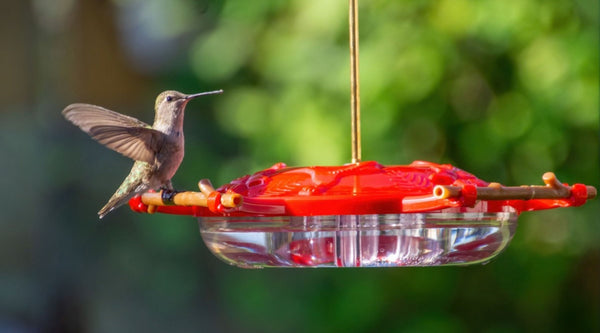
Males arrive first and spend a week or two claiming territory before the females follow — so a feeder that sits untouched through the first days of May isn't a failed feeder, it's an early one. Hummingbirds have exceptional spatial memory, and the feeder that's already there when they arrive is the one they'll come back to next year. AspenPerch® has a built-in ant moat and a Polyperch® comfort perch, so birds rest between sips instead of hovering through the whole meal.
Shop AspenPerch® →May: Zero to Everywhere in Three Weeks
| Week 1 | Reports jump fivefold in seven days. |
| Week 2 | Nearly double again. Females arriving now. |
| Week 3 | Spring high point. This is as visible as hummingbirds get until August. |
| Late May | Numbers start easing as birds settle onto territory. Nesting is underway. |
What to do: Keep it full — this is the month a new feeder gets found. And if you plant one thing, make it eastern red columbine: it blooms now, exactly when the birds land.

Keep pests off without pesticides — worth getting ahead of now, before nesting season makes spray a bad idea near the nest.
AspenPerch®'s built-in ant moat blocks ants with a water barrier, and HummGuard® Nectar Tips keep bees and wasps out without changing anything for the birds.
Shop HummGuard® →June: The Lull That Fools Everyone
| Statewide | Reports drop by about a third from the May high and sit flat all month. |
| Why | Females are sitting on nests. A hummingbird incubating two eggs leaves for only a few minutes at a time — she's still there, just not where you can see her. |
What to do: Don't take a quiet June feeder as the season ending. It's the middle of the breeding season, and the busiest stretch of the year is eight weeks away. Skip the insecticide too — nesting females need small insects and spiders for protein, and spider silk is what binds the nest together.
Why nesting season is the demanding one
There's a wrinkle specific to hummingbirds. Most female birds build up a temporary calcium store in their bones, called medullary bone, and draw on it to make eggshell. Hummingbirds have very little of it, so a laying female has less in reserve. Researchers have seen nesting females eating wood ash and other mineral-rich materials, which they think helps replace the calcium that goes into eggs. In one 1994 study, every bird seen eating ash was a female tending a nest.

It's part of why Pop's Nectar includes calcium and electrolytes rather than sugar alone. Nesting females need extra calcium during egg-laying, and plain sugar water has essentially none. Read more on the research behind it.
Shop Nectarlyte® 8 oz →July: The Young Start Flying
| Statewide | Climbing steadily all month as fledglings join the adults at feeders. |
| Departures | Some adult males are already leaving. Their part of the season ends first. |
August: Peak of the Year
The biggest month of the year, and it ends the season.
| All month | Climbing week on week to the year's high point in the final week of August. |
| Who's here | Mostly females and this year's young, fueling for the trip. Many adult males have already gone. |
| Why so early | Georgia and Alabama peak in September, Florida in October. New England birds start earlier because they have farther to travel. |
Be generous, not economical — this is the month that matters most.
Birds fueling for a long flight south need feeders topped up more often, and it's also the month most people have stopped paying attention. The 2lb Nectarlyte® powder or the Nectarade® liquid concentrate keeps you from running out mid-surge.


September: A Fast, Orderly Exit
| Week 1 | Still busy, just off the peak. |
| Weeks 2–4 | Falls away by roughly half each week. By month's end there's very little left. |
| Berkshires | A few days ahead of the coast, as in spring. |
What to do: Keep it up. The last birds through are usually that summer's young making the trip for the first time, and a feeder left standing does not delay anyone — hummingbirds migrate on day length, not food supply.
October: Effectively Over by Week One
| Week 1 | A final scattering of stragglers. |
| Rest of month | Essentially nothing. |
| Planting | Prime wildflower sowing window opens — aim for around the first frost. |
What to do: Leave one feeder up into early October for the last stragglers, then bring it in before hard freezes become common. Frozen nectar can injure a hummingbird's bill.

This is the planting month.
Sow the Perfect Little Sanctuary® blend now — Massachusetts winters give most of the varieties exactly the cold, moist stratification they need.
Shop the Perfect Little Sanctuary® blend →November & December: Vagrant Season
Season over — and the most interesting months for a birder.
| Statewide | Ruby-throated are long gone. |
| Cape Cod & the Islands | Vagrant season. Black-chinned records cluster from late October to mid-December. Calliope records run late October through December. Rufous can appear any time from late July onward and occasionally stay all winter. |
Why November is when Massachusetts gets interesting. Every one of the state's six accepted hummingbird species except Ruby-throated is a western or southwestern bird that has no business being here. Almost all of them are found in late fall or early winter, and almost all on Cape Cod, Nantucket, or Martha's Vineyard.
They're found because somebody left a feeder up. The state's only Broad-billed Hummingbird spent from late August to early December 2008 in a Dennis garden. If something turns up at your feeder in November, photograph it and tell a local birding group — female and immature hummingbirds usually can't be named without a licensed bander measuring them in the hand.

Seeing one bird chase everyone else off?
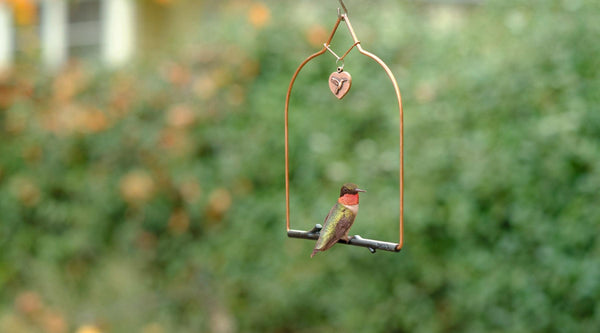
That's usually a resident claiming both the feeder and a nearby swing as its own guarded territory. Rufous, the most likely vagrant to show up at a Massachusetts feeder, is a famously territorial bird — a second feeder and a second swing, spaced out of sight of each other, gives an arriving bird its own station instead of a fight over yours.
Shop a second swing →The Year at a Glance
| When | What |
|---|---|
| Last week of April | Feeders up statewide; first arrivals |
| Mid-May | Spring high point; females arriving |
| June | The nesting lull — quiet feeders are normal |
| May – July | Nesting season; usually one brood, occasionally two |
| Last week of August | Peak of the year |
| September | Fast departure; halving week on week |
| Early October | Last stragglers; feeders down before hard freezes |
| October – November | Sow wildflower seed, around the first frost |
| November – December | Vagrant season on the Cape and Islands |
Frequently Asked Questions
When do hummingbirds return to Massachusetts?
The last week of April. The very first reports appear in the third week, but the season opens properly in the fourth — which is why Mass Audubon recommends feeders go out then.
When do hummingbirds leave Massachusetts?
Numbers fall away through September, roughly halving each week after the first, and by early October there's very little left. A final scattering of stragglers passes through in the first week of October.
How long do hummingbirds stay in Massachusetts?
About five months — late April through September. It's the shortest and most sharply defined hummingbird season of any state we've mapped.
When do hummingbirds lay eggs in Massachusetts?
Nesting runs May through July. The female incubates two pea-sized eggs for around two weeks and feeds the young for another three. In New England's shorter season she'll usually manage one brood, occasionally two.
Why is my hummingbird feeder quiet in June?
Because females are sitting on nests. Reports drop by about a third from the May high and stay flat all month. A hummingbird incubating eggs leaves for only a few minutes at a time — she's still there, just not where you can see her.
Why We Built This Calendar
Pop's Birding has been helping hummingbird lovers for three generations, and one of the questions our customers ask most often is "When do hummingbirds arrive and leave my state?" We built this calendar to give a direct, sourced answer, not a generic one. Massachusetts surprises people twice. The busiest week of the whole year is the last week of August, not midsummer, and June goes quiet because females are sitting on their nests, not because the birds have left. A feeder taken down in either stretch misses some of the best of the season.
How We Built This Calendar
The month-by-month pattern comes from ten years of eBird checklists (2016–2025) for Massachusetts, read week by week. We cross-checked feeder timing and nesting biology against Mass Audubon, and rare species against the Massachusetts Avian Records Committee. We also tested whether the state needed separate regional calendars and found it doesn't: across a state under 190 miles wide, the Berkshires and the coast arrive within days of each other.
Sources
- eBird bar chart data, Cornell Lab of Ornithology — Massachusetts statewide, 2016–2025. Source for all month-by-month seasonal figures.
- Mass Audubon — Breeding Bird Atlas 2, feeder timing, nectar recipe, and nesting biology.
- Massachusetts Avian Records Committee — accepted rarity records and their dates.
- des Lauriers, J. R. (1994). Hummingbirds eating ashes. The Auk, 111(3), 755–756. Documents five nesting female hummingbirds eating wood ash; no males were seen doing so in that study.
- Adam, M. D., & des Lauriers, J. R. (1998). Observations of hummingbirds ingesting mineral-rich compounds. Journal of Field Ornithology, 69, 257–261. Source for hummingbirds' greatly reduced medullary bone and for the mineral-rich materials they eat.
- Werning, S. (2018). Medullary bone is phylogenetically widespread and its skeletal distribution varies by taxon. Journal of Ornithology, 159, 527–543. Source for medullary bone being confirmed in hummingbirds.
Know before they arrive
You don't have to keep this calendar taped to the fridge. Insider Birding Access members get seasonal notes timed to your region — when to have feeders out, what the birds are doing right now, and what's worth doing in your yard this season. We take the guesswork out of the calendar. Joining takes about thirty seconds, and there's 10% off your first order in it.
Join Insider Birding Access →Free to join. 10% off your first order.
Shop Massachusetts's Hummingbird Favorites


Bethany Sloan has served as General Manager of Pop's Birding since 2010, continuing the legacy of her grandfather, William "Pops" Sloan, inventor of the Original Hummingbird Swing. A lifelong hummingbird enthusiast, educator, and independent researcher, she leads the company's educational content, including its 50-State Hummingbird Guide series, Regional Guide, Species Guide and Hummingbird Learning Center. Bethany combines scientific research, regional migration data, and more than 16 years of hands-on experience to create trusted educational resources for bird enthusiasts across North America.