Aug 19, 2026
Rufous Hummingbird Behavior: Diet, Courtship, Nesting & Family
Watch a Rufous Hummingbird at a feeder for five minutes and you'll see the whole personality on display: a bird about a third the weight of a chickadee, chasing off intruders twice its own weight, then vanishing into a wildflower meadow it will remember, in detail, for at least a year. This is the guide to everything that isn't about identifying the bird or tracking its migration — the diet, the courtship, the nesting, the memory that made it a favorite of behavioral scientists, and the family of look-alike relatives it belongs to. Looking for a different species entirely? Start with our full overview of hummingbird species found in the United States.
Summary: Rufous Hummingbirds are famously aggressive, feed on nectar plus small insects for protein, and are one of the best-studied wild birds for spatial memory. They belong to the genus Selasphorus, alongside Allen's, Broad-tailed, and Calliope Hummingbirds.
Quick Facts
- Typical wild lifespan: a few years; most don't reach old age
- Oldest recorded individual: a female of at least 8 years, 11 months, recaught during banding in British Columbia in 2004
- Clutch size: 2 eggs (occasionally 3), incubated 15–17 days
- Diet: nectar from tubular flowers, plus small insects for protein and fat
- Claim to fame: a leading model species for studying spatial memory and cognition in wild birds
The Feistiest Hummingbird in North America
Cornell Lab doesn't mince words on this point: the Rufous Hummingbird is "one of the feistiest hummingbird in North America." The brilliant orange male and the green-and-orange female are relentless attackers at flowers and feeders, going after — if not always defeating — even the large hummingbirds of the Southwest, which can be double their weight.
The aggression is not seasonal and not limited to males. All ages and both sexes are aggressive, even during brief one- to two-week stopovers in the course of migration, when they may chase off resident Broad-tailed, Broad-billed, Violet-crowned, and Black-chinned Hummingbirds. Males may drive females off feeders even during the breeding season. Cornell adds that they've been seen chasing chipmunks away from their nests.

Feeding and Diet
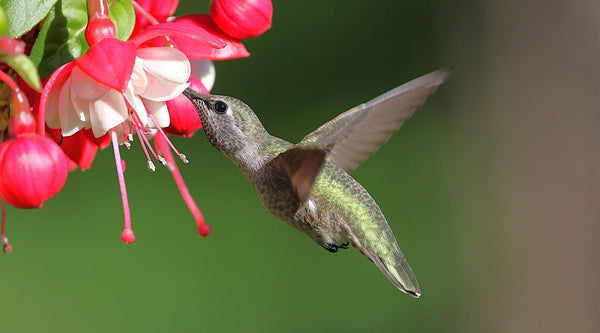
Rufous Hummingbirds feed primarily on nectar from colorful, tubular flowers. Cornell lists columbine, scarlet gilia, penstemon, Indian paintbrush, mints, lilies, fireweeds, larkspurs, currants, and heaths among their favorites, and they readily use sugar-water feeders as well.
Insects supply the protein and fat that nectar can't. Rufous Hummingbirds take gnats, midges, and flies from the air and aphids from plants — and, as the U.S. Forest Service notes, they also practice "a bit of larceny by stealing insects already caught in spider webs." This matters more than it might sound: research on nestling provisioning has found that female Rufous Hummingbirds increase their insect foraging while feeding chicks, since arthropods are a key source of protein, vitamins, and fatty acids.
That appetite reaches its extreme right before migration. A study of Rufous Hummingbirds refueling at isolated subalpine stopover meadows found they can pack on as much as 44% of their body mass in just the four days before resuming their journey south — among the most dramatic short-term weight gain documented in any migratory bird. For the full migration story, see our Migration & Range guide.

Courtship and Mating
Males perform a dive display when a female enters their breeding territory — and the actual shape of that dive has been misreported for years. It's often described as "a steep oval or J-shaped" flight, but a field study of 26 territorial males on their breeding grounds in Alberta found the dive is specifically J-shaped — concave upward on both the climb and the descent — and explicitly contradicts the older reports of an oval pattern. If the female perches, the male may switch to low, horizontal figure-8s flown directly in front of her, producing whining and popping sounds at the bottom of the dive. A single male may mate with several females across a season, and — as with all North American hummingbirds — his involvement ends there. Females handle nest-building, incubation, and raising the young entirely alone.
Key paper: Hurly, T. A., R. D. Scott, and S. D. Healy (2001). "The Function of Displays of Male Rufous Hummingbirds." The Condor: Ornithological Applications 103(3):647–651.

Nesting and Raising Young
Females waste no time: they begin nesting within three days of arriving on the breeding grounds. Nests go up to about 30 feet high in coniferous or deciduous trees — Sitka spruce, western red cedar, Douglas-fir, pines, hemlock, birch, maples, thimbleberry, and occasionally ferns or vines — hidden among drooping branches.
Here's a genuinely odd detail: although this is not a colonially nesting species, Cornell reports observations from Washington state of 20 or more Rufous Hummingbird nests only a few yards apart in the same tree. For a bird this territorial, that's a remarkable exception.
The female builds alone, using soft plant down held together with spider web, then decorates (or camouflages) the outside with lichen, moss, and bark. Finished nests are about 2 inches across with an inner cup about an inch wide. Nests may be reused the following year — though not necessarily by the same individual.
Clutch size is two to three tiny white eggs, each about half an inch long. Incubation runs 15 to 17 days. The nestling period runs longer than the incubation period — Birds of the World's breeding data, based on 15 nests studied in British Columbia and a separate chick-growth study, puts it at roughly 21 to 26 days. Hatchlings emerge with their eyes closed, naked apart from sparse gray down along the back, and entirely helpless. Unlike many hummingbirds farther south, Rufous females raise just one brood a season — there simply isn't time for more this far north.

Meet the Family: Selasphorus Relatives
The genus name Selasphorus comes from the Ancient Greek for "flame-bearing" — a nod to the fiery iridescence found throughout the group. Rufous shares that genus with three species you're likely to actually cross paths with in the field: Allen's Hummingbird, its closest look-alike and the species it's most often confused with; Broad-tailed Hummingbird, a larger high-elevation cousin found across the Rockies; and Calliope Hummingbird, North America's smallest breeding bird, which overlaps with Rufous across much of the Mountain West. A fourth relative, the Bumblebee Hummingbird, is a Mexican endemic that only rarely strays north to Arizona.
The Rufous Hummingbird was formally described for science in 1788 by German naturalist Johann Friedrich Gmelin, in his revised and expanded edition of Linnaeus's Systema Naturae. Gmelin based his description on two earlier accounts — the "ruff-necked hummingbird" described by John Latham in 1782, and the "ruffed honeysucker" described by Thomas Pennant in 1785 — and coined the binomial name Trochilus rufus. The species name rufus is Latin for "red" or "reddish," a direct reference to the male's vivid coppery-orange plumage.

Torpor
Like other hummingbirds, the Rufous Hummingbird can enter torpor — a controlled overnight drop in body temperature and metabolic rate — to survive cold nights and stretches when energy reserves run low. It matters more for this species than for most: it breeds farther north than any other hummingbird and migrates through high-elevation mountain country where overnight freezes are common even in summer. Reliable torpor is very likely part of what makes that extreme range, geographic and altitudinal, possible at all.
The Memory Behind the Migration
What makes this species a favorite of behavioral scientists is what it remembers. For decades, researchers T. Andrew Hurly and Susan Healy have run field experiments on wild Rufous Hummingbirds at breeding-season sites in southwestern Alberta, setting up arrays of artificial flowers within an individual bird's own territory. That work has repeatedly shown that Rufous Hummingbirds can remember which specific flowers they've already emptied — over retention intervals ranging from a few minutes to more than an hour — can learn and adapt to a flower's particular refill schedule, and can even learn the correct order in which to revisit a whole sequence of flowers, a foraging strategy called "traplining."
The recall isn't limited to a single season, either. As All About Birds puts it, some birds have been seen returning from migration and investigating where a feeder had been the previous year, even though it had since been moved. It has made the Rufous Hummingbird one of the premier wild model species in animal cognition — a surprising legacy for a bird best known to most backyard observers simply as "the aggressive orange one."
Key paper: Healy, S. D. & Hurly, T. A. (1995). "Spatial memory in rufous hummingbirds (Selasphorus rufus): A field test." Animal Learning & Behavior 23(1):63–68.
Why this bird is rated Near Threatened traces back to geography — breeding habitat has been disappearing across parts of the Pacific Northwest even as it's actually expanding elsewhere in the Rockies and Great Basin. That full story — where it's shrinking, where it's growing, and what that means for where you'll actually find this bird — lives on our Migration & Range guide.
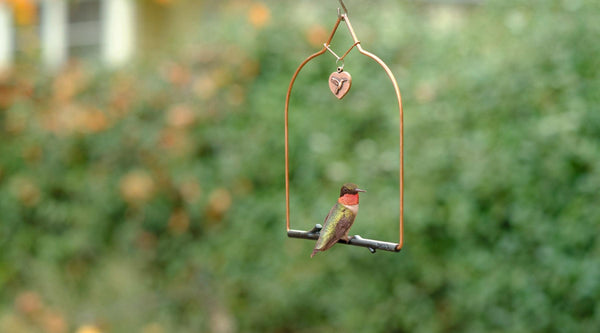
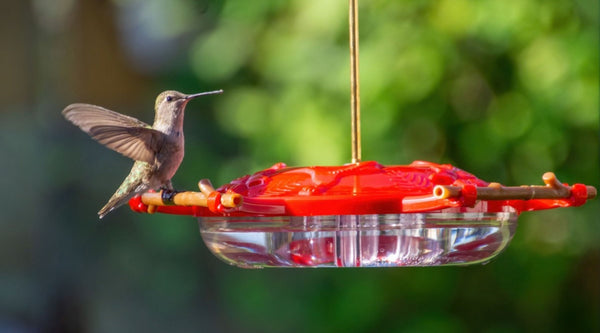
Given how territorial and food-driven this species is, a well-stocked feeder is a genuine draw. A leak-proof feeder with a comfort perch lets a notoriously feisty bird feed without spending extra energy hovering, and Pop's Nectar supports the energetic demands of a species that may double its body weight in fat before resuming migration. Skip the insecticide, too — nesting females depend on insects for protein while feeding chicks.
Frequently Asked Questions
Why are Rufous Hummingbirds considered so aggressive?
All ages and both sexes defend feeding territories relentlessly, attacking rival hummingbirds — including species double their weight — and even chasing chipmunks from their nests. The behavior persists year-round, including during brief migration stopovers, which likely reflects how valuable a reliable nectar source is to a bird constantly fueling one of the most demanding migrations in the bird world.
Do Rufous Hummingbirds really remember individual flowers?
Yes, and it's been studied extensively. Decades of field research on wild birds in Alberta has shown Rufous Hummingbirds can remember which specific flowers they've already emptied, how long it takes a flower to refill, and even the order in which to revisit a sequence of flowers.
What does a Rufous Hummingbird eat?
Mostly nectar from tubular flowers like penstemon, columbine, and Indian paintbrush, supplemented with small insects — gnats, midges, flies, and aphids — for protein and fat, especially while raising chicks.
Is the Rufous Hummingbird related to other hummingbirds I might see?
Yes — it belongs to the genus Selasphorus, along with Allen's, Broad-tailed, and Calliope Hummingbirds, all species you could realistically encounter in the same regions.
How long do Rufous Hummingbirds live?
Most live only a few years, but the oldest banded individual on record was a female of at least 8 years, 11 months, recaught during banding operations in British Columbia in 2004.
Why We Created This
Pop's Birding is a third-generation, Idaho-based family business that invented the hummingbird swing. One of the questions our customers ask most often is some version of "why is this hummingbird such a bully at my feeder?" — along with the diet, nesting, and family-tree questions that don't fit naturally into an identification or migration page. We built this guide to answer those directly, with real sourcing behind the behavior claims rather than the secondhand field-guide shorthand that gets repeated from site to site.
How We Created This
Every behavior on this page is checked against original research rather than repeated from field-guide summary language. The courtship dive described above, for example, is sourced to the actual field study of 26 territorial males in Alberta (Hurly, Scott & Healy, 2001) rather than to a secondhand summary of it. The "Meet the Family" section draws on the same taxonomic sourcing — ITIS and Cornell — used across every species guide on this site, verified independently rather than assumed from a single source.
Looking for the rest of the picture on this bird? See our Identification guide and Migration & Range guide, or browse every species in our full U.S. hummingbird guide. At Pop's Birding, we believe every backyard — big or small — has room for a little more wonder. Explore our feeders, nectars, swings, and wildflower seed blends to start building your own hummingbird sanctuary today.

Bethany Sloan has served as General Manager of Pop's Birding since 2010, continuing the legacy of her grandfather, William "Pops" Sloan, inventor of the Original Hummingbird Swing. A lifelong hummingbird enthusiast, educator, and independent researcher, she leads the company's educational content, including its 50-State Hummingbird Guide series, Regional Guide, Species Guide and Hummingbird Learning Center. Bethany combines scientific research, regional migration data, and more than 16 years of hands-on experience to create trusted educational resources for bird enthusiasts across North America.