Aug 10, 2026
Hummingbirds in West Virginia: The Complete Guide to All 4 Species
West Virginia's hummingbird checklist runs to just four species — a shorter list than most of its neighbors, but two of the entries are genuinely remarkable. One summer, a species that calls Panama and Central America home turned up at a feeder in Terra Alta and made state wildlife history. The other rarities are thin enough that West Virginia's own bird records committee treats every report with real scrutiny.
Free download
All 4 species, one page
This page covers every hummingbird confirmed in West Virginia, rarities included. The printable species guide is the practical companion — every species, its status, and how many records it has on file, sorted by how likely you are to actually see it.
Download the West Virginia species guideOne page · PDF · free to print and share

All 4 documented West Virginia hummingbird species, grouped by tier — cross-checked against the West Virginia Bird Records Committee's official state list and Review List, revised May 2025.
The Hummingbird You're Most Likely to See
Ruby-throated Hummingbird Breeds Here
West Virginia's only regularly breeding hummingbird — and the only hummingbird native to the entire Mid-Atlantic and Northeast. They nest throughout the Mountain State wherever there's a mix of trees, shrubs, and open space: forest edges, hollows, farmsteads, yards, and stream corridors all qualify. The Second Atlas of Breeding Birds in West Virginia (2021) documented 170 breeding species statewide, Ruby-throated among them.
West Virginia's season peaks unusually late and unusually hard — statewide checklist reports hit nearly 35% in the first week of September, the highest peak measured anywhere in the region, then collapse by more than two-thirds within a month. Where you are matters: Monongalia and Wood counties tend to run about a week behind the rest of the state. See the West Virginia hummingbird calendar for the full regional breakdown.

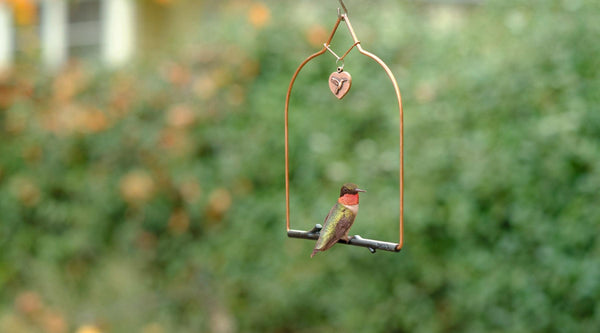
Quick ID: A black-masked face and a brilliant ruby-red throat that can look flat black without direct light identify an adult male; females and immatures show a plain whitish throat and a rounded, white-tipped tail with no red at all.

A Little Throne for Your Ruby-throated
Ruby-throated is West Virginia's only regularly breeding hummingbird, nesting throughout the Mountain State from forest edges to yards and stream corridors. The Charm Redwood Swing gives it a real perch to hold before the state's rare fall and winter visitors start showing up at the same feeder.
Shop Charm Redwood Swing →Ruby-throated vs. Black-chinned: Where Identification Actually Breaks Down
Adult male Ruby-throated and Black-chinned Hummingbirds are usually easy to tell apart in good light — one shows a red gorget, the other a black one edged in violet-purple. But females and immatures of the two species are close to identical in the field. The one reliable field mark on a perched bird is wing-to-tail proportions: Ruby-throated has a longer tail that extends visibly past the wingtips at rest, while Black-chinned has longer wings that reach the tip of the tail or extend just slightly beyond it. Some birders also watch for tail-pumping — Black-chinned habitually pumps its tail while hovering, Ruby-throated tends to hold its tail still.

Black-chinned is a genuine but accidental West Virginia record — see below for the details — so an unusual-looking female hummingbird here is worth a second look, even though Ruby-throated remains the far more likely explanation by a wide margin.
If You're Lucky: West Virginia's Rare and Historic Visitors
Every species below carries the West Virginia Bird Records Committee's review requirement — genuine documented rarities, not birds to expect at a feeder.
Rufous Hummingbird Rare / Casual Visitor
West Virginia's most frequently recorded rare visitor, and the species most likely to turn up east of the Rockies as a vagrant anywhere in the country. It was added to West Virginia's official state list in 2021, on the strength of enough fall and winter records over the years to warrant inclusion, per the committee's own stated rationale. It's genuinely thin here — most weeks statewide represent only a handful of checklists, and December is the single best month in the data, even though "best" still means a small trickle rather than anything resembling a real wave.
Adult males are unmistakable — fiery coppery-orange overall with an iridescent orange-red throat — and famously aggressive, chasing off other hummingbirds regardless of size difference. Females and immatures are trickier: green-backed above, with rufous-washed flanks and a rusty patch at the base of the tail.

Quick ID: Adult males are almost entirely coppery-orange with a glowing orange-red throat, and the only largely rufous-backed hummingbird in North America; females and immatures are green-backed with rufous-washed flanks.

An Extra Feeder for Your Rare Visitors
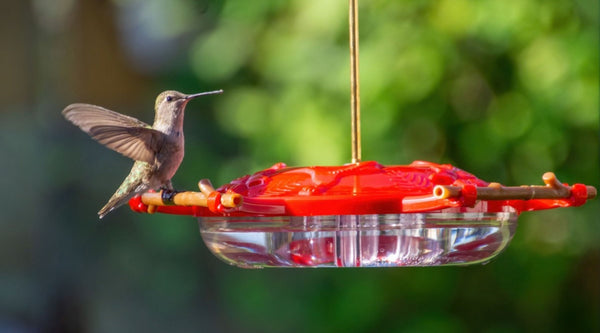
If you're lucky enough to see one of West Virginia's rare visitors — Rufous is the most likely, but any of them could turn up — a second AspenPerch Feeder gives it a place of its own to visit instead of competing with your resident Ruby-throated for the same station.
Shop AspenPerch® Feeder →Black-chinned Hummingbird Historic / Accidental
West Virginia's only accepted record: a bird near Shepherdstown, Jefferson County, present from October 11, 2006 through January 30, 2007 — nearly four months at the same feeder. Nothing has been documented since.
Adult males show a velvety black throat edged with a thin band of violet-purple, visible only at the right angle — otherwise it reads as solid black. Females and immatures are effectively inseparable from female Ruby-throated in the field.

Quick ID: A velvety black throat with a thin, hard-to-see band of iridescent purple and a small white spot behind the eye mark an adult male; females are essentially identical to female Ruby-throated except for longer wings that reach nearly to the tail tip.
Mexican Violetear Historic / Accidental
West Virginia's only accepted record, and its most remarkable: a hummingbird that normally calls Panama and Central America home spent from late June into August 2003 at a feeder in Terra Alta, Preston County — the first time the species had ever been recorded in the Mountain State, seen by hundreds of observers. A bird that small and light can be blown hundreds of miles off course in a single storm without much effort, and that's the leading explanation for how it ended up so far from home. Nothing has been recorded since — 22 years and counting.
Mexican Violetear is genuinely distinctive among North American hummingbirds in one specific way: the sexes look alike. Both males and females are shining green overall, with a glittering violet-blue patch on the sides of the neck and chest, and a blue-green tail crossed by a bold black band. It's also noticeably larger than West Virginia's other hummingbirds — 4 to 5 inches long with a mostly straight, black bill, compared to Ruby-throated's roughly 3.5 inches. Older birding records, including West Virginia's own, sometimes refer to it by its former name, Green Violet-eared Hummingbird, from before taxonomists split the old "Green Violetear" into separate Mexican and Lesser Violetear species in 2016.

Quick ID: Both sexes look essentially alike — an all-green hummingbird with a glittering violet patch across the ear coverts and upper chest, and a blackish band crossing the blue-green tail; larger and stockier than West Virginia's other hummingbirds, with an all-dark bill.
Give Every Visitor a Reason to Stay
Black-chinned and Mexican Violetear are each single-record West Virginia accidentals — including the astonishing 2003 Terra Alta Mexican Violetear, blown far off course from its Central American range. Nectarlyte's electrolytes and calcium give whichever true rarity shows up next a real reason to linger long enough to be documented, and a real wildflower planting gives it a reason to come back.


West Virginia Hummingbirds at a Glance
| Species | West Virginia Records | Best Chance |
|---|---|---|
| Ruby-throated | Only regular breeder; nearly every sighting | Mid-April through September, statewide |
| Rufous | Added to state list 2021; thin but recurring | October through December |
| Black-chinned | 1 accepted record (Oct 2006–Jan 2007), Jefferson Co. | Not expected — genuine one-off |
| Mexican Violetear | 1 accepted record (2003, Terra Alta), state's first-ever | Not expected — genuine one-off |
Frequently Asked Questions
How many species of hummingbirds are in West Virginia?
Four species have been documented in West Virginia. Ruby-throated is the only regular breeder, Rufous is a genuine but thin recurring fall and winter visitor, and Black-chinned and Mexican Violetear are both individually documented, one-record-only rarities.
Are there hummingbirds in West Virginia in winter?
Rarely, but genuinely. Rufous is a real recurring fall/winter visitor, thin but present most years from October through December, with December typically the best month. True winter accidentals are vanishingly unlikely in any given year, but West Virginia has real documented exceptions, including the state's Black-chinned record, which ran into January.
What was the hummingbird found in Terra Alta, West Virginia?
A Mexican Violetear (formerly called Green Violet-eared Hummingbird) — a species normally found from Mexico to Nicaragua. It spent late June into August 2003 at a Terra Alta feeder, the first record of the species ever confirmed in West Virginia, and it's believed to have been blown far off its normal range by a storm.
How do I tell Ruby-throated and Black-chinned Hummingbirds apart?
Adult males are the easy case: Ruby-throated shows a red gorget, Black-chinned shows a black throat with a thin violet-purple band at the base. Females and young are effectively inseparable in the field — wing-to-tail proportions on a perched bird are the one useful mark.
For feeder setup, nectar ratios, and native plants that support these species, head back to our how-to-attract-hummingbirds-in-West-Virginia guide. For region-by-region arrival and departure windows, see the West Virginia hummingbird calendar.
Why We Created This
Pop's Birding has been helping hummingbird lovers for three generations. One of the questions our customers ask most often is "What hummingbirds are actually in West Virginia?" — we built this guide to give a direct, sourced answer, not a generic one. West Virginia's list is short, but two of its four species carry genuinely remarkable stories, and we wanted a page that tells them properly rather than skipping the rarities or repeating unverified claims alongside real, documented ones.
How We Created This
Every species status on this page comes from the West Virginia Bird Records Committee's official state list and Review List (Brooks Bird Club, revised May 2025), cross-checked against the committee's own accepted-record details for exact dates, counties, and finders. Ruby-throated and Rufous both show a real, measurable presence in eBird's statewide data, though Rufous is genuinely thin; Black-chinned and Mexican Violetear are both individually documented single records, verified against primary sources — the West Virginia Division of Natural Resources' own account for the Terra Alta bird, and the committee's own accepted-record file for the Jefferson County Black-chinned sighting. A commonly repeated claim about a Broad-tailed Hummingbird record in West Virginia doesn't appear anywhere in the committee's own archive, so it isn't included here.
Sources
- West Virginia Bird Records Committee, Brooks Bird Club, official state list and Review List, revised May 28, 2025. Source for every species' status and accepted-record history on this page.
- West Virginia Division of Natural Resources. Source for the Terra Alta Mexican Violetear account.
- Bailey, C. & Rucker, W., eds. 2021. The Second Atlas of Breeding Birds in West Virginia. Penn State University Press. Source for Ruby-throated's confirmed-breeder status.
- eBird bar chart data, Cornell Lab of Ornithology — West Virginia statewide.
Know before they arrive
You don't have to keep this calendar taped to the fridge. Insider Birding Access members get seasonal notes timed to your region — when to have feeders out, what the birds are doing right now, and what's worth doing in your yard this season. We take the guesswork out of the calendar. Joining takes about thirty seconds, and there's 10% off your first order in it.
Join Insider Birding Access →Free to join. 10% off your first order.
Shop West Virginia's Hummingbird Favorites


Bethany Sloan has served as General Manager of Pop's Birding since 2010, continuing the legacy of her grandfather, William "Pops" Sloan, inventor of the Original Hummingbird Swing. A lifelong hummingbird enthusiast, educator, and independent researcher, she leads the company's educational content, including its 50-State Hummingbird Guide series, Regional Guide, Species Guide and Hummingbird Learning Center. Bethany combines scientific research, regional migration data, and more than 16 years of hands-on experience to create trusted educational resources for bird enthusiasts across North America.