Sep 03, 2026
Hummingbirds in Virginia: The Complete Guide to All 10 Species
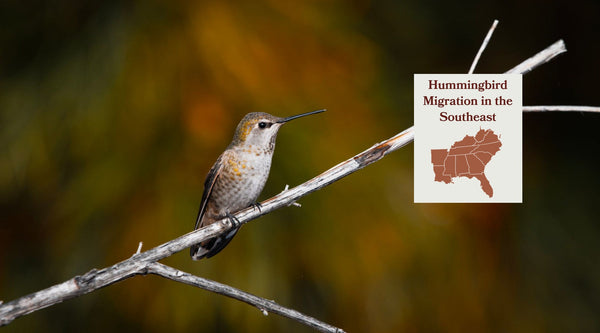
In November 2019, a hummingbird that had no business being in the Shenandoah Valley in winter showed up in Frederick County and stayed. It was still there in early spring, long enough that the Virginia Avian Records Committee could confirm what its rose-pink crown already suggested: an Anna's Hummingbird, a species whose home range doesn't come within a thousand miles of Virginia. It's still the only accepted Anna's record the state has ever had.
Ten hummingbird species are on the Virginia Avian Records Committee's official state checklist — more than any neighboring state, ahead of North Carolina's nine, Tennessee's eight, and well ahead of West Virginia's four. One breeds here every summer. One is common enough that the committee stopped tracking it as a rarity years ago. The other eight range from a species with six documented Virginia records to three species the state has seen exactly once each.
Free download
All 10 species, one page
Every Virginia hummingbird with its status — from Ruby-throated, on nearly a third of statewide checklists at its September peak, down to three species documented exactly once — sized 8.5" x 11" for easy reference and printing.
Download the Virginia species guideOne page · PDF · free to print and share

All 10 documented Virginia hummingbird species, grouped by tier — statewide eBird data, 2016–2025, cross-checked against the Virginia Avian Records Committee's official state checklist and its published record dates.
The Hummingbird You're Most Likely to See
Ruby-throated Hummingbird Breeds Here
Virginia's only nesting hummingbird, and by a wide margin its most common one. Statewide frequency climbs from a mid-April arrival to a September peak of 32% of checklists, and the pattern repeats county by county — Fairfax at 34%, Albemarle over 45%, Prince William past 42%. Most of the state empties out by mid-October. One thing worth being direct about: a small number of Ruby-throateds get reported through the winter in Hampton Roads — Norfolk, Virginia Beach, Chesapeake — every year. That's real, but it isn't a wintering population. American Bird Conservancy states plainly that Ruby-throated is "typically absent from the state in winter," and Audubon's own Christmas Bird Count data backs that up: even a record-high winter count found just six birds statewide, each one individually tracked by name and location. A hummingbird at a Hampton Roads feeder in January is far more likely to be the next entry on this page.

Quick ID: Adult males show a brilliant ruby-red throat that reads black without direct light, an emerald crown and back, and a short forked black tail. Females and immatures are green above and whitish-gray below, with white-tipped outer tail feathers and no rufous anywhere. From April through September in Virginia, a hummingbird is essentially always this one.

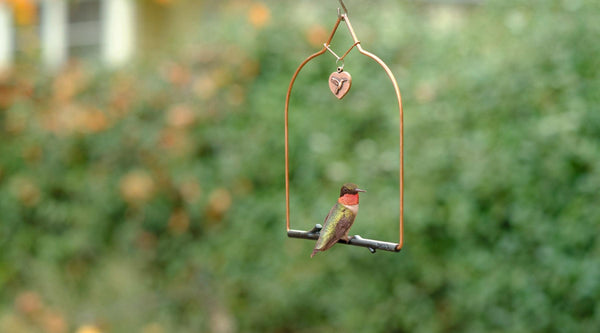
A Little Throne for Your Ruby-throated
Virginia's only breeder holds nesting territory statewide all summer. A stable perch gives it somewhere to watch from besides your feeder port — a place to hold territory before Rufous and the season's rarities start filtering through each fall.
Shop Charm Redwood Swing →Virginia's Regular Fall Visitor
Once Ruby-throated clears out in October, Virginia's hummingbird season doesn't end so much as it changes character — a western species with a real, ongoing presence takes over for the rest of the year.
Rufous Hummingbird Migrant/Winter
VARCOM's own term for Rufous is "Occasional" — its precise definition: expected to occur annually, but sufficiently low-density that an observer can't reliably count on encountering it in the field. That's a genuine step up from every other western hummingbird on Virginia's list, all of which rate Rare or Accidental. The statewide eBird signal is thin, but Montgomery County (Blacksburg) tells a clearer story: a real, sustained presence from late October through December, peaking near 2.5% of checklists in mid-November on double-digit checklist counts nearly every week of that stretch — a genuine population pattern, not a single well-photographed bird. Virginia's Rufous records became too regular for VARCOM to individually catalog years ago, which is itself evidence of how established the pattern is.

Quick ID: Adult males are almost entirely orange-rufous with a glowing orange-red throat — the only largely rufous-backed hummingbird in North America. Females and immatures are green above with cinnamon-washed flanks, a coppery rump, and rufous at the base of the tail feathers, which no Ruby-throated ever shows. The one real look-alike is Allen's, further down this page: outside the hand, female and immature Rufous and Allen's are for practical purposes identical.

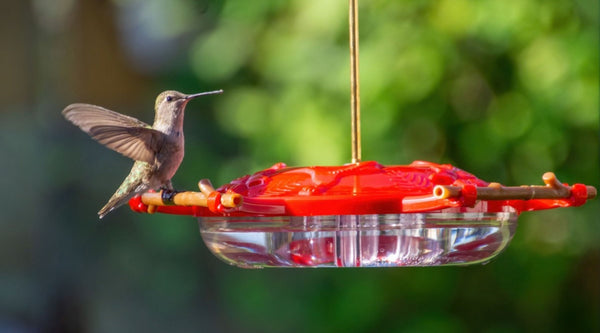
An Extra Feeder for Your Rufous Visitor
Rufous is famously aggressive at a feeder and will chase off anything else in the yard, regardless of size. A second station spread across the yard gives a lingering Ruby-throated or a passing rarity room of its own instead of one bird claiming the whole supply.
Shop AspenPerch Feeder →Virginia's Recurring Rarities
Two more species show up often enough to earn VARCOM's Rare classification or a genuinely recurring record pattern, rather than a single isolated sighting.
Black-chinned Hummingbird Rare / Casual Visitor
The only hummingbird on Virginia's list VARCOM codes "Rare" outright — its strongest classification below a regularly occurring species. At least six accepted records to date, most recently documented in Virginia Birds, the Virginia Society of Ornithology's own newsletter: "Virginia's sixth Black-chinned Hummingbird," banded near Jamesville in Northampton County in November 2017 and present through the month. The species has also turned up on Christmas Bird Counts at Lynchburg and Williamsburg. There's no real eBird signal behind it, though — every reported statewide percentage sits at or below the standard 0.15% rounding floor, meaning the record entirely comes from VARCOM's own documented sightings rather than any detectable checklist pattern.

Quick ID: Adult males show a velvety black chin and upper throat, bordered below by a thin band of iridescent purple visible only in good light — from most angles it just reads black. Look for a small white spot behind the eye and a long, straight black bill. Females have a plain, essentially unmarked pale throat and aren't reliably separable from female Ruby-throated by sight alone.
Calliope Hummingbird Rare / Casual Visitor
VARCOM's own abundance code for Calliope is "Accidental," but the record history reads differently: multiple accepted sightings with activity continuing into the 2023–2024 season, the most recent of any Rare-tier hummingbird on this list. That winter's bird was found on the Northumberland-Lancaster Christmas Bird Count in late November 2023, banded and confirmed by veteran bander Bruce Peterjohn on December 8, and stayed in the area until April 26, 2024 — an unusually long five-month stay. Augusta County carries a real eBird signal to match, building through October and November and peaking near 2.4% of checklists in mid-October on consistent double-digit checklist counts, a genuine regional pattern rather than one bird's worth of reports.

Quick ID: North America's smallest hummingbird, and identifiable by that alone in most cases — hunched posture, short bill and tail. Adult males show a gorget of separate magenta rays radiating outward against a white throat, rather than a solid patch, unique among North American hummingbirds. Females are green above with fine dark streaking on a whitish throat.

Make Your Sanctuary Worth a Detour
Black-chinned and Calliope are both genuinely recurring here, not one-time flukes — real electrolytes beyond plain sugar water give a documented rarity a reason to linger instead of just passing through.
Shop Nectarlyte® Powder →If You're Lucky: Virginia's Documented Rarities
The remaining six species range from a genuine, if borderline, recurring visitor down to three species Virginia has recorded exactly once each.
Allen's Hummingbird Historic / Accidental
Roughly three accepted Virginia records, the best-documented a Selasphorus hummingbird at a Chesterfield County residence that arrived November 20, 2010, stayed through the winter into spring 2011, and was captured and identified in the hand by a licensed bander — the only method that reliably separates Allen's from female and immature Rufous. No newer accepted record has surfaced since. That fifteen-year gap sits right at this project's own threshold for calling a species genuinely historic rather than an active, if thin, pattern; we're treating it as borderline for now and will revisit if nothing new turns up by the early 2030s. The eBird trail is essentially nonexistent — a single-checklist blip in Rappahannock County is all that shows up in the 2016–2025 data, nowhere near enough to represent a real population.

Quick ID: A Rufous look-alike. Adult males show a deep reddish-orange gorget and a coppery eye patch contrasting against a green back — but some male Rufous are green-backed too, so the back alone isn't conclusive. Females and immatures are essentially identical to female Rufous in the field; separating them reliably takes a bander's measurement of the outer tail feather width, exactly how Virginia's best-documented record was confirmed.
Anna's Hummingbird Historic / Accidental
One accepted record: the Frederick County bird from the top of this page, present November 14, 2019 through March 2, 2020, and accepted by VARCOM that February. VARCOM's own definition of Accidental status is fewer than six records in fifty years — Virginia has had exactly one. The eBird data lines up precisely with that single bird: Frederick County shows a real, building signal through November and December, peaking near 7.6% of checklists in early December, with statewide numbers otherwise sitting at the rounding floor. It's the clearest single-record match on this entire page — one bird, one place, one eBird footprint.

Quick ID: The only North American hummingbird with an iridescent crown as well as throat — adult males glow rose-pink from the top of the head down, unlike anything else on Virginia's list. Females carry a small central patch of rose-red spotting on an otherwise pale throat.
Buff-bellied Hummingbird Historic / Accidental
One accepted record, Virginia's first: a bird present at private residences in Norfolk from December 2, 2020 through January 15, 2021, photographed by Barbara Innes and Margaret Gomez and accepted by VARCOM in January 2022. No second Virginia record has followed. The eBird data captures the exact tail end of that stay — Norfolk shows a real spike in early-to-mid January, peaking near 4.7% of checklists, with statewide numbers otherwise essentially flat. A single-bird footprint, and a clean one.

Quick ID: A fairly large hummingbird with a warm buff belly and a striking red bill with a dark tip — the single best mark, since no regular Virginia species shows red on the bill. The throat and breast are iridescent blue-green in good light and read gray-dark in shade; sexes look similar.
Rivoli's Hummingbird Historic / Accidental
One accepted record, and Virginia's only one of this species ever: a bird present in Radford from October 22 to 25, 2003. It was originally accepted under the name Magnificent Hummingbird, then re-reviewed and re-accepted as Rivoli's Hummingbird in 2017 after the American Ornithological Society split the species in two. The record predates this page's 2016–2025 eBird pull window, so there's no checklist signal behind it at all.

Quick ID: A notably large hummingbird that often looks all-dark until the light catches it — adult males show a purple crown and an iridescent emerald throat, with a blackish belly that reads nearly black from most angles. Both sexes carry a small white spot behind the eye; females are greenish overall with a grayish, speckled throat and no bright gorget.
Violet-crowned Hummingbird Historic / Accidental
One accepted record, and a genuinely remarkable one: a bird near Roanoke in June 2009. Outside of Texas, this species almost never strays east — Cornell's own regional review of western hummingbird vagrancy singles this record out as one of the more notable eastern occurrences of any western hummingbird species. No second Virginia record has followed, and like Rivoli's, this one predates the eBird pull window this page draws on.

Quick ID: The only hummingbird in the United States with no colorful gorget at all — the throat and underparts are clean white in both sexes, males and females look essentially identical, and the bill is long, nearly straight, and bright reddish-orange with a black tip. Nothing else on Virginia's list is built like this one.
Mexican Violetear Historic / Accidental
One accepted record, Virginia's most recent hummingbird addition: a bird in Carroll County from October 30 to November 1, 2023, added to the official state checklist the following April. Neighboring Maryland has a real, sustained eBird signal for this species, but Virginia's own 2016–2025 data shows nothing at all for it — even during the exact window this accepted record falls in, an honest gap rather than a pattern to paper over.

Quick ID: An all-glittering-green bird, larger than any of Virginia's regular species, with a violet-blue ear patch and a violet-blue band across the chest, and a straight black bill. Both sexes look alike, though females average slightly duller.

Give Every Visitor a Reason to Stay
Whether it's your resident Ruby-throated or a genuine one-off like Rivoli's or Violet-crowned, real nectar sources give any visitor, common or rare, more reason to stick around your yard.
Shop Wildflower Seed →Virginia Hummingbirds at a Glance
One species accounts for nearly all of Virginia's hummingbird activity: Ruby-throated peaks near 32% of statewide checklists, while every other confirmed species tops out under a single percentage point at the statewide scale. That gap is too wide for a shared bar chart to show anything useful, so here's the same information as a table instead. The real regional signals — Montgomery County's Rufous season, Augusta's Calliope pattern — are charted at true scale on the Virginia hummingbird calendar.
| Species | Status | Virginia Records |
|---|---|---|
| Ruby-throated Hummingbird | Breeding | Confirmed statewide breeder; statewide peak 32% in September |
| Rufous Hummingbird | Migrant / Winter Visitor | VARCOM code "Occasional"; real Oct–Dec pattern in Montgomery Co. |
| Black-chinned Hummingbird | Rare | At least 6 accepted records; VARCOM's only "Rare"-coded hummingbird |
| Calliope Hummingbird | Rare / Casual | Multiple records; most recent banded bird present Nov 2023–Apr 2024 |
| Allen's Hummingbird | Historic (borderline) | ~3 accepted records; most recent 2010–2011, Chesterfield Co. |
| Anna's Hummingbird | Historic / Accidental | 1 accepted record — Frederick Co., Nov 2019–Mar 2020 |
| Buff-bellied Hummingbird | Historic / Accidental | 1 accepted record — Norfolk, Dec 2020–Jan 2021 |
| Rivoli's Hummingbird | Historic / Accidental | 1 accepted record — Radford, Oct 2003 |
| Violet-crowned Hummingbird | Historic / Accidental | 1 accepted record — near Roanoke, June 2009 |
| Mexican Violetear | Historic / Accidental | 1 accepted record — Carroll Co., Oct–Nov 2023 |
Frequently Asked Questions
How many kinds of hummingbirds have been documented in Virginia?
Ten, all on the Virginia Avian Records Committee's official state checklist. Ruby-throated is the only one that nests here; Rufous is a real, low-density fall-and-winter visitor; and the other eight range from Black-chinned, with at least six documented records, down to three species Virginia has recorded exactly once each.
What is the most common hummingbird in Virginia?
Ruby-throated Hummingbird, by an enormous margin. It peaks near 32% of statewide checklists in September, and no other confirmed species tops a single percentage point anywhere in the state. From April through September, a Virginia hummingbird is almost certainly this one.
Are there hummingbirds in Virginia in the winter?
A small number of individually tracked Ruby-throateds get reported around Hampton Roads each winter, but that's not a real wintering population — Audubon's own record-high winter count found just six birds statewide. Rufous Hummingbird is the more likely candidate for any hummingbird seen after October, especially in the Blacksburg area.
How do I tell a Rufous from an Allen's Hummingbird in Virginia?
For an adult male, the back: Rufous is typically solid copper, Allen's shows a green back — but some male Rufous are green-backed too, which erases that shortcut. Females and immatures of the two are essentially identical in the field. Virginia's best-documented Allen's record was only confirmed because the bird was captured and measured in the hand; without that, assume any Selasphorus hummingbird here is a Rufous.
What was the rarest hummingbird ever recorded in Virginia?
Three species tie for rarest, with exactly one accepted record apiece: Rivoli's Hummingbird (Radford, 2003), Violet-crowned Hummingbird (near Roanoke, 2009 — a genuinely remarkable eastern record for a species that almost never strays past Texas), and Mexican Violetear (Carroll County, 2023).
Why We Created This Guide
Pop's Birding has been helping hummingbird lovers for three generations. One of the questions our customers ask most often is "what hummingbirds are actually in my state?" — we built this guide to give a direct, sourced answer for Virginia specifically, not a generic one. Most identification content treats the Mid-Atlantic as a one-species region and stops there, and that misses what makes Virginia distinctive: a real, low-density fall visitor the records committee no longer individually catalogs, a rarity list anchored in named, dated, committee-accepted records rather than guesswork, and one of the more remarkable eastern strays on record in Violet-crowned Hummingbird's lone 2009 appearance.
How We Created This Guide
We started with statewide eBird checklist data from the Cornell Lab of Ornithology, covering 2016 through 2025, then layered in counties chosen for what they could show us — the core spring-through-fall Ruby-throated pattern in Northern Virginia, Rufous's real fall-into-winter presence in Montgomery County, and a few counties tied to specific accepted rarity records. Since checklist data alone can't tell the whole story, we checked every species against the Virginia Avian Records Committee's Official State Checklist to round out the picture. Ruby-throated dominates the state's checklists so completely that a shared-scale chart would show one bar and nine slivers, so we say that plainly instead of forcing a chart that wouldn't tell you much. One thing worth explaining: Hampton Roads' coastal counties post Ruby-throated checklists nearly every week of the year, which could look like a real wintering population — but American Bird Conservancy and Audubon's Christmas Bird Count data, a record-high winter count of just six individually tracked birds statewide, show it's really a handful of individual birds sticking around, not a population.
Sources
- eBird bar chart data, Cornell Lab of Ornithology — Virginia statewide plus Fairfax, Loudoun, Prince William, Albemarle, Montgomery, Frederick, Norfolk, Augusta, and Rappahannock counties, 2016–2025.
- Virginia Avian Records Committee, Official State Checklist (effective December 2025) — source for all 10 species and their state status codes.
- Virginia Avian Records Committee (VARCOM) — source for individual accepted-record dates, counties, and documentation.
- American Bird Conservancy — source for Ruby-throated Hummingbird's winter absence from Virginia.
Know before they arrive
You don't have to keep this calendar taped to the fridge. Insider Birding Access members get seasonal notes timed to your region — when to have feeders out, what the birds are doing right now, and what's worth doing in your yard this season. We take the guesswork out of the calendar. Joining takes about thirty seconds, and there's 10% off your first order in it.
Join Insider Birding Access →Free to join. 10% off your first order.
Shop Virginia's Hummingbird Favorites


Bethany Sloan has served as General Manager of Pop's Birding since 2010, continuing the legacy of her grandfather, William "Pops" Sloan, inventor of the Original Hummingbird Swing. A lifelong hummingbird enthusiast, educator, and independent researcher, she leads the company's educational content, including its 50-State Hummingbird Guide series, Regional Guide, Species Guide and Hummingbird Learning Center. Bethany combines scientific research, regional migration data, and more than 16 years of hands-on experience to create trusted educational resources for bird enthusiasts across North America.