Sep 11, 2026
Maryland Hummingbird Season: A Month-by-Month Calendar
Maryland runs three hummingbird schedules at once. Southern Maryland gets Ruby-throated Hummingbird in the middle of April, a full two weeks before the mountains of Garrett County, holds the highest reporting rate anywhere in the state through late summer, and is the last region to empty in October. The Bethesda suburbs and the Deep Creek Lake highlands run a week or two behind it on both ends. And the Ocean City coast does something different altogether: Ruby-throated never climbs past a tenth of Worcester County's checklists even at peak, yet a thin trickle of hummingbird reports there continues right through winter. Add three western visitors that arrive after the Ruby-throateds have gone — Rufous, Calliope, and Black-chinned — and Maryland's hummingbird year is longer and more varied than its size suggests. Here's how it unfolds, month by month.
The short answer: mid-April in Southern Maryland, the last week of April everywhere else, reliably common statewide by early May, a statewide peak in the first week of September, and gone by mid-October — late September on the Eastern Shore, the first week of October in the mountains and the Washington suburbs, mid-October in Southern Maryland.
| Question | Answer |
|---|---|
| When do they arrive? | Second week of April in Southern Maryland (Calvert County); third week of April statewide; last week of April in the mountains and the Washington suburbs |
| When should feeders go up? | First week of April in Southern Maryland and on the Eastern Shore; mid-April everywhere else |
| When do they nest? | Late May through July, statewide |
| Busiest month? | Late August into early September — statewide peak of 34% of checklists in the first week of September; Calvert County hits 47% the week before |
| When do they leave? | In stages — the Eastern Shore by late September, the mountains and Montgomery County by the first week of October, Southern Maryland by mid-October |
| Any in winter? | Rufous, regularly — the only western hummingbird Maryland's records committee doesn't require documentation for — from late October into February. Calliope and Black-chinned turn up in real, recurring numbers in November and December, and a few Ruby-throated reports persist on the Worcester County coast through winter |
Free download
The whole year on one page
Arrival and departure region by region, when to hang feeders in your part of the state, and when to watch for the western visitors — sized 8.5" x 11" for easy reference and printing.
Download the printable calendarOne page · PDF · free to print and share
Maryland's Hummingbird Season at a Glance
Before the month-by-month detail, here's the whole season in two pictures. The first is Ruby-throated's full-year curve — the only species with enough Maryland sightings to fill a chart on its own. The second is the same year for the three western visitors that actually recur. They get their own chart because Ruby-throated's peak is roughly seventy times higher than Black-chinned's and more than a hundred times Rufous's: drawn on one shared scale, all three flatten into a line along the bottom axis and their real seasons disappear. Scaled to their own numbers, the shapes are plain — nothing from March through September, then three small but genuine late-fall seasons, each peaking in a different week.


How often each species turns up on eBird checklists, week by week — statewide, 2016-2025. Source: eBird bar chart data (Cornell Lab of Ornithology), 2016-2025 (pulled Aug 2026). Maryland's three rarest species — Anna's, Allen's, and Mexican Violetear — are all real, committee-accepted birds with one or two records apiece, all predating this data window, and can't be charted.
Regions used below
We track four counties chosen to span Maryland's real geography: the Mountains — Garrett County (Deep Creek Lake, Oakland), the highest and coldest ground in the state; the Washington Suburbs — Montgomery County (Bethesda, Silver Spring, Rockville); Southern Maryland — Calvert County (Prince Frederick, Solomons), on the Chesapeake's western shore; and the Eastern Shore — Worcester County (Ocean City, Berlin), on the Atlantic coast. Statewide figures cover the whole state, including Baltimore, Annapolis, and the central counties we don't break out separately; the four counties show how much the statewide average hides.
Regional Arrival and Departure Snapshot
Here's the same timing on the map. Southern Maryland arrives first and leaves last; the Eastern Shore arrives with everyone else but empties first; the mountains and the suburbs sit in between on both ends.

One thing to know before you start
A hummingbird at a Maryland feeder in late fall or winter is more likely a western visitor than a lingering Ruby-throated. Maryland's records committee doesn't review winter Ruby-throated reports at all — it's a regular species, code 1 on the official list — while Black-chinned, Anna's, Calliope, and Allen's are all code 2, reviewable anywhere in the state. The Maryland Biodiversity Project puts it plainly: any hummingbird visiting feeders in late fall or winter is more likely to be a western vagrant than a Ruby-throated. That's why this calendar keeps going after the Ruby-throateds leave, and why a November or December bird is always worth a photograph before you name it.
January: Rufous Lingers, and Maryland's First Black-chinned
Ruby-throated numbers sit at zero in Garrett, Montgomery, and Calvert counties in January; only the Worcester County coast shows a thin scatter of reports, a handful of checklists in the first and last weeks of the month. Rufous Hummingbird is the bird to watch: reports run through every week of January statewide, tailing off from the December peak but still present — these are birds that arrived in the fall and stayed.
January is also the month Maryland finally got the species it had been waiting for. The state's first accepted Black-chinned Hummingbird — voted the most-expected new state bird for years — was an immature male at a St. Mary's County feeder, banded on 24 January 2020, that stayed into February. That's the small late-winter bump on the second chart above. If you see any hummingbird in Maryland this month, photograph it and report it to the MD/DC Records Committee.
February & March: The Deep Quiet, and Feeder Prep
February and March are the quiet months — but not the empty ones. Rufous reports continue at a low level through the third week of February before fading to almost nothing by the end of March, and the Worcester coast keeps its thin winter trickle of Ruby-throated reports going. Inland, in the mountains and suburbs, our data shows an unbroken zero. March is prep time: by the end of the month, Southern Maryland is two weeks from its first arrivals.

Get your feeder up before the first bird arrives, not after.
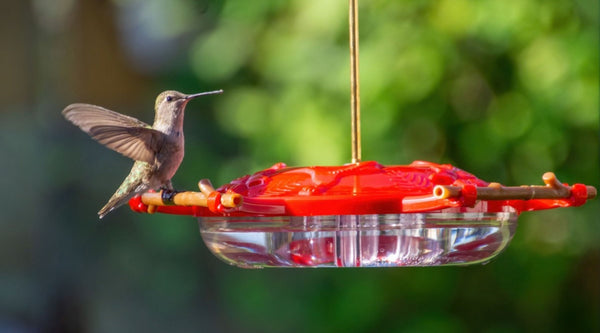
Maryland's arrival staggers across about two weeks — Southern Maryland in the second week of April, the mountains and suburbs in the last — so a feeder that goes out in the first week of April costs you nothing, while one still in the garage when the first scout turns up costs you the sighting. March is also the month to check last year's feeder for cracked seals and worn ports before the season depends on it. AspenPerch® has a built-in ant moat and a Polyperch® comfort perch, so birds rest between sips instead of hovering through the whole meal.
Shop AspenPerch® →April: Southern Maryland First, Then the Rest
April is when Maryland's season begins, and it begins in the south. Calvert County crosses the arrival threshold in the second week of April — nearly 2% of checklists, then 6% in the third week, when Montgomery County is still under 1% and Garrett County has barely registered a bird. By the last week of April every county is on: Calvert at 15%, Garrett at 6%, the Eastern Shore at 5%, Montgomery at 3.5%. The mountains are last to start but climb fast once they do. This is scout-bird territory statewide — the earliest, most adventurous males pushing north ahead of the main wave — and in Southern Maryland it's already the real thing.
| Region | Ruby-throated Arrives | Reliably Common |
|---|---|---|
| Southern Maryland (Calvert County) | Second week of April | Last week of April |
| Eastern Shore (Worcester County) | Third week of April | Last week of April |
| Mountains (Garrett County) | Last week of April | First week of May |
| Washington Suburbs (Montgomery County) | Last week of April | Second week of May |
"Arrives" is the first of two consecutive weeks where at least 1% of a county's checklists report the species, backed by at least five actual checklists — not the scattered scout birds of early April. "Reliably common" is the first week a county's reports reach 25% of that county's own seasonal peak. We checked the checklist count behind each of these, not just the percentage: Calvert's second-week arrival rests on 20 checklists and its third week on 71, while Montgomery's third week — 0.8% on more than 6,600 checklists — genuinely hadn't started yet. Southern Maryland's two-week head start is real, not an artifact of a thinly-birded county crossing a line on weak data.
May: The Wave Fills the State
May is the month every region catches up. Statewide, Ruby-throated climbs from under 6% of checklists in the last week of April to nearly 12% by the second week of May. The mountains are the surprise: Garrett County, last to see a bird in April, is reporting hummingbirds on 16–19% of checklists through May, a higher rate than Montgomery County (7–10%) or the Eastern Shore (4–8%). Calvert holds the top spot at 16–21%. By the second week of May, every county we track is reliably common.
June: Nesting Season Settles In
Statewide activity levels off through June, holding around 11% as birds settle into nesting. Females become secretive around the nest during this stretch, which can make feeder activity look quieter even though the birds haven't gone anywhere — they're spending more time incubating and less time visibly perched. Males take no part in nest duties and stay visible and territorial. Southern Maryland is the exception to the lull: Calvert County reaches 24% in the first two weeks of June, well ahead of any other county.
Why nesting season is the demanding one
There's a wrinkle specific to hummingbirds. Most female birds build up a temporary calcium store in their bones, called medullary bone, and draw on it to make eggshell. Hummingbirds have very little of it, so a laying female has less in reserve. Researchers have seen nesting females eating wood ash and other mineral-rich materials, which they think helps replace the calcium that goes into eggs. In one 1994 study, every bird seen eating ash was a female tending a nest.

It's part of why Pop's Nectar includes calcium and electrolytes rather than sugar alone. Nesting females need extra calcium during egg-laying, and plain sugar water has essentially none. Read more on the research behind it.
Shop Nectarlyte® 8 oz →July: Building Toward the Peak
Activity climbs steadily through July, from about 13% of checklists statewide early in the month to 19% by month's end, as the first broods fledge and juveniles join adults at feeders and flowers. The climb is steepest in the south and the mountains: Calvert goes from 22% to 38% across the month, Garrett from 18% to 29%. Montgomery follows at 12% to 17%. The Eastern Shore, by contrast, barely moves — Worcester County stays in the 6% range all month, the same as it was in May.

Keep pests off without pesticides.
AspenPerch®'s built-in ant moat blocks ants with a water barrier, and HummGuard® Nectar Tips keep bees and wasps out without changing anything for the birds.
Shop HummGuard® →August: The Climb to the Peak
August is when Maryland's numbers go vertical. Statewide, Ruby-throated rises from 22% of checklists in the first week to 31% in the last — and then keeps climbing into September. Calvert County peaks in the last week of August at 47%, the highest reporting rate anywhere in the state all year; Garrett hits 40% the same week. Birds are in hyperphagia, the intensive pre-migration feeding phase: a Ruby-throated Hummingbird weighs about three grams and packs on fat worth roughly another quarter to a third of that before heading south — banding work on the Gulf Coast has found the heaviest birds arriving with nearly double their lean weight in fuel. Not a single western visitor has registered yet; that season is still two months off.
This is the month to be generous, not economical.
Maryland's birds are putting on fuel for a flight that ends thousands of miles south, and a feeder that runs dry mid-surge is a missed meal at the worst possible time. The 2lb Nectarlyte® powder or the Nectarade® liquid concentrate keeps you topped up through the busiest weeks of the year.


September: The Statewide Peak, Then the Fast Exit
September opens at the top and ends near the bottom. The first week is Maryland's statewide peak — 34% of all checklists, with Montgomery County reaching its own high of 35% the same week — and then the birds leave, fast. Statewide reports fall to 30% in the second week, 22% in the third, and 12% in the last: two-thirds gone in three weeks. The Eastern Shore is first out — Worcester County drops under 3% by the last week of September and is effectively done. The mountains follow close behind, Garrett falling from 39% to 8% across the month. Montgomery holds 13% into the last week, and Calvert nearly 20%. Wherever you live, keep feeders full through September — a departing bird's last Maryland meals are the ones that matter most.
October: The Last Ruby-throated Leave, the Western Season Begins
October is when the last Ruby-throated Hummingbirds leave Maryland, region by region. The mountains and the Washington suburbs both have their last real week in the first week of October and are under 1% by the second; the Eastern Shore is already there. Southern Maryland leaves last: Calvert County is still at 11% in the first week of October, 5.6% in the second, and above 2% in the third — only in the last week of the month is it finally gone, two weeks after everywhere else. Statewide, a few stragglers linger into the third week. Then the season turns over. The last week of October is the first real pulse of Rufous Hummingbird statewide, and in Garrett County both Rufous and Calliope begin showing up in the same late-October weeks. Pop's tip: keep at least one feeder up for two to three weeks after your last Ruby-throated sighting, and consider leaving it up through December — in Maryland, the western visitors are a real season, not a long shot.

October is the planting month, not the tidying-up month.
Sow native wildflower seed now and it gets the cold, moist Maryland winter most varieties need before they'll bloom reliably next spring — the same spring your hummingbirds come back to.
Shop the Perfect Little Sanctuary® blend →November: Calliope's Month, Rufous Rising
Ruby-throated is essentially absent statewide in November. This is instead the heart of Maryland's western-hummingbird season, and it belongs to two species at once. Calliope Hummingbird peaks in the third week of November — 49 checklists across the decade in that single week, the busiest Calliope week of the year — and the pattern has real history behind it: the state's first record was a hatch-year female in Prince George's County on 16 November 2004, the sixth report was a bird on Tilghman Island on 16–17 November 2012, and the recent Garrett County birds have all turned up between late October and early November. Rufous rises alongside it, reaching its first peak in the last week of November. Rufous turns up often enough that the MD/DC Records Committee codes it as a non-review species — the only western hummingbird in Maryland treated that way. If a feeder-visiting hummingbird looks fiery orange rather than green-backed this month, there's a real chance it's a Rufous; if it's small, green, and streaky-throated, photograph it — it could be a Calliope.
December: Peak Rufous, and Maryland's Biggest Rarity Week
December is Maryland's best Rufous month. Statewide, the second week of December ties the last week of November as the busiest Rufous week of the year, and in Montgomery County it's the outright peak — half a percent of Bethesda-area checklists, a real, findable bird in the Washington suburbs in the middle of December. December is also home to the single largest rarity signal anywhere in Maryland's ten years of data: a Black-chinned Hummingbird at a Calvert County feeder in the first week of December 2025, reported on 86 checklists in one week as birders converged on it. It was Calvert's second Black-chinned in four years, after a bird on 31 October 2021. Maryland's second Anna's Hummingbird was a December bird too — a hatch-year male at a Middletown feeder in Frederick County on 9 December 2010 — and the state's only accepted Allen's Hummingbird, an immature female confirmed by DNA, was found in Calvert County on Christmas Eve 2008. Both were birds that turned up where somebody was still paying attention in the cold.

If one bird is chasing everything else off, that's Rufous behaving exactly as expected.
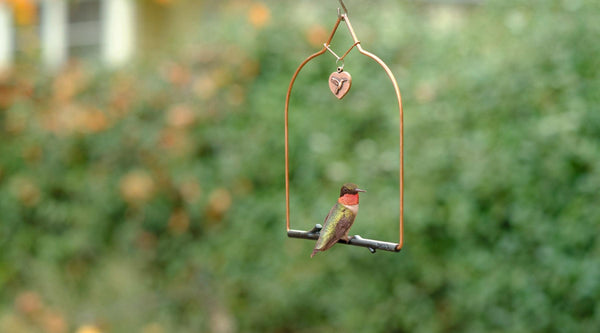
Rufous is genuinely territorial, and a single feeder with a swing beside it tends to become one bird's guarded patch — it perches on the swing to watch the feeder it's already defending. A second feeder and a second swing, placed out of sight of each other, gives the next bird its own station to claim instead of a fight over yours.
Shop a second swing →The Year at a Glance
| Months | Statewide Activity |
|---|---|
| January | No Ruby-throated inland; Rufous present every week, tailing off from December |
| February — March | Quiet; last Rufous reports fade by mid-March; feeder prep |
| April | Southern Maryland arrives in the second week; every county on by the last week |
| May | Fast statewide arrival; reliably common everywhere by the second week; mountains busier than suburbs |
| June — July | Nesting through fledging; Southern Maryland far ahead of everywhere else |
| August | The climb — Calvert hits 47% in the last week, the state's highest rate all year |
| September | Statewide peak (34%) in week one, then a two-thirds drop; Eastern Shore leaves first |
| October | Last Ruby-throated leave, Southern Maryland last; Rufous and Calliope season begins |
| November | Calliope peak (week three); Rufous rising to its first peak |
| December | Peak Rufous; the month Maryland's biggest rarities have turned up |
Frequently Asked Questions
When do hummingbirds come back to Maryland?
The second week of April in Southern Maryland, and the last week of April in the mountains and the Washington suburbs — a two-week spread from Calvert County to Garrett County, with the Eastern Shore in between. Statewide, real sustained arrivals begin in the third week of April. Feeders should be up by the first week of April in Southern Maryland and on the Eastern Shore, and by mid-April everywhere else.
When do hummingbirds leave Maryland?
In stages, from the coast inward and then south. Ruby-throated Hummingbirds leave the Eastern Shore by late September, the mountains and Montgomery County by the first week of October, and Southern Maryland by mid-October. Statewide, reports fall from 34% of checklists in the first week of September to 12% by the last, and to under 2% by the second week of October. A few stragglers linger into the third week of October, but for most of the state the season is over by then.
When do hummingbirds leave Southern Maryland?
Later than anywhere else in the state. Calvert County is still reporting Ruby-throated on 11% of checklists in the first week of October — when Garrett and Montgomery counties are already under 4% — and is still above 2% in the third week, only emptying in the last week of the month. Southern Maryland arrives first in April and leaves last in October; its season runs a full month longer than the mountains'.
When do hummingbirds migrate through Maryland?
Southbound movement is under way by the second week of September and largely finished by the first week of October. The birds fuel for it through all of August — the climb from 22% to 34% of checklists between early August and early September is the pre-migration surge, with the state's highest single reporting rate (47% in Calvert County) landing in the last week of August. Northbound, the whole state fills in over about three weeks from mid-April.
How long do hummingbirds stay in Maryland?
About six months for most of the state — mid-to-late April through early October — and closer to six and a half in Southern Maryland, where they arrive earliest and leave latest. Add the western-visitor season, which runs from late October through February, and the practical "hummingbird watching" window in Maryland stretches to about ten months.
Should I keep a feeder up through a Maryland winter?
Yes, if you want a real shot at the western visitors — and in Maryland that's a genuine season, not a long shot. Rufous runs from late October through February with peaks in late November and mid-December; Calliope peaks in the third week of November; Black-chinned has turned up in three separate years since 2020, twice in Calvert County. Maryland's records committee doesn't review winter Ruby-throated reports, but it does review every one of the western species, so a late-season bird is worth photographing and reporting whatever you think it is.
Why We Built This Calendar
Pop's Birding has been helping hummingbird lovers for three generations. One of the questions our customers ask most often is "When do hummingbirds arrive and leave my state?" — we built this calendar to give a direct, sourced answer, not a generic one. Most timing advice online gives a single date for an entire state, which is exactly wrong for a place shaped like Maryland: Calvert County has hummingbirds a full two weeks before Garrett County does in spring, and keeps them two weeks longer in fall. A single statewide date would be a month wrong across the length of one state. We wanted a calendar that tells you the truth for where you actually live, not an average that's wrong in the mountains and wrong on the bay.
How We Built This Calendar
We pulled eBird bar chart data (Cornell Lab of Ornithology), 2016–2025, for Maryland statewide and four counties: Garrett (mountains), Montgomery (Washington suburbs), Calvert (Southern Maryland), and Worcester (Eastern Shore). Arrival and departure are the first and last of two consecutive weeks with at least 1% of a county's checklists reporting the species, backed by at least five real checklists. A Worcester County Mexican Violetear signal didn't match Maryland's two accepted records, so we left it off as likely misidentification. The genuine finding: Calvert County arrives two weeks ahead of the mountains, carries the state's highest reporting rate all summer, and leaves two weeks after everyone else. The county comparison is our own analysis of the raw eBird data.
Sources
- eBird bar chart data, Cornell Lab of Ornithology — Maryland statewide and county-level (Garrett, Montgomery, Calvert, Worcester), 2016-2025. Source for all month-by-month seasonal figures and the regional arrival/departure pattern.
- Official List of the Birds of Maryland, Maryland/DC Records Committee of the Maryland Ornithological Society, via Maryland DNR; and the committee's Maryland Bird Records page. Source for each species' review status and first-record accession numbers.
- Maryland Biodiversity Project — species accounts for Calliope, Rufous, and Black-chinned Hummingbird. Source for the dates and locations of the individual records cited on this page.
- Zenzal & Moore, "Stopover biology of Ruby-throated Hummingbirds during autumn migration", The Auk 133:237–250 (2016). Source for the pre-migration fat-load figures in the August section.
- des Lauriers, J. R. (1994). Hummingbirds eating ashes. The Auk, 111(3), 755–756. Documents five nesting female hummingbirds eating wood ash; no males were seen doing so in that study.
- Adam, M. D., & des Lauriers, J. R. (1998). Observations of hummingbirds ingesting mineral-rich compounds. Journal of Field Ornithology, 69, 257–261. Source for hummingbirds' greatly reduced medullary bone and for the mineral-rich materials they eat.
- Werning, S. (2018). Medullary bone is phylogenetically widespread and its skeletal distribution varies by taxon. Journal of Ornithology, 159, 527–543. Source for medullary bone being confirmed in hummingbirds.
Know before they arrive
You don't have to keep this calendar taped to the fridge. Insider Birding Access members get seasonal notes timed to your region — when to have feeders out, what the birds are doing right now, and what's worth doing in your yard this season. We take the guesswork out of the calendar. Joining takes about thirty seconds, and there's 10% off your first order in it.
Join Insider Birding Access →Free to join. 10% off your first order.
Shop Maryland's Hummingbird Favorites


Bethany Sloan has served as General Manager of Pop's Birding since 2010, continuing the legacy of her grandfather, William "Pops" Sloan, inventor of the Original Hummingbird Swing. A lifelong hummingbird enthusiast, educator, and independent researcher, she leads the company's educational content, including its 50-State Hummingbird Guide series, Regional Guide, Species Guide and Hummingbird Learning Center. Bethany combines scientific research, regional migration data, and more than 16 years of hands-on experience to create trusted educational resources for bird enthusiasts across North America.