Aug 06, 2026
North Carolina Hummingbird Season: A Month-by-Month Calendar
North Carolina's hummingbird year is genuinely different depending on where you live. The Piedmont and mountains follow a familiar spring-arrival, fall-departure pattern — but the coast barely follows a "departure" at all. Our own county-level review of eBird data found real Ruby-throated activity persisting there straight through November and into December, a pattern confirmed by the North Carolina Museum of Natural Sciences' decades-long study of the state's wintering hummingbirds. Here's how the year actually unfolds, region by region.
The short answer: late March on the Outer Banks and in the Piedmont, early April in the mountains and around Wilmington, and the coast barely tapers off even into winter.
| Question | Answer |
|---|---|
| When do they arrive? | Late March on the Outer Banks and in the Piedmont; early April in the mountains and around Wilmington |
| When should feeders go up? | Late March on the Outer Banks and in the Piedmont; early April in the mountains (literal zero through March) and around Wilmington (no signal above the winter baseline until April) |
| When do they nest? | Late May through late July |
| When do they leave? | Mountains and Piedmont: September into October. Coast: barely tapers, holding real activity into December. |
| Any in winter? | Rufous is the most notable visitor, and a genuine Ruby-throated overwintering population persists on the coast |
Free download
The whole year on one page
Arrival windows region by region, when to hang feeders in your part of the state, and when to watch for Rufous — sized 8.5" x 11" for easy reference and printing.
Download the printable calendarOne page · PDF · free to print and share
North Carolina's Hummingbird Season at a Glance
Before the region-by-region detail below, here's the whole season in two pictures — Ruby-throated's full-season curve, and the winter visitors worth watching for, shown at their own scale since they're a small fraction of Ruby-throated's numbers.


How often each species turns up on eBird checklists, week by week — statewide, 2016–2025. Note the statewide chart shows Ruby-throated only; the line never fully returns to zero because of the coastal overwintering population. The regional breakdown below shows exactly when that pattern shifts by region.
Regional Arrival and Departure Snapshot
| Region | Spring Arrival | Fall Departure |
|---|---|---|
| Outer Banks | Some overwinter; migrant wave by late March | Barely tapers — still 4–8% across November |
| Wilmington & Southern Coast | Some overwinter; migrant wave by early April | Barely tapers — still 4–5% into November |
| Piedmont | Late March–early April | September, with real stragglers into October |
| Mountains | Early April — genuinely zero presence through all of March | Still 52% of peak in late September; most gone by mid-October |
Windows derived from eBird bar chart data (Cornell Lab of Ornithology), 2016–2025, for Mecklenburg, Wake, Buncombe, New Hanover, and Dare counties.

County-level arrival and departure windows, mapped from the same eBird data above.
January & February: Coastal Holdouts, Everywhere Else Quiet
| Coastal Plain | A genuine, if small, Ruby-throated presence persists all winter — never fully dropping to zero, per our own data and North Carolina Museum of Natural Sciences research. |
| Piedmont & Mountains | Genuinely quiet — Wake and Buncombe counties show literal zero, and Mecklenburg has only a handful of individual checklists total across both months, consistent with an occasional straggler rather than any real presence. All three stay this way into early March too. |
This is also peak season for North Carolina's winter rarities — Rufous most notably, with Black-chinned, Calliope, Allen's, Broad-billed, and Anna's all documented as genuine one-off visitors. If you spot any hummingbird in North Carolina this time of year, it's worth a photo and a report.
March: The Wave Begins
| Early March | Still quiet almost everywhere — the coast is at its winter baseline, and the Piedmont and mountains haven't stirred yet. |
| Late March | The Outer Banks (Dare) picks up a real migrant wave on top of the overwintering birds, and the Piedmont (Mecklenburg, Wake) sees its first scouts — both arriving on roughly the same schedule. |
Males typically arrive first and establish territories, with females following about 10–14 days later — a quiet feeder in the first week or two of the season is completely normal.

Give the incoming wave somewhere to land.
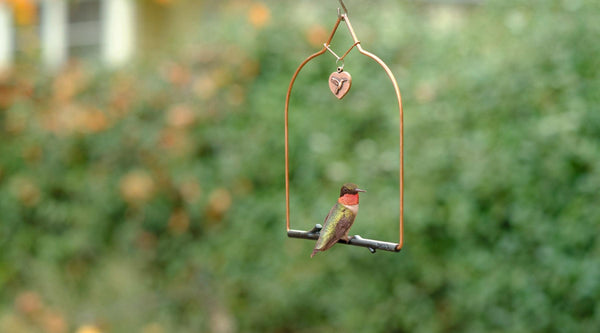
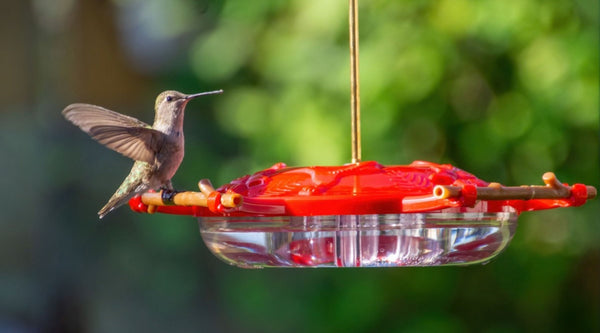
A single feeder works fine when one resident owns the yard — but as more birds arrive, that same feeder becomes something to fight over. A second feeder and a second swing, set up before the rush and spaced out of sight of each other, means the next arrival has its own place to claim instead of picking a fight for the first one.
Shop a second feeder →April: Mountains and Wilmington Catch Up
| Early April | The mountains around Asheville (Buncombe County) and the Wilmington area (New Hanover) both join in last, with neither region showing real activity above the winter baseline until now. |
By this point every part of the state has heard from Ruby-throated — the Outer Banks and Piedmont just got a two-week head start.
May: The Outer Banks Wave Moves Through
On the Outer Banks, May is when the spring rush thins out. Hummingbird sightings there drop by more than half over the month as the April wave passes through, settling back to the steady summer crowd Dare County keeps until fall. Inland it's the opposite — the birds that showed up around Charlotte, Raleigh, and Asheville in April are staying put and staking out their summer territories.
June: Nesting Season
North Carolina's breeding Ruby-throateds settle in and nest statewide. Feeder activity can taper off somewhat as females become secretive around the nest, though it never goes fully silent. Sightings statewide hit their summer low in early June, so a quiet feeder this month is completely normal — then they start picking up again by the end of the month.
Why nesting season is the demanding one
There's a wrinkle specific to hummingbirds. Most female birds build up a temporary calcium store in their bones, called medullary bone, and draw on it to make eggshell. Hummingbirds have very little of it, so a laying female has less in reserve. Researchers have seen nesting females eating wood ash and other mineral-rich materials, which they think helps replace the calcium that goes into eggs. In one 1994 study, every bird seen eating ash was a female tending a nest.

It's part of why Pop's Nectar includes calcium and electrolytes rather than sugar alone. Nesting females need extra calcium during egg-laying, and plain sugar water has essentially none. Read more on the research behind it.
Shop Nectarlyte® 8 oz →July: Adult Males Head South
July is when things pick up fast. Sightings climb steadily all month across the state, and around Asheville they nearly double between the first week and the last.
By late July, adult males — done with their part in nesting — begin heading south, even while some nests are still active and this year's juveniles are just starting to show up, keeping overall sightings climbing right through August.
August: The Piedmont Reaches Its High Point
If you live around Charlotte or Raleigh, August is your busiest month, not September. Feeders there hit their high point in mid-August, with close to half of local birdwatchers' checklists reporting a hummingbird, and stay that busy into early September before the drop begins. The rest of the state keeps building all month toward the early-September peak.
September: The Statewide Peak
| Early September | Statewide peak — mountain counties actually peak here too, at 59% of checklists in Buncombe County, before dropping off through the month. |
Females and juveniles follow adult males south through September, and once the decline starts, birds leave the mountains and Piedmont fast — but the coast doesn't follow the same script at all.

Seeing one bird chase everyone else off?
That's usually a resident claiming both the feeder and a nearby swing as its own guarded territory. A second feeder and a second swing, spaced out of sight of each other, gives another bird — the incoming migrant or a displaced resident — its own station to guard instead of fighting over one.
Shop a second swing →October: The Mountains and Piedmont Empty Out
| Late September–mid-October | Mountains and Piedmont drop sharply — Buncombe goes from 52% of its peak in late September to under 2% by mid-October. |

October is the planting month.
Sow now and native wildflowers get the cold, moist period most varieties need to bloom reliably next spring.
Shop the Perfect Little Sanctuary® blend →November & December: The Coast Doesn't Get the Memo
While the mountains and Piedmont are essentially empty of Ruby-throateds by mid-October, New Hanover County (Wilmington) tells a completely different story: real activity holds at 4–5% of checklists through every week of November, and doesn't meaningfully decline in December either. This isn't a slow fade — it's a genuine, stable coastal population that barely resembles "departure" at all.
Rufous Hummingbird is the most notable of North Carolina's winter rarities, occasionally joined by Black-chinned, Calliope, Allen's, Broad-billed, and Anna's — all genuine one-off records, actively studied by the North Carolina Museum of Natural Sciences' decades-long banding project.
Pop's tip: If you're anywhere near the coast, there's real value in keeping a feeder up all winter — you're not just hoping for a rarity, you may be hosting a genuine, if small, overwintering Ruby-throated population. Farther inland, a winter feeder is still worth it for the chance at Rufous. Our winter hummingbird feeder care guide covers heated feeders and the two-feeder swap.
Frequently Asked Questions
When do hummingbirds come back to North Carolina?
Late March on the Outer Banks and in the Piedmont, early April in the mountains and around Wilmington. Our own data shows the mountains stay at literal zero through all of January, February, and March, while both coastal counties already have a small overwintering population before their spring waves arrive — the Outer Banks' wave just comes about two weeks ahead of Wilmington's.
When do hummingbirds leave North Carolina?
It depends heavily on region. The mountains and Piedmont empty out through September and early October — Buncombe County drops from 52% of its peak in late September to under 2% by mid-October. The coast barely tapers at all, holding real activity through November and into December.
How long do hummingbirds stay in North Carolina?
In the mountains and Piedmont, roughly six months, arriving late March to early April and mostly gone by mid-October. On the coast, it's closer to year-round — a genuine population persists through the winter months.
Why is my Asheville feeder still quiet in early April?
Because the mountains are one of two regions on the same late schedule — Buncombe County sits at literal zero through all of March, with the first scouts not appearing until the first week of April, the same timing as the Wilmington area. The Outer Banks and Piedmont are both about two weeks ahead of you.
Should I keep a feeder up through a North Carolina winter?
Yes, especially near the coast, where a real Ruby-throated population persists all winter rather than just occasional rarities passing through. Farther inland, a winter feeder still gives you a genuine shot at Rufous, North Carolina's most notable winter visitor.
Why We Built This Calendar
Pop's Birding has been helping hummingbird lovers for three generations, and one of the questions our customers ask most often is "when do hummingbirds arrive and leave my state?" Most timing advice online gives a single date for an entire state, which is exactly wrong for a place the size of North Carolina — the Outer Banks and the Wilmington area are both genuinely coastal, but their real arrival dates run two weeks apart, and the mountains stay at literal zero long after the coast has already had visitors for months. A single date would be misleading for most of the state. We built this calendar to tell you the truth for where you actually live, not an average that's wrong everywhere.
How We Built This Calendar
Every arrival, departure, and peak date on this page comes from eBird bar chart data for North Carolina statewide and for five counties — Mecklenburg (Charlotte), Wake (Raleigh), Buncombe (Asheville), New Hanover (Wilmington), and Dare (Outer Banks) — covering 2016 through 2025, with each region's arrival and reliably-present weeks measured against its own seasonal peak rather than a statewide one. The real surprise in the data: the coast isn't one region — Dare County and New Hanover County both sit on the coast and both host a small overwintering population all winter, but the Outer Banks' spring wave arrives a full two weeks before Wilmington's does, putting Wilmington's real arrival closer to the mountains' timing than to its fellow coastal county, which is why this calendar splits the coast into two regions instead of treating it as one. We also built two charts rather than one, since Ruby-throated so thoroughly dominates North Carolina's hummingbird activity that Rufous, Black-chinned, and Calliope would be flat, invisible lines at the same scale. The five-county comparison and the coastal split are our own analysis, not a repackaging of eBird's own statewide bar chart, and percentages throughout describe how often a species appears on submitted checklists, not a population count.
Sources
- eBird bar chart data, Cornell Lab of Ornithology — North Carolina statewide and county-level (Mecklenburg, Wake, Buncombe, New Hanover, Dare), 2016–2025. Source for all month-by-month seasonal figures and the regional arrival/departure pattern.
- Carolina Bird Club, "Wintering Hummingbirds". Source for the winter-vagrant research context and the coastal Ruby-throated overwintering pattern.
- des Lauriers, J. R. (1994). Hummingbirds eating ashes. The Auk, 111(3), 755–756. Documents five nesting female hummingbirds eating wood ash; no males were seen doing so in that study.
- Adam, M. D., & des Lauriers, J. R. (1998). Observations of hummingbirds ingesting mineral-rich compounds. Journal of Field Ornithology, 69, 257–261. Source for hummingbirds' greatly reduced medullary bone and for the mineral-rich materials they eat.
- Werning, S. (2018). Medullary bone is phylogenetically widespread and its skeletal distribution varies by taxon. Journal of Ornithology, 159, 527–543. Source for medullary bone being confirmed in hummingbirds.
- Estades, C. F., Vukasovic, M. A., & Tomasevic, J. A. (2008). Giant Hummingbirds (Patagona gigas) ingest calcium-rich minerals. The Wilson Journal of Ornithology, 120(3), 651–653.
Event dates and formats change from year to year. Check organizer websites before making plans.
Know before they arrive
You don't have to keep this calendar taped to the fridge. Insider Birding Access members get seasonal notes timed to your region — when to have feeders out, what the birds are doing right now, and what's worth doing in your yard this season. We take the guesswork out of the calendar. Joining takes about thirty seconds, and there's 10% off your first order in it.
Join Insider Birding Access →Free to join. 10% off your first order.
Shop North Carolina's Hummingbird Favorites


Bethany Sloan has served as General Manager of Pop's Birding since 2010, continuing the legacy of her grandfather, William "Pops" Sloan, inventor of the Original Hummingbird Swing. A lifelong hummingbird enthusiast, educator, and independent researcher, she leads the company's educational content, including its 50-State Hummingbird Guide series, Regional Guide, Species Guide and Hummingbird Learning Center. Bethany combines scientific research, regional migration data, and more than 16 years of hands-on experience to create trusted educational resources for bird enthusiasts across North America.