Sep 02, 2026
Hummingbirds in South Carolina: The Complete Guide to All 10 Species
On September 20, 2021, a hummingbird flew into a mist net at Hilton Pond Center in York, South Carolina, and the banders who took her out knew within seconds that something was off. She was an adult female, green-backed and cinnamon-flanked like a hundred Rufous Hummingbirds they'd handled before — but the tail was too long, the wing chord measured 51.1 millimeters, and the outer tail feathers were the wrong pattern. They measured, photographed, banded, and released her. She was a Broad-tailed Hummingbird, a bird of the Rocky Mountains, and the first ever documented in South Carolina. The state's records committee accepted the record that year. That's how most of South Carolina's hummingbird list has been written: one bird at a time, in winter or fall, usually in someone's yard, and often in a bander's hand.
Ten hummingbird species are on the South Carolina Bird Records Committee's official state list, maintained through the Carolina Bird Club. One lives here year-round, at least along the coast. One arrives every winter from the West. The other eight are rarities — and the committee's own status categories, printed on the list, tell you how solid each one is. Nine are Definitive, documented by specimen, photograph, or recording. One is Provisional, resting on a written description alone.
Free download
All 10 species, one page
Every South Carolina hummingbird with its status — from Ruby-throated, on more than a third of late-summer checklists, down to a species the committee has accepted on a written description alone — sized 8.5" x 11" for easy reference and printing.
Download the South Carolina species guideOne page · PDF · free to print and share

All 10 documented South Carolina hummingbird species, grouped by tier — statewide eBird data, 2016–2025, cross-checked against the South Carolina Bird Records Committee's official state list and annual reports.
The Hummingbird You're Most Likely to See
Ruby-throated Hummingbird Resident
South Carolina's only nesting hummingbird, and by an enormous margin its most common one. Ruby-throated appears on 35% of all statewide checklists at its early-September peak — 60% around Rock Hill, 57% around Lexington, 51% around Greenville — as the summer's young birds and the first southbound migrants pile up at feeders together. Most leave by mid-October. But a real, recurring population stays through winter along the coast, and that's why this page calls the species a year-round resident rather than a summer breeder. Audubon's Christmas Bird Count has recorded Ruby-throateds in South Carolina in each of the last three seasons: 48 on the 123rd count across seven circles, a state record, then 31 and 39, including 13 on Hilton Head Island alone. The Carolina Bird Club, which houses the state records committee, notes that coastal winter hummingbirds are not as rare as once thought — while cautioning that away from the immediate coast, most winter hummingbirds are western species, not Ruby-throated.

Quick ID: Adult males show an all-red iridescent throat that can look solid black in poor light, a green crown, a dark cheek, and a forked black tail. Females and immatures are green above and plain white below, with white tips on the outer tail feathers and no rufous anywhere. From April through September in South Carolina, any hummingbird is almost certainly this species. From November through February it's the exception, especially inland — a winter hummingbird here deserves photographs and a report.

A Little Throne for Your Ruby-throated
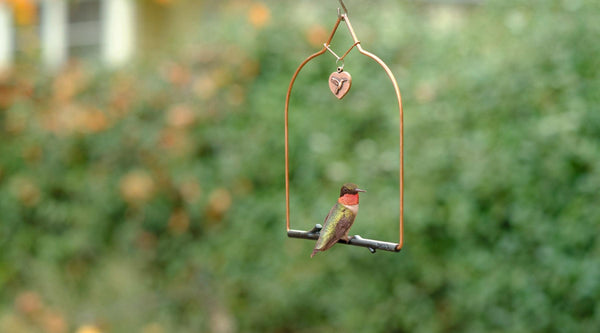
Ruby-throated is the only hummingbird nesting in South Carolina, and by early September it's holding a yard against its own returning young and the first southbound migrants passing through. A Charm Redwood Swing gives it a perch to claim as its own, right at feeder height, instead of guarding the feeder port itself all day.
Shop Charm Redwood Swing →Passing Through: South Carolina's Regular Winter Visitor
Rufous Hummingbird Migrant/Winter
The West's most wide-ranging hummingbird, and South Carolina's winter one. Rufous nests in the Pacific Northwest and Alaska, and a growing share of the population winters across the Southeast rather than in Mexico. In South Carolina it's a November-to-March bird: the statewide eBird signal peaks in January, and around Columbia — Lexington County — it reaches 2.3% of checklists in the first week of the year, sustained through the winter rather than spiking for a single bird. The committee's own treatment is the clearest signal of its status: Rufous is the only western hummingbird not on the South Carolina review list. Every other one — Black-chinned, Anna's, Calliope, Allen's, Broad-tailed, Broad-billed, Buff-bellied — requires documentation for every sighting. Rufous doesn't, because the committee expects it.

Quick ID: Adult males are almost entirely orange-rufous with a glowing orange-red throat — unmistakable. Most South Carolina birds are females or immatures: green above with cinnamon-washed flanks, a coppery rump, and rufous at the base of the tail feathers, which no plumage of Ruby-throated shows. The one look-alike is Allen's, below, which has a single South Carolina record; in practice a winter hummingbird with rufous in the tail here is a Rufous, and if it's an adult male, a bander can confirm it from the shape of the outer tail feathers.

An Extra Feeder for Your Rufous
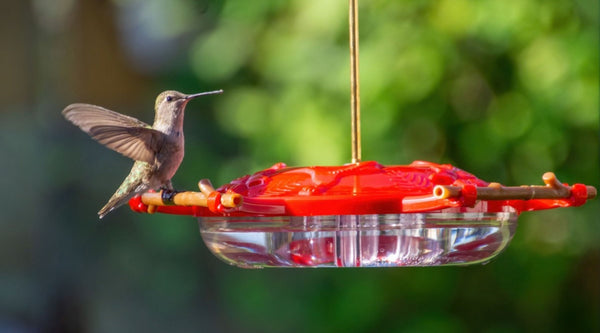
Rufous winters in South Carolina alongside any Ruby-throateds that stayed on the coast for the season, and the two don't share a feeder port easily. A second AspenPerch Feeder gives your returning Rufous a station of its own, away from whatever's already claimed the first one.
Shop AspenPerch® Feeder →If You're Lucky: South Carolina's Recurring Rarities
Two more species are on the state list as recurring rarities — review species that have turned up more than once in recent years and could plausibly show up again. Both are winter arrivals, and both were confirmed by banders.
Black-chinned Hummingbird Rare / Casual Visitor
The West's Ruby-throated counterpart, and a rare but recurring winter visitor here. South Carolina's committee first accepted the species in 1996, and it has kept turning up: Audubon's Christmas Bird Count logged one on the James Island count in the winter of 2022–23 and another on the Keowee count, in Oconee County, in 2024–25, and Hilton Pond Center has banded Black-chinneds among its winter vagrants. That Keowee bird is why Oconee shows a January eBird spike — about a dozen checklists in its best week, the signature of one well-visited individual. The committee keeps Black-chinned at full review status statewide, which means it treats the species as a genuine rarity, not a regular winter bird the way North Carolina's committee does. A caution that comes with this species: some of the raw eBird Black-chinned reports here are likely misidentified Ruby-throateds, because the two are nearly identical outside the hand.

Quick ID: Adult males have a velvety black throat with a thin violet band at its base that only shows at the right angle. Females and immatures are the problem — green above and white below, just like Ruby-throated. The usable field marks: on Black-chinned, the folded wingtips reach nearly to the tip of the tail, while Ruby-throated's tail extends clearly past the wings; Black-chinned's bill is slightly longer and droops a little; and it pumps its tail almost constantly while hovering. In South Carolina, timing helps as much as any mark — a Ruby-throated-type bird in December or January is worth a close look, and a bander can settle it.
Buff-bellied Hummingbird Rare / Casual Visitor
A hummingbird of the Texas Gulf Coast and eastern Mexico that has been wandering farther east along the Gulf and Atlantic coasts in winter. South Carolina's committee accepted the species to its Definitive list in 2003, and a committee report in the winter 2021 issue of The Chat noted a then-pending sighting from Summerville, in Dorchester County, that would be the state's third record if accepted. So: at least two accepted records, likely three, with activity into the recent past — a thin pattern, but a live one, and the reason this species sits with the recurring rarities rather than the one-offs.

Quick ID: Larger than any regular South Carolina hummingbird, with a red bill tipped in black, a glittering green throat and chest on both sexes, a buff-tan belly, and a rufous tail. Nothing else on the state list combines a red bill with a green throat — Broad-billed, below, also has a red bill but is blue-throated and gray-bellied.

Make Your Sanctuary Worth a Detour
Black-chinned and Buff-bellied are South Carolina's two recurring rarities — each with more than one accepted record, and each a plausible repeat visitor. Nectarlyte's electrolytes and calcium give a returning rarity a real reason to linger long enough to be documented.
Shop Nectarlyte® Powder →One and Done: South Carolina's Historic Accidentals
The other six species on the state list are historic accidentals — each backed by a single accepted record, or nothing documented in more than a decade. Nearly all arrived in winter, and most were identified by banders.
Calliope Hummingbird Historic / Accidental
Three records over fifteen years, all in the Upstate, all in winter. The first was found in a yard in Greer in December 1999 and accepted by the committee in its 2000–2001 report; Hilton Pond Center, which banded one of the three, has noted that only three Calliopes have ever been seen in the state; and the third turned up on a Greenville-area Christmas Bird Count in the winter of 2013–14, reported in The Chat. Three records make it more than a one-off, but nothing has been accepted in the twelve years since, while the committee holds it at full review status — so the silence is real, and this page lists it as historic rather than recurring. Georgia's committee, by contrast, treats Calliope as a regular winter visitor, which is why the two neighboring states classify the same bird differently.

Quick ID: The smallest hummingbird in the United States, with a short tail that sits about level with the wingtips at rest. Adult males show magenta streaks radiating down a white throat rather than a solid gorget. Females are told from female Rufous by size, that short tail, very little rufous in the tail, and a pale buff wash spread evenly across the breast rather than concentrated on the flanks.
Allen's Hummingbird Historic / Accidental
One accepted record. The committee added Allen's to the Definitive list in its 2007 annual report, and no report since has mentioned the species — nineteen years without a second. A single eBird checklist from Beaufort County in the 2016–2025 window carries the species name, and we count it as unconfirmed rather than as a second record. Allen's is a California coastal breeder that winters in Mexico; the handful that stray east are nearly always found in winter, and nearly always confirmed only in a bander's hand.

Quick ID: A Rufous look-alike. Adult males have a green back where a male Rufous is mostly orange — but some male Rufous show green backs too, so even that isn't conclusive. Females and immatures are, for field purposes, identical to Rufous; the difference lies in the width and shape of the outer tail feathers, which are narrower on Allen's, and it takes a bander with the bird in hand to be sure. Assume Rufous, report the bird, and let the banders decide.
Broad-tailed Hummingbird Historic / Accidental
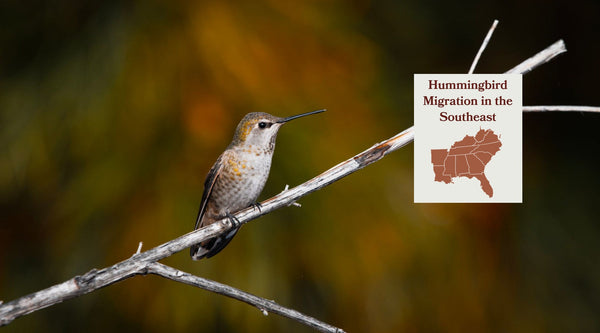
The bird at the top of this page. An adult female, mist-netted at Hilton Pond Center in York on September 20, 2021 — wing chord 51.1 mm, tail 31.0 mm, weight 3.50 grams — photographed and released, reported in The Chat that fall and accepted by the committee as the state's first record in its 2021 report. It remains the only one. It's also the only rarity on this page found in early fall rather than winter, and the lone York County eBird checklist for the species in September is that bird.

Quick ID: Adult males show a rose-magenta throat close to Ruby-throated's red, but with a thin white eye-ring instead of the dark cheek, and a high metallic wing-trill in flight. Females are the challenge — green above with buff flanks and rufous in the tail, like a female Rufous, but larger and longer-tailed, with less copper in the tail and a rufous wash that's paler and more diffuse. The South Carolina bird was identified by measurement.
Broad-billed Hummingbird Historic / Accidental
Two records, the most recent from January 7, 2008: an adult male on Wadmalaw Island, southwest of Charleston, banded by Hilton Pond Center staff and written up in The Chat in 2010 as the second Broad-billed ever seen in South Carolina. Nothing since — eighteen years and counting — and no eBird signal at all in the 2016–2025 window. A Southwest desert hummingbird, and a genuine stray this far east.

Quick ID: The bright red, black-tipped bill is diagnostic in every plumage. Adult males add a shimmering blue throat on a mostly emerald body; females are gray below with a white line curving behind the eye and a bill that's red at the base with a dark tip. Against Buff-bellied, the other red-billed species on this list, Broad-billed has a blue throat and gray belly rather than green and buff.
Anna's Hummingbird Historic / Accidental
One record. A bird at Hanahan, in Berkeley County, in 2010, reported by bander Doreen Cubie with a description and photographs that the committee's report in The Chat called very well documented; the committee accepted it to the Definitive list. For the Pacific coast's most abundant hummingbird, a single South Carolina record in a state where banders actively work winter feeders is a clear sign of how rarely Anna's gets this far east.

Quick ID: The only North American hummingbird with an iridescent crown as well as throat — males glow rose-pink from the top of the head down. Females are plump and short-billed with grayish-green flanks and usually a small red throat spot; against female Ruby-throated or Black-chinned, Anna's is stockier, dingier below, and holds its tail still while hovering.
Blue-throated Mountain-gem Historic / Accidental
South Carolina's least-supported hummingbird, by the committee's own accounting. Blue-throated Mountain-gem is the one hummingbird on the state list carried as Provisional rather than Definitive — the committee's category for a species with only written documentation, no photograph, specimen, or recording. It was accepted at that level in 1993, from a bird reported that July, and has never been promoted in the thirty-three years since. A real entry on the official list, and an honest one about its own limits.

Quick ID: The largest hummingbird that nests in the United States, with two white face stripes — one above the eye and a short one below it — a gray belly, and big white corners on a blackish tail that flash in flight. Adult males add a sapphire throat. Size alone rules out every regular South Carolina species; a bird this large at a feeder should be photographed from every angle.
One name we don't count
The committee's supplemental list carries an eleventh hummingbird, Cuban Emerald, marked Hypothetical — a published report that was never documented to the committee. It isn't on the official state list, and this page doesn't count it. If that ever changes, this page will.

Give Every Visitor a Reason to Stay
Calliope, Allen's, Broad-tailed, Broad-billed, Anna's, and Blue-throated Mountain-gem are each single-record or long-silent South Carolina accidentals. A real wildflower planting gives whichever one turns up next a reason to come back, common or exceedingly rare.
Shop Wildflower Seed →South Carolina Hummingbirds at a Glance
One species accounts for nearly all of South Carolina's hummingbird activity: Ruby-throated peaks at 35% of statewide checklists, Rufous at 0.2%, and five species have no eBird signal at all in the past decade. That gap is too wide for a shared bar chart to show anything useful, and it hides the part that matters for a South Carolina birder — that the interesting hummingbirds here are winter birds, and the state's record list has been built mostly between November and February. Here's the same information as a table instead; the South Carolina hummingbird calendar charts each region at its true scale.
| Species | Status | South Carolina Records |
|---|---|---|
| Ruby-throated Hummingbird | Year-Round Resident | Statewide peak 35% in September; 60% around Rock Hill; recorded on Christmas Bird Counts in each of the last three winters, mostly coastal |
| Rufous Hummingbird | Migrant / Winter Visitor | November–March; 2.3% around Columbia in early January; the only western hummingbird not on the state review list |
| Black-chinned Hummingbird | Rare / Casual | Full review; first accepted 1996; recent Christmas Bird Count records 2022–23 (James Island) and 2024–25 (Keowee) |
| Calliope Hummingbird | Historic / Accidental | Full review; 3 records, 1999–2014, all Upstate, all winter; none since |
| Buff-bellied Hummingbird | Rare / Casual | Full review; accepted 2003; 2 records, a 3rd pending as of 2021 |
| Allen's Hummingbird | Historic / Accidental | Full review; 1 record, accepted 2007 |
| Broad-tailed Hummingbird | Historic / Accidental | Full review; 1 record — York, September 20, 2021, banded |
| Broad-billed Hummingbird | Historic / Accidental | Full review; 2 records, most recent Wadmalaw Island, January 2008 |
| Anna's Hummingbird | Historic / Accidental | Full review; 1 record — Hanahan, 2010 |
| Blue-throated Mountain-gem | Historic / Accidental | Provisional status (written documentation only); 1 record, 1993 |
Frequently Asked Questions
How many kinds of hummingbirds have been documented in South Carolina?
Ten, all on the South Carolina Bird Records Committee's official state list. Only one, Ruby-throated, nests in the state; Rufous visits every winter; and the other eight are rarities, from two species with recent recurring records down to six with a single record or nothing in over a decade.
Is a hummingbird in South Carolina in winter unusual?
Less than it used to be, but still worth reporting. Along the coast, a modest number of Ruby-throateds now stay through winter — Audubon's Christmas Bird Count has found them in each of the last three seasons, including 13 on Hilton Head Island in one count. Inland, a winter hummingbird is more likely to be a western species, most often Rufous. The Carolina Bird Club asks that winter hummingbirds be reported so banders can identify them.
Which hummingbird is the rarest in South Carolina?
By the committee's own categories, Blue-throated Mountain-gem — the only hummingbird on the state list carried as Provisional, meaning it rests on a written description from 1993 with no photograph or specimen. Among the Definitive species, Allen's, Broad-tailed, and Anna's each have exactly one accepted record.
How do I tell a Rufous Hummingbird from a Ruby-throated in South Carolina?
Look for rufous color. A Rufous of any age or sex shows cinnamon on the flanks and rufous at the base of the tail feathers; a Ruby-throated never does — its flanks are gray-white and its tail is green and black. Season helps too: from November through February, most hummingbirds away from the coast are Rufous, while from April through September nearly every South Carolina hummingbird is a Ruby-throated.
Why does the state records committee want reports of Black-chinned Hummingbirds?
Because South Carolina's committee treats Black-chinned as a full review species — documentation is requested for every sighting, anywhere in the state. The bird is a rare winter visitor here, and female and immature Black-chinneds are nearly identical to Ruby-throateds, so most confirmed records come from banders who can measure the bird. North Carolina's committee reviews the species only in its mountains, which is why the two neighboring states classify the same bird differently.
Why We Created This Guide
Pop's Birding has been helping hummingbird lovers for three generations. One of the questions our customers ask most often is "what hummingbirds are actually in my state?" — we built this guide to give a direct, sourced answer for South Carolina specifically, not a generic one. Most identification content treats the Southeast as Ruby-throated country and stops there, and that misses what's distinctive here: a coastal winter population of the state's own hummingbird, a regular western winter visitor, and a rarity list built almost entirely from winter feeders and banders' hands — with a state committee that tells you, species by species, exactly how strong the evidence is.
How We Created This Guide
We started with statewide eBird bar chart data from the Cornell Lab of Ornithology, covering 2016 through 2025, plus nine counties that capture South Carolina's coast, the Columbia area, Rock Hill, and the Upstate. Since a few weeks of heavy reporting on one bird can inflate a species' apparent recurrence in raw checklist data, we checked every regional signal's week-by-week pattern and checklist count against the South Carolina Bird Records Committee's official state list, review list, and annual reports, along with record accounts published in The Chat and by Hilton Pond Center — that's how a dozen checklists built around one Keowee-area Black-chinned Hummingbird reads as what it is, while Lexington County's ten-week winter Rufous Hummingbird signal holds up as a real population. Ruby-throated's statewide dominance is stated directly rather than squeezed onto a shared-scale chart, and its winter presence rests on three consecutive seasons of Audubon Christmas Bird Count data rather than the eBird composite alone.
Sources
- eBird bar chart data, Cornell Lab of Ornithology — South Carolina statewide plus Charleston, Beaufort, Horry, Richland, Lexington, York, Greenville, Anderson, and Oconee counties, 2016–2025.
- South Carolina Bird Records Committee, Official list of the birds of South Carolina (Carolina Bird Club; as of the 2023 annual report) — source for all 10 species, their Definitive/Provisional status, and review status; and its annual reports archive — source for acceptance years.
- Carolina Bird Club, "Wintering Hummingbirds" — coastal winter Ruby-throated and inland winter western species.
- National Audubon Society, Christmas Bird Count results, 123rd–125th counts — South Carolina Ruby-throated winter totals and the James Island and Keowee Black-chinned records.
- The Chat (Carolina Bird Club) — Vol. 74 No. 2 (2010), Hilton Jr., second South Carolina Broad-billed record; Vol. 78 No. 1 (Winter 2014), SC BRC report, Anna's Hummingbird at Hanahan; Vol. 78 No. 2 (Spring 2014), Greenville Calliope; Vol. 85 No. 1 (Winter 2021), SC BRC report, Summerville Buff-bellied; Fall 2021 "Briefs for the Files," York Broad-tailed.
- Hilton Pond Center for Piedmont Natural History, "This Week at Hilton Pond," 15–21 September 2021 — first South Carolina Broad-tailed record, with banding measurements.
Know before they arrive
You don't have to keep this calendar taped to the fridge. Insider Birding Access members get seasonal notes timed to your region — when to have feeders out, what the birds are doing right now, and what's worth doing in your yard this season. We take the guesswork out of the calendar. Joining takes about thirty seconds, and there's 10% off your first order in it.
Join Insider Birding Access →Free to join. 10% off your first order.
Shop South Carolina's Hummingbird Favorites


Bethany Sloan has served as General Manager of Pop's Birding since 2010, continuing the legacy of her grandfather, William "Pops" Sloan, inventor of the Original Hummingbird Swing. A lifelong hummingbird enthusiast, educator, and independent researcher, she leads the company's educational content, including its 50-State Hummingbird Guide series, Regional Guide, Species Guide and Hummingbird Learning Center. Bethany combines scientific research, regional migration data, and more than 16 years of hands-on experience to create trusted educational resources for bird enthusiasts across North America.