Aug 04, 2026
Hummingbirds in Kentucky: The Complete Guide to All 6 Species
Kentucky's hummingbird scene is a lot simpler than Texas's or Arizona's — one dependable breeder does almost all the work, one western species turns up as a genuine, recurring winter visitor, and every few years something truly unexpected shows up at a feeder for a single, memorable season. That simplicity makes identification easy for ninety percent of sightings, and genuinely interesting for the other ten.
Free download
All 6 species, one page
This page covers every hummingbird confirmed in Kentucky, rarities included. The printable species guide is the practical companion — every species, its status, and how many records it has on file, sorted by how likely you are to actually see it.
Download the Kentucky species guideOne page · PDF · free to print and share

All 6 documented Kentucky hummingbird species, grouped by tier — statewide eBird data, cross-checked against the Kentucky Bird Records Committee's own accepted-record history.
The Hummingbird You're Most Likely to See
Ruby-throated Hummingbird Breeds Here
Kentucky's only regularly breeding hummingbird, and the species behind nearly every sighting in the state — nine times out of ten, a hummingbird in Kentucky is a Ruby-throated. Adult males show off a brilliant, iridescent ruby-red throat that can look flat black without direct light hitting it at the right angle, paired with a green back and a slightly forked tail. Females and young carry a plain whitish throat instead, with a rounded, white-tipped tail — no red at all, which is the quickest way to sex a bird at the feeder.
Partners in Flight estimates the total population at roughly 34 to 36 million birds, making it one of the most abundant hummingbirds in North America. The real numbers back up just how dominant it is in Kentucky: Ruby-throated peaks at roughly 42% of statewide checklists in September. Every other species genuinely recorded in Kentucky peaks under half a percent — most of them well under that.

Quick ID: A black-masked face and a brilliant ruby-red throat that can look flat black without direct light identify an adult male; females and immatures show a plain whitish throat and a rounded, white-tipped tail with no red at all.
Where you are matters for timing. Ruby-throated arrival runs a genuine month-long gradient west to east across the state — reliably common in far-western counties well before it reaches central Kentucky. See the Kentucky hummingbird calendar for the county-by-county breakdown.
Ruby-throated vs. Black-chinned: Where Identification Actually Breaks Down
Adult male Ruby-throated and Black-chinned Hummingbirds are usually easy to tell apart in good light — one shows a red gorget, the other a black one edged in violet-purple. But females and young of the two species are effectively inseparable in the field without measurements taken in the hand — which is exactly why any winter "Ruby-throated-looking" bird photographed in Kentucky is worth a second look and a report to a local bander.

In practice: an unusual-looking female hummingbird in Kentucky is still far more likely to be a Ruby-throated than a genuine Black-chinned — see below for why Black-chinned's own Kentucky record is harder to pin down than it first appears.

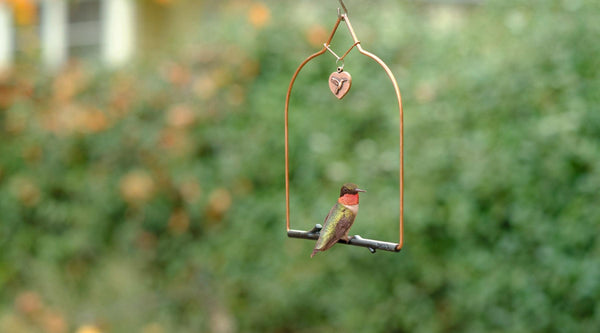
A Little Throne for Your Ruby-throated
Your Ruby-throated spends the whole breeding season defending this patch of yard from rivals and arriving migrants alike. Charm Redwood Swing gives it an actual perch to hold that territory from — right where you can watch.
Shop Charm Redwood Swing →Hummingbirds in Kentucky in Winter
Ruby-throated mostly clears out for the winter, but that doesn't mean Kentucky feeders go quiet. One western species turns up regularly enough, across multiple years of checklist data, to genuinely count as a recurring winter visitor — not common, but real and repeating, which sets it apart from the one-off rarities further down this page.
Rufous Hummingbird Migrant/Winter — the regular winter visitor
A western species that reliably turns up in Kentucky once Ruby-throated has moved on, and the only western hummingbird the Kentucky Bird Records Committee does not require documentation for. Kentucky hummingbird bander Brainard Palmer-Ball, Jr. has documented fall arrivals beginning as early as late July, with most activity running from August through the winter, and overwintering birds typically departing between mid-March and mid-April.
Adult males are unmistakable — fiery coppery-orange overall with an iridescent orange-red throat — and famously aggressive, known to chase off other hummingbirds even when the intruder is twice their size. Females and immatures are green-backed with rufous-washed flanks and a rufous tail base, a much subtler look than the males.

Quick ID: Adult males are almost entirely coppery-orange with a glowing orange-red throat, and the only largely rufous-backed hummingbird in North America; females and immatures are green-backed with rufous-washed flanks, best separated from Allen's by their broader outer tail feathers.
Rufous vs. Allen's: One of the Hardest Calls in North American Birding
Kentucky's confirmed record list includes both Rufous and Allen's Hummingbird, and separating them is widely regarded as one of the trickiest identification problems in the hobby — hundreds of Selasphorus hummingbirds stray east of the Rockies every fall, and telling the two apart from a distance is genuinely difficult even for experienced birders.
The unreliable myth: "orange with a green back means Allen's." Some male Rufous also show green backs, so back color alone isn't safe. A more useful rule of thumb: if the back is less than half green, it's almost certainly Rufous.
The reliable method: tail feather shape. In Allen's, all the tail feathers are narrower than in Rufous, most noticeably the outer three; adult male Rufous also shows a distinctive notch on the second tail feather that Allen's lacks. This is genuinely hard to see in the field and is usually confirmed only when a bird is examined in the hand — exactly the kind of work that identified Kentucky's own Allen's record. Female and immature Rufous and Allen's are essentially identical without that in-hand check, which is exactly why Kentucky's single Allen's record leans on banding documentation rather than photos alone.

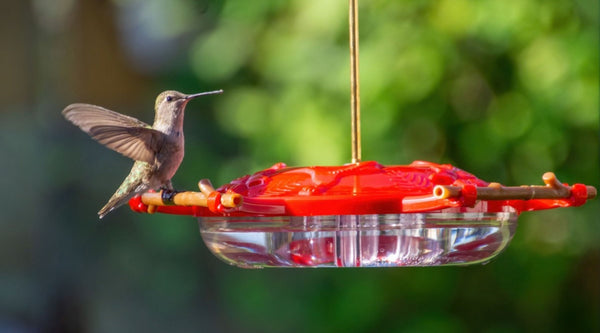
An Extra Feeder for Your Rufous
A wintering Rufous doesn't share — it'll claim a feeder and chase off anything that gets close, even birds twice its size. AspenPerch Feeder gives it its own station, so you're not refereeing all winter.
Shop AspenPerch Feeder →If You're Lucky: Kentucky's Rare and Historic Visitors
Every species below carries the Kentucky Bird Records Committee's review requirement — genuine documented rarities, each a single bird in a single season, not a recurring pattern. Keep a feeder up through winter and you're giving yourself the best possible shot at hosting one of them.
Allen's Hummingbird Historic / Accidental
Kentucky's only accepted record is a single bird that appeared at a private Pulaski County feeder on October 3, 2023, and kept returning through mid-January 2024 — the state's first confirmed record of the species. It was caught, banded, and identified in the hand, which was necessary since female and immature Allen's can't be reliably told apart from Rufous by eye alone. Nothing has been accepted since.
Adult males show a bronze-green back with a coppery tail, eye patch, and belly, plus a deep reddish-orange gorget. Females and immatures look almost identical to female Rufous and are reliably separated only by tail feather shape, usually confirmed in the hand.

Quick ID: A bronze-green back paired with a coppery tail, eye patch, and belly marks an adult male; females and immatures are essentially identical to female Rufous and are reliably separated only by tail feather shape, usually confirmed in the hand.
Anna's Hummingbird Historic / Accidental
A West Coast species entirely outside its normal range in Kentucky. A single Anna's Hummingbird was documented in Jefferson County during the winter of 2021–2022 — Kentucky's only accepted record, the same category of event as Allen's, not a sign of a regular wintering population.
Adult males have an iridescent rose-pink crown and throat — the only North American hummingbird species with the pink extending up over the entire head, not just the throat. Females are gray-green above with a scattering of red or bronze flecks at the throat, chunkier and less pointed-looking than a female Ruby-throated.

Quick ID: The only North American hummingbird with a fully colored crown as well as gorget — a well-seen adult male flashes rose-pink from forehead to throat, unmistakable at the right angle; females show a stocky build with a pale eye stripe and, unusually for a female hummingbird, a few iridescent red spots on the throat.
Black-chinned Hummingbird Historic / Accidental
Black-chinned genuinely sits on Kentucky's review-required list — but unlike Allen's, Anna's, and Mexican Violetear, no specific accepted record (date, county, documentation) could be confirmed from any approved KBRC or Kentucky Ornithological Society source. A report from Calloway County in 2016 gets repeated fairly often, but it traces only to an unofficial consumer birding site and was never validated by the Kentucky Bird Records Committee — this page doesn't treat it as a real record. Given how close female and immature Black-chinned looks to female Ruby-throated, an unverified report is genuinely more likely to be a misidentified Ruby-throated than a confirmed Black-chinned.
Adult males show a velvety black throat edged with a thin band of violet-purple, visible only at the right angle — otherwise it reads as solid black. Females and young are effectively inseparable from female Ruby-throated in the field.

Quick ID: A velvety black throat with a thin, hard-to-see band of iridescent purple and a small white spot behind the eye mark an adult male; females are essentially identical to female Ruby-throated except for longer wings that reach nearly to the tail tip.
Mexican Violetear Historic / Accidental
Kentucky's only confirmed record is a bird that spent late August 1999 at a Taylor Mill, Kenton County location — videotaped and photographed, not just a sight record — accepted under the species' pre-2016 name, Green Violet-ear. Nothing has been recorded since, 26 years and counting. Unlike Ruby-throated, Rufous, or the state's other rarities, Mexican Violetear doesn't follow a predictable north-south migration on a fixed calendar at all — its movements are still considered something of an open question among researchers, more a wandering response to flower bloom than a scheduled migration route.
Both sexes look essentially alike: a glittering metallic green hummingbird with a violet-blue patch across the ear coverts and upper chest that gives the species its name, and a blue-green tail crossed by a broad blackish band — unmistakable on sight, unlike anything else in Kentucky.

Quick ID: Both sexes look essentially alike — an all-green hummingbird with a glittering violet patch across the ear coverts and upper chest, and a blackish band crossing the blue-green tail; larger and stockier than Kentucky's other hummingbirds, with an all-dark bill.
Give Every Visitor a Reason to Stay
Whether it's Kentucky's next well-documented rarity or just a Rufous topping off before the cold sets in, real nectar sources make your yard worth the stop. Nectarlyte Powder adds the electrolytes and calcium plain sugar water skips, and Wildflower Seed gives any visitor — common or exceptionally rare — natural blooms to come back to.


Kentucky Hummingbirds at a Glance
Ruby-throated so overwhelmingly dominates Kentucky's hummingbird checklists — roughly 42% of statewide reports at its September peak — that a bar chart comparing it against everything else genuinely isn't useful here. Every other species on this list peaks under half a percent, and would show up on a shared-scale chart as nothing more than an invisible sliver next to Ruby-throated's bar.
| Species | Kentucky Records | Best Chance |
|---|---|---|
| Ruby-throated | Only regular breeder; ~9 in 10 sightings; ~42% peak statewide | Mid-April through October, statewide |
| Rufous | Regular winter visitor, recurring across multiple years | Late July through mid-April |
| Allen's | 1 accepted record (2023–24) | Not expected — genuine one-off |
| Anna's | 1 accepted record (winter 2021–22) | Not expected — genuine one-off |
| Black-chinned | Review species; no confirmed accepted record on file | Not expected — no confirmed record |
| Mexican Violetear | 1 accepted record (1999) | Not expected — no predictable pattern |
Frequently Asked Questions
How many species of hummingbirds are in Kentucky?
Six species have been documented in Kentucky. Ruby-throated is the only regular breeder, Rufous is a regular winter visitor, and Allen's, Anna's, Black-chinned, and Mexican Violetear are all review-required rarities — Allen's, Anna's, and Mexican Violetear each have exactly one confirmed accepted record, while Black-chinned has none that could be verified from any approved source.
Are there hummingbirds in Kentucky in winter?
Yes — Rufous Hummingbird is a regular winter visitor, with documented arrivals as early as late July and overwintering birds typically departing between mid-March and mid-April. Single winter records also exist for Anna's and Allen's, though neither is a regular occurrence.
Is Anna's Hummingbird a regular winter visitor to Kentucky?
No. A single Anna's Hummingbird was documented in Jefferson County during the winter of 2021–2022 — a genuine accidental record, not evidence of a recurring wintering population. It's the same category of event as the state's single Allen's Hummingbird record, not a pattern to expect at your own feeder.
Is Black-chinned Hummingbird confirmed in Kentucky?
Black-chinned is on Kentucky's official review list, meaning the state's records committee would review a documented sighting — but no specific accepted record could be confirmed from Kentucky Bird Records Committee or Kentucky Ornithological Society sources. A widely repeated 2016 Calloway County report was never validated by the committee and isn't treated as confirmed here.
How do I tell Ruby-throated and Black-chinned Hummingbirds apart in Kentucky?
Adult males are straightforward: Ruby-throated shows a red gorget, Black-chinned shows a black throat with a thin violet-purple band at the base. Females and young of the two species are effectively inseparable in the field — in practice, an unusual-looking female hummingbird in Kentucky is far more likely to be a Ruby-throated than a genuine Black-chinned.
For feeder setup, nectar ratios, and native plants that support these species, head back to our how-to-attract-hummingbirds-in-Kentucky guide. For region-by-region arrival and departure windows, see the Kentucky hummingbird calendar.
Why We Created This
Pop's Birding has been helping hummingbird lovers for three generations. One of the questions our customers ask most often is "What hummingbirds are actually in Kentucky?" — we built this guide to give a direct, sourced answer, not a generic one. Kentucky's real story is simpler than most states', but easy to get subtly wrong: Ruby-throated so overwhelmingly dominates the checklist data that it's tempting to read too much into whatever's left over, and that cuts both ways — dismissing a real recurring visitor as noise, or mistaking a single well-publicized rare bird (or an unverified report) for a confirmed pattern.
How We Created This
Every number on this page comes from eBird checklist data (Cornell Lab of Ornithology), pulled statewide and from five representative Kentucky counties, cross-checked against the Kentucky Bird Records Committee's official state list. Because a single well-publicized rare bird can produce a statistic that resembles regular presence in a summary percentage, we check the actual week-by-week pattern behind every species rather than stopping at a peak number — that's what confirms Rufous as a genuine, repeating visitor across multiple years, while Allen's, Anna's, and Mexican Violetear each cluster into a single documented bird's stay. Black-chinned is a genuine Kentucky Bird Records Committee review species, but no accepted record could be confirmed from any approved source, so it's tiered with the state's other rarities rather than treated as a regular visitor.
Sources
- Kentucky State List of Birds, Kentucky Bird Records Committee (KBRC/KOS), January 2025 update. Source for each species' official review status and Kentucky's full 6-species hummingbird list.
- Palmer-Ball, B. Jr. 1996. The Kentucky Breeding Bird Atlas. University Press of Kentucky. Source for Ruby-throated's confirmed-breeder status and nesting habitat.
- American Birding Association, fall 2023 Kentucky/Tennessee rare-bird roundup. Source for Kentucky's first confirmed Allen's Hummingbird record.
- eBird bar chart data, Cornell Lab of Ornithology — Kentucky statewide and county-level.
Know before they arrive
You don't have to keep this calendar taped to the fridge. Insider Birding Access members get seasonal notes timed to your region — when to have feeders out, what the birds are doing right now, and what's worth doing in your yard this season. We take the guesswork out of the calendar. Joining takes about thirty seconds, and there's 10% off your first order in it.
Join Insider Birding Access →Free to join. 10% off your first order.
Shop Kentucky's Hummingbird Favorites


Bethany Sloan has served as General Manager of Pop's Birding since 2010, continuing the legacy of her grandfather, William "Pops" Sloan, inventor of the Original Hummingbird Swing. A lifelong hummingbird enthusiast, educator, and independent researcher, she leads the company's educational content, including its 50-State Hummingbird Guide series, Regional Guide, Species Guide and Hummingbird Learning Center. Bethany combines scientific research, regional migration data, and more than 16 years of hands-on experience to create trusted educational resources for bird enthusiasts across North America.