Aug 23, 2026
Ohio Hummingbird Season: A Month-by-Month Calendar
Ohio's hummingbird season doesn't end everywhere at once. Columbus hummingbirds stick around a full month longer than Cleveland's do — even though all three cities we track peak in the very same week come fall, and arrive within about a week of each other each spring.
The short answer: Ruby-throated Hummingbird is Ohio's only confirmed breeding species, arriving late April in Columbus and Cincinnati, about a week later around Cleveland. Most of Ohio empties out by mid-October, but the Columbus area holds on into late October — nearly a month longer than Cleveland. Ohio also has a real, if thin, winter visitor: Rufous Hummingbird shows up most years from September through January, so a feeder left up after Ruby-throated leaves has a genuine chance at something rarer.
Ohio Hummingbird Timing at a Glance
| Question | Answer |
|---|---|
| Arrive | Late April in Columbus and Cincinnati; about a week later around Cleveland |
| Feeders up | 1–2 weeks before arrival — mid-April statewide is a safe target |
| Nesting begins | Shortly after arrival, generally by early May statewide |
| Busiest week | Early September — Cleveland, Columbus, and Cincinnati all peak the same week |
| Leave | Late September (Cleveland) to late October (Columbus) |
| Winter | Ruby-throated gone, but Rufous Hummingbird is a real, recurring possibility September through January |
Free download
The whole year on one page
Arrival windows by region, when to hang feeders, and the fall window when Ohio's rare visitors turn up — sized 8.5" x 11" for easy reference and printing.
Download the printable calendarOne page · PDF · free to print and share
Ohio's Hummingbird Season at a Glance
Ruby-throated Hummingbird so overwhelmingly dominates Ohio's numbers that showing it alongside a rarer species on one shared-scale chart would flatten the rarer bird into an invisible flat line. So this is two charts, not one — each showing a real season shape instead of a flattened one.

Ruby-throated Hummingbird, statewide, on its own scale — Ohio's only confirmed breeder.
That chart tells the main story, but Ohio also has one genuinely established winter visitor. Rufous Hummingbird is shown on its own chart, zoomed to when it actually occurs, since it's flat for roughly two-thirds of the year.

Rufous Hummingbird, statewide — Ohio's one established, regular winter visitor, zoomed to September–January.
Ohio also has six other documented western species — Allen's, Anna's, Black-chinned, Broad-billed, and Calliope Hummingbird, plus Mexican Violetear. None appears on a chart here: each has too few accepted records to show a meaningful season shape, though the reasons differ by species — more on that in the November section and in How We Built This Calendar, below.
Regions used on this page: Cuyahoga County (Cleveland), Franklin County (Columbus), and Hamilton County (Cincinnati) — a real north-to-south spread across the state, from the Lake Erie shore to the Ohio River.

Arrival and departure windows by county, derived from eBird bar chart data (Cornell Lab of Ornithology), 2016–2025.
One thing to know before you read the month-by-month detail: Cleveland, Columbus, and Cincinnati all peak in the very same week each fall, and their spring arrivals are only about a week apart — but Columbus doesn't let go nearly as fast. Its hummingbirds stick around nearly a full month longer than Cleveland's. Arriving within a week of each other doesn't mean leaving together.
January, February & March: The Quiet Season
| Statewide | Ruby-throated absent everywhere — no genuine breeding-season activity to report this early. |
| Where a feeder was left up | A Rufous Hummingbird that settled in for the winter can persist into January — the Ohio Cardinal, the Ohio Ornithological Society's records journal, documented one staying "well into the season" until January 20th in a recent winter. By February, even that trickle has stopped. |
What to do: If you kept a feeder up from the fall for a chance at a lingering rarity, January is exactly the stretch it might still pay off. Otherwise, there's nothing to put out yet.
April: Arrival Begins
| Statewide | First Ruby-throated Hummingbirds of spring arrive by late April in Columbus and Cincinnati, with Cleveland about a week behind. |
What to do: Have your feeder up by mid-April, ahead of the state's arrival week in late April.

Get your feeder up before the first bird arrives, not after.
Ohio's arrival runs about a week from Columbus and Cincinnati to Cleveland, so a feeder that goes out early costs you nothing — one that's still in the garage when the first bird turns up costs you the sighting. April is also the month to check last year's feeder for cracked seals and worn ports before the season depends on it. AspenPerch® has a built-in ant moat and a Polyperch® comfort perch, so birds rest between sips instead of hovering through the whole meal.
Shop AspenPerch® →May: Nesting Begins
| Statewide | Arrival completes everywhere; nesting begins shortly after arrival — expect quieter feeder activity as females spend more time incubating, not less activity overall. |
What to do: Keep feeders clean and full even if visits seem to drop off — that's nesting behavior, not birds leaving.
June & July: Nesting Season
| Statewide | Stable breeding season across the state. Feeder activity can look quiet while females are on the nest. |
What to do: Skip the insecticide near feeders — nesting females rely on small insects for protein alongside nectar.
Why nesting season is the demanding one
There's a wrinkle specific to hummingbirds. Most female birds build up a temporary calcium store in their bones, called medullary bone, and draw on it to make eggshell. Hummingbirds have very little of it, so a laying female has less in reserve. Researchers have seen nesting females eating wood ash and other mineral-rich materials, which they think helps replace the calcium that goes into eggs. In one 1994 study, every bird seen eating ash was a female tending a nest.

It's part of why Pop's Nectar includes calcium and electrolytes rather than sugar alone. Nesting females need extra calcium during egg-laying, and plain sugar water has essentially none. Read more on the research behind it.
Shop Nectarlyte® 8 oz →August: Building Toward the Peak
| Statewide | Numbers climb steadily through the month everywhere, building toward a peak that lands the same week statewide in September. |
What to do: Keep everything full and clean — the whole state is about to hit its busiest week together.

Keep pests off without pesticides.
Hummingbirds rely on small insects for protein, so spraying near a feeder can cost them a food source, not just protect one. AspenPerch®'s built-in ant moat blocks ants with a water barrier, and HummGuard® Nectar Tips keep bees and wasps out without changing anything for the birds.
Shop HummGuard® →September: Peak Season, Statewide
| Statewide | Cleveland, Columbus, and Cincinnati all hit their busiest week of the year in the same week, early in the month — a genuinely unusual finding. Of the 37 states where we track multiple counties, only three peak in one shared week — Ohio, Massachusetts and North Dakota. |
What to do: Southbound migration is already underway even as local numbers peak — birds passing through add to birds still nesting, so don't read a busy feeder as "more staying," necessarily.
This is the month to be generous, not economical.
Hummingbirds preparing for migration enter hyperphagia, feeding hard enough to add fat worth roughly a quarter to a third of their lean body weight before a long flight. The large 2lb Nectarlyte® powder or the Nectarade® liquid concentrate keeps you from running dry through the whole fueling window.


October: Cleveland & Cincinnati Empty Out
| Cleveland | Last regular activity by the end of September — the first part of the state to go quiet. |
| Cincinnati | Holds on into mid-October before emptying out. |
What to do: Most of Ohio's Ruby-throated Hummingbirds leave by mid-October. If you're in the Cleveland or Cincinnati areas and your feeder goes quiet this month, that's expected — Columbus is the one holding on. See November, below, for what a feeder left up can still catch.

This is the planting month.
Sow now and native wildflowers get the cold, moist period most varieties need to bloom reliably next spring.
Shop the Perfect Little Sanctuary® blend →November: Columbus Holds On, and Ohio's Real Rarities Turn Up
| Columbus | Last regular Ruby-throated activity in late October — nearly a month behind Cleveland. Only scattered stragglers remain into November. |
| Statewide | Rufous Hummingbird is well into its real fall window by now. This is also when most of Ohio's genuine western rarities have actually been documented — real, committee-reviewed records, though most represent a single bird, not a recurring pattern. |
What to do: None of Ohio's rare visitors is common, but they're real enough to be worth watching for if your feeder is still up after the local Ruby-throateds have left. A few records are worth knowing the shape of: a male Anna's Hummingbird spent several weeks at a north Columbus feeder in fall 2024, drawing enough birders that the hosts opened their yard to visitors — a genuine single-bird event, not an annual pattern. Ohio's Allen's Hummingbird record is thinner still — exactly one, ever — and close enough in appearance to Rufous, Ohio's much more common winter Selasphorus, that the Ohio Bird Records Committee treats it as exceptional, not expected. Black-chinned Hummingbird is a different case: it has three separate accepted Ohio records, a real if thin recurring pattern rather than one bird's extended stay, though all three cluster into this same narrow late-fall window rather than spreading across the season. See How We Built This Calendar, below, for what that means for the numbers.

Seeing one bird chase everyone else off?
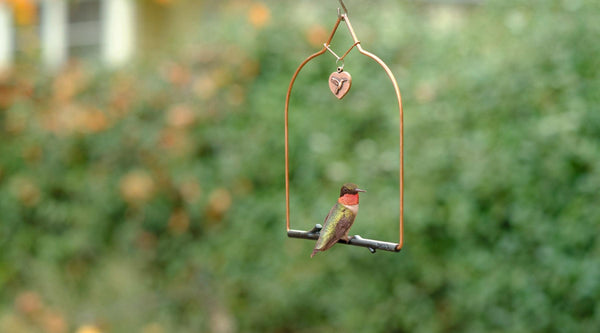
That's usually a resident claiming both the feeder and a nearby swing as its own guarded territory. A second feeder and a second swing, spaced out of sight of each other, gives another bird its own station to guard instead of fighting over one.
Shop a second swing →December: Rufous Continues
| Statewide | Rufous Hummingbird remains a real, if quieter, possibility statewide — a bird that arrived in the fall can plausibly stay through the whole month and into January. |
What to do: If you're keeping a winter feeder, check it regularly rather than assuming the season is over — Ohio birders have documented Rufous staying into late January. Our winter hummingbird feeder care guide covers heated feeders and the two-feeder swap.
The Year at a Glance
| Month | What's Happening |
|---|---|
| January – March | Quiet statewide; occasional lingering Rufous into January |
| April | Arrival begins — Columbus and Cincinnati first, Cleveland about a week later |
| May | Arrival completes; nesting begins statewide |
| June – July | Nesting season statewide |
| August | Numbers climb, building toward the September peak |
| September | Busiest week — Cleveland, Columbus & Cincinnati together |
| October | Cleveland empties out first, then Cincinnati; wildflower planting window |
| November | Ruby-throated gone statewide; most of Ohio's documented rarities cluster here |
| December | Rufous winter window continues |
Frequently Asked Questions
When do hummingbirds arrive in Ohio?
Late April in Columbus and Cincinnati, with Cleveland about a week behind — the three don't arrive on quite the same schedule, even though they peak in the very same week each September.
When do hummingbirds leave Ohio?
Late September in Cleveland, mid-October in Cincinnati, and late October in Columbus — nearly a month behind Cleveland despite peaking in the very same week each September. Ruby-throated is Ohio's only breeder, so once it leaves, any hummingbird you see afterward is a genuine rarity, not a straggler of the same wave.
Are there hummingbirds in Ohio in the winter?
Ruby-throated, no — it's gone statewide by the end of October, with only scattered stragglers into November. But Rufous Hummingbird is a real, recurring winter visitor most years, typically September through January, and Ohio has documented several other western species as genuine, if much rarer, records too.
What hummingbird species are in Ohio?
Ruby-throated Hummingbird is Ohio's only confirmed breeder. Rufous Hummingbird is a real, established winter visitor. Six more western species have been documented as genuine, committee-accepted rarities — Allen's, Anna's, Black-chinned, Broad-billed, and Calliope Hummingbird, plus Mexican Violetear — though most represent just one to four records total, not an annual pattern.
Why don't hummingbirds leave Cleveland and Columbus at the same time?
They peak in the exact same week each September and arrive within about a week of each other, so it's a fair question. The honest answer is we don't fully know why the departure gap is so much wider than the arrival gap — but it's a real, consistent pattern in the data, not noise. See How We Built This Calendar, below.
Why We Built This Calendar
Pop's Birding has been helping hummingbird lovers for three generations. One of the questions our customers ask most often is "When do hummingbirds arrive and leave my state?" — we built this calendar to give a direct, sourced answer, not a generic one. Most timing advice online gives a single date for an entire state, which misses a genuinely strange pattern in Ohio: Cleveland and Columbus peak in the very same week, but don't leave together at all.
How We Built This Calendar
Every date on this page comes from eBird bar chart data (Cornell Lab of Ornithology), 2016–2025, for Ohio statewide and three counties chosen for real geographic spread: Cuyahoga (Cleveland), Franklin (Columbus), and Hamilton (Cincinnati). We checked each date against the raw checklist count behind it, not just the percentage, because the three counties log very different numbers of checklists. Rare species were checked against the Ohio Bird Records Committee's accepted records rather than eBird activity alone, which is why Allen's, Anna's, and Black-chinned are named on this page but not charted. The county comparison is our own analysis, not a rewrite of eBird's charts.
Sources
- eBird bar chart data, Cornell Lab of Ornithology — Ohio statewide and county-level (Cuyahoga, Franklin, Hamilton), 2016–2025. Source for all month-by-month seasonal figures and the regional arrival/departure pattern.
- Ohio Bird Records Committee (OBRC), a committee of the Ohio Ornithological Society. Source for Ohio's official rare-bird review process and the accepted-record counts for Allen's, Anna's, Black-chinned, Broad-billed, and Calliope Hummingbird, and Mexican Violetear.
- The Ohio Cardinal, the Ohio Ornithological Society's quarterly records journal. Source for the documented Rufous Hummingbird that stayed until January 20th.
- Zenzal & Moore, “Stopover biology of Ruby-throated Hummingbirds during autumn migration”, The Auk 133:237–250 (2016). Source for the pre-migration fat-load figures in the September section.
- des Lauriers, J. R. (1994). Hummingbirds eating ashes. The Auk, 111(3), 755–756. Documents five nesting female hummingbirds eating wood ash; no males were seen doing so in that study.
- Adam, M. D., & des Lauriers, J. R. (1998). Observations of hummingbirds ingesting mineral-rich compounds. Journal of Field Ornithology, 69, 257–261. Source for hummingbirds' greatly reduced medullary bone and for the mineral-rich materials they eat.
- Werning, S. (2018). Medullary bone is phylogenetically widespread and its skeletal distribution varies by taxon. Journal of Ornithology, 159, 527–543. Source for medullary bone being confirmed in hummingbirds.
Know before they arrive
You don't have to keep this calendar taped to the fridge. Insider Birding Access members get seasonal notes timed to your region — when to have feeders out, what the birds are doing right now, and what's worth doing in your yard this season. We take the guesswork out of the calendar. Joining takes about thirty seconds, and there's 10% off your first order in it.
Join Insider Birding Access →Free to join. 10% off your first order.
Shop Ohio's Hummingbird Favorites


Bethany Sloan has served as General Manager of Pop's Birding since 2010, continuing the legacy of her grandfather, William "Pops" Sloan, inventor of the Original Hummingbird Swing. A lifelong hummingbird enthusiast, educator, and independent researcher, she leads the company's educational content, including its 50-State Hummingbird Guide series, Regional Guide, Species Guide and Hummingbird Learning Center. Bethany combines scientific research, regional migration data, and more than 16 years of hands-on experience to create trusted educational resources for bird enthusiasts across North America.