Aug 05, 2026
Hummingbirds in Illinois: The Complete Guide to All 7 Species
Illinois's own bird records committee makes an unusual distinction: only two hummingbird species in the whole state carry its top "Regular" designation, meaning expected every year without fail. One is Ruby-throated, the state's only breeder. The other is Rufous — a species most people wouldn't expect to see in Illinois at all. Five more species round out the state's list, each a genuine, documented rarity.
Free download
All 7 species, one page
This page covers every hummingbird confirmed in Illinois, rarities included. The printable species guide is the practical companion — every species, its status, and how many records it has on file, sorted by how likely you are to actually see it.
Download the Illinois species guideOne page · PDF · free to print and share

All 7 documented Illinois hummingbird species, grouped by tier — cross-checked against the Illinois Ornithological Records Committee's (IORC) official state checklist and Review List.
The Hummingbird You're Most Likely to See
Ruby-throated Hummingbird Breeds Here
Illinois Department of Natural Resources calls it "a common migrant and summer resident statewide," nesting May through July. The Illinois Breeding Bird Atlas independently corroborates this as the state's only breeding hummingbird — from spring through fall, it's the hummingbird filling Illinois feeders.

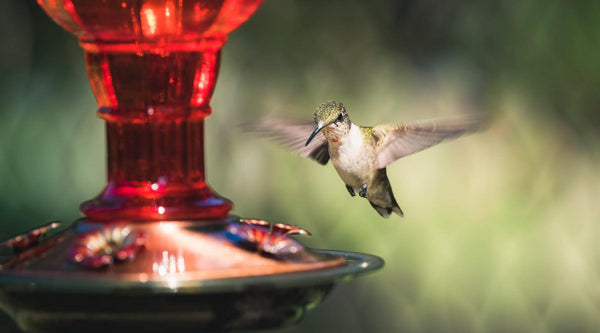
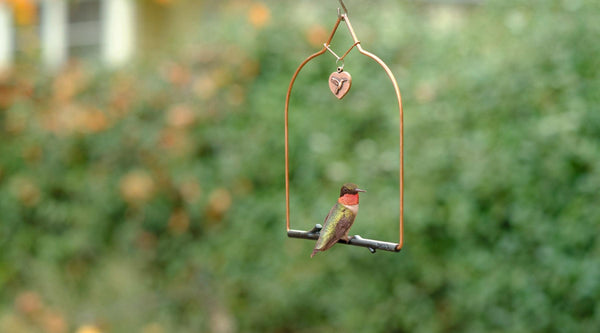
Quick ID: Adult males show a brilliant iridescent ruby-red throat that can look flat black until light hits it directly, paired with an emerald-green back. Females and immatures lack the red throat, showing a plain whitish throat and a rounded, white-tipped tail instead.

A Little Throne for Your Ruby-throated
Give your breeding Ruby-throated a lookout that says this yard's already spoken for — a stable perch to guard territory as migrants start filtering through each spring.
Shop Charm Redwood Swing →Illinois's Other "Expected" Species
Rufous Hummingbird Migrant/Winter
IORC codes Rufous "Regular" — the committee's own top tier, meaning at least eight records in the previous ten years and expected within the state annually. It's the only hummingbird besides breeding Ruby-throated to carry that designation, a direct committee statement that this is a genuine, repeatable statewide pattern rather than a run of coincidental sightings.
Adult males are unmistakable — fiery coppery-orange overall with an iridescent orange-red throat — and famously aggressive, chasing off other hummingbirds regardless of size difference. Females and immatures are trickier: green-backed above, with rufous-washed flanks and a rusty patch at the base of the tail.

Quick ID: Adult males are almost entirely coppery-orange with a glowing orange-red throat, and the only largely rufous-backed hummingbird in North America; females and immatures are green-backed with rufous-washed flanks.

An Extra Feeder for Your Rufous Visitor
Rufous is famously pushy at the feeder — a second station, spaced away from your main one, gives your regular Ruby-throateds somewhere to retreat when a Rufous shows up and claims the territory.
Shop AspenPerch Feeder →Illinois's Recurring Rarity
Broad-billed Hummingbird Rare / Casual Visitor
At least four accepted Illinois records, scattered across different years and seasons rather than one long stay: Sherman, Sangamon County, September 2017; Lerna, Coles County, May 2020; and LaBagh Woods Forest Preserve in Cook County, May 2021, the state's fourth record. A specimen tail-feather fragment is also on file. Genuine, repeating recurrence — not a single isolated event.

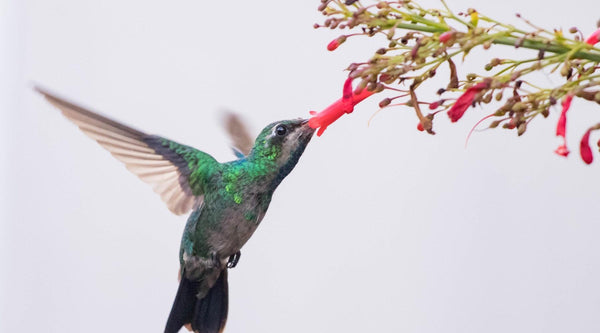
Quick ID: A vivid red bill tipped in black is diagnostic on both sexes; adult males add a shimmering blue throat and rich green body. Females are golden-green above and gray below, with a white line behind the eye.

Make Your Sanctuary Worth a Detour
A hummingbird that's flown this far off course deserves more than plain sugar water — added electrolytes and calcium give a wandering Broad-billed a real reason to stick around a day or two longer.
Shop Nectarlyte® Powder →If You're Lucky: Illinois's Historic Rarities
Four more species have been formally accepted by the Illinois Ornithological Records Committee — real, documented occurrences, but each with nothing recurring on a regular basis.
Anna's Hummingbird Historic / Accidental
Two accepted records, 14 years apart: a banded bird in Chillicothe, Peoria County, in late 2010 — Illinois's first, after an earlier 1990 report was rejected — and a bird in Princeton, Bureau County, that stayed nearly three months from October 2024 to January 2025. That second bird's long stay generated a large volume of eBird checklists from many different observers, which can look like a recurring pattern in the raw data but is really just one well-watched individual. Two records over 14+ years is the textbook Historic/Accidental case.

Quick ID: The only North American hummingbird with a fully colored crown as well as throat — males glow rose-pink from head to throat. Females show a central patch of rose-red spotting on an otherwise plain throat, with a stocky, broad-tailed build.
Broad-tailed Hummingbird Historic / Accidental
Illinois's only accepted record: Champaign, Champaign County, November 2023. Nothing recorded before or since.

Quick ID: Adult males have a rose-magenta throat and produce a distinctive high metallic trill with their wings in flight, audible before the bird is visible. Females closely resemble female Rufous but lack the extensive rufous wash on the flanks.
Mexican Violetear Historic / Accidental
Two accepted records, 12 years apart: St. Clair County in August 2009 — originally accepted under the pre-2017 name Green Violet-ear and later formally re-confirmed as Mexican Violetear via specimen comparison — and Mundelein, Lake County, in August 2021, the state's second record. Nothing recurring between them.

Quick ID: Both sexes look essentially alike — an all-green hummingbird with a glittering violet patch across the ear coverts and upper chest, and a blackish band crossing the blue-green tail.
Allen's Hummingbird Historic / Accidental
Illinois's only accepted record, documented by an incomplete specimen — two tail feathers, catalog number ISM 660484 at the Illinois State Museum — plus a series of photographs. Nothing recorded since.

Quick ID: Adult males show a coppery tail, eye patch, and belly against a bronze-green back, with a deep reddish-orange gorget. Females and immatures are extremely difficult to separate from female Rufous without a bird in hand.

Give Every Visitor a Reason to Stay
Real nectar sources planted in your yard are what actually bring visitors back — whether that's a regular Ruby-throated or a rarity passing through once in a decade.
Shop Wildflower Seed →Illinois Hummingbirds at a Glance
Ruby-throated's dominance here isn't a close call — statewide eBird frequency peaks near 29.8%, and every other confirmed species stays under 1% at true statewide scale. With a gap this wide, a bar chart wouldn't show anything the table below doesn't already say plainly, so this section skips straight to the table.
| Species | Illinois Records | Best Chance |
|---|---|---|
| Ruby-throated | Only breeder; nearly every sighting | May through October, statewide |
| Rufous | IORC "Regular" — expected annually | Fall, statewide |
| Broad-billed | 4+ accepted records, 2017-2021 | Not expected — but genuinely recurring |
| Anna's | 2 accepted records, 2010 and 2024-25 | Not expected — genuine rarity |
| Broad-tailed | 1 accepted record (2023), Illinois's only | Not expected — genuine one-off |
| Mexican Violetear | 2 accepted records, 2009 and 2021 | Not expected — genuine rarity |
| Allen's | 1 accepted record, Illinois's only | Not expected — genuine one-off |
Frequently Asked Questions
How many species of hummingbirds are in Illinois?
Seven species have been documented in Illinois. Ruby-throated is the only breeder, Rufous is officially expected every year, Broad-billed is a genuinely recurring rarity with 4+ records, and Anna's, Broad-tailed, Mexican Violetear, and Allen's are each historic rarities.
Is Rufous Hummingbird common in Illinois?
It's genuinely expected, if not common — Illinois's own bird records committee codes Rufous "Regular," its top tier, meaning it's recorded in at least eight of the last ten years and expected annually. It's the only hummingbird besides breeding Ruby-throated to carry that designation.
What is Illinois's most-documented rare hummingbird?
Broad-billed Hummingbird, with at least four accepted records scattered across different years and locations since 2017 — genuine, repeated recurrence rather than a single event.
Has a Ruby-throated look-alike ever nested in Illinois?
No — Illinois's only confirmed breeding hummingbird is Ruby-throated itself. Every other species on this list, including the "Regular" Rufous, is a migrant, winter visitor, or genuine rarity with no confirmed Illinois nesting record.
For feeder setup, nectar ratios, and native plants that support these species, head back to our how-to-attract-hummingbirds-in-Illinois guide. For arrival and departure windows, see the Illinois hummingbird calendar.
Why We Created This
Pop's Birding has been helping hummingbird lovers for three generations. One of the questions our customers ask most often is "What hummingbirds are actually in my state?" — and for Illinois, that answer includes a genuine surprise: Rufous Hummingbird, a species most people associate with the Pacific Northwest, is officially expected in Illinois every single year. We built this page to give a direct, sourced answer, correcting a factual error on our own prior page about Broad-billed Hummingbird's record count along the way.
How We Created This
We pulled eBird bar chart data for Illinois statewide to establish which species show a real, measurable presence at genuine statewide scale — meaning large, representative sample sizes, not a handful of local checklists. Only Ruby-throated cleared a meaningful bar; every other species measured well under 1% at true statewide scale, even Rufous, whose "Regular" status comes from the Illinois Ornithological Records Committee's own accepted-record count rather than raw eBird frequency. We cross-checked every rare and historic species directly against IORC's official state checklist and Review List, which is how we caught and corrected an error on this page's prior version: Broad-billed Hummingbird had been described as having a single accepted record in Coles County, when IORC's own records show at least four accepted records across four different counties and years.
Sources
- Illinois Ornithological Records Committee (IORC), Illinois State List of Birds. Source for all 7 species on this page.
- IORC, Review List of Illinois Birds. Source for which species require documentation.
- IORC Updates. Source for individual accepted-record details.
- Illinois Department of Natural Resources. Source for Ruby-throated's breeding status.
- eBird bar chart data, Cornell Lab of Ornithology — Illinois statewide.
Know before they arrive
You don't have to keep this calendar taped to the fridge. Insider Birding Access members get seasonal notes timed to your region — when to have feeders out, what the birds are doing right now, and what's worth doing in your yard this season. We take the guesswork out of the calendar. Joining takes about thirty seconds, and there's 10% off your first order in it.
Join Insider Birding Access →Free to join. 10% off your first order.
Shop Illinois's Hummingbird Favorites


Bethany Sloan has served as General Manager of Pop's Birding since 2010, continuing the legacy of her grandfather, William "Pops" Sloan, inventor of the Original Hummingbird Swing. A lifelong hummingbird enthusiast, educator, and independent researcher, she leads the company's educational content, including its 50-State Hummingbird Guide series, Regional Guide, Species Guide and Hummingbird Learning Center. Bethany combines scientific research, regional migration data, and more than 16 years of hands-on experience to create trusted educational resources for bird enthusiasts across North America.