Jul 26, 2026
Alaska Hummingbird Season: A Month-by-Month Calendar
Timing derived from eBird data, 2016–2025 (sourced July 2026)
Alaska has two hummingbird seasons, and they barely overlap. Rufous Hummingbirds arrive in April and are gone by early September. Anna's Hummingbirds — a species that didn't occur here a generation ago — turn up as the Rufous leave and stay through the winter. In Southeast Alaska that means a feeder can have customers in any month of the year. Just never the same bird.
Free download
The whole year on one page
Arrival windows region by region, when to hang feeders where you are, and when to watch for wintering Anna's. Printed small enough to tape inside the shed door.
Download the Alaska cheat sheetOne page · PDF · free to print and share
Alaska's Hummingbird Season at a Glance
Before the month-by-month detail below, here's the whole season in one picture — two species, two very different curves, with almost no overlap between them.

How often each species turns up on eBird checklists, week by week — statewide, 2016–2025. The month-by-month, region-by-region breakdown below shows how these two seasons actually play out on the ground.
Here's the whole year, month by month.
Regions used below
Southeast — Ketchikan, Sitka, Juneau, and the Inside Passage
Southcentral — Anchorage, the Kenai Peninsula, Mat-Su, Prince William Sound
Interior Alaska, including Fairbanks, isn't covered here. The Alaska Department of Fish and Game describes Rufous as common only in Southeast and Southcentral Alaska; farther inland, a hummingbird is a rare sighting, not a season.
January
Anna's country, on the coast.
| Southeast | Anna's Hummingbirds at feeders in the depths of winter. Not a fluke, not a single famous bird — a steady presence through the month. |
| Southcentral | Essentially none. The Anna's that appeared in fall don't make it through December. |
What to do: If you're in Southeast Alaska and keeping a winter feeder, this is when it matters most. Use a heated feeder, or rotate two so one is always thawed. Anna's survive cold nights by dropping into torpor — lowering their body temperature dramatically to conserve energy — but they need fuel to come out of it in the morning.
February
The quietest month of the year.
| Southeast | Anna's still present, at their lowest ebb of the winter. |
| Elsewhere | Nothing in Southcentral. |
What to do: Keep the winter feeder going if you started one. Late winter is the hardest stretch for a bird that isn't supposed to be here.
March
Anna's peak briefly, then the switchover begins.
| Week 1 | A small late-winter bump in Anna's reports across the Southeast, then a steady decline through the month. |
| Late March | Hang your feeders in Southeast Alaska. The first Rufous can reach Southeast Alaska in the closing days of March. |
| Southcentral | Still empty of Rufous. It waits a bit longer. |
Pop's tip: Put the feeder out before you expect birds, not after. A Rufous arriving in Ketchikan has flown roughly 3,900 miles from Mexico — the longest migration of any bird on Earth measured against body size. The first feeder it finds is the one it remembers.
April
Arrival month, and the year's biggest event.
| Week 1 | First Rufous around Juneau. |
| Weeks 2–4 | Numbers roughly double each week — from a handful of reports to more than one in five birdwatchers by month's end in Southeast. One of the fastest arrivals of any bird in North America. |
| Southcentral | The very first birds appear late in the month, but only just. |
| Events | The Alaska Hummingbird Festival runs all month in Ketchikan, hosted at the Southeast Alaska Discovery Center — a juried art show open to all Alaskan artists, Saturday morning bird walks, the Friday Night Insights lecture series, and Earth Day activities. All free. |
What to do: Feeders out and full across Southeast. Hang one in Southcentral by mid-month if you're in Anchorage or on the Kenai.
May
Southcentral finally opens. Nesting begins.
| Southcentral | Rufous arrive and peak in the same month, cresting around the third week. Numbers are far thinner than Southeast — roughly one birdwatcher in sixty. |
| Southeast | Busy and settling. Males have claimed territories; females are building. |
| Anna's | Effectively gone until August, everywhere. They don't breed here in any numbers. |
Why nesting season is the demanding one
A female builds the nest, incubates, and raises the young entirely alone — and in Alaska she has to fit all of it into a season barely four months long. There is no time for a second attempt if the first fails.
There's a wrinkle specific to hummingbirds. Most female birds build up a temporary calcium store in their bones, called medullary bone, and draw on it to make eggshell. Hummingbirds have very little of it, so a laying female has less in reserve. Researchers have seen nesting females eating wood ash and other mineral-rich materials, which they think helps replace the calcium that goes into eggs. In one 1994 study, every bird seen eating ash was a female tending a nest.

It's part of why Pop's Nectar includes calcium and electrolytes rather than sugar alone. Nesting females need extra calcium during egg-laying, and plain sugar water has essentially none. Read more on the research behind it.
Shop Nectarlyte® 8 oz →What to do: Keep feeders clean and full, and skip the insecticide. Nesting females need small insects and spiders for protein, and spider silk is what holds the nest together.
June
Quiet on the surface, busy in the trees.
| Southeast | Reports dip slightly. Females are sitting on nests rather than visiting feeders. |
| Southcentral | Steady, at low numbers. |
| Events | Summer Hummingbird Days at the Alaska Wildlife Conservation Center in Girdwood, hosted with the US Fish and Wildlife Service — live banding demonstrations, talks on hummingbirds and pollinators, kids' activities, and practical advice on feeders and pollinator gardens in Alaska. Free with admission. |
What to do: Don't read a quieter feeder as the season ending. A female on eggs leaves the nest only briefly each hour — she's still there, just not where you can see her.
Keep pests off without pesticides.
AspenPerch®'s built-in ant moat blocks ants with a water barrier, and HummGuard® Nectar Tips keep bees and wasps out without changing anything for the birds.


July
Peak month in Southeast.
| Southeast | The year's high point, in the first week — more than one in five birdwatchers. This summer's young are flying and joining the adults at feeders. |
| Southcentral | A small early-July bump, then a fast decline. The season is already ending here. |
| Departures | Adult males begin heading south, well ahead of females and young. Rufous start their southbound journey remarkably early. |
This is the month to be generous, not economical.
Southeast is at its peak numbers of the year right now, and adult males are already fueling up for an early southbound journey — the large 2lb Nectarlyte® powder or the Nectarade® liquid concentrate keeps you from running out mid-surge.


With this summer's young now flying and joining adults at feeders, it's also when chasing and real territorial disputes show up the most.

Seeing one bird chase everyone else off?
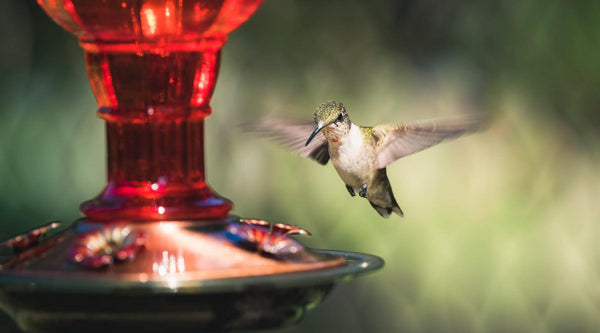
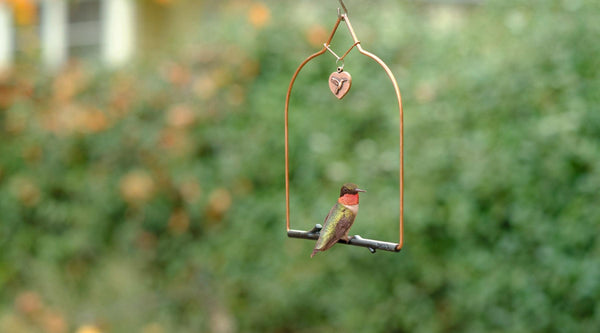
That's usually a resident claiming both the feeder and a nearby swing as its own guarded territory. A second feeder and a second swing, spaced out of sight of each other, gives another bird its own station to guard instead of fighting over one.
Shop a second swing →August
The handover month.
| Southeast | Rufous hold fairly steady into the month, then decline through the last two weeks. |
| Southcentral | Rufous essentially gone by mid-month. |
| Anna's | Start reappearing. Reports climb through the month in Southeast and Southcentral as Rufous leave. |
What to do: Don't take the feeder down when the Rufous stop coming. The second season is starting.
September
Rufous out, Anna's in.
| Rufous | Gone almost everywhere. A scattering in the first week in Southeast, nothing at all by the third. |
| Anna's, Southeast | Climbing hard — from about one birdwatcher in a hundred at the start of the month to about one in fifteen at the end. |
| Anna's, Southcentral | A few start turning up around Anchorage. |
What to do: Clean the feeder and keep it going. Anything at your feeder in Alaska from now until March is an Anna's, and worth reporting.
October
The Anna's high season.
| Southeast | The strongest month of the Anna's year, holding steady all month at the highest sustained rate of any winter month. |
| Southcentral | A modest but real presence around Anchorage. |
| Planting | Too late. Alaska sows in late spring, not fall. |
What to do: This is the month to commit to winter feeding, because it's the month you'll find out whether you have a bird. Set up a heated feeder or a second one to rotate before the hard freezes arrive.
November
Southcentral closes. Southeast doesn't.
| Southeast | Anna's dip mid-month, then recover. They're settling in for the winter. |
| Southcentral | Reports trail off — very few Anna's around Anchorage make it past November. |
What to do: If you're in Anchorage and had an Anna's in the fall, this is when it usually ends. In Southeast, keep going.
December
A hummingbird in an Alaskan December.
| Southeast | Anna's rise again — December reports run higher than November's. They are genuinely wintering here. |
| Southcentral | None. |
What to do: Keep the nectar from freezing and report what you see. A wintering Anna's in Alaska is a bird at the very edge of what its species can do, and the records matter.
The Year at a Glance
| When | What |
|---|---|
| Late March | Feeders up in Southeast Alaska |
| Early April | Rufous arrive and build fast in Southeast; Alaska Hummingbird Festival, Ketchikan |
| Mid-April | Feeders up in Southcentral |
| May – July | Nesting season; one brood only |
| June | Summer Hummingbird Days, Girdwood |
| Early July | Peak Rufous numbers in Southeast |
| Late August | Rufous depart; Anna's begin arriving |
| October | Peak Anna's season in Southeast |
| All winter, Southeast | Keep a heated feeder up for wintering Anna's |
Frequently Asked Questions
When do hummingbirds come back to Alaska?
Early April in Southeast Alaska around Juneau. Southcentral follows about a month later, in early May.
When do hummingbirds leave Alaska?
Rufous depart earliest from Southcentral, mostly gone by early August. Southeast holds on longer, with numbers falling off fast through late August and essentially none left by mid-September.
Do hummingbirds stay in Alaska year-round?
Rufous don't — every bird leaves for Mexico by fall. Anna's is the exception: genuinely present around Juneau right through December, January, and February.
Do hummingbirds reach Fairbanks and the Interior?
Only rarely. Alaska's hummingbirds are birds of Southeast and Southcentral Alaska, and the Alaska Department of Fish and Game describes Rufous as common only in those two regions. An earlier edition of this calendar described a regular Rufous season around Fairbanks. A recheck showed that pattern came from a data error, so we've removed it. If a hummingbird turns up at your feeder in the Interior, photograph it and report it, because it's a genuinely rare sighting.
Should I keep a feeder up through an Alaska winter?
In Southeast, yes — Anna's are reliably there from October through February, and a maintained (often heated) feeder is how most of them get found. Southcentral is the exception — very few Anna's make it past November around Anchorage.
Why We Built This Calendar
Pop's Birding has been helping hummingbird lovers for three generations, and one of the questions our customers ask most often is "When do hummingbirds arrive and leave my state?" In Alaska the honest answer is really two answers. Rufous Hummingbirds own the summer, arriving in April and gone by early September, while Anna's Hummingbirds turn up as the Rufous leave and, in Southeast, stay through the winter. A single set of dates would miss half the story, so we built this calendar to show both seasons, month by month and region by region.
How We Built This Calendar
Every arrival, departure and peak date on this page comes from ten years of eBird checklists (2016–2025) for Alaska as a whole and for Juneau (Southeast) and Anchorage (Southcentral). We count a first arrival as the week sightings rise clearly above the off-season baseline and keep climbing, and set feeder dates two weeks ahead of that. Species status is checked against the Checklist of Alaska Birds and the Alaska Department of Fish and Game.
Sources
- eBird bar chart data, Cornell Lab of Ornithology — Alaska statewide plus Juneau and Anchorage boroughs, 2016–2025. Source for all arrival, departure, peak, and species frequency figures.
- Cornell Lab of Ornithology, All About Birds — Rufous Hummingbird. Source for migration distance and the northernmost-breeding claim.
- Alaska Department of Fish and Game — Long-Distance Hummingbird Sheds Light on Migration.
- Alaska Public Lands Information Centers — Bird Festivals, and Audubon Alaska's bird festival listing. Sources for event timing.
- Alaska Department of Fish and Game — Alaska's Backyard Birds: Rufous Hummingbird. Source for Rufous being common in Southeast and Southcentral Alaska, and Anna's and Costa's as casual there.
- Checklist of Alaska Birds, 32nd edition (2026), University of Alaska Museum. Source for each species' official Alaska status.
- des Lauriers, J. R. (1994). Hummingbirds eating ashes. The Auk, 111(3), 755–756. Documents five nesting female hummingbirds eating wood ash; no males were seen doing so in that study.
- Adam, M. D., & des Lauriers, J. R. (1998). Observations of hummingbirds ingesting mineral-rich compounds. Journal of Field Ornithology, 69, 257–261. Source for hummingbirds' greatly reduced medullary bone and for the mineral-rich materials they eat.
- Werning, S. (2018). Medullary bone is phylogenetically widespread and its skeletal distribution varies by taxon. Journal of Ornithology, 159, 527–543. Source for medullary bone being confirmed in hummingbirds.
Event dates and formats change from year to year. Check organizer websites before making plans.
Know before they arrive
You don't have to keep this calendar taped to the fridge. Insider Birding Access members get seasonal notes timed to your region — when to have feeders out, what the birds are doing right now, and what's worth doing in your yard this season. We take the guesswork out of the calendar. Joining takes about thirty seconds, and there's 10% off your first order in it.
Join Insider Birding Access →Free to join. 10% off your first order.
Shop Alaska's Hummingbird Favorites


Bethany Sloan has served as General Manager of Pop's Birding since 2010, continuing the legacy of her grandfather, William "Pops" Sloan, inventor of the Original Hummingbird Swing. A lifelong hummingbird enthusiast, educator, and independent researcher, she leads the company's educational content, including its 50-State Hummingbird Guide series, Regional Guide, Species Guide and Hummingbird Learning Center. Bethany combines scientific research, regional migration data, and more than 16 years of hands-on experience to create trusted educational resources for bird enthusiasts across North America.