Aug 04, 2026
Hummingbirds in Massachusetts: The Complete Guide to All 6 Species
Six hummingbird species have been accepted to the official Massachusetts state list, but the arithmetic is stark: one of them nests here, and the other five have managed roughly 67 records between them in the state's entire recorded history — and two of those five haven't been seen at all in over a decade. That gap is exactly what makes identification in Massachusetts straightforward most of the year — and genuinely interesting the moment something shows up in November.
Free download
All 6 species, one page
This page covers every hummingbird confirmed in Massachusetts, rarities included. The printable species guide is the practical companion — every species, its status, and how many records it has on file, sorted by how likely you are to actually see it.
Download the Massachusetts species guideOne page · PDF · free to print and share

All 6 documented Massachusetts hummingbird species, grouped by tier — cross-checked against the Massachusetts Avian Records Committee's official Review List and state list, updated January 2026.
The Hummingbird You're Most Likely to See
Ruby-throated Hummingbird Breeds Here
The only hummingbird that breeds in Massachusetts — and the only one that breeds regularly anywhere in the eastern United States. Mass Audubon calls it the state's smallest breeding bird. In practice, if you see a hummingbird in Massachusetts between May and September, this is what it is.
The female does everything alone: builds a walnut-sized nest of plant down and lichen bound with spider silk, incubates two pea-sized eggs for around two weeks, and feeds the young for another three. In New England's shorter season she'll usually manage one brood, occasionally two — unlike the two or three that are routine in the Deep South.
When to expect the most activity: Statewide numbers peak in the last week of August — earlier than in the southern states, simply because New England birds have farther to travel before winter. See the Massachusetts hummingbird calendar for the full week-by-week curve.

Quick ID: Males have a ruby-red gorget that looks flat black until light hits it head-on. Females and young have plain whitish throats, sometimes with faint spotting, and young males often show fine dark streaking or a few scattered red flecks by late summer. Between May and September it's effectively the only hummingbird in the state, so a summer bird needs no second guessing.

A Little Throne for Your Ruby-throated
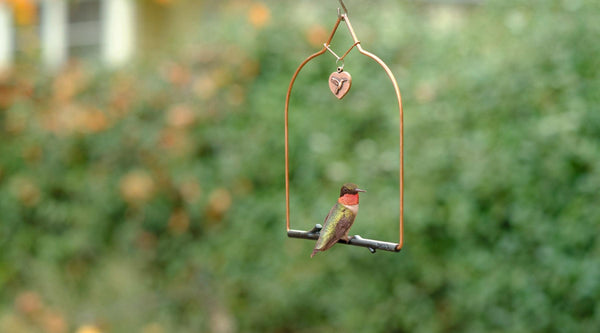
Ruby-throated is Massachusetts's only breeder, holding this yard from May through the end of August before the long trip south. Charm Redwood Swing gives your nesting bird a real perch to defend that territory from.
Shop Charm Redwood Swing →Ruby-throated vs. Black-chinned: Where Identification Actually Breaks Down
Adult male Ruby-throated and Black-chinned Hummingbirds are usually easy to tell apart in good light — one shows a red gorget, the other a black one edged in violet-purple. But females and young of the two species are close to identical in the field. The most useful mark on a perched bird is wing-to-tail proportions: Ruby-throated has a longer tail that extends visibly past the wingtips at rest, while Black-chinned has longer wings that reach the tip of the tail or extend just slightly beyond it. Behavior helps too — Black-chinned tend to pump and fan their tails almost constantly while hovering, a habit Ruby-throated doesn't share as consistently.

Black-chinned is a genuine, recurring Massachusetts rarity — nine accepted records since 1979, detailed below — so an unusual-looking hummingbird here in late fall is worth a second look, even though Ruby-throated has almost always cleared out by then.
Massachusetts's Fall and Winter Visitor
Ruby-throated does not overwinter in Massachusetts — but that doesn't mean every hummingbird disappears when it leaves. One western species turns up here reliably, and its timing runs opposite to what most people expect.
Rufous Hummingbird Migrant/Winter
The most frequent vagrant by a wide margin — around 44 accepted Massachusetts records on the Records Committee's own estimate, more than all the other rarities combined. But the timing is the opposite of what most people expect. Rufous turn up here in late fall and winter, not spring, with records running from October through the following March. Several have overwintered: one spent December 2020 through March 2021 in South Orleans, and another in West Harwich from December 2011 through March 2012 — the state's first confirmed overwintering hummingbird record.
Quick ID: Adult males are unmistakable coppery orange. Females and young are green-backed with rufous-washed flanks, rufous at the base of the tail, and a few red flecks at the throat — and cannot be reliably separated from Allen's Hummingbird in the field. The Massachusetts Avian Records Committee is explicit that any Selasphorus hummingbird should be banded and measured if possible, since even excellent photographs often can't settle it.


An Extra Feeder for Your Rufous
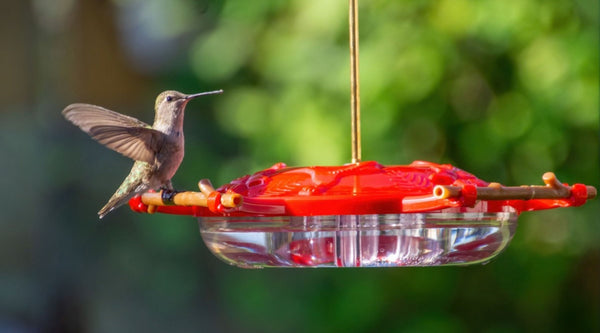
Rufous shows up in Massachusetts looking for a station of its own once Ruby-throated has cleared out for the winter — and some have overwintered right through to March. AspenPerch Feeder gives a genuine late-season visitor somewhere reliable to land.
Shop AspenPerch Feeder →Rufous vs. Allen's: Massachusetts's Hardest Identification Call
This is the identification problem the guide doesn't have room for, and it's worth understanding before you look at the rarities below — because Rufous and Allen's account for most of Massachusetts's genuine vagrant confusion. Adult male Allen's shows a bronze-green back against a coppery tail, eye patch, and belly, while adult male Rufous is typically solid copper overall — but a meaningful minority of male Rufous also show green backs, which wipes out that shortcut entirely. Females and young of both species are close to identical by eye.
The only field mark ornithologists consider reliable is tail feather shape, and even that usually requires a bird in the hand or a very sharp photo of a fanned tail: Allen's has narrower tail feathers throughout, most noticeably the outer three, while Rufous shows a distinct notch or "pinch" at the tip of the second tail feather from center (R2) — a mark documented by hummingbird bander Sheri Williamson and used as the banding-guide standard. It's exactly why the Massachusetts Avian Records Committee requires banding and measurement for Selasphorus submissions rather than accepting field photos alone.
Massachusetts's Recurring Rarities
Two species carry the Massachusetts Avian Records Committee's full review requirement but show a real recurring pattern across multiple decades — genuine rarities, never regular, but not one-offs either.
Black-chinned Hummingbird Rare / Casual Visitor
Nine accepted records since the state's first in 1979, clustered from late October to mid-December and concentrated almost entirely on Cape Cod, Nantucket, and Martha's Vineyard. All are one-off individuals — genuinely recurring at the state level, never regular at any single site.

Quick ID: Adult males show a velvety black throat edged with a thin band of iridescent purple, visible only at the right angle — from most angles the throat simply reads as black. A small white spot behind the eye is a useful mark even at a distance. Females have a plain, pale throat and are not reliably separable from female Ruby-throated by sight alone.
Calliope Hummingbird Rare / Casual Visitor
Seven accepted records spanning 2002 to 2016 across four counties, mostly late October through December. North America's smallest bird, and its identification is actually more straightforward than Rufous or Allen's.

Quick ID: Adult males show a gorget of separate magenta streaks radiating outward against a white throat, rather than a solid iridescent patch — unlike anything else on Massachusetts's list. Females and young are green above with a peachy wash below and fine dark stippling on the throat.

Make Your Sanctuary Worth a Detour
Black-chinned and Calliope both turn up on Cape Cod and the Islands with genuine multi-decade records behind them. A real nectar recipe with electrolytes and calcium gives a hummingbird that's already come hundreds of miles off course a reason to stick around and get documented.
Shop Nectarlyte® Powder →If You're Lucky: Massachusetts's Historic Rarities
The other two haven't been documented in well over a decade despite remaining full-review species — each a genuine one-off or a cluster that ended years ago, not a pattern to expect.
Allen's Hummingbird Historic / Accidental
Six accepted records between 1988 and 2012 across five counties — a surprisingly high count for a species whose entire breeding range is a narrow strip of California and southern Oregon coastline — but none accepted in the fourteen years since, despite remaining a full-review species. The Records Committee treats every submission as a banding case rather than a field call; see the tail-feather identification detail above, since by eye alone an Allen's in Massachusetts is essentially a guess.

Quick ID: Adult males show a bronze-green back against a coppery tail, eye patch, and belly — but reliable separation from Rufous requires tail feather shape, not overall color.
Broad-billed Hummingbird Historic / Accidental
A single record: one adult male in Dennis, from late August to early December 2008, banded there by one of the state's few licensed hummingbird banders. This one required no tail-feather forensics — a bright red bill tipped in black, paired with a shimmering blue throat and rich green body, has nothing else in North America to be confused with. It remains the most visually unmistakable rarity Massachusetts has ever recorded, which is part of why the three-and-a-half-month stay became local news.

Quick ID: A vivid red bill tipped in black is diagnostic on both sexes; the adult male adds a shimmering blue-green throat and rich green body — no other Massachusetts hummingbird shows that red-billed combination.
If you spot a hummingbird out of season — especially in late fall or winter — or one that doesn't look like a standard Ruby-throated, log it on eBird Massachusetts and notify a local birding group. Nearly every Massachusetts rarity record began with someone noticing something odd at a backyard feeder in November. Our Massachusetts hummingbird calendar covers exactly when to watch for them.

Give Every Visitor a Reason to Stay
Whether it's Massachusetts's next Black-chinned or Calliope, or just a hungry migrant passing through, real nectar sources are what turn a passerby into a repeat visitor. Wildflower Seed gives any hummingbird — common or exceptionally rare — a reason to stay.
Shop Wildflower Seed →Where in Massachusetts Are Hummingbirds Most Common?
The Berkshire highlands hold the state's highest concentration of nesting hummingbirds — 76% of surveyed blocks in Mass Audubon's most recent Breeding Bird Atlas, the highest of any ecoregion in the state. Cape Cod and the Islands, meanwhile, produce a wildly disproportionate share of the state's rarest records — Black-chinned from the desert Southwest, Allen's from the Pacific coast, and in 2008 a single Broad-billed Hummingbird that spent three and a half months in a Dennis garden before anyone could quite believe it.
Massachusetts Hummingbirds at a Glance
| Species | Massachusetts Records | Best Chance |
|---|---|---|
| Ruby-throated | Only breeder, statewide | May–September; peaks last week of August |
| Rufous | ~44 accepted records; most frequent vagrant | October–March; some overwinter |
| Black-chinned | 9 accepted records (1979–2022) | Late Oct–mid-Dec; Cape Cod & Islands |
| Calliope | 7 accepted records (2002–2016) | Late Oct–Dec |
| Allen's | 6 accepted records (1988–2012); none since | Not expected — thin, dated record |
| Broad-billed | 1 accepted record ever (Dennis, 2008) | Not expected — genuine one-off |
Frequently Asked Questions
How many species of hummingbirds are in Massachusetts?
Six species have been accepted to the official state list. Only Ruby-throated breeds here; Rufous is a genuine recurring fall/winter visitor; Black-chinned and Calliope are rare but genuinely recurring; and Allen's and Broad-billed are historic rarities with no records in over a decade.
Are there hummingbirds in Massachusetts in winter?
Ruby-throated does not overwinter, but Rufous Hummingbird does turn up reliably in late fall and winter, with records running from October through the following March and several birds documented overwintering on Cape Cod. Any hummingbird seen in Massachusetts after October is far more likely to be a rarity than a lingering Ruby-throated.
Where are Massachusetts's rare hummingbirds usually found?
Overwhelmingly on Cape Cod, Nantucket, and Martha's Vineyard, which produce a disproportionate share of the state's rarest fall records.
How do I tell Ruby-throated and Black-chinned Hummingbirds apart in Massachusetts?
Adult males are the easy case: Ruby-throated shows a red gorget, Black-chinned shows a black throat with a thin violet-purple band at the base. Females and young are close to identical — wing-to-tail proportions on a perched bird, and a Black-chinned's habit of pumping its tail while hovering, are the most useful marks.
How do I tell Rufous and Allen's Hummingbirds apart in Massachusetts?
In the field, often you can't. The only reliable mark is tail feather shape — Allen's has narrower tail feathers throughout, while Rufous shows a distinct notch at the tip of the second tail feather from center (R2) — and that usually requires a bird in the hand or a sharp photo of a fanned tail to check. It's why the Massachusetts Avian Records Committee requires banding and measurement for any Selasphorus hummingbird reported in the state rather than accepting field photos alone.
For feeder setup, nectar ratios, and native plants that support these species, head back to our how-to-attract-hummingbirds-in-Massachusetts guide. For region-by-region arrival and departure windows, see the Massachusetts hummingbird calendar.
Why We Created This
Pop's Birding has been helping hummingbird lovers for three generations. One of the questions our customers ask most often is "What hummingbirds are actually in my state?" — and for Massachusetts, most answers online stop at "Ruby-throated, plus the occasional rarity," without explaining just how genuinely difficult some of those rarities are to identify, or where in the state they actually turn up. We built this page to give a direct, sourced answer: the complete, officially documented list, with real identification detail for every species — including an honest account of where field ID simply isn't reliable, rather than pretending every hummingbird can be confidently named from a photo.
How We Created This
We cross-checked Massachusetts's species list and record counts against the Massachusetts Avian Records Committee's own accepted records rather than relying on generic field-guide descriptions — the Rufous-versus-Allen's section in particular required going beyond a simple summary, since the only field mark ornithologists consider reliable, tail feather shape, usually needs a bird in hand or a sharp photo of a fanned tail, which is why the committee requires banding and measurement for Selasphorus submissions rather than accepting field photos alone. That record history also draws a real distinction this page keeps: Black-chinned and Calliope are genuinely recurring across decades, while Allen's and Broad-billed are historic rarities with no documented record in over a decade, a difference the raw review-required status alone doesn't capture. We also connected Mass Audubon's Breeding Bird Atlas data, which shows the Berkshires holding the state's highest concentration of nesting Ruby-throated Hummingbirds while Cape Cod and the Islands produce a disproportionate share of the rarest fall records — original analysis on our part rather than a rewrite of any single source.
Sources
- Massachusetts Avian Records Committee, official state list, updated January 2026. Source for Massachusetts's full 6-species hummingbird list.
- Massachusetts Avian Records Committee, Review List, updated January 2026, with individual species record pages. Source for every species' accepted-record count and history on this page.
- Mass Audubon, Breeding Bird Atlas 2 (2007–2011). Source for Ruby-throated's block-occupancy data.
- eBird bar chart data, Cornell Lab of Ornithology — Massachusetts statewide.
Know before they arrive
You don't have to keep this calendar taped to the fridge. Insider Birding Access members get seasonal notes timed to your region — when to have feeders out, what the birds are doing right now, and what's worth doing in your yard this season. We take the guesswork out of the calendar. Joining takes about thirty seconds, and there's 10% off your first order in it.
Join Insider Birding Access →Free to join. 10% off your first order.
Shop Massachusetts's Hummingbird Favorites


Bethany Sloan has served as General Manager of Pop's Birding since 2010, continuing the legacy of her grandfather, William "Pops" Sloan, inventor of the Original Hummingbird Swing. A lifelong hummingbird enthusiast, educator, and independent researcher, she leads the company's educational content, including its 50-State Hummingbird Guide series, Regional Guide, Species Guide and Hummingbird Learning Center. Bethany combines scientific research, regional migration data, and more than 16 years of hands-on experience to create trusted educational resources for bird enthusiasts across North America.