Jul 16, 2026
How to Attract Hummingbirds in Alaska: A Backyard Sanctuary Guide
On January 13, 2010, in a backyard in Tallahassee, Florida, a bander named Fred Dietrich slipped a numbered band onto the leg of a one-year-old female Rufous Hummingbird — a bird weighing about as much as a penny. Six months later, in June, Kate McLaughlin caught that same bird in Chenega Bay, Alaska, on the far side of Prince William Sound. She had traveled 3,530 miles. According to the Alaska Department of Fish and Game, it remains the longest hummingbird migration ever documented.
Whether you're gardening in Juneau, Ketchikan, Anchorage, or a coastal Southcentral community, this guide will walk you through everything you need to turn your space into an Alaska hummingbird destination: who's around and when, how to size your setup to any space, feeder and nectar care, pest-safe cleaning, and the native plants and wildflower seed varieties best suited to Alaska's short growing season.
The short version, if you're in a hurry:
To attract hummingbirds in Alaska, put up a leak-proof feeder filled with fresh, dye-free nectar by late March in Southeast Alaska or mid-April in Southcentral, keep it clean and refilled every 5–6 days in cool weather, skip the insecticide so hummingbirds can still hunt insects for protein, and plant native, nectar-rich flowers like salmonberry, western columbine, and fireweed so your yard offers real food alongside the feeder.
- Where they are: hummingbirds are common in Southeast and Southcentral Alaska; farther inland, including around Fairbanks, one is a rare sighting
- Best feeder type: leak-proof design with a comfort perch, like the AspenPerch® Hummingbird Feeder
- Best nectar: plain 4:1 water-to-sugar ratio, no red dye — or Pop's Nectar with added electrolytes and calcium
- Feeder timing: up by late March in Southeast Alaska, mid-April in Southcentral — the first Rufous arrive in the opening days of April
- Nectar change frequency: every 5–6 days in Alaska's cool summers, every 2–3 days during a warm spell
- Pest control: no insecticide — use vinegar-water spray and HummGuard® nectar tips instead
- Top native plants: salmonberry, western columbine, fireweed, Indian paintbrush (varies by region — see below)
- Best wildflower planting window: late spring, once the ground has thawed and the risk of hard frost has passed
Free download
Take Alaska with you
Everything on this page on one page you can print and keep by the back door — the two species you'll see, timing by region, feeder care, and the best native plants for your part of Alaska.
Download the Alaska cheat sheetOne page · PDF · free to print and share
Which Hummingbirds You'll See in Alaska

Alaska sits at the very northern edge of hummingbird range in North America, and it's genuinely a two-species state. Rufous Hummingbird is Alaska's only breeder, nesting farther north than any hummingbird in the world and holding the record for the longest hummingbird migration ever documented — 3,530 miles from a Tallahassee, Florida backyard to Prince William Sound. It's common in Southeast Alaska and thinner around Anchorage and Southcentral; farther inland, a hummingbird is a rare sighting, not a season. Anna's Hummingbird is the more surprising find: a genuine newcomer that doesn't breed in Alaska but has become a regular fall-and-winter visitor, reported around Juneau from mid-August through early March. Costa's Hummingbird has been recorded as a casual visitor, and a handful of Ruby-throated Hummingbirds have turned up as genuine vagrants.
Want to go deeper on identification? Our full Hummingbirds in Alaska species guide breaks down Rufous versus Anna's and the state's genuine rarities, including exactly how to tell them apart.
When Do Hummingbirds Arrive and Leave Alaska?
Statewide Picture
Before the region-by-region detail below, here's the whole season in one picture — two species, two very different curves, with almost no overlap between them.

How often each species turns up on eBird checklists, week by week — statewide, 2016–2025. The region-by-region detail below shows how these two seasons play out differently in Southeast and Southcentral.
Arrival Times by Region
Alaska's hummingbird season is short, and where you are changes a lot about what you'll see. Rufous compress an entire breeding cycle into about four months in the southeast corner of the state, and arrive a month later and in far smaller numbers around Anchorage.
| Region | First Arrivals | Reliably Present | Hang Feeders By |
|---|---|---|---|
|
Southeast (Juneau, Sitka, Ketchikan) |
Early April | Mid-April – late August | Late March |
|
Southcentral (Anchorage, Kenai, Mat-Su) |
Early May | Early May – late July | Mid-April |
Windows derived from eBird bar chart data (Cornell Lab of Ornithology), 2016–2025, for Juneau City and Borough and Anchorage Municipality. "First arrivals" is the first week reporting rates rise clearly above the off-season baseline and keep climbing; "reliably present" is when the species is being reported on a quarter or more of birdwatchers' sighting lists. No Alaska agency publishes region-by-region arrival dates, so these windows are eBird-derived.
A correction: an earlier edition of this guide described a regular hummingbird season around Fairbanks and the Interior. A recheck showed that pattern came from a data error, so we've removed it. The Alaska Department of Fish and Game describes Rufous as common only in Southeast and Southcentral Alaska.
Leaving in Fall
The season ends abruptly almost everywhere. Around Juneau, hummingbird sightings fall from roughly one checklist in eight in mid-August to one in eighteen by month's end, and near zero by the second week of September. Southcentral empties even earlier, with most Rufous gone by early August.
Part of that is how early they start. Adult males begin heading south in July, well before the young birds — so the last hummingbirds at your feeder in August are usually that summer's fledglings, fueling up for a first trip to Mexico they've never made before.
A Note on Winter Hummingbirds
Here's the thing most Alaska hummingbird guides haven't caught up with: Alaska now has a winter hummingbird, and it isn't the one that breeds here.
Anna's Hummingbirds are reported around Juneau throughout December, January, and February, at rates several times higher than anything Rufous manages outside its summer season. They're surviving Alaska winters on a combination of milder coastal temperatures, backyard feeders, and an ability to enter torpor — dropping their body temperature dramatically overnight to conserve energy.
If you're in Southeast Alaska, this changes the calculation on when to take your feeder down. A feeder left up through the winter may be the difference for a bird that's a very long way from where its species used to live.
🗓️ Feeder Timing at a Glance
Put your feeder up: Late March in Southeast Alaska, mid-April in Southcentral. The first Rufous of the season arrive hungry after a journey most birds their size would not survive.
Take it down: About two weeks after the last hummingbird you see — which in most of Alaska means September.
In Southeast, consider leaving one up all winter. Anna's Hummingbirds are now regular here from October through February, and a maintained feeder is how most of them are found.
Want the full timing picture? Our Alaska hummingbird season calendar breaks the year down month by month and region by region — including the handover in late August, when the Rufous leave and the Anna's arrive.
Attracting Hummingbirds No Matter Your Space
You don't need acres of land to invite wonder into your yard. Hummingbirds are famously adaptable — all they're really looking for is a dependable food source, a safe place to perch, and a little color.

- Small patio or balcony: One feeder hung from a bracket or shepherd's hook, paired with a container of red or orange tubular blooms like fuchsia, is plenty to get noticed. Hummingbirds are solitary feeders by nature, so a single feeder works great in tight spaces. See our guide to which hummingbird products work best on a small patio or balcony if space is tight.
- Average backyard: Add a mix of feeders and native blooms along a fence line or garden bed, and give your visitors a swing or two nearby to rest and survey their territory between sips.
- Large yard with trees: Take advantage of the shade, and use trees like Sitka spruce or red alder as windbreaks near feeding areas — coastal Alaska's wind can be a real factor. Spread multiple feeders far apart, since hummingbirds are territorial and will happily chase each other off a single feeder.
Choose a Saucer Type Feeder to Prevent Leaks
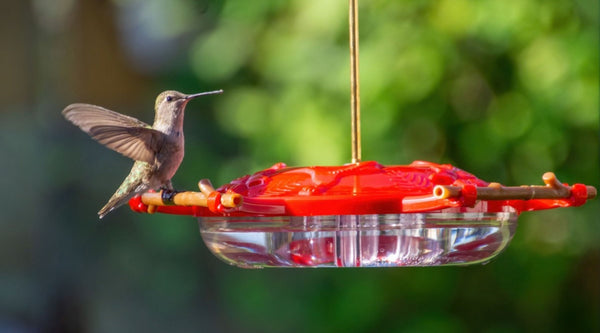
A feeder is only as good as what's in it — and how well it's kept. Pop's AspenPerch® Hummingbird Feeder is leak-proof by design and paired with our patented Polyperch® comfort perch, so your hummingbirds can rest and feed at the same time instead of hovering the whole meal.
Shop the feeder
AspenPerch® Hummingbird Feeder, 8 oz

Alaska's Rufous arrive already running on fumes after one of the longest migrations of any bird their size — a leak-proof feeder ready the moment they land means no missed refueling in those first critical days.
Shop the AspenPerch® Feeder →Keep Feeders Clean with Fresh Nectar
Feeding Fundamentals
- Only fill what they'll drink in a few days. An 8 oz feeder rarely needs to be topped all the way off — overfilling just means more nectar sitting around long enough to spoil.
- Skip the red dye. Your feeder's color does the attracting; dyed nectar offers no benefit and isn't necessary.
- Use a real nectar recipe, or save yourself the math with the ready-to-use option below.

Alaska's cool summers mean nectar can safely go 5–6 days between changes — Nectarade® Ready to Use Liquid comes pre-mixed and ready to pour, making feeder care through Southeast Alaska's rainy season about as low-effort as it gets.
Shop the Ready to Use Nectar →How Often to Change Nectar in Alaska
Alaska's cool, mild summer temperatures mean nectar generally lasts longer here than in warmer states:
| Outdoor Temp | Change Nectar Every |
|---|---|
| Below 70°F (typical Alaska summer) | 5–6 days |
| 70–80°F (a warm spell) | 3–4 days |
| Above 80°F (rare) | 1–2 days |
If the nectar ever looks cloudy before that window is up, change it early — cloudiness means it's already started to ferment, even in cooler weather.
Keeping Feeders Pest-Free Without Insecticide
Hummingbirds don't live on nectar alone — small insects make up a big part of their protein diet, especially for feeding chicks. That means insect spray is off the table around your feeding station; it removes a food source hummingbirds depend on and can be harmful to them directly.
Ants and Bees
Deter ants and bees with a vinegar-water spray around (not on) the feeder ports, or wipe down the hanging hook where ants tend to march down.

Still crashing the party? HummGuard® Nectar Tips slide onto the AspenPerch's feeding ports — a flexible membrane lets hummingbird beaks through and closes tight against anything bigger.
Shop HummGuard® Tips →Plant an Alaska Native Hummingbird Garden
Feeders are a wonderful supplement, but nothing beats real, native nectar. Native plants evolved right alongside Alaska's hummingbirds, so they bloom on the right schedule and produce exactly the nectar these birds are looking for.
Best Native Nectar Plants for Alaska
- Salmonberry — one of the very first blooms of spring, and critically important for arriving Rufous Hummingbirds before much else is in flower
- Western columbine — an early, reliable native that hummingbirds and the Rufous itself likely help pollinate
- Fireweed — Alaska's iconic summer bloom, tall and unmistakable, a strong midsummer nectar source
- Indian paintbrush (yellow paintbrush) — another reliable native favorite
Pop's tip: Because hummingbird nesting is timed almost exactly to the peak of salmonberry and blueberry bloom, prioritizing these two shrubs does double duty — supporting nesting hummingbirds and giving you a real harvest to enjoy yourself.
If You're Near the Border
If you're relocating from or splitting time with the Pacific Northwest, our Washington guide and Oregon guide may be of interest — Rufous Hummingbirds migrating to Alaska's coast pass directly through both states on their way north.
When to Plant the Perfect Little Sanctuary® Blend in Alaska
Late spring, once the ground has fully thawed, is the safest planting window in most of Southeast and Southcentral Alaska — typically May into early June, after the risk of hard frost has passed. This is a genuine departure from nearly every other state in this series: 9 of the 12 blend varieties either need or benefit from a cold, moist stratification period, but Alaska's winters are long and severe enough that fall-sown seed risks damage rather than the gentle dormancy period these plants are adapted to elsewhere. A late-spring sowing, timed to the start of Alaska's short but intense growing season, is the more reliable approach here.

Alaska is the one state in this series where fall planting isn't the answer. Perfect Little Sanctuary® Wildflower Seed Blend is ready whenever you are — sow it in late spring, once the ground has thawed, for the best shot at a bloom.
Shop the Seed →Top Performers in Alaska
Alaska's short growing season and severe winters make it the most challenging climate for this blend anywhere in the 50-state series. Realistically, expect mixed results, and lean on the true Alaska natives listed above for your most reliable nectar sources. That said, a couple of the blend's 12 varieties are worth trying:
- White Yarrow (Achillea millefolium) — yarrow grows wild across Alaska and is by far the best-suited variety in this blend for the state's climate. Worth knowing that commercially sold yarrow is often European stock rather than the native Alaskan subspecies, though both handle the conditions.
- Siberian Wallflower (Erysimum × marshallii, often sold as Cheiranthus allionii) — not an Alaska native, and biennial, so it won't bloom its first year. But its cold tolerance and preference for a short, cool season give it a better-than-average shot here.
Pop's tip: For Alaska specifically, we'd recommend leaning more heavily on true native plants like salmonberry, columbine, and fireweed than on this blend, which was developed with the growing conditions of the Lower 48 in mind. We'll continue researching options better suited to Alaska's extreme climate as we refine this series.
Give Them a Place to Rest
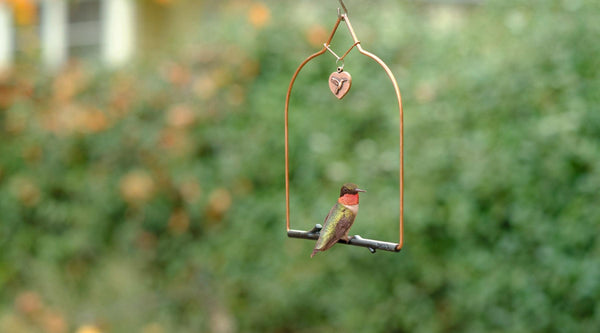
Hummingbirds spend a surprising amount of their day perched, not flying — watching their territory, digesting, and simply resting between feedings. A Pop's Original Hummingbird Swing hung near your feeder gives them exactly that spot, and it turns your feeding station into a front-row seat for watching them up close. Hang it about 1 foot from your feeder, at the same height (Pop's rule of thumb), and don't be surprised if a hummingbird claims it as their own personal lookout post.
This matters even more once Rufous — Alaska's only breeding species, and a notably territorial one — settles in for the summer. A second feeder-and-swing pairing, spaced out of sight of the first, gives less dominant birds somewhere to land instead of a fight over a contested station.
Shop the Perfect Perch
Original Series Hummingbird Swing, Onyx

A second swing gives a chased-off bird its own perch to fall back to — especially once Rufous starts guarding territory in earnest.
Shop the Original Swing →Keep Your Sanctuary Safe from Predators
A feeding station draws more than hummingbirds, and knowing what's actually worth worrying about — and what isn't — makes for a safer yard. Cats and window strikes are the two best-documented threats to hummingbirds around any home. See our full Hummingbird Predators guide for the complete picture.
Alaska has no native snakes, which sets it apart from nearly every other state in this series — but Southeast and Southcentral Alaska's own Steller's Jay is a confirmed nest predator worth knowing about. Cornell Lab of Ornithology's All About Birds describes Steller's Jay as a common nest predator that takes eggs and chicks from the nests of many species, and the Alaska Department of Fish and Game confirms the species is common across the same Southeast and Southcoastal range where Alaska's Rufous population is concentrated. Genuinely rare at any individual feeder, but worth keeping nearby cover trimmed back and feeders away from dense brush where a jay could stage an approach.
Summary: Key Takeaways for Attracting Hummingbirds in Alaska
Building a hummingbird-friendly yard doesn't take a green thumb or a big budget — just a little consistency and the right setup. Here's everything from this guide in one place:
- Rufous Hummingbird is Alaska's only breeding species — common in Southeast, thinner around Anchorage, and rare farther inland. It holds the record for the longest hummingbird migration ever documented: 3,530 miles, from a Florida backyard to Prince William Sound.
- Anna's Hummingbird is a genuine newcomer, now reported around Juneau right through December, January and February — Alaska's winter hummingbird is not the one that breeds here.
- Feeder timing: up by late March in Southeast Alaska, mid-April in Southcentral — the first Rufous arrive in the opening days of April.
- In Southeast, consider leaving a feeder up year-round for wintering Anna's.
- Any size space works — one feeder is plenty for a balcony; larger yards can support multiple feeders spaced apart, since hummingbirds are territorial.
- Use a leak-proof feeder with a comfort perch, like the AspenPerch®, and fill it only as full as it'll be drunk in a few days.
- Skip red dye in nectar; a plain 4:1 sugar-water ratio or Pop's Nectar (with electrolytes and calcium) both work.
- Change nectar every 5–6 days in Alaska's cool summers, every 2–3 days during a warm spell.
- Clean the feeder at every nectar change with warm water and vinegar — no soap or bleach.
- Never use insecticide near feeders; hummingbirds rely on insects for protein. Use vinegar-water spray and HummGuard® nectar tips for pest control instead.
- Add a hummingbird swing near the feeder to give them a place to rest and be observed up close.
- Cats and window strikes are the two best-documented threats to hummingbirds; Alaska has no native snakes, but Southeast and Southcentral's own Steller's Jay is a confirmed nest predator worth a little extra caution around.
- Native, nectar-rich plants (salmonberry, western columbine, fireweed, Indian paintbrush) are especially important in Alaska, since this blend's varieties are a harder fit here than almost anywhere else in the country.
- Sow wildflower seed in late spring once the ground has thawed, rather than fall.
Get these basics in place, and the wonder takes care of itself.
Frequently Asked Questions
A few of the questions we hear most from fellow hummingbird lovers across Alaska:
Does Alaska really have hummingbirds?
Yes. Rufous Hummingbird is a common and reliable breeder in Southeast Alaska — reported by more than one in five birdwatchers at the height of summer — and this is the northernmost breeding range of any hummingbird in the world. They're much thinner around Anchorage and Southcentral, and rare farther inland.
When should I put my hummingbird feeder out in Alaska?
Late March in Southeast Alaska. The first Rufous arrive in the opening days of April and numbers climb fast — by the end of April they're already at close to peak abundance. In Southcentral, aim for mid-April, since birds there arrive about a month later.
Do hummingbirds stay in Alaska year-round?
Rufous don't. They leave for Mexico beginning in July, with most gone from Southcentral by early August and from Southeast by mid-September. Anna's Hummingbirds are a different story — they're now reported around Juneau right through December, January, and February. Winter hummingbirds in Alaska are real, and they're increasing.
Do hummingbirds reach Fairbanks and the Interior?
Only rarely. Alaska's hummingbirds are birds of Southeast and Southcentral Alaska, and the Alaska Department of Fish and Game describes Rufous as common only in those two regions. An earlier edition of this guide described a regular Rufous season around Fairbanks. A recheck showed that pattern came from a data error, so we've removed it. If a hummingbird turns up at your feeder in the Interior, photograph it and report it, because it's a rare sighting.
How often should I clean my hummingbird feeder in Alaska?
Clean it every time you change the nectar — every 5–6 days in Alaska's typically cool summers, and every 2–3 days during a warm spell above 80°F.
What are the best plants to attract hummingbirds in Alaska?
Salmonberry matters more than any other, because it's one of the first things blooming when Rufous arrive. Western columbine, fireweed, and Indian paintbrush are all strong native choices that carry through the rest of the short season.
Alaska Hummingbird Resources
Audubon Chapters
Alaska is home to several local Audubon chapters, including Juneau Audubon Society. Find the one closest to you with Audubon's Find Your Local Audubon tool.
If You Find an Injured or Grounded Hummingbird
Hummingbirds are protected under federal and Alaska state law, so only a licensed wildlife rehabilitator can legally care for one.
- Alaska Sick or Dead Bird Hotline — 1-866-527-3358
- Alaska WildBird Rehabilitation Center (Mat-Su Valley) — 907-892-2927
- Bird Treatment and Learning Center (Bird TLC) (Anchorage) — a well-established rehabilitation center founded in 1988
Hummingbird Research in Alaska
Alaska is home to some of the most significant hummingbird research anywhere in the world, studying Rufous Hummingbirds — the most widely distributed hummingbird species in North America and the only one commonly found in Alaska.
- Alaska Hummingbird Project (based in Cordova), founded by master bander Kate McLaughlin, has been capturing and banding hummingbirds in Prince William Sound since 2007, and operates the northernmost hummingbird banding stations in the world. This is the same bander — and the same stretch of coast — behind the record at the top of this page: the Rufous banded in a Tallahassee backyard was recaptured here six months and 3,530 miles later. Alaska-banded birds have since been recovered as far away as California, Texas, Colorado, and Florida.
- Alaska Wildlife Conservation Center (Girdwood) partners with U.S. Fish & Wildlife Service biologists each year to capture, band, and release hummingbirds visiting the sanctuary, with live public demonstrations.
- Kenai National Wildlife Refuge, led by biologist Todd Eskelin, is currently attempting the first-ever full satellite tracking of a hummingbird's migration route from Alaska to Mexico, in partnership with the Banding Coalition of the Americas' HumTrack program.
- Tongass Hummingbird Project (Juneau), led by biologist Gwen Baluss since 2013 in partnership with Juneau Audubon Society, has documented individual hummingbirds returning to the same summer spot year after year.
- Alaska has only three licensed hummingbird banders in the entire state.
Hummingbird Events & Festivals in Alaska
- Alaska Hummingbird Festival (Ketchikan) — a month-long celebration of the Rufous Hummingbird's return to the Tongass National Forest, hosted at the Southeast Alaska Discovery Center. Includes a juried art show open to all Alaskan artists, Saturday morning guided bird walks, the Friday Night Insights lecture series, and Earth Day activities. All programs are free to the public. Held every year, throughout April.
- Summer Hummingbird Days at the Alaska Wildlife Conservation Center (Girdwood), hosted with the U.S. Fish and Wildlife Service — a family-friendly day featuring live hummingbird banding demonstrations, talks on hummingbird natural history and pollinators, kids' activities, and practical advice on setting up feeders and pollinator gardens in Alaska. Free with admission. Held every year, in June.
Why We Built This Guide
Pop's Birding has been helping hummingbird lovers for three generations. One of the questions our customers ask most often is "How do I actually attract more hummingbirds to my yard?" — we built this guide to give a direct, practical answer, not a generic one. Most Alaska hummingbird guides stop at "you might see a Rufous in summer," when our own eBird research turned up a winter hummingbird in Anna's — the kind of finding that changes when you'd actually take a feeder down.
How We Built This Guide
The timing figures on this page come from eBird checklist data (Cornell Lab of Ornithology) for Alaska statewide and two boroughs — Juneau and Anchorage — chosen to represent Southeast and Southcentral, 2016 through 2025. Where Rufous is common comes from the Alaska Department of Fish and Game's species account. Species accounts were cross-checked against Cornell Lab of Ornithology's All About Birds and Birds of the World, Audubon's Field Guide, and the Alaska Department of Fish and Game's own published research on the record-setting banded Rufous. Steller's Jay earned its place in the predators section only after we confirmed its nest-predation behavior with Cornell's All About Birds and its Southeast/Southcoastal Alaska range directly with the Alaska Department of Fish and Game's own species page.
Sources
- eBird bar chart data, Cornell Lab of Ornithology — Alaska statewide plus Juneau and Anchorage boroughs, 2016–2025. All arrival, departure, and species frequency figures on this page come from this dataset.
- Cornell Lab of Ornithology, All About Birds — Rufous Hummingbird
- Healy, S. & Calder, W. A. (2020). Rufous Hummingbird, in Birds of the World. Cornell Lab of Ornithology.
- Audubon Field Guide — Rufous Hummingbird
- Alaska Department of Fish and Game — Alaska's Backyard Birds: Rufous Hummingbird. Source for Rufous being common only in Southeast and Southcentral Alaska.
- Alaska Department of Fish and Game — Long-Distance Hummingbird Sheds Light on Migration
- Cornell Lab of Ornithology, All About Birds — Steller's Jay Life History. Source for confirming Steller's Jay as a common nest predator of eggs and chicks.
- Alaska Department of Fish and Game — Alaska's Backyard Birds: Jays. Source for confirming Steller's Jay's range in Southeast and Southcoastal Alaska.
Know before they arrive
You don't have to keep this calendar taped to the fridge. Insider Birding Access members get seasonal notes timed to your region — when to have feeders out, what the birds are doing right now, and what's worth doing in your yard this season. We take the guesswork out of the calendar. Joining takes about thirty seconds, and there's 10% off your first order in it.
Join Insider Birding Access →Free to join. 10% off your first order.
Your Alaska Backyard Sanctuary
Every real hummingbird sanctuary comes down to the same staples: mess- and pest-free food, a place to perch, native flowers, and fresh nectar. Here's everything from this guide to get all the bases covered in your own Alaska yard.


Bethany Sloan has served as General Manager of Pop's Birding since 2010, continuing the legacy of her grandfather, William "Pops" Sloan, inventor of the Original Hummingbird Swing. A lifelong hummingbird enthusiast, educator, and independent researcher, she leads the company's educational content, including its 50-State Hummingbird Guide series, Regional Guide, Species Guide and Hummingbird Learning Center. Bethany combines scientific research, regional migration data, and more than 16 years of hands-on experience to create trusted educational resources for bird enthusiasts across North America.