Aug 04, 2026
Hummingbirds in Louisiana: The Complete Guide to All 14 Species
Louisiana is genuinely one of the best states in the country for winter hummingbird variety, even though only one species breeds here. That combination — a single predictable summer breeder, then a real cast of regular winter visitors, plus a genuine run of documented rarities — is what makes identification here more interesting than it first looks.
Free download
All 14 species, one page
This page covers every hummingbird confirmed in Louisiana, rarities included. The printable species guide is the practical companion — every species, its status, and how many records it has on file, sorted by how likely you are to actually see it.
Download the Louisiana species guideOne page · PDF · free to print and share

All 14 documented Louisiana hummingbird species, grouped by tier — cross-checked against the Louisiana Bird Records Committee's official Review List and state checklist, revised March 2025.
The Hummingbird You're Most Likely to See
Ruby-throated Hummingbird Resident
Louisiana's only breeding hummingbird, and the species behind most sightings from spring through fall — breeding commonly throughout the state's wooded areas. But winter tells a different story: the Louisiana Ornithological Society notes that Ruby-throateds present in winter are almost always greatly outnumbered by several western species, especially Rufous and Black-chinned. Nancy Newfield's long-running Louisiana Winter Hummingbird Project, banding since 1979, established that the ruby-throats present in winter generally aren't the same individuals that nested there in spring — real winter signal concentrates in southern Louisiana population centers like East Baton Rouge and Orleans parishes.

Quick ID: Males flash a brilliant ruby-red throat in good light, but it reads as solid black most of the time — the forked black tail is the more reliable everyday mark. Females have a plain whitish throat and a more rounded, white-tipped tail.

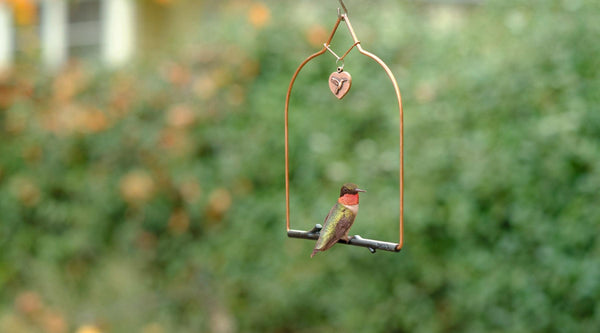
A Little Throne for Your Ruby-throated
Give Louisiana's breeding Ruby-throated a lookout that says this territory's spoken for — a stable perch to hold through the season before winter's western visitors start filtering in each fall.
Shop Charm Redwood Swing →Ruby-throated vs. Black-chinned: Where Identification Actually Breaks Down
Adult male Ruby-throated and Black-chinned Hummingbirds are usually easy to tell apart in good light — one shows a red gorget, the other a black one edged in violet-purple. But females and immatures of the two species are close to identical in the field — the Louisiana Ornithological Society itself flags this, noting that raw sighting counts of "Ruby-throated" in winter should be treated as an upper bound, with committee and banding data as the authoritative source.

In practice: a winter hummingbird that looks like a female Ruby-throated is genuinely as likely to be a Black-chinned as the real thing, especially in southern Louisiana — which is exactly why Louisiana has been the epicenter of Gulf Coast winter-hummingbird banding research since 1979.
Hummingbirds in Louisiana in Winter
Ruby-throated mostly clears out for the winter, but that doesn't mean Louisiana feeders go quiet — quite the opposite. Seven species turn up regularly enough, none requiring documentation from the Louisiana Bird Records Committee, to genuinely count as part of the state's winter hummingbird mix. That non-review status is a real committee determination, but it doesn't mean all seven are equally common — some have deep, well-documented winter records, while a couple only recently graduated off the review list with a genuinely thin record count behind them. Both kinds are covered honestly below.
Allen's Hummingbird Migrant/Winter
Removed from Louisiana's Review List in 2013, but the record behind that delisting is genuinely thin: four accepted records, all clustered in a single stretch from 2001 to 2003 — Lafourche, St. Tammany, East Baton Rouge, and Iberville parishes, several banded by Nancy Newfield. Nothing has been documented since in the sources reviewed for this page. Non-review status here reflects the Louisiana Bird Records Committee's own graduated-occurrence standard, not a claim that Allen's shows up every winter.

Quick ID: Males glow with a reddish-orange throat and typically a solid green back, giving a mixed orange-and-green look. Females and immatures are green above with rufous-washed flanks and rufous patches at the base of the tail.
Black-chinned Hummingbird Migrant/Winter
An uncommon but genuinely regular wintering species since the state's first record in Baton Rouge, December 1955 — never on the Review List at all. Louisiana is the epicenter of Gulf Coast winter-hummingbird banding research: Nancy Newfield's project banded 184 Black-chinned in southern Louisiana between 1979 and 1999 alone.

Quick ID: Males show a velvety black throat, only revealing a thin purple band in direct light — otherwise it just looks solid black. Females are plain and pale-throated, best told apart by white-tipped outer tail feathers and a small white spot behind the eye.
Broad-billed Hummingbird Migrant/Winter — the newest graduate
Removed from the Review List on March 15, 2025 — the most recent of any Louisiana hummingbird, meaning this species only just crossed the threshold from review-required to regular. The record behind it is a genuine, banding-confirmed returning pattern: an adult female was documented at a Terrebonne Parish feeder for two consecutive winters (2016-17 and 2017-18), recaptured and re-banded on her second stay — real evidence of site fidelity, not a one-off.

Quick ID: A vivid red bill tipped in black is diagnostic on both sexes; adult males add a shimmering blue-green throat and body, females a duller grayish underside.
Broad-tailed Hummingbird Migrant/Winter
Removed from the Review List back in 2002, but like Allen's, the actual record here is thin: exactly one accepted sighting, an immature male in Lafayette Parish in April 1995. Three other submitted Broad-tailed reports from 2001 to 2003 were specifically not accepted by the committee — two for insufficient documentation to rule out Rufous or Allen's, one where the photos better matched Ruby-throated. That's a genuine caution: this species is difficult to confirm in Louisiana without hard evidence, not a bird to expect at a feeder.

Quick ID: Males have a rose-magenta throat and produce a loud, distinctive metallic wing trill in flight — often heard before seen. Females show green throat spotting rather than solid color, with a pale eyering that helps separate her from similar species.
Buff-bellied Hummingbird Migrant/Winter
Off the Review List longer than any other Louisiana hummingbird — removed all the way back in April 1988 — consistent with Louisiana's coastal position right next to Buff-bellied's core Texas Gulf Coast range. A genuinely regular, long-established non-review winter visitor, not a rarity, though individual record-level detail from that era is largely undigitized.

Quick ID: A bright red bill tipped in black, a metallic olive-green throat and breast, and a soft buff-tan belly set this species apart — no other regular Louisiana hummingbird shows that red-billed combination.
Calliope Hummingbird Migrant/Winter
North America's smallest breeding bird, and a genuinely well-documented Louisiana winterer — removed from the Review List in 2002 specifically because winter numbers stayed relatively high from the late 1990s through 2001-02. Louisiana's accepted-records archive includes dozens of banded or specimen-backed birds, multiple simultaneous individuals in a single winter, multi-month stays, and banded returnees showing real cross-year site fidelity.

Quick ID: North America's smallest breeding hummingbird, with a hunched posture and short tail. Males have a unique streaked, ray-like magenta throat unlike any other species' solid gorget. Females are tiny even by hummingbird standards, with very little rufous in the tail.
Rufous Hummingbird Migrant/Winter — the dominant winter species
Never on the Review List at any point in its history, and the Louisiana Ornithological Society treats it as the dominant regular wintering western hummingbird in the state. Rufous doesn't breed in Louisiana — the real pattern is sustained winter presence from around January through April, a gap through its actual Pacific Northwest and Rocky Mountain breeding season, then rebuilding through fall to a genuine December peak.

Quick ID: Males glow with a fiery orange-red throat and a coppery-orange body — one of the most recognizable hummingbirds in North America. Females and immatures are green above with rusty flanks and rufous patches at the base of the tail.
Rufous vs. Allen's: One of the Hardest Calls in North American Birding
Louisiana's confirmed record list includes both Rufous and Allen's Hummingbird, and separating them is widely regarded as one of the trickiest identification problems in the hobby — hundreds of Selasphorus hummingbirds stray east of the Rockies every fall and winter, and telling the two apart from a distance is genuinely difficult even for experienced birders.
The unreliable myth: "orange with a green back means Allen's." Some male Rufous also show green backs, so back color alone isn't safe. A more useful rule of thumb: if the back is less than half green, it's almost certainly Rufous — which is also, simply on the numbers, the far more likely bird in Louisiana given Allen's thin, decades-old record.
The reliable method: tail feather shape. In Allen's, all the tail feathers are narrower than in Rufous, most noticeably the outer three; adult male Rufous also shows a distinctive notch on the second tail feather that Allen's lacks. This is genuinely hard to see in the field and is usually confirmed only when a bird is examined in the hand — exactly the kind of banding work Louisiana's own hummingbird researchers have specialized in since the 1970s.

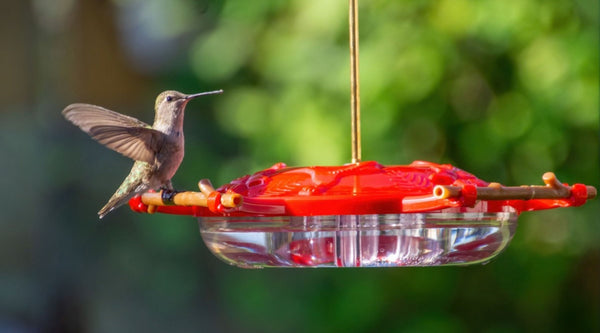
An Extra Feeder for Your Winter Visitors
Louisiana's winter feeders often see more western visitors than resident Ruby-throateds — Rufous, Black-chinned, Buff-bellied, and Calliope all turn up regularly. A second station spread across the yard gives each of them room instead of one dominant bird claiming the whole supply.
Shop AspenPerch Feeder →If You're Lucky: Louisiana's Rare and Historic Visitors
Every species below carries the Louisiana Bird Records Committee's active Review List requirement — genuine documented rarities. Four have a real recurring pattern across multiple decades; two are single, once-ever records. Both kinds are worth knowing.
Anna's Hummingbird Rare / Casual Visitor
Two accepted Louisiana records, fifteen years apart: an adult male in Baton Rouge, East Baton Rouge Parish, in October 2002, and a female banded in Lafayette Parish by Erik Johnson in December 2017. Genuinely on the Louisiana Bird Records Committee's current active Review List, not a graduate — a real, if infrequent, possibility rather than a bird to expect.

Quick ID: The only North American hummingbird with a fully colored crown as well as throat — males glow rose-pink from head to throat. Females show a central patch of rose-red spotting on an otherwise plain throat, with a stocky, broad-tailed build.
Blue-throated Mountain-gem Rare / Casual Visitor
Three accepted records spanning three decades — a female in Baton Rouge in November 1992, a second female banded by Nancy Newfield in Slidell in spring 1995, and a third bird in Baton Rouge from December 2021 into March 2022. A fourth 1993 Baton Rouge report was specifically not accepted, for an inadequate ten-second feeder view. Genuinely one of the largest hummingbirds in the country, and a real recurring pattern even at low frequency.

Quick ID: One of the largest U.S. hummingbirds; adult males show a bold, solid blue throat patch bordered by white facial stripes, females share the same white stripes without the blue.
Green-breasted Mango Rare / Casual Visitor
Three accepted records: an immature male in Caddo Parish in August 2009 (the first state record), a second immature bird in Concordia Parish in July 2023, and a third — Louisiana's first documented wintering individual — in Terrebonne Parish from December 2023 into February 2024, banded by Nancy Newfield and extensively observed. A real, if rare, recurring pattern rather than a one-off.

Quick ID: A bold black stripe runs from chin to belly on both sexes, bordered by shimmering bluish-green; the tail flashes reddish-purple to magenta, and the bird is notably larger than Louisiana's other hummingbirds.
Mexican Violetear Rare / Casual Visitor
Three accepted records across three different decades: Louisiana's first, in Lafayette Parish in the summer of 1999; a second in St. Landry Parish in May 2004; and a third in Bienville Parish in July 2016. Genuinely recurring, not a single isolated event, though still infrequent enough to require Review List documentation every time.

Quick ID: Both sexes look essentially alike — an all-green hummingbird with a glittering violet patch across the ear coverts and upper chest, and a blackish band crossing the blue-green tail.
Lucifer Hummingbird Historic / Accidental
Louisiana's only accepted record: a female present at a New Iberia, Iberia Parish feeder for a single day during a winter storm in December 2017, photographed and identification-confirmed by an outside Lucifer expert. The species was added to Louisiana's Review List the same year this record was accepted. Nothing has been documented since.

Quick ID: A small hummingbird with a long, curved bill unlike any other North American species. Males show a green back, a long forked tail, and an iridescent purple gorget that flares outward at the sides. Females are buffy below with a dusky ear patch and pale eyebrow stripe.
Rivoli's Hummingbird Historic / Accidental
Louisiana's only accepted record: an immature male present in Slidell, St. Tammany Parish, from mid to late November 2004 — known as Magnificent Hummingbird at the time, renamed Rivoli's after the American Ornithological Society's 2017 taxonomic split. Nothing has been recorded since.

Quick ID: One of the largest hummingbirds in the country; adult males often look entirely dark until light catches a violet crown and glittering green throat, both sexes show a small white spot behind the eye.
Give Every Visitor a Reason to Stay
Whether it's a genuine Review List rarity like Green-breasted Mango or a returning banded regular like Broad-billed, real nectar sources and a boost of electrolytes beyond plain sugar water give any visitor more reason to stick around your yard.


Louisiana Hummingbirds at a Glance

Peak weekly checklist frequency, eBird statewide data, filtered to genuine large-sample weeks so a handful of local checklists can't inflate a species' apparent frequency. Mexican Violetear, Lucifer, Rivoli's, Blue-throated Mountain-gem, and Green-breasted Mango are too rare to register a measurable statewide frequency and aren't plotted — see the table below for their real, committee-verified record counts.
| Species | Louisiana Records | Best Chance |
|---|---|---|
| Ruby-throated | Only breeder; regular but outnumbered in winter | April through September, statewide |
| Allen's | 4 accepted records (2001-03), non-review since 2013 | Not expected — thin, dated record |
| Black-chinned | Uncommon but regular winterer since 1955 | Winter, statewide, banding-confirmed |
| Broad-billed | Non-review since Mar 2025; returning banded bird | Winter; newly regular, still uncommon |
| Broad-tailed | 1 accepted record (1995); non-review since 2002 | Not expected — thin, dated record |
| Buff-bellied | Non-review since 1988, longest of any LA species | Fall-winter, southern & coastal parishes |
| Calliope | Non-review since 2002; dozens of banded records | Winter, well-documented statewide |
| Rufous | Never review-listed; dominant winter species | Roughly January through April, and fall-winter build |
| Anna's | 2 accepted records (2002, 2017) | Not expected — genuine rarity |
| Blue-throated Mountain-gem | 3 accepted records across 3 decades | Not expected — genuine rarity |
| Green-breasted Mango | 3 accepted records (2009, 2023, 2023-24) | Not expected — genuine rarity |
| Mexican Violetear | 3 accepted records across 3 decades | Not expected — genuine rarity |
| Lucifer | 1 accepted record (Dec 2017), Louisiana's only | Not expected — genuine one-off |
| Rivoli's | 1 accepted record (Nov 2004), Louisiana's only | Not expected — genuine one-off |
Frequently Asked Questions
How many species of hummingbirds are in Louisiana?
Fourteen species have been documented in Louisiana. Ruby-throated is the only regular breeder; Allen's, Black-chinned, Broad-billed, Broad-tailed, Buff-bellied, Calliope, and Rufous are all non-review winter species, though their actual record depth varies widely; and Anna's, Blue-throated Mountain-gem, Green-breasted Mango, Lucifer, Mexican Violetear, and Rivoli's are genuine Review List rarities.
Are there hummingbirds in Louisiana in winter?
Yes — Louisiana is genuinely one of the best states in the country for winter hummingbird variety. Rufous is the dominant regular winter species, Black-chinned and Buff-bellied are both long-established regulars, and Calliope has one of the best-documented winter records of any non-Ruby-throated species in the state.
Is Allen's Hummingbird a regular visitor to Louisiana?
Not really, despite being off the Review List. Allen's has exactly four accepted Louisiana records, all clustered between 2001 and 2003, with nothing documented since. Non-review status reflects the committee's graduated-occurrence standard at the time, not an ongoing regular presence.
How do I tell Ruby-throated and Black-chinned Hummingbirds apart in Louisiana?
Adult males are the easy case: Ruby-throated shows a red gorget, Black-chinned shows a black throat with a thin violet-purple band at the base. Females and young are effectively inseparable in the field — the Louisiana Ornithological Society itself treats raw winter "Ruby-throated" sightings as an upper bound, deferring to banding data for a real answer.
For feeder setup, nectar ratios, and native plants that support these species, head back to our how-to-attract-hummingbirds-in-Louisiana guide. For region-by-region arrival and departure windows, see the Louisiana hummingbird calendar.
Why We Created This
Pop's Birding has been helping hummingbird lovers for three generations. One of the questions our customers ask most often is "What hummingbirds are actually in Louisiana?" — we built this guide to give a direct, sourced answer, not a generic one. Louisiana's real story deserves more nuance than a simple review/non-review label: several of the state's "regular" winter species graduated off the Review List with genuinely thin historical records, while others are backed by decades of banding data. We wanted a page that gets that distinction right.
How We Created This
Every classification on this page comes from the Louisiana Bird Records Committee's current Review List (revised March 15, 2025) and the Official Louisiana State Field Check-list, cross-checked against LBRC's own Annual Reports and individual species record pages for exact dates, parishes, and banding details. Non-review status is a real committee determination, but it doesn't automatically mean "common" — Allen's and Broad-tailed both graduated off the Review List with only one to four accepted records total, which we say explicitly rather than letting non-review status imply a regularity the record doesn't support. Where a species' true frequency is well documented — Black-chinned, Calliope, Buff-bellied, Rufous — we say that explicitly too, drawing on Nancy Newfield's long-running Louisiana Winter Hummingbird Project and the Louisiana Ornithological Society's own published guidance.
Sources
- Louisiana Bird Records Committee, official Review List, revised March 15, 2025. Source for every species' review status and delisting history on this page.
- Official Louisiana State Field Check-list, Louisiana Ornithological Society. Source for Louisiana's full 14-species hummingbird list.
- Louisiana Ornithological Society, winter hummingbird identification article. Source for the Ruby-throated/Black-chinned winter identification caveat and Nancy Newfield's banding research context.
- eBird bar chart data, Cornell Lab of Ornithology — Louisiana statewide.
Know before they arrive
You don't have to keep this calendar taped to the fridge. Insider Birding Access members get seasonal notes timed to your region — when to have feeders out, what the birds are doing right now, and what's worth doing in your yard this season. We take the guesswork out of the calendar. Joining takes about thirty seconds, and there's 10% off your first order in it.
Join Insider Birding Access →Free to join. 10% off your first order.
Shop Louisiana's Hummingbird Favorites


Bethany Sloan has served as General Manager of Pop's Birding since 2010, continuing the legacy of her grandfather, William "Pops" Sloan, inventor of the Original Hummingbird Swing. A lifelong hummingbird enthusiast, educator, and independent researcher, she leads the company's educational content, including its 50-State Hummingbird Guide series, Regional Guide, Species Guide and Hummingbird Learning Center. Bethany combines scientific research, regional migration data, and more than 16 years of hands-on experience to create trusted educational resources for bird enthusiasts across North America.