Jul 19, 2026
Hummingbird Migration in the Southeast: One Bird, and the Ones Moving In
Quick overview: The Southeast has exactly one breeding hummingbird — and that single species carries an entire network of flowers that evolved to be pollinated by it. Ruby-throated Hummingbirds arrive on the Gulf Coast in early March and most are gone by the first of October, when they face a 500-mile nonstop crossing of open water. Then something new happens: western hummingbirds that have no business being here start showing up for the winter. Keep a feeder up through October everywhere, and year-round on the Gulf Coast, where the winter birds are.
🗓️ Feeder Timing at a Glance
Put your feeder up: Early March on the Gulf Coast; mid-March in the Deep South; late March into early April in the Upper South
Take it down: Through October everywhere — and on the Gulf Coast, don't take it down at all
Which Hummingbirds You'll See in the Southeast
One species breeds here. Everything else on this list is a winter guest — which is a relatively recent development, and one of the more interesting things happening in American birding.
Ruby-throated Hummingbird
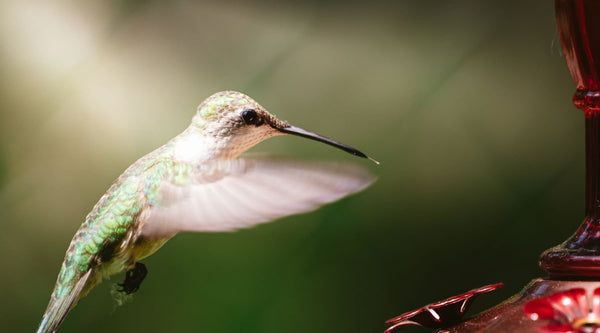
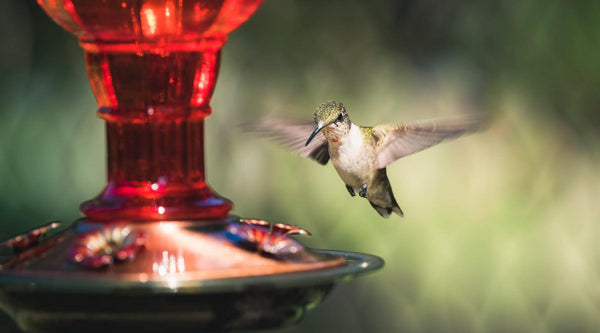
The region's only breeding hummingbird, and — as Cornell Lab puts it — eastern North America's sole breeding hummingbird, full stop. Males show the classic iridescent ruby gorget that can look black until the light hits it; females and juveniles are green above and white below. Present from March through early October across the region, and responsible for pollinating a whole suite of native plants entirely on its own.

Rufous Hummingbird
The most common western hummingbird in the winter Southeast, and it isn't close. eBird reports that from October to January, Rufous "is the most common species by far in the East, outnumbering other species by up to ten to one." Bright coppery-orange males; females and immatures are green with rufous flanks and much harder to identify. These birds bred in the Pacific Northwest and Alaska and turned the wrong way — except it may not be wrong at all.

Black-chinned Hummingbird
The second-most-regular winter western, particularly along the Gulf. It was first recorded in Louisiana at Baton Rouge in December 1955, and records have increased substantially in recent decades — the Louisiana Ornithological Society now considers it an uncommon but regular wintering species. Males have a velvety black throat edged in violet. Females are very close to female Ruby-throated, which matters more here than anywhere else.

Calliope Hummingbird
North America's smallest bird, and a genuine annual winter visitor to the Southeast now. Males show a magenta gorget that splits into separate rays rather than a solid patch. A bird that breeds in the mountains of Idaho and Montana turning up at a feeder in Alabama in January is exactly the kind of thing that makes this region worth paying attention to.

Buff-bellied Hummingbird
Worth being precise about this one, because it's often described as a Southeast resident and it isn't. Buff-bellied breeds only in south Texas and Mexico. Cornell Lab notes that "after the breeding season, some Buff-bellied Hummingbirds move northeastward to Louisiana to spend the winter." So within our region it's a scarce winter visitor — chiefly to Louisiana — rather than a year-round resident. Soft tan belly, metallic green throat, reddish bill.

And the long shots
As of eBird’s 2012 review, Allen’s occurs nearly annually. Broad-tailed, Anna's, and Broad-billed have multiple records. Green-breasted Mango, Green Violetear, and Rivoli's have each turned up a handful of times. A hummingbird at a Southeast feeder in December is worth a photograph — it could be almost anything.
What's Actually Happening in This Region
If you've read our Southwest guide, this region is its mirror image.
Southeastern Arizona has about fifteen hummingbird species sorting out one canyon between them. The Southeast has one — and that one bird does a job that fifteen species split elsewhere. It's the sole pollinator of a set of flowers that evolved specifically around it, it times its whole year to their bloom, and it does it while making one of the more extreme migrations of any bird its size.
And then, in the last forty years, that monopoly started to break.
One Bird, One Whole Network
The USDA Forest Service puts it this way: "Some scientists believe that as many as 19 species of plants found in the eastern United States have co-evolved with hummingbirds, noting the relationships between the tubular shape of certain flowers and the length and shape of a hummingbird's bill."
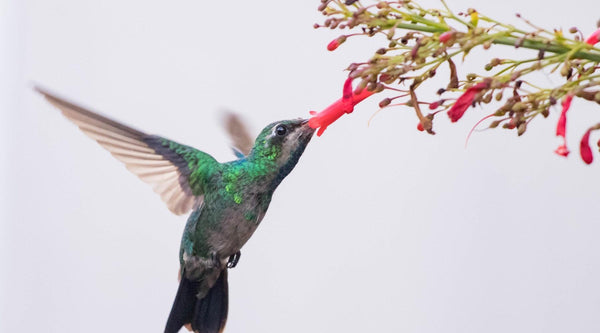
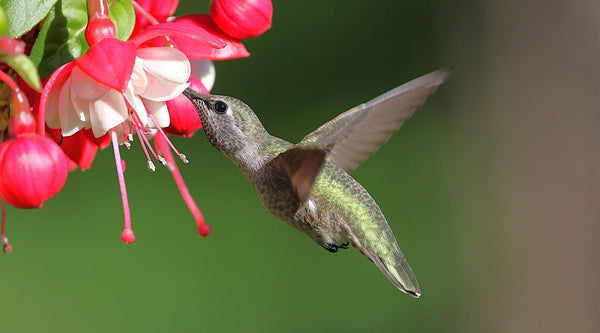
Those flowers are familiar even if you've never thought about why they look the way they do — red buckeye, wild columbine, coral honeysuckle, trumpet creeper, cardinal flower, jewelweed. Long tubes. Red or orange. No landing platform. No scent worth mentioning. Every one of those traits is a filter, and what it filters for is a hovering bird with a long bill.
Cardinal flower is the clearest case: in the Northeast, the Ruby-throated is effectively its only pollinator. Its floral tube is simply too long for most bees to reach the nectar at all.
And the relationship isn't one-sided. Bertin (1982, Canadian Journal of Zoology) measured what hummingbirds actually add: jewelweed seed set increased 8–17% when hummingbirds visited alongside insects, compared with insects alone.
There's even a mechanism for it. Jewelweed flowers dangle on thin stalks and swing when something lands on or hovers at them. Hurlbert and colleagues (1996, Oecologia) tested whether that wobble matters by immobilising some flowers. It does: birds "had significantly longer contact with anthers and more pollen deposited on their bills and crowns when foraging at mobile flowers than at flowers that had been experimentally immobilized." The flower moving is part of how it gets pollinated.
The Bloom Relay
Here's where it gets practical. The plants don't all bloom at once — they hand off.
Arrival, March into May. The USDA Forest Service singles out red columbine as "one of the first food plants that returning ruby throated hummingbirds depend upon during their spring migration northwards," and notes that arrival coincides with the flowering of red buckeye, clove currant, and columbine together. In Louisiana, the Ornithological Society records birds arriving "coinciding with blooming native plants, such as Copper Iris, Red Buckeye, and Crossvine."
Breeding season, June through August. Trumpet creeper and bee balm carry the middle of the year, while adults are raising young and need reliable fuel close to the nest.
Departure, August into October. Cardinal flower and jewelweed. This is the critical handoff, and it's the one worth planting for.
One honest note on all this. Bertin looked at whether the flowering times of 22 food plants actually track Ruby-throated migration across their shared range, and found that only one did reliably: jewelweed. So the relay is a real, useful pattern in any given garden — but it isn't a perfectly synchronised continental schedule, and we'd rather tell you that than oversell it.
🌿 What You Can Do: Plant Something That Blooms in September
Of everything in this guide, this is the one that matters most — and the reason is specific to this region.
A Ruby-throated leaving the Southeast in the fall may face a nonstop 500-mile crossing of the Gulf of Mexico, which the USDA Forest Service describes as "a nonstop flight of up to 500 miles over a period of 18 to 22 hours." To survive it, the bird has to nearly double its body weight first — from about 3.25 grams to 6 grams. There is no refuelling stop over open water.
That tank-up happens in late August and September, in your yard, on whatever is still flowering. And late summer is exactly when most gardens have gone quiet.
Plant for September. Cardinal flower (Lobelia cardinalis) blooms July into September. Jewelweed (Impatiens capensis) runs July into October — and it's the single plant whose bloom Bertin found actually tracks Ruby-throated migration across their shared range. Add Turk's cap, firebush, or late salvias in the Deep South and Gulf. Then plant red buckeye and wild columbine for March, so your yard covers both ends of the journey.
For plant lists matched to your conditions, see our state guides: Georgia, Louisiana, North Carolina, and Tennessee.
The Monopoly Breaks
For most of recorded history, a hummingbird in the winter Southeast was simply an error — a bird that had failed to leave.
That's changed, and recently. Writing in 2012, eBird dated the shift: "The appearance of these western hummingbirds is a phenomenon that has been realized only recently. Starting in the mid-1980s, each ensuing year has seemed to reveal more hummingbirds of more species in the late fall."
The Maryland numbers, tallied through 2000, give the shape of it — Rufous went from roughly one record per decade between 1952 and 1981, to two in the 1980s, four between 1990 and 1993, seven between 1994 and 1997, and eight between 1998 and 2000.
The obvious explanation is that these are lost birds. The banding data says otherwise. eBird reports "numerous records of banded birds reappearing in subsequent years," including one Virginia Rufous that was recovered in Montana and then found back in Virginia the following winter. In Louisiana, banded Black-chinneds return to the same yard in successive winters, and returnees often arrive earlier in the fall than they did the first time.
These aren't strays. They're birds using a route, and coming back to it.
What's driving it is genuinely unsettled. The Louisiana Ornithological Society lists the candidates plainly: more flower gardens and nectar feeders, milder winters, delayed nesting, more observers watching, better identification skills, or some combination. The one rigorous study on feeders driving a hummingbird range shift — Greig, Wood and Bonter (2017, Proceedings of the Royal Society B) — concerns Anna's Hummingbird in the West, not eastern wintering. So the feeder explanation is plausible and partly supported by analogy, not demonstrated. We'd rather say that than pretend it's settled.
One consequence worth knowing: on the Gulf Coast, winter Ruby-throateds are usually outnumbered by western species. If you have a hummingbird in January in Louisiana or Mississippi, the odds favour Rufous or Black-chinned — and female and immature birds often can't be told apart without a bander in hand.
The Other Bird That Feeds Them
There's a second species propping up this system, and it isn't a hummingbird.
Yellow-bellied Sapsuckers drill orderly rows of wells in tree bark, and the sap draws a crowd. Daily, Ehrlich and Haddad (1993, PNAS) found sapsucker sap "is stolen by over 40 species, including hummingbirds, warblers, chipmunks, squirrels, wasps, and butterflies" — and made a striking claim about how much it matters: "the breeding distribution of the closely related yellow-bellied sapsucker appears to determine the northern limits of the breeding ranges of the Rubythroat and Rufous hummingbirds."
That idea traces to Miller and Nero (1983, Canadian Journal of Zoology), who argued that the spring arrival dates and northern breeding limits of the Ruby-throated are set by this relationship — sap being the energy source that lets a hummingbird exist that far north before flowers open.
For the Southeast specifically, the relevance is winter. Yellow-bellied Sapsuckers winter throughout this region, and their wells are working food sources in December and January — for late Ruby-throateds, and for the western birds now spending the season here. If you have trees with neat rows of holes, that's a feeder you didn't have to fill.
Migration Timing by Sub-Region
One important distinction. You may see a hummingbird on the Gulf Coast in January or February. That is almost certainly a bird that overwintered — often a western species — not an early spring migrant. Genuine northbound arrivals start in early March. It matters because it changes what your feeder is for: in February you're supporting a bird that stayed, in March you're greeting one that just crossed the Gulf.
Conservation: What's at Stake Here
- Ruby-throated Hummingbird — abundant and rated low concern: Cornell Lab reports that populations "steadily increased every year from 1966 to 2019", a global breeding population near 36 million, and 8 out of 20 on the Continental Concern Score. But English and colleagues (2021, Scientific Reports) found the species has "declined since approximately 2004 throughout most of the species' breeding range" — roughly 17% between 2004 and 2019. Long-term healthy, recently slipping.
- Rufous Hummingbird — the winter visitors here belong to a population down about 72% since 1968, an Orange Alert Tipping Point species and IUCN Near Threatened. Southeastern feeders may be part of that story rather than a footnote to it.
- The plants — worth naming as a conservation issue in their own right. When one bird is the sole effective pollinator of a flower, that flower's future is tied to the bird's. Cardinal flower and jewelweed don't have a backup.
Should I Take My Feeder Down in Fall?
Not before the end of October anywhere in the region — and on the Gulf Coast, we'd argue not at all.
The old worry that a feeder keeps birds from leaving doesn't hold up. Departure runs on day length and the hormonal cascade that follows, not on food. What a late feeder actually does is help the birds still moving through, at the precise moment they're trying to put on the fat for a Gulf crossing.
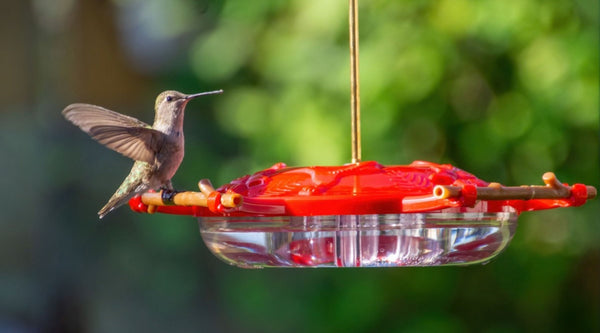
On the Gulf Coast, a winter feeder is doing something different again — supporting western hummingbirds that are now regular there, and occasional Ruby-throateds that stayed. Those are the birds that make this region unusual, and a feeder is often the only reason anyone knows they're present.
How to Help Hummingbirds Through This Region
- Plant for late summer. Cardinal flower and jewelweed bloom exactly when departing birds need to double their weight — see the section above
- Keep feeders up through October, and year-round on the Gulf Coast
- Change nectar every two to three days in the region's summer heat and humidity, and every one to two days above 90°F or in direct sun — discard at the first sign of cloudiness
- Report winter hummingbirds. A December bird anywhere in the Southeast is genuinely useful data, and if a licensed bander can see it, better still — that's how the wintering story is being documented
- Photograph before you identify. Female and immature winter hummingbirds often can't be told apart in the field, so a photo is worth more than a guess
- Leave sapsucker trees alone. Rows of small holes in your maples or birches are feeding hummingbirds in months when nothing is blooming
- Skip the insecticide. Insects supply protein nectar can't, especially during the region's long breeding season
Frequently Asked Questions
When should I put my hummingbird feeder out in the Southeast?
Early March on the Gulf Coast, mid-March in the Deep South interior, and late March into early April in the Upper South. Put it out a week or two ahead of when you expect the first bird — being early costs nothing.
I saw a hummingbird in January. Was that an early arrival?
Almost certainly not. It was a bird that overwintered rather than migrated, and on the Gulf Coast it was more likely a western species than a Ruby-throated. Genuine spring migrants don't reach the coast until early March.
Is the Ruby-throated really the only hummingbird that breeds here?
Yes. Cornell Lab calls it eastern North America's sole breeding hummingbird. Every other species in this guide is a winter visitor. Buff-bellied, often described as a Southeast resident, actually breeds only in south Texas and Mexico and reaches Louisiana as a winter visitor.
Why are western hummingbirds showing up here in winter?
Nobody's certain. Candidates include the spread of nectar feeders and flower gardens, milder winters, more people watching and better at identifying, or a combination. The only rigorous study of feeders driving a hummingbird range shift concerns Anna's Hummingbird in the West, so the feeder explanation is plausible rather than proven. What is clear is that banded birds return to the same yards in later winters — these are not random strays.
What should I plant to help hummingbirds most in the Southeast?
Something that blooms in September. Departing Ruby-throateds nearly double their body weight before crossing the Gulf of Mexico, and that fuelling happens in late summer when most gardens have finished. Cardinal flower and jewelweed are the two best choices; red buckeye and wild columbine cover the March arrival.
How far do Ruby-throated Hummingbirds fly nonstop?
Up to about 500 miles across the Gulf of Mexico, in roughly 18 to 22 hours. Not every bird takes that route — many go overland around the Gulf through Texas and Mexico — but those that cross do it without stopping, which is why the pre-migration weight gain matters so much.
Should I keep my feeder up all winter in the Southeast?
On the Gulf Coast, yes — wintering western hummingbirds are now regular there and a feeder is often how they're found. Elsewhere in the region, keep it up through October and don't be surprised by a November visitor.
Why does one bird matter so much to the local flowers?
Because several eastern plants evolved around hummingbird pollination and have no equally effective alternative. Cardinal flower's floral tube is too long for most bees. Research also found jewelweed sets 8 to 17% more seed when hummingbirds visit alongside insects than with insects alone. With a single hummingbird species in the region, that whole relationship rests on one bird.
How We Know This
Species status and timing draw on the Cornell Lab of Ornithology's All About Birds, eBird's account of western hummingbirds in the East, Audubon, and the Louisiana Ornithological Society. Migration physiology and plant relationships come from the USDA Forest Service. Pollination research comes from Bertin (1982, Canadian Journal of Zoology) and Hurlbert et al. (1996, Oecologia). The sapsucker relationship comes from Daily, Ehrlich & Haddad (1993, PNAS) and Miller & Nero (1983, Canadian Journal of Zoology). Population trends come from English et al. (2021, Scientific Reports), and the feeder–range-shift research from Greig, Wood & Bonter (2017, Proceedings of the Royal Society B). Nectar guidance follows the Georgia Department of Natural Resources.
Key Takeaways
- Ruby-throated is the only breeding hummingbird in eastern North America — one bird carrying a pollination network that fifteen species split in the Southwest
- Several eastern plants evolved around it: cardinal flower is effectively pollinated by nothing else, and jewelweed sets 8–17% more seed when hummingbirds visit alongside insects
- Genuine spring arrival is early March on the Gulf Coast, not January — winter birds are overwinterers, not early migrants
- Departing birds nearly double their weight, from about 3.25 to 6 grams, before a nonstop 500-mile Gulf crossing — which is why September bloom matters more here than anywhere
- Since the mid-1980s, western hummingbirds have wintered here in growing numbers, with Rufous outnumbering all others by up to ten to one
- Banding shows these are returning individuals, not lost strays — though what's driving the shift remains unsettled
- Buff-bellied is a winter visitor from south Texas, not a Southeast resident
- Yellow-bellied Sapsucker wells feed hummingbirds through the winter months when nothing is in bloom
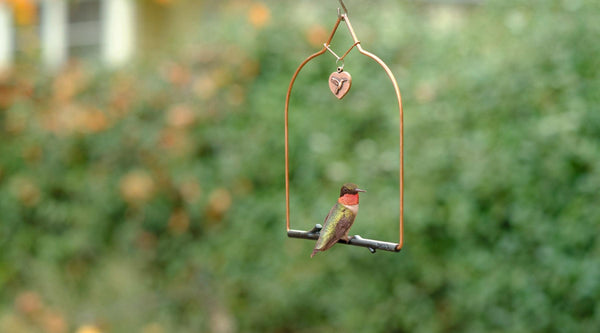
At Pop's Birding, we believe every backyard — big or small — has room for a little more wonder. Explore our feeders, nectars, swings, and wildflower seed blends to start building your own hummingbird sanctuary today.

Bethany Sloan has served as General Manager of Pop's Birding since 2010, continuing the legacy of her grandfather, William "Pops" Sloan, inventor of the Original Hummingbird Swing. A lifelong hummingbird enthusiast, educator, and independent researcher, she leads the company's educational content, including its 50-State Hummingbird Guide series, Regional Guide, Species Guide and Hummingbird Learning Center. Bethany combines scientific research, regional migration data, and more than 16 years of hands-on experience to create trusted educational resources for bird enthusiasts across North America.