Jul 12, 2026
Where to Hang a Hummingbird Feeder: The Complete Placement Guide
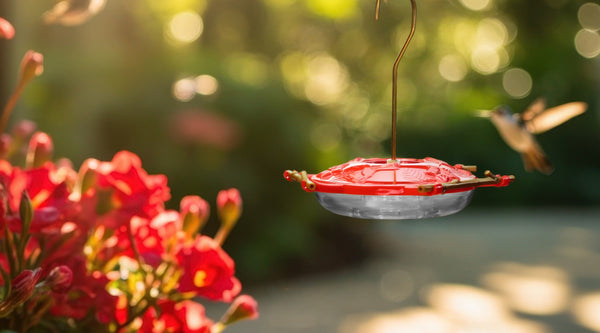
Quick answer: The best place to hang a hummingbird feeder is in partial shade, high enough that a cat can't reach it (at least 4 feet up) but low enough that you'll actually clean and refill it, near trees or shrubs where hummingbirds can perch, but out in the open with at least 15 feet between the feeder and any low, dense shrub where a cat could hide. If it has to be near a window, keep it within about 3 feet of the glass, and treat the window too. Hang a second feeder where a bird at the first one can't see it. Then add a comfortable perch nearby, because hummingbirds spend a large share of the day perched rather than flying.
You could have the best hummingbird feeder on the market, but if it's hanging in the wrong spot, you'll be staring at an empty perch all summer. Placement affects everything: how quickly hummingbirds find your feeder, how safe they feel visiting it, how long your nectar stays fresh, and how good a view you actually get. Below is what matters, why it matters, and where the numbers come from. Some come from wildlife agencies and published research. A few are our own practical recommendations, and we say so when that's the case.
Height: 4–6 Feet Is the Sweet Spot
Height is really about two limits. The lower one is safety: University of Illinois Extension suggests hanging feeders at least 4 feet above the ground to keep them away from cats and snakes. The upper limit is you. Oregon State University Extension's hummingbird guide advises putting feeders where you can clean and fill them easily, and a feeder you have to drag out a stepladder for is a feeder that gets cleaned less often than it should. Put those two together and you get our recommended range of 4 to 6 feet. That range is our own synthesis, not a number any agency publishes, but both ends of it rest on their guidance. Height alone isn't the whole story, though. A cat can use a nearby branch, table, or railing to close the gap, so what's next to the feeder matters as much as how high it hangs. We learned that one firsthand. See Cats and Hummingbirds: What We've Learned Keeping Both Safe in Our Own Yard for the full story, photo evidence included.

How to Hang a Hummingbird Feeder: Hooks, Eaves, Poles and Tree Branches
Once you know the spot, the hardware is simple. Here's how the common options compare. These are practical tips from our own yard and years of making feeders and swings, not agency guidance.
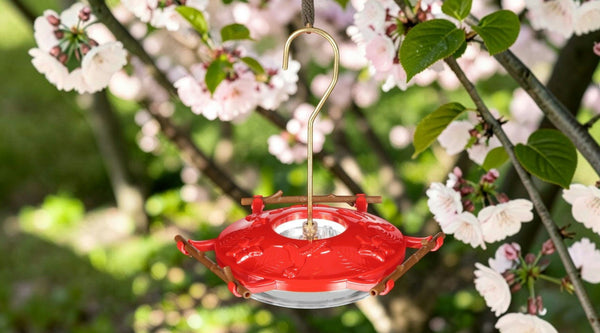
- From a porch eave or overhang: A screw hook set into a wooden eave or porch beam puts a feeder in built-in afternoon shade and right where you can see it. Keep it low enough to reach for cleaning. Check how close it is to nearby windows (see the window section below).
- From a shepherd's hook or pole: A pole lets you put the feeder exactly where you want it: in the open, at the right height, and away from shrubs. It's also easy to move into shade as the season changes. The downside is that ants climb poles, so a feeder with an ant moat is worth having. Our guide, How to Keep Ants Out of a Hummingbird Feeder: 7 Fixes That Work, covers pole-specific fixes.
- From a balcony or small patio: A railing bracket or ceiling hook works well. See What Hummingbird Products Work Best on a Small Patio or Balcony? for small-space setups.
- Any hanger: A feeder should hang level and not swing wildly. A feeder that tilts or swings hard in the wind spills nectar, and the drips attract ants and bees.
Can You Hang a Hummingbird Feeder in a Tree?
Yes, and a tree can be a great spot as long as you pick the right part of it. Choose a branch with open space around and below the feeder, so hummingbirds have a clear flight path in and out. Don't tuck it deep into the leaves. Hang it far enough out on the branch that a cat or squirrel can't simply walk the limb to it. A tree also gives you natural perches and dappled shade, which covers two items on the checklist at once. This is our own practical advice. We didn't find an agency or study that specifically addresses hanging hummingbird feeders in trees, so we're offering it as experience, not research.

Hanging from an eave, porch beam, or wooden post? Our Perfect Little Screw Hooks thread into any wooden surface, and their 1/2" opening keeps a feeder or swing hanging level instead of tilting and dripping. Made in the USA.
Shop Screw Hooks →Sun and Shade: Morning Sun, Afternoon Shade
Shade is about the nectar. The Oklahoma Department of Wildlife Conservation advises against hanging feeders in bright sunlight and recommends partially shaded spots instead. Oregon State's extension guide explains why: sun makes the solution mold sooner. Our favorite version is morning sun with afternoon shade, which keeps the feeder bright and easy to spot early in the day and out of the hottest hours. That split is our own practical preference, not a published rule. What the agencies agree on is partial shade. Good places to find it include under a tree canopy, along an east-facing wall, or beneath a porch overhang or awning.
Does a Hummingbird Feeder Need to Be in the Shade?
It doesn't have to be, but you'll change the nectar more often if it isn't. The American Bird Conservancy recommends keeping hummingbird feeders in the shade to keep them clean and prevent mold. A feeder in full sun isn't off limits, it just needs fresh nectar sooner. One question people often ask is whether hummingbirds themselves prefer sun or shade. We looked, and every shade recommendation we found is about keeping the nectar from spoiling. We didn't find research showing the birds prefer one or the other when choosing where to feed.
How often should you change nectar in a sunny spot? It depends on your temperature. How Long Does Hummingbird Nectar Last? has the full schedule, and our Nectar Change Calculator works it out for your own forecast.

Distance from Cover: 10–15 Feet, Not Buried in It
Hummingbirds want somewhere nearby to rest, watch for rivals, and escape if they need to. Purdue Extension recommends placing feeders near trees or perching areas, in a spot open enough for hummingbirds to fly freely around the feeder. The other half of the rule is about what hides in cover. Rutgers Cooperative Extension advises placing feeders at least 15 feet from low vegetation where cats can hide. So we think about two kinds of cover. A tree or tall shrub with perching branches 10 to 15 feet away is a good neighbor. That distance is our practical number, not an agency figure. A low, dense bush right beside the feeder is an ambush spot, and it should be 15 feet or more away. Cats aren't the only thing that hunts from concealment. For the less obvious predator, see When Praying Mantises Prey on Hummingbirds, and How to Protect Yours.

Distance from Windows: If a Feeder Sits Near Glass, Keep It Close
Window collisions are one of the biggest threats hummingbirds face in a backyard, and more feeder traffic means more chances for a strike. The fix that prevents strikes isn't feeder distance at all. It's treating the glass so birds can see it's there. For hummingbirds, the U.S. Fish and Wildlife Service says the pattern needs spacing as tight as 2 inches by 2 inches, because they're so much smaller than most birds.
If a feeder is already near a window, closer is better than a middle distance. In a field study published in the Wilson Bulletin, Klem and colleagues moved feeders to set distances from windows. None of the collisions recorded with feeders 1 meter (about 3 feet) from the glass were fatal. At 5 and 10 meters (about 16 and 33 feet), a majority were. A bird leaving a feeder that close simply hasn't built up much speed. One honest caveat: that study used seed platform feeders in fall and winter, so the birds were songbirds, not hummingbirds. The physics carry over, but no one has run the same test with hummingbird feeders. Once the glass is treated, the same Fish and Wildlife Service guide recommends placing feeders 3 feet or less from windows, "the closer, the better."
You'll still see advice to hang feeders 30 feet or more from windows instead, and some extension guides still publish it. The American Bird Conservancy takes a firmer line: there's no distance from windows that can truly be considered safe. Nobody has tested distances beyond about 33 feet, so we can't tell you a far-away feeder is dangerous. What the evidence does show is that close beats the middle range, and that treating the glass matters more than any distance.
Need to treat a window? Why Hummingbirds Are Especially Vulnerable to Window Strikes covers the 2-inch spacing rule, which products hold up, and what to do if a bird does hit.

Visibility: Give Them a Clear Line of Sight
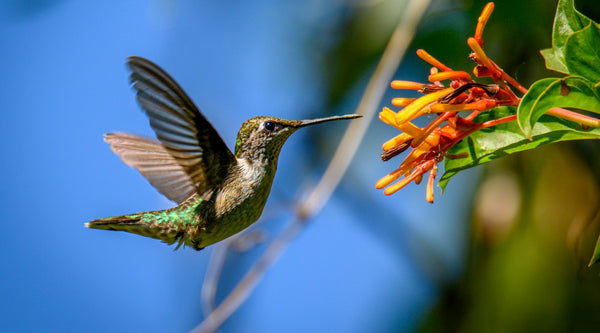
Hummingbirds find food mainly by sight, which is why the red parts on a feeder matter and why a feeder hidden behind a wall, deep in shade, or behind branches can go unnoticed by a passing bird. Sight isn't their only sense, though. A 2021 study in Behavioral Ecology and Sociobiology found that wild Anna's, Allen's, and Costa's Hummingbirds avoided feeders scented with certain ant chemicals. That's the first evidence that hummingbirds use smell when deciding where to feed. So: sight gets them to the feeder, and a clean feeder free of ants keeps them coming back. It can also take a while for them to find a new one. The South Carolina Department of Natural Resources notes it may take time before birds find a feeder and settle into a routine. If yours is still quiet, Hummingbirds Not Using Your New Feeder? Here's Why walks through the usual reasons.
Front Yard or Backyard?
Either can work. Hummingbirds don't know which yard is which. What matters is that the spot meets the rest of this checklist. The one thing we'd add is to hang it where you can see it from a window you actually use. You'll notice the first visits sooner, you'll spot when the nectar is getting cloudy, and you'll enjoy the view you put it up for. That's our own advice, not a research finding.
Shop the feeder
AspenPerch® Hummingbird Feeder, 8 oz

If you've picked a spot you can see from the house, the AspenPerch® makes the most of it. Its Grandview™ perch placement sits the Polyperch® perches above an open bowl instead of beside a port, so as a hummingbird leans in to drink you watch its face and tongue, not its back. It's built for the placement problems in this guide. There's a built-in ant moat for pole and tree setups where ants climb in, a leak-proof design so there are no drips to draw bees, and a threaded brass hanger with a 1.25" opening that fits a standard hook. It comes apart in two pieces for cleaning and is top-rack dishwasher safe. Made in the USA with a lifetime warranty.
Shop AspenPerch® →Multiple Feeders: Reduce the Territorial Drama
Hummingbirds are famously territorial, and a single dominant bird will often guard one feeder against all comers. If you're not seeing much traffic despite good placement, the fix is a second feeder the bully can't watch. The Oklahoma Department of Wildlife Conservation recommends setting up a second feeder out of sight of the first. Research backs the idea. A study that tracked tagged Ruby-throated Hummingbirds at 45 feeders, published in Ecology and Evolution, found that feeder defense increased when birds could see well around the feeder, though only in forested habitat. Break the sightline and you make the guard's job harder.
How Far Apart Should Hummingbird Feeders Be?
Purdue Extension suggests spacing feeders 10 to 15 feet apart, and University of Illinois Extension recommends at least that much. Distance alone isn't the point, though. The goal is that a bird perched at one feeder can't see the other. Around a corner of the house, on the far side of a large shrub, or one in front and one in back all work well. In our experience, breaking the line of sight does more than adding extra feet. If you can see both feeders from one perch, a dominant bird can too.
Add a Perch Nearby: What the Research Says
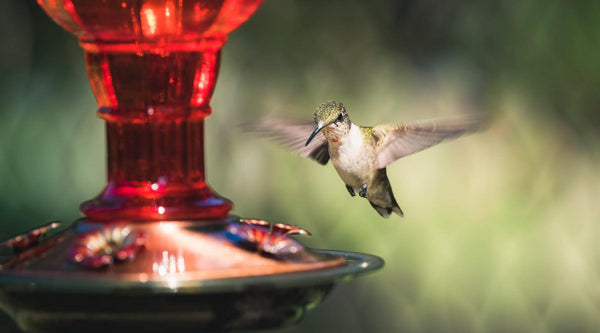
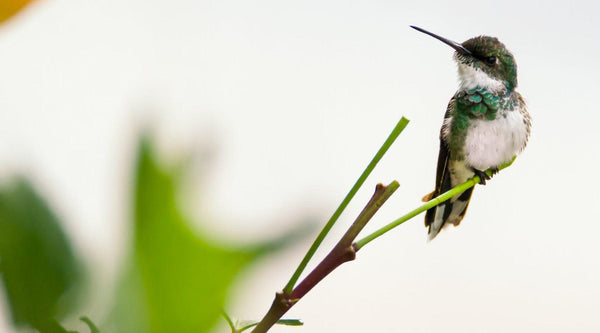
A lot of placement advice leaves this out: hummingbirds spend a large share of their day perched, not flying. Classic field studies, summarized in a 1986 paper in Nature, found hummingbirds spend about 75% of their waking hours perched and only about 20% feeding. Energy-budget research on Broad-billed Hummingbirds, published in Functional Ecology, found that how hard they work each day shifts with how much nectar is around. When food is scarce, they spend more of the day on the move and less of it resting. Perching lets them conserve energy, digest, preen, and keep watch over their food. Clemson Cooperative Extension notes that hummingbirds like to perch in nearby trees to keep an eye out for intruders. We go deeper into the research in Do Hummingbirds Really Prefer to Perch? What the Research Shows.
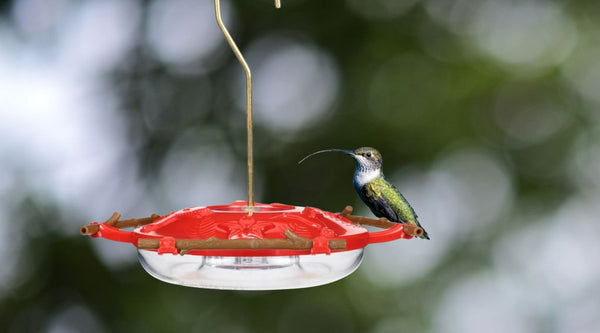
What that means at the feeder: a comfortable perch close by, whether a branch, a small bar, or a swing, gives a hummingbird somewhere to rest and watch over its food source without leaving your yard. We want to be precise here, because this is easy to overstate. We haven't found research showing that a swinging perch works better than a fixed one, or that a perch by itself makes visits longer. What's well established is that hummingbirds rest and guard from nearby perches, so giving them one near your feeder fits how they already behave. We break down that distinction in Do Hummingbird Swings Really Work? What the Research Actually Shows.
Shop the swing
Original Hummingbird Swing™, Onyx

This is the idea Pops built the Original Hummingbird Swing™ around: a perch that hangs right beside the feeder, where a hummingbird can rest and keep watch over its food source. The perch is our patented Polyperch®, made to mimic the look, shape, and feel of the perches hummingbirds seek in nature. The Onyx finish is a deep matte black that makes a hummingbird's colors stand out in every photo. Each swing comes with an 'S' hook for hanging, and it's 100% made in the USA with a lifetime guarantee.
Shop the Original Swing →Our placement basics for a nearby swing or perch:
- Hang it roughly 1 foot from the feeder, close enough that it reads as part of the same feeding spot
- Match it to the same height as your feeder so the two work as one feeding station
- Keep it in the open, not buried in dense branches, for the same reasons as the feeder
- If it's near a window, treat it like the feeder: keep it within about 3 feet of treated glass, not at a middle distance
Those spacing numbers are our own recommendations from years of watching swings in use, not research figures. Full details are in Where to Hang a Hummingbird Swing: Placement Guide.
Quick Placement Checklist
| Factor | Recommendation |
|---|---|
| Height | At least 4 feet up (out of cats' reach); our sweet spot is 4–6 feet so it's easy to clean |
| Sun/Shade | Partial shade; morning sun with afternoon shade is our favorite |
| Distance from cover | Perching trees about 10–15 feet away; low, dense shrubs at least 15 feet away |
| Distance from windows | Treat the glass first; if a feeder is near it, keep it within about 3 feet, not at a middle distance |
| Visibility | Open flight path, visible to passing birds, and visible to you from inside |
| Multiple feeders | Out of sight of each other, and at least 10–15 feet apart |
| Nearby perch | A swing or perch about a foot from the feeder, at the same height |
Where Should You Not Hang a Hummingbird Feeder?
- In all-day, direct sun: nectar ferments and molds faster, so you'll change it far more often.
- Right beside low, dense shrubs: that's where cats wait. Keep those at least 15 feet away.
- At a middle distance from an untreated window: in the Klem study, fatal collisions happened at 5 and 10 meters (about 16 and 33 feet) but not at about 3 feet.
- Anywhere a cat can jump from: railings, tables, fence tops, or low branches right next to the feeder.
- Where you can't reach it easily: if refilling means a ladder, cleaning will slip, and regular cleaning matters more than almost anything else on this list.
- In view of another feeder when one bird is bullying the rest.
- Where it swings hard in the wind: spilled nectar draws ants and bees. That's our practical advice, not an agency rule.
Key Takeaways
- Hang feeders at least 4 feet up to keep them away from cats; 4–6 feet also keeps them easy to clean.
- Partial shade keeps nectar fresher longer and cuts down on cleaning.
- Perching trees nearby are good, but keep low, dense shrubs at least 15 feet away. That's where cats hide.
- Treat nearby windows first. If a feeder sits near glass, keep it within about 3 feet rather than at a middle distance.
- Put a second feeder out of sight of the first, at least 10–15 feet away, to reduce territorial guarding.
- Hummingbirds spend a large share of the day perched, so a comfortable perch near the feeder gives them somewhere to rest and keep watch.
Frequently Asked Questions
Where is the best place to hang a hummingbird feeder?
In partial shade, at least 4 feet off the ground, near trees or tall shrubs where hummingbirds can perch but at least 15 feet from low, dense bushes where cats can hide, and with an open flight path in and out. Pick a spot you can see from the house, and if it's near a window, keep it within about 3 feet of the glass and treat the window too.
How high should I hang a hummingbird feeder?
At least 4 feet above the ground, which University of Illinois Extension suggests to keep feeders away from cats and snakes. We recommend 4 to 6 feet, so it's still easy to reach for cleaning and refilling. That upper limit is our practical recommendation, not an agency number.
Should a hummingbird feeder be in sun or shade?
Partial shade. Direct sun makes nectar ferment and mold faster, which is why wildlife agencies and extension services recommend shade. Morning sun with afternoon shade is our favorite version. We didn't find research showing hummingbirds themselves prefer sun or shade. The recommendation is about keeping the nectar fresh.
Can I hang a hummingbird feeder in a tree?
Yes. Choose a branch with open space around and below the feeder so hummingbirds have a clear flight path, and hang it far enough out that a cat or squirrel can't walk the limb to reach it. Avoid tucking it deep into the leaves. This is our practical advice. We didn't find research that specifically tests hanging hummingbird feeders in trees.
How close can a hummingbird feeder be to a window?
Treating the window itself is what prevents strikes. For hummingbirds, the U.S. Fish and Wildlife Service says markings need to be as close as 2 inches apart. If a feeder is near a window, keep it within about 3 feet of the glass. In a field study by Klem and colleagues, no collisions were fatal with feeders about 3 feet from windows, while most were fatal at about 16 and 33 feet. That study used songbirds, not hummingbirds, and the American Bird Conservancy notes that no feeder distance is truly safe, so treat the glass either way.
Do hummingbirds need a perch near their feeder?
They don't need one to feed, but they spend a large share of the day perched to rest, digest, and keep watch over their food, and they like to do that from nearby perches. A branch or swing about a foot from the feeder gives them that spot close to the food.
How many hummingbird feeders should I have?
If one dominant hummingbird is guarding your feeder, add a second one out of sight of the first. Extension services suggest spacing feeders at least 10 to 15 feet apart. Being out of sight matters more than the exact distance.
How far apart should hummingbird feeders be?
At least 10 to 15 feet apart, which is what Purdue Extension and University of Illinois Extension suggest. More important, a bird at one feeder shouldn't be able to see the other, so around a corner or on the other side of a shrub works best.
Where should you not hang a hummingbird feeder?
Avoid all-day direct sun, spots right next to low, dense shrubs where cats hide, anything a cat can jump from, a middle distance from an untreated window, places you can't easily reach to clean, and spots within view of another feeder when one bird is guarding.
Will hummingbirds find a new feeder?
Yes, but it can take a while. The South Carolina Department of Natural Resources notes it may take time for birds to find a feeder and settle into a routine. A clear flight path, red feeder parts, and a spot near flowers or perches all help.
Summary
Feeder placement often matters more than the feeder itself. Hang it at least 4 feet up (we like 4–6 feet), in partial shade, near perching trees but at least 15 feet from low, dense shrubs, and close to treated glass rather than at a middle distance from a window. Give a second feeder its own space out of sight of the first. Just as important, and often overlooked, is a comfortable place to perch near the feeder, since hummingbirds spend so much of their day resting and keeping watch. If you're setting up from scratch, our Haven Bundle pairs the AspenPerch® feeder with your choice of swing so you can build the whole station at once.
Shop the Placement Essentials
Everything this guide recommends for a well-placed feeding station: the feeder, a perch to hang beside it, the hardware to hang both, and nectar to keep it fresh.


Bethany Sloan has served as General Manager of Pop's Birding since 2010, continuing the legacy of her grandfather, William "Pops" Sloan, inventor of the Original Hummingbird Swing. A lifelong hummingbird enthusiast, educator, and independent researcher, she leads the company's educational content, including its 50-State Hummingbird Guide series, Regional Guide, Species Guide and Hummingbird Learning Center. Bethany combines scientific research, regional migration data, and more than 16 years of hands-on experience to create trusted educational resources for bird enthusiasts across North America.