Aug 01, 2026
How to Keep Bees Away From a Hummingbird Feeder: 6 Fixes
Quick answer: To keep bees and wasps off a hummingbird feeder, block their reach and take away what draws them in. Use bee guards or a feeder whose nectar sits below the ports, skip feeders with yellow parts, hang a feeder in the shade, and keep the outside of the feeder clean and drip-free. If they still won't leave, a shallow plate of richer sugar water set away from the feeder can lure them off. Never use pesticides, insecticide sprays, or petroleum jelly — they put hummingbirds at risk, and bees are pollinators worth protecting too.
Key Points
- Bee guards work on reach: a honey bee's tongue averages about 7 millimeters — roughly a quarter inch — far shorter than a hummingbird's bill and tongue.
- Yellow draws bees and wasps, and bees favor feeders in full sun — so a feeder with no yellow parts, hung in shade, sees fewer of them.
- Wasps can chase hummingbirds away from a feeder. We found no documented case of a bee or wasp killing a hummingbird.
- Keep your nectar at the standard 1:4. If you want to pull bees off, set out a separate plate of richer 1:2 sugar water instead.
Bees, Wasps, or Yellowjackets? Know What's at Your Feeder
"Bees at the feeder" usually means one of three different insects, and they show up for different reasons. Knowing which one you've got helps you pick the right fix — and it explains why the problem often seems to appear out of nowhere in late summer.
Honey Bees
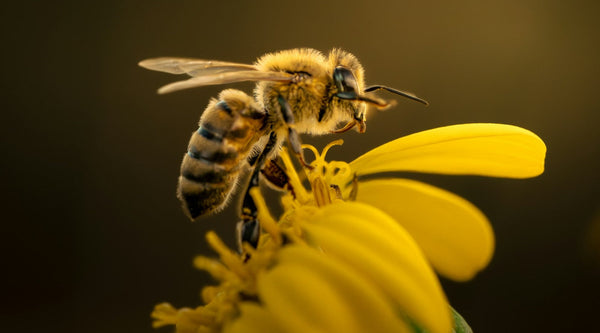
Honey bees are fuzzy, golden-brown, and usually calm. They come to hummingbird feeders when flowers run short. University of Florida IFAS Extension notes that bees are more likely to go looking for other sugar sources when nectar resources are scarce, and that they'll exploit any sugary resource near their nest. Oregon State University Extension calls late summer and early autumn a critical, difficult time of year for honey bees. That's the stretch when a sugar-water feeder looks most appealing to them.
Yellowjackets, Paper Wasps, and "Hornets"
Wasps are the more aggressive visitors. Yellowjacket colonies peak in late summer, and UC IPM's pest note on yellowjackets explains that colonies need large amounts of sugar then, so foraging wasps become especially interested in sweet things. Paper wasps are a familiar feeder nuisance too — Virginia Tech Extension names hummingbird feeders specifically as one of the sugary spots they frequent.
What most people call a "hornet" at the feeder is often something else. According to University of Maryland Extension, the bald-faced hornet is an aerial yellowjacket rather than a true hornet, and the European hornet is the only true hornet established in the U.S.
What About Sweat Bees?
Sweat bees are small bees — many are only a quarter- to three-quarter-inch long — that the Missouri Department of Conservation describes as attracted to perspiration for its moisture and salts. Their sting is mild. We couldn't find an agency or university source documenting sweat bees at hummingbird feeders, so we can't tell you they're after the nectar. If tiny bees are pestering you while you refill on a hot day, your own sweat may be part of the draw.
Can Bees or Wasps Hurt Hummingbirds?
The documented harm is displacement, not injury. In a 2020 study of Ruby-throated Hummingbirds published in the Wilson Journal of Ornithology, hummingbirds avoided feeders where wasps were present, switched feeders more often, and were sometimes chased off by the wasps — and they were never seen chasing the wasps away. That's one study of one species, and it measured avoidance, not stings. Operation RubyThroat, a long-running hummingbird banding project, similarly notes that stinging insects sometimes take over a feeder and drive hummingbirds away.
As for stings: Georgia's Wildlife Resources Division calls yellowjackets a real danger to hummingbirds and to the people who tend feeders, but doesn't cite specific cases, and we couldn't find a documented case of a bee or wasp killing a hummingbird. The practical problem is that a feeder crowded with wasps is a feeder your hummingbirds stop using — which is one of the quieter reasons behind hummingbirds not coming to your feeder.
1. Add a Bee Guard
A bee guard is a small insert that fits over or into a feeder's feeding port so that nectar sits just out of an insect's reach. It works because of a simple size mismatch. Colorado State University Extension explains that bee guards work because bees and wasps have much shorter tongues than hummingbirds, and Michigan State University's pollinator program puts the average tongue length of Italian honey bees at about 7 millimeters (a range of roughly 6.3 to 7.4 mm) — about a quarter inch. Texas Parks & Wildlife also recommends bee guards to discourage bees and wasps. Pop's Hummguard® tips are bee guards that fit Pop's AspenPerch® Feeder.

Do Bee Guards Actually Work?
Mostly, yes — but with a caveat worth knowing. Operation RubyThroat notes that bee guards may work well at deterring insects, but that some hummingbirds don't like them either. If your birds hesitate after you add guards, give them a few days before deciding, and keep the other fixes on this list working alongside them. And a guard only helps if the outside of the port stays clean: a drip of nectar sitting on top of the guard is still within reach.

Most bee guards rely on distance alone. Hummguard® Nectar Tips add a seal: each tip has a flexible membrane that opens when a hummingbird inserts its bill and closes tight when the bill comes out, leaving a barrier bees and wasps can't get through. A ring of 12 slides onto the feeding ports of Pop's AspenPerch® feeder.
Shop Hummguard® Tips →2. Choose a Saucer-Style Feeder
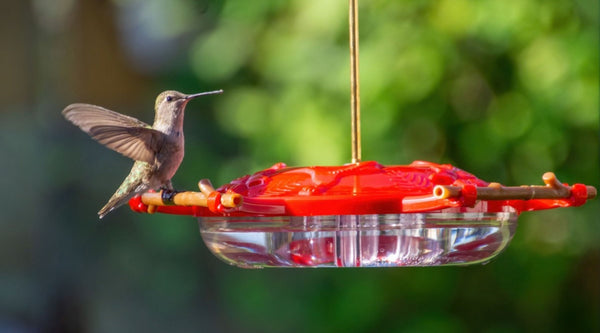
Feeders come in two broad designs: bottle-style, where nectar sits above the feeding ports and drains down, and saucer-style, where nectar sits in a basin below the ports. University of Georgia Cooperative Extension recommends saucer-type feeders or feeders with bee guards for keeping bees away. The reasoning is reach again: in a saucer, the nectar surface sits below the port opening, so an insect standing on the port has to stretch down to it — the reach bees and wasps don't have. Bottle feeders have a second weak spot. University of Arkansas Cooperative Extension notes that bottle-style feeders may drip when placed in direct sun, and drips are exactly what insects find first.
One correction to a common claim: a saucer design helps with bees and wasps, but it doesn't stop ants on its own — ants walk right in. For ants you need a water-filled ant moat, which is its own topic in our guide to keeping ants out of a hummingbird feeder. If you're weighing designs more broadly, see saucer vs. bottle vs. window hummingbird feeders.

Shop the feeder
AspenPerch® Hummingbird Feeder, 8 oz

Everything in the two fixes above is built into one feeder. The AspenPerch® keeps nectar in an open bowl below its perches, with a leak-proof design — no drips to draw insects in. The ant moat is built into the frame, and the feeding ports take Hummguard® Nectar Tips when bees and wasps show up. Made in the USA, dishwasher safe (top rack), and backed by Pop's Lifetime Warranty.
Shop AspenPerch® →3. Skip the Yellow
Yellow is a strong visual draw for bees and wasps. The USDA Forest Service's guide to attracting hummingbirds advises choosing feeders with no yellow parts for exactly that reason, and University of Georgia Extension gives the same advice. Hummingbirds don't need the yellow — the same Forest Service guide notes they prefer red flowers, though they'll feed on other colors too. If your feeder has yellow flower-shaped ports or accents, swap them out or choose a feeder without yellow parts. The same rule applies to bee guards: University of Arkansas Extension specifically warns against buying yellow ones.

4. Hang It in Shade, Away From Flower Gardens
Operation RubyThroat observes that bees seem to prefer feeders in direct sunlight, and that hanging a second feeder in the shade often lets hummingbirds feed without being bothered by bees. Shade helps the nectar too: Georgia's Wildlife Resources Division notes that nectar doesn't spoil as quickly in a shaded feeder as it does in the sun. If bees are a persistent problem, it also helps to keep the feeder a little apart from your busiest flower beds rather than in the middle of them, so pollinator traffic isn't concentrated right where you're trying to watch hummingbirds. That's our own advice rather than agency guidance, and it doesn't mean skipping flowers — a garden full of native blooms is still one of the best things you can do for hummingbirds, as we cover in how to create a hummingbird sanctuary in your backyard.

Try Moving the Feeder a Few Feet
Once bees or wasps have found a feeder, moving it can buy you time. Colorado State University Extension suggests moving the feeder to a slightly different spot because the insects won't find it right away, and University of Maryland Extension likewise suggests relocating it around the yard. There's no controlled study behind this one, but there is good reason to think your hummingbirds will keep up: in a study published in Animal Cognition, wild Rufous Hummingbirds learned the location of a rewarding flower after a single visit, and when the flower was moved they homed in on the flower itself. That research used artificial flowers rather than feeders, so treat it as encouraging rather than proof.
Picking a new spot? Height, sun, cover, and distance from windows all matter as much as insects do. Our complete guide to where to hang a hummingbird feeder walks through every factor, and how long hummingbird nectar lasts shows how much a shady spot stretches your change schedule.
5. Keep It Clean and Leak-Free
Drips and sticky residue on the outside of a feeder are what insects find first. Operation RubyThroat notes that leaky, dripping feeders attract many more bees and ants than properly maintained ones, and Texas Parks & Wildlife adds that bees and wasps have a harder time finding your feeder when you rinse the outside of the bottle and the feeding ports before hanging it back up. Check for leaks regularly, wipe away drips as soon as you see them, and rinse the exterior every time you refill. A dry, residue-free feeder simply isn't as interesting to insects as one with sugar water crusted around the ports.
How often should you really clean it? It depends on the temperature, and in hot weather the answer is more often than most people think. Get the full routine in How to Clean a Hummingbird Feeder (and Why It Matters).

6. Don't Weaken the Nectar — It's Already Working in Your Favor
Standard hummingbird nectar is 1 part white sugar to 4 parts water. Honey bees are economical foragers: a review in Frontiers in Ecology and Evolution describes them as preferring more rewarding food sources, such as those with higher sugar concentration. So there's no reason to water your nectar down to discourage bees — doing so just shortchanges the hummingbirds on calories. Keep it at 1:4, and use richer sugar water only in a separate decoy, as described below. If you're not sure how to mix the correct ratio, see The Correct Hummingbird Nectar Ratio (And How to Measure It for Any Batch Size), or make it even easier with our Nectar Mixing & Change Calculator.

Set Up a Bee Decoy (the Right Way)
If honey bees are still crowding the feeder, give them something better somewhere else. Operation RubyThroat's method: mix a super-concentrated sugar water — 1 part sugar to 2 parts water — and pour it into a very shallow plate, preferably a big yellow one. Put a natural sea sponge in the plate so bees don't drown and hummingbirds can't fall in (they advise against synthetic sponges). Then, each day, move the plate a foot or two farther from the hummingbird feeder. The gradual move works with honey bee habits: foragers return to a food source they know, and a 2023 study in Ecosphere found honey bees stuck with the same foraging patch far more consistently than bumble bees did. Walking the plate away a little at a time takes them with it.

The feeder only stays hummingbird-first if the nectar in it stays fresh and full-strength. Pop's Nectarlyte® powder concentrate is made with 100% pure cane sugar and no dyes or preservatives, with added electrolytes and calcium. One 8 oz bag makes over a liter, so you can mix small, fresh batches instead of guessing at ratios every refill.
Shop Nectarlyte® Powder →Wasps Take a Different Bait
Yellowjackets and other wasps aren't only after sugar, and Operation RubyThroat suggests a different lure for them: a plate with a small lump of hamburger meat soaked in apple juice, set away from the feeder. If wasps have fully taken over a feeder, their other suggestion is to let the insects have that feeder and put up others where the hummingbirds can find them.
What to Avoid Entirely
Never use pesticides, insecticide sprays, or petroleum products like petroleum jelly on or near a hummingbird feeder. Operation RubyThroat is blunt: under no circumstance should insecticides or other poisons be used at hummingbird feeders, and sticky compounds like Vaseline can mat a hummingbird's feathers, which can cause hypothermia or keep the bird from flying. The U.S. Fish & Wildlife Service documents the same mechanism in its guidance on oil and wildlife — oil interferes with the water repellency of feathers — though that guidance is written about oil spills, not feeders. Bees deserve protecting too: the USDA notes that three-fourths of the world's flowering plants depend on animal pollinators to reproduce. Every method above works without putting anything toxic near the feeder.
Do Peppermint Oil, Vinegar, or Cooking Spray Keep Bees Away?
The evidence is thinner than the internet suggests. University of Maryland Extension, answering a question through Ask Extension, says there are no scientific studies establishing peppermint oil as a deterrent or what concentration to use. The closest research we found is a 2013 field study in Pest Management Science in which peppermint and several other essential oils repelled yellowjackets and paper wasps from baited traps — but it didn't test honey bees, and it didn't test hummingbird feeders. For vinegar, cinnamon, dryer sheets, and olive oil, we found no agency or university evidence at all.
Cooking oil is where the sources disagree. Georgia's Wildlife Resources Division suggests smearing vegetable oil on the feeder around the feeding ports to foil bees, while Operation RubyThroat warns against sticky substances that can reach a hummingbird's feathers. Our stance at Pop's: keep anything oily or sticky off the feeder itself. A hummingbird's face and throat feathers pass right over those ports, and bee guards, shade, and a clean feeder solve the problem without that risk.
Should You Use a Yellowjacket Trap?
Traps can help with yellowjackets, with two caveats. First, placement: UC IPM advises putting traps along the edge of your property, as far from your patio and activity areas as possible — which also means well away from the hummingbird feeder. Second, the lure matters. Oregon State University Extension notes that the commercial lure heptyl butyrate is a highly effective yellowjacket attractant that doesn't attract honey bees — but UC IPM adds that it mainly draws the western yellowjacket rather than every species. A homemade trap baited with sugar water will catch honey bees too, which is why Georgia's Wildlife Resources Division advises against using a trap if honey bees are gathering at your feeders.
Key Takeaways
- Figure out what you're dealing with: honey bees show up when flowers run short, and yellowjackets turn to sugar in late summer.
- Bee guards and saucer-style feeders work on reach — bee and wasp tongues are far shorter than a hummingbird's.
- Skip yellow feeder parts, hang a feeder in shade, and move it a few feet if insects have already found it.
- Keep nectar at the standard 1:4; use richer 1:2 sugar water only in a separate decoy plate walked away a foot or two a day.
- Wasps can drive hummingbirds off a feeder, but we found no documented case of one killing a hummingbird.
- Skip pesticides and anything oily or sticky on the feeder, and treat home remedies like peppermint oil as unproven.
Frequently Asked Questions
Do bee guards actually work?
Mostly, yes. Bees and wasps have much shorter tongues than hummingbirds — a honey bee's averages about 7 millimeters, roughly a quarter inch — so a guard that keeps nectar just out of that reach blocks them. Some hummingbirds are wary of guards at first, so give your birds a few days to adjust.
Can bees or wasps kill a hummingbird?
We found no documented case of a bee or wasp killing a hummingbird. The documented problem is displacement: in a 2020 study, Ruby-throated Hummingbirds avoided feeders where wasps were present and were sometimes chased off by them.
Why are bees suddenly all over my hummingbird feeder?
Usually because natural food is running short. Honey bees look for other sugar sources when flowers are scarce, and yellowjacket colonies need large amounts of sugar in late summer, so feeders get busier with insects late in the season.
Why do bees and wasps like yellow feeders?
Yellow is a strong visual attractant for bees and wasps. The USDA Forest Service recommends feeders with no yellow parts for that reason, and hummingbirds don't need the yellow to find a feeder.
Should I make hummingbird nectar weaker to keep bees away?
No. Keep your feeder at the standard 1 part sugar to 4 parts water. Weakening it shortchanges the hummingbirds, and if you want to draw bees off, a separate plate of richer 1:2 sugar water set away from the feeder works better.
How do I make a bee decoy for a hummingbird feeder?
Mix 1 part sugar to 2 parts water, pour it into a shallow plate (yellow is ideal), and add a natural sea sponge so bees don't drown. Each day, move the plate a foot or two farther from the hummingbird feeder.
What is the best DIY way to keep bees off a hummingbird feeder?
The DIY fixes with real support behind them are simple: rinse drips off the feeder and ports, remove or cover yellow parts, hang a feeder in shade, move the feeder a few feet, and set out a 1:2 sugar-water decoy plate away from it.
Does peppermint oil keep bees away from hummingbird feeders?
It's unproven. One field study found peppermint and other essential oils repelled yellowjackets and paper wasps from traps, but it didn't test honey bees or hummingbird feeders, and extension experts note there are no studies establishing it as a bee deterrent.
Does feeder placement affect bees and wasps?
Yes. Bees seem to prefer feeders in direct sun, so a feeder in the shade often gets fewer of them — and shaded nectar spoils more slowly, too.
Can I use pesticides to keep bees away from a hummingbird feeder?
No. Insecticides and other poisons should never be used at hummingbird feeders. They can harm the birds, and bees are important pollinators — the goal is to redirect them, not harm them.
Do yellowjacket traps catch honey bees?
Traps baited with the commercial lure heptyl butyrate don't attract honey bees, but homemade traps baited with sugar water do. Either way, place traps far from the hummingbird feeder.
What about ants — do the same fixes work?
Only partly. A clean, drip-free feeder helps with both, but ants need their own approach, starting with a water-filled ant moat — see our full guide to keeping ants out of a hummingbird feeder.
Summary
Keeping bees and wasps off a hummingbird feeder comes down to the same basic idea as keeping ants out: put the nectar out of reach and remove what draws them in. A bee guard and a saucer-style feeder handle the reach problem; avoiding yellow, choosing shade, and keeping the feeder clean handle the rest. No pesticides required, and no need to weaken the nectar your hummingbirds actually want. AspenPerch® was built with exactly this in mind: a leak-proof saucer design with a built-in ant moat, plus optional Hummguard® Nectar Tips that fit its feeding ports to keep bees and wasps out.
Ready to keep your feeder hummingbird-only? Shop the AspenPerch® Hummingbird Feeder or add Hummguard® Nectar Tips to your AspenPerch®.
Shop the Setup That Keeps Bees Off
Nectar out of reach, ports sealed to insects, and fresh nectar ready to go — here's what this guide recommends for a hummingbird-only feeder.


Bethany Sloan has served as General Manager of Pop's Birding since 2010, continuing the legacy of her grandfather, William "Pops" Sloan, inventor of the Original Hummingbird Swing. A lifelong hummingbird enthusiast, educator, and independent researcher, she leads the company's educational content, including its 50-State Hummingbird Guide series, Regional Guide, Species Guide and Hummingbird Learning Center. Bethany combines scientific research, regional migration data, and more than 16 years of hands-on experience to create trusted educational resources for bird enthusiasts across North America.