Jul 18, 2022
The Correct Hummingbird Nectar Ratio (And How to Measure It for Any Batch Size)
Hummingbirds run almost entirely on sugar, burning through calories faster than nearly any other animal alive, so the nectar in your feeder is doing real work. Get the ratio wrong and you're either shortchanging them on the energy they need to get through the day, or serving something that can make them sick. It's a simple mix, but it's not one to guess at or eyeball. This guide covers the correct ratio for homemade nectar and for Pop's own products, with exact measurements for whatever size feeder you're filling, so every batch you mix is genuinely good for the birds drinking it.
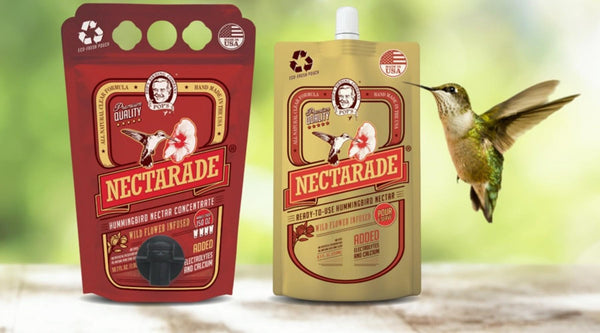
Quick answer: Start with a clean feeder, then mix 1 part plain white sugar to 4 parts water (1:4). That's the hummingbird food ratio recommended by the U.S. Fish & Wildlife Service, and it lands close to the 20–25% sugar found in the flowers hummingbirds feed from. For a 16 oz feeder, that's ½ cup sugar to 2 cups water; for an 8 oz feeder, ¼ cup sugar to 1 cup water. Never use honey, brown or raw sugar, artificial sweeteners, fruit juice, or red dye. Pop's Nectarlyte® powder concentrate uses that same 1:4 ratio (1 part Nectarlyte® to 4 parts warm water). Pop's Nectarade® Concentrate uses 1:2 (1 part Nectarade® to 2 parts water), since it's already a more concentrated liquid. Nectarade® Ready to Use needs no mixing at all.
"Parts" confuses more people than it should, mostly because the same word is doing double duty for totally different products — and because half the internet writes the recipe as 4:1 while the other half writes 1:4. Here's exactly what it means, exact sugar-water measurements for every common feeder size, and the mistakes worth avoiding before you fill a feeder.
Always Start With a Clean Feeder
Before any nectar goes in, the feeder itself matters more than most recipes give it credit for. Sugar residue left behind from a previous fill is exactly what mold and bacteria need to get started, so even perfectly mixed fresh nectar poured into a dirty feeder is compromised from the moment it goes in. If it's been more than a few days since your last cleaning, or if you're setting up a feeder for the first time this season, clean it before you fill it — not after. See our complete guide to cleaning a hummingbird feeder for the full step-by-step. The U.S. Fish & Wildlife Service recommends plain water or a weak vinegar solution, since cleaning products can leave a harmful residue behind.
Shop the feeder
AspenPerch® Hummingbird Feeder, 8 oz

If a clean feeder is step one of every batch, the feeder should make that step easy. The AspenPerch® comes apart into two pieces plus a brass rod, it's top-rack dishwasher safe, and its open bowl lets you see the nectar at a glance — so you'll spot cloudiness before the birds do. It holds 8 oz, which is exactly one 1-cup-water batch from the chart below, and it has a built-in ant moat. Made in the USA with a lifetime warranty.
Shop AspenPerch® →What "Parts" Actually Means
A "part" is just a unit of measurement you choose — a cup, an ounce, a tablespoon, whatever fits your container. The ratio tells you how many of those units of one ingredient to combine with how many units of the other. As long as you use the same unit for both ingredients, the ratio holds no matter how big or small the batch is.
For example, a 1:4 ratio means:
- 1 cup sugar (or nectar concentrate) : 4 cups water
- 1 ounce sugar (or nectar concentrate) : 4 ounces water
- 1 tablespoon sugar (or nectar concentrate) : 4 tablespoons water
Sugar to Water or Water to Sugar? 4:1 and 1:4 Are the Same Recipe
You'll see the hummingbird nectar ratio written both ways: "1:4 sugar to water" and "4:1 water to sugar." They describe the identical mix — one scoop of sugar for every four scoops of water. The number that goes with the sugar is always the small one. If a recipe ever tells you to use more sugar than water, something has been flipped.
Same goes for the names. Hummingbird food, hummingbird water, sugar water, nectar, syrup, formula, solution, mix — they all mean the same homemade 1:4 recipe. The only time the ratio changes is when you're mixing a commercial concentrate, which starts out stronger than plain sugar (more on that below).
Basic Hummingbird Nectar Recipe
1 cup sugar + 4 cups water makes about 5 cups of nectar — scale up or down using the same ratio. Download the printable PDF version to save or print cleanly, with no page clutter.
Ingredients
- 1 cup white granulated sugar
- 4 cups water
Steps
- Make sure your feeder is clean before you start (see the cleaning guide above).
- Heat the water. Warm or boiling water dissolves the sugar faster and more completely — boiling is optional, not required (see "Do You Have to Boil Hummingbird Water?" below).
- Stir in the sugar until completely dissolved.
- Let the mixture cool completely to room temperature. Hot nectar can warp plastic feeder parts and isn't safe to serve.
- Fill your feeder and hang it in partial shade.
- Refrigerate any extra in a sealed container and use it within a week.
No red dye, honey, or anything else needed — plain sugar and water is the closest match to natural flower nectar.
Homemade Nectar: 1 Part Sugar to 4 Parts Water
This is the standard ratio for DIY nectar, and it's the one wildlife agencies agree on — Penn State Extension, the Missouri Department of Conservation, and the Smithsonian's National Zoo all give the same 1:4 recipe.
How Much Sugar for a 16 oz Hummingbird Feeder? (And Every Other Size)
Match the water to your feeder's capacity, then add sugar at one-quarter of that amount. Everything below is measured by volume with ordinary kitchen cups and spoons, at the 1:4 ratio:
| Feeder Size | Water | Sugar | Best For |
|---|---|---|---|
| 4 oz | ½ cup | 2 tablespoons | Window and mini feeders, or a first feeder in hot weather |
| 8 oz | 1 cup | ¼ cup (4 tablespoons) | One standard feeder — limits waste |
| 16 oz | 2 cups | ½ cup | One large feeder, or two 8 oz feeders |
| 32 oz (1 quart) | 4 cups | 1 cup | Several feeders, or a batch plus extra for the fridge |
| 64 oz (½ gallon) | 8 cups | 2 cups | Busy yards during peak migration |
| 1 gallon | 16 cups | 4 cups | Many feeders — only if you'll use it within a week |
One cup of sugar dissolved into 4 cups of water makes about 5 cups of nectar — the same simple math our free Nectar Change Calculator uses below, so the amounts on this page and the amounts it gives you will always line up. And if you're only feeding one or two birds, a half-full feeder you change often beats a full one that sits.
Why 1:4? What Flower Nectar Actually Contains
The ratio isn't arbitrary. A physics-of-feeding study published in PNAS puts the nectar of hummingbird-pollinated flowers at about 20–25% sugar, and the 1:4 mix is built to sit close to that range. Because a cup of sugar weighs a lot less than a cup of water, a 1:4 mix measured by volume actually comes out a little under that — roughly 17–18% sugar by weight — which keeps it on the watery side of natural nectar rather than the syrupy side.
Stronger isn't automatically better, either. In feeding trials with Rufous Hummingbirds, researchers publishing in Oecologia found the birds chose the sugar concentrations that let them take in energy fastest, and actively avoided very concentrated solutions. Thicker syrup is slower to drink, so past a point, more sugar means less food per second at the feeder.
Do You Have to Boil Hummingbird Water?
No — and this is one place where the experts genuinely split. The Smithsonian's National Zoo says plainly that the water does not need to be boiled. Texas Parks & Wildlife recommends boiling to slow fermentation, and Penn State Extension's method pours boiling water over the sugar. What they all agree on: the sugar must dissolve completely, and the nectar must be fully cool before it goes in the feeder. Our take: boil if you like, but put the effort into the feeder first — a boiled batch poured into a dirty feeder still spoils fast.
Is a 3:1 Ratio OK? What About Stronger Nectar in Cold Weather?
1:4 is the standard hummingbird nectar ratio, and it's the right one to use year-round. Some feeding guides allow a slightly stronger mix, up to about 1 part sugar to 3 parts water, during cold, rainy spells when fresh water is plentiful and birds need extra energy. That's rainy-weather advice, not freezing-weather advice. Once temperatures drop below freezing, groups that work with wintering hummingbirds say to stay at 1:4. As nectar freezes, the liquid left behind gets more sugary, and birds may have no free water to dilute it. Never go stronger than 1:3 in any weather.
The better fix for freezing is the feeder, not the recipe. The U.S. Fish & Wildlife Service suggests bringing feeders indoors on cold nights or hanging an incandescent bulb nearby for warmth. Rotating two feeders — one thawing inside while the other hangs out — works too. Our winter hummingbird feeder care guide covers heaters, the night swap and two-feeder rotation in detail. And if you're wondering whether a fall feeder keeps birds from migrating on time, our guide on when to take your hummingbird feeder down covers what the research shows.
Want the math done for you? The feeder chart above covers the common sizes, but our free Nectar Change Calculator builds a batch around your feeder and your local temperature — telling you how much to mix and how often to change it, so nothing goes to waste.
What Not to Add — Ever
Plain white granulated sugar and water is the entire recipe. Every substitution below either doesn't help, or actively puts hummingbirds at risk:
- Honey. The most serious mistake on this list. Penn State Extension warns that fermented honey can cause a fatal fungal disease in hummingbirds, and the Missouri Department of Conservation notes the fungus attacks the birds' tongues. Never make nectar from honey.
- Brown sugar, raw sugar, turbinado, or molasses. The U.S. Fish & Wildlife Service lists brown sugar as a wrong choice for feeders, and the Smithsonian's National Zoo says never to use raw, unprocessed sugars. These sugars keep some of their molasses — which is exactly what gives them their color — and molasses isn't something hummingbirds find in flower nectar. Plain white sugar is nearly pure sucrose, the closest match to what flowers offer.
- Corn syrup. Also on the Smithsonian's never-use list. It's a different sugar blend than the table sugar every tested recipe is built on.
- Artificial sweeteners or sugar substitutes. Zero usable calories — a hummingbird drinking these gets none of the energy it needs, no matter how much it drinks. The Missouri Department of Conservation is blunt: never use them in hummingbird feeders.
- Fruit juice, including pomegranate juice. It comes up as a "natural" way to tint nectar red, but it isn't necessary and isn't risk-free: juice introduces unknown sugar concentrations, acids, and potential preservatives that haven't been tested for hummingbird safety.
- Red dye. Unnecessary on its own merits — Penn State Extension points out that hummingbirds are drawn to the red on the feeder itself, not dyed nectar. The Smithsonian's National Zoo goes further, saying dye isn't needed and could be harmful, and Texas Parks & Wildlife advises leaving it out since no one knows for certain whether it harms hummingbirds. If birds aren't visiting, color is rarely the reason — our 7 common fixes for an empty feeder covers what usually is.
Can You Use Powdered, Organic, or Cane Sugar?
Cane sugar: yes, as long as it's white and granulated. White sugar is sucrose whether it started as sugarcane or sugar beets. Organic sugar: check the color — if it's tan or golden, it still carries some molasses, so treat it like raw sugar and skip it. Powdered (confectioners') sugar: skip it. Most brands add cornstarch to keep it from clumping, which isn't something that belongs in nectar, and it's hard to measure accurately at a 1:4 ratio. If the label says anything besides sugar, it's not the right sugar for a hummingbird feeder.
Pop's Nectarlyte® Powder Concentrate: 1 Part Powder to 4 Parts Warm Water
Nectarlyte® uses the same familiar 1:4 ratio as homemade nectar, just with our powder blend in place of plain sugar.
| Nectarlyte® Powder | Warm Water | Yields |
|---|---|---|
| ¼ cup | 1 cup | About 1¼ cups prepared nectar — fills an 8 oz feeder |
| 1 cup | 4 cups | About 5 cups prepared nectar |
| 8 oz package | 34 fl oz warm water | Over 1 liter prepared nectar |
| 2 lb package | 128 fl oz warm water | Over 1 gallon prepared nectar |

Already comfortable with 1:4? Nectarlyte® keeps the exact ratio you just learned — no new math — and swaps plain sugar for 100% pure cane sugar with added electrolytes and calcium, no dyes or artificial preservatives. One 8 oz bag makes over a liter.
Shop Nectarlyte® Powder →Pop's Nectarade® Concentrate: 1 Part Concentrate to 2 Parts Water
Nectarade® Concentrate is a more concentrated liquid base than powder, so it uses a different ratio — 1 part Nectarade® to 2 parts water, not 1:4. With our liquid concentrate, you can save time by filling your feeder directly 1/3 full with Nectarade® and the remaining 2/3 with water. If using this method, mix the solution after filling to spread it evenly. Curious what's in the bottle besides sugar? What's in Nectarade® walks through every ingredient.
| Nectarade® Concentrate | Water | Yields |
|---|---|---|
| ¼ cup | ½ cup | ~¾ cup prepared nectar |
| 1 cup | 2 cups | ~3 cups prepared nectar |
| 50.7 oz bottle | ~101 fl oz water | Over 150 fl oz prepared nectar |
Pop's Nectarade® Ready to Use: No Mixing Required
This one's simple: there's no ratio to measure at all. Shake the bottle and pour it directly into your feeder.

Everything above — parts, cups, which number goes with the sugar — disappears here. One 8.5 oz bag of Nectarade® Ready to Use fills a standard 8 oz feeder with nothing to measure, heat, or cool: 100% pure cane sugar with electrolytes and calcium, no dyes.
Shop Nectarade® Ready to Use →Quick Reference: All Ratios Side by Side
| Product | Ratio | Unit Example |
|---|---|---|
| Homemade nectar (everyday) | 1 : 4 (sugar : water) | ½ cup sugar : 2 cups water (16 oz feeder) |
| Nectarlyte® Powder | 1 : 4 (powder : water) | 1 cup powder : 4 cups warm water |
| Nectarade® Concentrate | 1 : 2 (concentrate : water) | 1 cup concentrate : 2 cups water |
| Nectarade® Ready to Use | No mixing | Pour directly into feeder |
Why the Ratios Differ Between Products
It comes down to how concentrated each product already is. Nectarlyte® is a dry powder, so it needs a larger volume of water added to reach the right final sugar concentration — the same 1:4 logic as plain sugar. Nectarade® Concentrate is already a liquid with a higher starting concentration, so it needs proportionally less added water (1:2) to land at the same final strength as a homemade 1:4 batch.
Still deciding between homemade, powder, and liquid? Liquid nectar vs. powder concentrate compares cost, convenience, and mixing side by side, and electrolyte nectar vs. plain sugar water looks at the research on electrolytes and calcium beyond plain sugar.
Does Nectar Go Bad?
Yes — mixed nectar starts breaking down the moment it's made, and that process speeds up considerably once it's sitting in a feeder in the heat. Cloudiness, a sour smell, or visible mold are all signs it's time to dump it and start over, and letting it go too long isn't just wasteful — the U.S. Fish & Wildlife Service warns that spoiled sugar solution can be toxic to hummingbirds. For exact timelines by temperature and full storage guidance, see How Long Does Hummingbird Nectar Last?
Storing Homemade Nectar: The Short Version
- In the fridge: extra nectar keeps in a sealed container for no more than one week, per the Smithsonian's National Zoo.
- In the feeder, warm weather: the Smithsonian suggests changing it every other day, and at least twice a week in hot weather. Our own rule at 90°F and up: every 1–2 days.
- In the feeder, cooler weather: at least once a week, or sooner if it turns cloudy — the Missouri Department of Conservation gives the same weekly rule of thumb.
- Before refilling: never top off old nectar with new. Empty, clean, then fill.
The simplest way to avoid waste is to mix only what your birds will finish before it's due for a change — which is exactly what the feeder chart and the Nectar Change Calculator above are for.
Sugar water draws more than hummingbirds. If ants or bees find your feeder, the fix is almost never the recipe — see how to keep ants out of a hummingbird feeder and how to keep bees away from a hummingbird feeder, including why the standard 1:4 ratio already works in your favor.
Key Takeaways
- Clean the feeder before you fill it — fresh nectar in a dirty feeder is compromised from the start.
- The standard nectar ratio is 1 part sugar to 4 parts water. "4:1 water to sugar" is the same recipe written the other way around.
- For a 16 oz feeder, mix ½ cup sugar into 2 cups water; for an 8 oz feeder, ¼ cup sugar into 1 cup water.
- "Parts" means any consistent unit — cups, ounces, tablespoons — used equally for both ingredients.
- Never use honey, brown or raw sugar, corn syrup, artificial sweeteners, fruit juice, or red dye — plain white sugar is the only safe ingredient besides water.
- Boiling is optional; letting the nectar cool completely is not.
- 1:4 is the standard ratio year-round, including freezing weather. Protect the feeder, not the recipe.
- Nectarlyte® Powder uses the same familiar 1:4 ratio as homemade nectar; Nectarade® Concentrate uses 1:2; Nectarade® Ready to Use needs no mixing at all.
Frequently Asked Questions
What is the correct hummingbird nectar ratio?
1 part sugar to 4 parts water (1:4) for homemade nectar. That's the ratio recommended by the U.S. Fish & Wildlife Service and state wildlife agencies, and it sits close to the sugar level of the flowers hummingbirds feed from.
How much sugar do I need for a 16 oz hummingbird feeder?
Mix ½ cup of white sugar into 2 cups of water. For an 8 oz feeder, use ¼ cup of sugar and 1 cup of water; for a 32 oz feeder, 1 cup of sugar and 4 cups of water.
Is 3:1 or 4:1 better for hummingbird food?
4:1 (the same as 1:4 sugar to water) is the everyday standard. A 3:1 mix is stronger. Some feeding guides allow it during cold, rainy spells when fresh water is plentiful, for the extra calories, but not as a freezing-weather fix. Use 1:4 the rest of the time, including freezing weather, and don't go stronger than 1:3.
Is the ratio different for Pop's Nectarlyte and Nectarade?
Yes. Nectarlyte® Powder uses the same 1:4 ratio as homemade nectar. Nectarade® Concentrate uses a 1:2 ratio since it's already a more concentrated liquid.
Does "parts" mean a specific measurement like cups or ounces?
No — a "part" is any unit you choose, as long as you use the same unit consistently for both ingredients in the ratio.
Can I make the nectar ratio stronger in winter?
Not for freezing weather. Keep the regular 1:4. Groups that work with wintering hummingbirds recommend staying at 1:4 in freezing weather. As nectar freezes, the leftover liquid gets more sugary, and birds may find no free water to dilute it. Keep the feeder from freezing instead: use a heater left on overnight, bring it in at night and put it out before first light, or rotate two feeders.
Do I have to boil the water for hummingbird nectar?
No. Boiling is optional — some agencies recommend it to slow fermentation, while the Smithsonian's National Zoo says it isn't necessary. Either way, make sure the sugar is fully dissolved and the nectar has cooled completely before it goes in the feeder.
Can I use honey, brown sugar, or fruit juice instead of white sugar?
No, and honey is genuinely dangerous — it can ferment and cause a fatal fungal infection. Brown and raw sugars aren't recommended by wildlife agencies, artificial sweeteners provide no calories, and fruit juice (including pomegranate juice used for natural color) introduces unknown sugars and acids that haven't been tested for hummingbird safety. Plain white granulated sugar is the only ingredient that belongs in the mix besides water.
Can I use powdered sugar to make hummingbird food?
No. Most powdered sugar contains added cornstarch, which doesn't belong in nectar. Use plain white granulated sugar.
How long can I keep homemade nectar in the fridge?
Up to one week in a sealed container. After that, mix a fresh batch.
Do I need to mix Nectarade Ready to Use with water?
No. Nectarade® Ready to Use is formulated to be poured directly into your feeder with no mixing required.
How do I know when nectar has gone bad?
Cloudiness, a sour smell, or visible mold are all signs to dump it, clean the feeder, and start fresh.
Summary
Every hummingbird nectar ratio traces back to the same goal: a mix close to the sugar level hummingbirds find in flowers, served from a clean feeder. Homemade nectar and Nectarlyte® Powder both use a 1:4 ratio — ½ cup of sugar to 2 cups of water fills a 16 oz feeder — and that's the standard ratio all year, including freezing weather. Nectarade® Concentrate uses 1:2 because it starts more concentrated, and Nectarade® Ready to Use skips mixing entirely. Skip the honey, brown sugar, fruit juice, and dye — plain white sugar and water is the whole recipe. Whichever product you use, "parts" just means picking a consistent unit and sticking with it.
Ready to skip the measuring altogether? Shop Nectarade® Ready to Use, or stock up on Nectarlyte® Powder Concentrate for your next batch.
Shop the Right Ratio, Every Time
Whichever method fits your routine — homemade, powder, or ready to pour — here's what this guide recommends for getting the ratio right every time.


Bethany Sloan has served as General Manager of Pop's Birding since 2010, continuing the legacy of her grandfather, William "Pops" Sloan, inventor of the Original Hummingbird Swing. A lifelong hummingbird enthusiast, educator, and independent researcher, she leads the company's educational content, including its 50-State Hummingbird Guide series, Regional Guide, Species Guide and Hummingbird Learning Center. Bethany combines scientific research, regional migration data, and more than 16 years of hands-on experience to create trusted educational resources for bird enthusiasts across North America.