Aug 06, 2026
Hummingbirds in North Carolina: The Complete Species Guide
North Carolina's hummingbird record is genuinely one of the richest in the East — nine species documented, from one dependable breeder to a notable regular winter visitor to a run of true rarities studied by an ongoing museum research project. That range means real identification challenges show up here more than in most states: North Carolina is one of the few places where a birder might actually need to separate Rufous from Allen's, or puzzle out a red-billed hummingbird that shouldn't be anywhere near the Atlantic coast.
This guide sorts out which hummingbird you're actually looking at, whether that's spring, summer, or a winter long shot — including exactly where field identification breaks down and why. For feeder setup, native plants, and pest-safe care, see our how-to-attract guide. For exact arrival and departure windows by region, see the North Carolina hummingbird calendar.
Free download
Take North Carolina with you
This page covers every hummingbird confirmed in North Carolina, rarities included. The printable cheat sheet is the practical companion — the species you'll actually see, arrival dates region by region, nectar change schedules by temperature, and the native plants worth putting in the ground.
Download the North Carolina cheat sheetOne page · PDF · free to print and share
The Hummingbird You're Most Likely to See
Ruby-throated Hummingbird
The only hummingbird that breeds regularly anywhere in the eastern United States, and the species behind nearly every North Carolina sighting from spring through fall — and, near the coast, through winter too. At roughly 3.5 inches long and weighing about as much as a penny, it's tiny even by hummingbird standards.
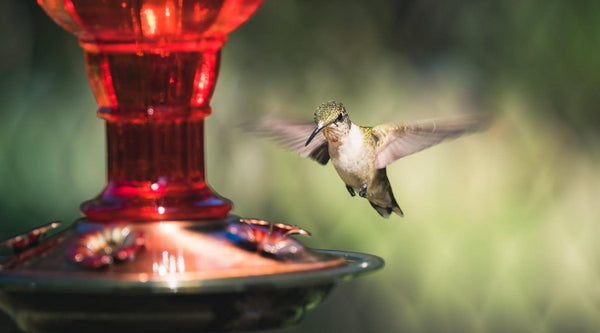
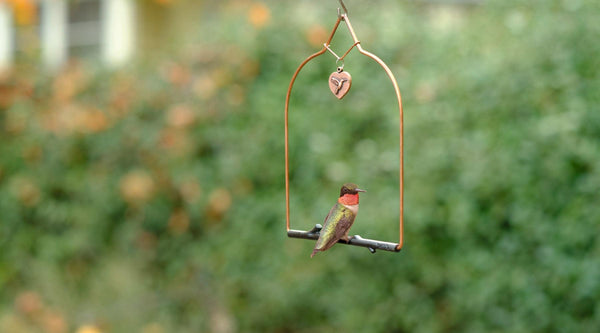
Adult males show an emerald or golden-green back and crown over gray-white underparts, with a brilliant iridescent ruby-red throat that can look flat black until the light catches it, and a dark, distinctly forked tail. Females and immatures carry a plain whitish throat with a rounded, black-and-white-banded tail — no red at all. Young males begin showing a scatter of red throat feathers by late summer as they molt toward adult plumage.
In flight, Ruby-throateds beat their wings roughly 50 times per second, producing the soft, low-pitched hum that often announces them before you see them.

Where you are matters, dramatically. Ruby-throated arrival runs a real spring gradient — genuinely zero presence in the mountains through all of March, while the coast already hosts a small overwintering population before spring migrants even arrive. See the North Carolina hummingbird calendar for the full regional breakdown.
Ruby-throated vs. Black-chinned: Where Identification Actually Breaks Down
Adult male Ruby-throated and Black-chinned Hummingbirds are usually easy to tell apart in good light — one shows a red gorget, the other a black one edged in violet-purple. But Cornell Lab's own species comparison is blunt about the rest: females and immatures of the two species are close to identical in the field. The one field mark Cornell points to on a perched bird: wing-to-tail proportions. Ruby-throated has a longer tail that extends visibly past the wingtips at rest; Black-chinned has longer wings that reach the tip of the tail or extend just slightly beyond it. Some birders also watch for tail-pumping — Black-chinned habitually pumps its tail while hovering, Ruby-throated tends to hold its tail still.
Black-chinned is rare but genuinely recorded in North Carolina, mostly along the coastal plain — so an unusual-looking female hummingbird here is worth a second look, even though Ruby-throated remains the far more likely explanation.
Hummingbirds in North Carolina in Winter
Ruby-throated mostly clears out for the winter across the Piedmont and mountains, but the coast tells a different story — and North Carolina's winter rarities are genuinely part of an active research program.
Rufous Hummingbird — the most notable winter visitor
A fiery orange western species that occasionally turns up as a fall and winter straggler, especially in the mountains and Piedmont, and sometimes along the milder coast. If you spot a hummingbird at your feeder in November or December, it's very likely this species rather than a lingering Ruby-throated.
Adult males are unmistakable — fiery coppery-orange overall with an iridescent orange-red throat — and famously aggressive, chasing off other hummingbirds regardless of size difference. Females and immatures are trickier: green-backed above, with rufous-washed flanks and a rusty patch at the base of the tail.

Rufous vs. Allen's: One of the Hardest Calls in North American Birding
North Carolina's confirmed record list includes both Rufous and Allen's Hummingbird, and separating them is widely regarded as one of the trickiest identification problems in the hobby.
The unreliable myth: "orange with a green back means Allen's." Some male Rufous also show green backs, so back color alone isn't safe. A more useful rule of thumb: if the back is less than half green, it's almost certainly Rufous.
The reliable method: tail feather shape. In Allen's, all the tail feathers are narrower than in Rufous, most noticeably the outer three; adult male Rufous also shows a distinctive notch on the second tail feather that Allen's lacks. This is genuinely hard to see in the field and is usually confirmed only when a bird is examined in the hand — exactly the kind of work North Carolina's own hummingbird banders do.
North Carolina's True Rarities
Keep a feeder up through winter and you're giving yourself a real shot at hosting something unusual. The North Carolina Museum of Natural Sciences has studied these "vagrant" winter hummingbirds for decades, and every species below is a genuine, documented North Carolina record.
Calliope Hummingbird
The smallest breeding bird in North America, and an especially rare find in North Carolina, most often reported in the Piedmont during winter, almost always at feeders in populated areas. Adult males are unmistakable once seen well: magenta rays fan out from the throat over a white underside. Females and immatures lack the flashy throat and are easily confused with female Broad-tailed — eBird notes the safest field marks are Calliope's smaller size, shorter tail with almost no rufous color, and a thin white line above the base of the bill.
Allen's Hummingbird
See the identification section above — genuinely one of the toughest calls in the hobby this far from its normal Pacific Coast range. Adult males show a bronze-green back with a coppery tail, eye patch, and belly, plus a deep reddish-orange gorget. Females and immatures look almost identical to female Rufous and are reliably separated only by tail feather shape, usually confirmed in the hand.

Broad-tailed Hummingbird
A genuine rarity — a Rocky Mountain species whose presence is often heard before it's seen. Adult males produce a distinctive, insectlike metallic trill with their wings in flight that no other North Carolina hummingbird makes. Visually, adult males show a rose-magenta gorget and lack the dark facial mask that Ruby-throated shows.

Broad-billed Hummingbird
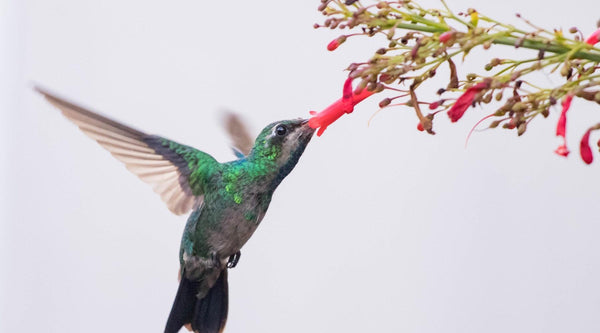
A genuine rarity here, with a normal range of Arizona and Mexico. Cornell Lab calls it unmistakable within that range: a vivid red bill tipped in black, an emerald body, and a glittering blue throat on adult males — no other North American hummingbird combines a red bill with a blue gorget. Females are duller, with grayish underparts and that same telltale red-and-black bill.

Anna's Hummingbird
A Pacific Coast species and a genuine long-distance stray when it turns up in North Carolina. Adult males show an iridescent rose-pink gorget that extends up over the crown, not just the throat — no other species on this list shows color on the head itself. Females and young are green above with a whitish throat, sometimes flecked with a few pink spots.

Buff-bellied Hummingbird
A genuine rarity, normally a Rio Grande Valley, Texas species that barely crosses into the U.S. at all — Cornell Lab notes some individuals move northeast to Louisiana for winter after breeding, and a North Carolina record represents that same general winter-dispersal tendency carried even farther. Look for a bronze-green back, a buffy belly, a rusty tail, and — the real giveaway — a bright red bill tipped in black. The gorget is green but often not well defined, unlike Broad-billed's vivid blue throat.

North Carolina Hummingbirds at a Glance
| Species | Status in North Carolina | Best Chance |
|---|---|---|
| Ruby-throated | Only regular breeder; nearly every sighting | Spring through fall statewide; year-round on the coast |
| Rufous | Most notable regular winter visitor | Fall and winter, mountains and Piedmont especially |
| Black-chinned | Rare but genuinely recorded | Coastal plain, non-breeding season |
| Calliope | True rarity | Piedmont, winter |
| Allen's | True rarity | Not expected — genuine one-off |
| Broad-tailed | True rarity | Not expected — genuine one-off |
| Broad-billed | True rarity | Not expected — genuine one-off |
| Anna's | True rarity | Not expected — genuine one-off |
| Buff-bellied | True rarity | Not expected — genuine one-off |
Frequently Asked Questions
How many species of hummingbirds are in North Carolina?
Nine species have been documented in North Carolina. Ruby-throated is the only regular breeder, Rufous is the most notable regular winter visitor, Black-chinned is rare but genuinely recorded (mostly on the coastal plain), and Calliope, Allen's, Broad-tailed, Broad-billed, Anna's, and Buff-bellied are all true rarities.
Are there hummingbirds in North Carolina in winter?
Yes — Rufous is the most notable winter visitor, especially in the mountains and Piedmont. On the coast, a genuine Ruby-throated population persists through the winter months rather than fully migrating south.
How do I tell Rufous and Allen's Hummingbirds apart?
It's one of the hardest identification calls in North American birding. The reliable method is tail feather shape — Allen's has narrower tail feathers throughout, and adult male Rufous shows a distinctive notch on the second tail feather that Allen's lacks — but this is usually confirmed only with the bird in hand. A simple rule of thumb: if the back is less than half green, it's almost certainly Rufous, since the "green back means Allen's" shortcut is a myth.
How do I tell Ruby-throated and Black-chinned Hummingbirds apart?
Adult males are the easy case: Ruby-throated shows a red gorget, Black-chinned shows a black throat with a thin violet-purple band at the base. Females and young are effectively inseparable in the field — Cornell Lab points to wing-to-tail proportions as the one useful field mark.
What is that red-billed hummingbird I saw in North Carolina?
Two North Carolina rarities have red bills: Broad-billed Hummingbird (vivid blue throat, emerald body) and Buff-bellied Hummingbird (green gorget that's often poorly defined, buffy belly, rusty tail). The throat color and belly color are the easiest way to tell them apart.
For feeder setup, nectar ratios, and native plants that support these species, head back to our how-to-attract-hummingbirds-in-North-Carolina guide. For region-by-region arrival and departure windows, see the North Carolina hummingbird calendar.
Sources
- Carolina Bird Club, "Wintering Hummingbirds". Source for the winter-vagrant research context.
- NC Museum of Natural Sciences — Prairie Ridge Ecostation. Source for the ongoing hummingbird banding research program.
- eBird bar chart data, Cornell Lab of Ornithology — North Carolina statewide and county-level, 2016–2025.
Know before they arrive
You've got the setup — now keep it working all year. Insider Birding Access members get seasonal notes timed to your region: when to have feeders out, what the birds are doing right now, and what's worth doing in your yard this season. Joining takes about thirty seconds, and there's 10% off your first order in it.
Join Insider Birding Access →Free to join. 10% off your first order.

Bethany Sloan has served as General Manager of Pop's Birding since 2010, continuing the legacy of her grandfather, William "Pops" Sloan, inventor of the Original Hummingbird Swing. A lifelong hummingbird enthusiast, educator, and independent researcher, she leads the company's educational content, including its 50-State Hummingbird Guide series, Regional Guide, Species Guide and Hummingbird Learning Center. Bethany combines scientific research, regional migration data, and more than 16 years of hands-on experience to create trusted educational resources for bird enthusiasts across North America.